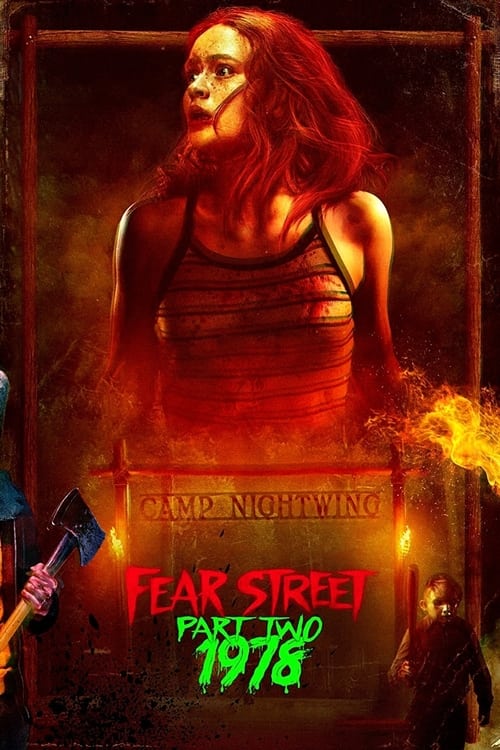
Fear Street: 1978
2021 · Leigh Janiak
When you're craving a proper slasher — cabins, flashlights, a killer in the dark — and want it to actually hurt a little. Best as part of a trilogy binge, ideally on a summer night.
What it's about
In the summer of 1978, two estranged sisters — responsible, college-bound Cindy and rebellious, angry Ziggy — are stuck together at Camp Nightwing, where campers from a cursed town and its luckier neighbor already can't stand each other. When the town's old evil surfaces mid-summer and a counselor picks up an axe, color war turns into a night of survival. It's the middle chapter of a trilogy, told as a survivor's account, but it works as its own campfire story.
The experience
A fast, aggressive, unapologetically bloody summer-camp slasher with a heavy 70s needle-drop soundtrack and real feeling underneath — the sister relationship gives the carnage stakes. It's tense and mean in the way the classic camp slashers were, with a modern pace.
Performances
Sadie Sink carries the film as Ziggy, all bruised defiance and wounded loyalty, and Emily Rudd matches her as the sister trying to hold everything together.
The craft
Leigh Janiak recreates the grain, gore, and geography of the late-70s camp slasher with obvious affection — period costuming, wall-to-wall era rock, and kills that don't flinch. Shot as part of a three-film production released on consecutive weeks, it manages a distinct look and rhythm from its siblings while feeding a larger mystery.
Why it matters
The centerpiece of Netflix's Fear Street experiment — a trilogy dropped over three weekends — which proved event-style horror could work on streaming and became a template for serialized genre releases.
Horror · Slasher · Teen horror · Witchcraft. A mean, bloody 70s summer-camp slasher with an axe in the dark, wall-to-wall rock, and two feuding sisters who give the kills real stakes.
Snapshot
Fear Street: 1978 is the middle chapter of Leigh Janiak's Fear Street trilogy, three feature-length horror films adapted from R.L. Stine's long-running young-adult book series and released by Netflix on consecutive weekends in July 2021. Where the first installment, 1994, plays as a Wes Craven–inflected teen-slasher-cum-mystery, 1978 is a period summer-camp slasher, consciously modeled on the Friday the 13th cycle. It is told largely in flashback: in the present-tense frame of 1994, an older survivor named C. Berman (Gillian Jacobs) recounts to the trilogy's heroine the night at Camp Nightwing when a counselor was possessed by the curse of the witch Sarah Fier and murdered his way through the camp. The film centers on two estranged sisters — responsible, college-bound Cindy (Emily Rudd) and rebellious teenage misfit Ziggy (Sadie Sink) — from the cursed, working-class town of Shadyside. As a formal object it is the trilogy's most genre-pure entry, an exercise in reconstructing the aesthetic and body-count grammar of late-1970s/early-1980s slasher cinema while nesting it inside a serialized supernatural mythology.
Industry & production
The Fear Street trilogy's production history is genuinely unusual and central to understanding the film. All three features were shot back-to-back as a single continuous production in 2019, primarily in Georgia (in and around the Atlanta metro area, a region whose tax incentives made it a dominant U.S. production hub in the 2010s). The project originated at Chernin Entertainment in partnership with 20th Century Fox and was developed as a theatrical release; the intent was a triptych rolled out in cinemas. Following the Walt Disney Company's 2019 acquisition of 21st Century Fox's film and television assets, the trilogy was reconfigured and ultimately licensed to Netflix, which released the three films weekly in July 2021 as a streaming event. This shift — from planned theatrical franchise to binge-adjacent streaming release — is the defining industrial fact of the enterprise, and it shaped the reception: the films were consumed and reviewed as a serialized whole rather than as discrete box-office entities. Because the release was streaming-exclusive, there are no conventional theatrical box-office figures for 1978; I will not invent viewership numbers, as Netflix's internal metrics for the period were not disclosed in standardized, verifiable form.
Shooting all three films in one block allowed the production to maintain continuity of crew, design language, and a recurring ensemble across three time periods (1994, 1978, and 1666), with certain actors playing multiple roles across eras.
Technology
Fear Street: 1978 was shot digitally, consistent with mainstream studio horror production of the late 2010s. The film's technological project is less about capture innovation than about period simulation: the digital image is graded, textured, and lit to evoke the grain, warmth, and color palette of 1970s film stock and of the summer-camp slashers it emulates. I do not have a reliably documented record of the specific camera package and will not assert one. What is verifiable from the finished work is the deliberate use of contemporary digital tools — color grading, controlled lighting, and prosthetic/practical gore effects supplemented conservatively — to manufacture a convincingly analog-feeling past. This is characteristic of the 2010s–2020s "nostalgia horror" mode, in which modern capture is disciplined into looking like the era being invoked.
Technique
Cinematography
The trilogy's cinematography is credited to Caleb Heymann, who gives 1978 a distinct visual identity from its sister films. Where 1994 leans on fluorescent, mall-and-suburb artificiality, 1978 is built around the natural and firelit textures of a summer camp: sun-dappled daylight, the amber of campfires and cabin lamps, and the deep, threatening blacks of the surrounding woods at night. The camera frequently isolates figures against darkness or the treeline, exploiting the slasher tradition's core spatial anxiety — the sense that the killer occupies the offscreen space just beyond the frame. Compositions quote the summer-camp subgenre's iconography (the color war, the dock, the mess hall, the infirmary) and stage violence with a mix of concealment and sudden, graphic reveal.
Editing
The film's editing sustains a dual rhythm: the leisurely, character-building tempo of the camp-movie first act, and the accelerating, kill-driven momentum of its back half, all while remaining legible as a story being narrated in flashback from 1994. The picture cross-cuts between the two sisters' converging fates once the massacre begins. I do not have the editor's name reliably fixed and decline to attribute the credit rather than risk error; the editorial strategy, however, is plainly organized around the slasher's escalating body-count structure and around the frame narrative's need to periodically remind us this is testimony.
Mise-en-scène / staging
Production design is the film's most conspicuous craft achievement. Camp Nightwing is dressed with meticulous late-1970s specificity — costuming, hair, camp signage, vehicles, and the color-war apparatus — to place the audience firmly in the Meatballs/Friday the 13th summer-camp imaginary. The staging exploits camp geography as a horror map: bright communal spaces give way to the isolating woods, and the film choreographs its set-pieces around thresholds (cabin doors, latrines, the bunk, the woods' edge). The class geography of the fiction is also staged spatially: Shadyside's cursed, poorer kids are visually and socially set against the affluent Sunnyvale campers, a divide the mise-en-scène keeps legible.
Sound
The trilogy's score is credited to Marco Beltrami working with collaborators (Anna Drubich and Brandon Roberts are associated with the trilogy's music); I state this with the caveat that readers should verify the precise per-film credit breakdown. Beyond original scoring, 1978 deploys period needle-drops as a genre and dating device, using late-1970s popular music both to establish the era and to counterpoint or ironize violence — a technique the whole trilogy foregrounds. Sound design in the horror sequences follows slasher convention: the amplified quiet of the woods, sudden percussive stingers, and the offscreen approach of the killer rendered through sound before image.
Performance
The film rests on Sadie Sink and Emily Rudd as the Berman sisters. Sink — already associated with 1980s-nostalgia horror through her Stranger Things work — plays Ziggy as an angry, fatalistic Shadyside outsider, and carries the film's emotional through-line; Rudd's Cindy is the buttoned-up sister whose composure is stripped away over the night. Gillian Jacobs frames the story as the adult survivor, her weathered, guarded performance lending the flashback its melancholy retrospective weight. The supporting camp ensemble (including Ted Sutherland as Nick Goode and McCabe Slye as the possessed counselor, among others) fills out the genre's requisite pool of victims and suspects. The performances are pitched slightly above the disposable-teen register the subgenre traditionally allows, in keeping with the trilogy's investment in its characters as continuing figures.
Narrative & dramatic mode
1978 operates in a nested, retrospective dramatic mode: it is a story told aloud by a survivor, framed by the trilogy's present-day investigation, so the audience watches knowing that catastrophe is foreordained and that only certain figures can emerge. This lends the camp idyll a tragic irony from the first frame. Within that frame, the film runs a classical slasher structure — establishment of community, transgression, escalating murders, final confrontation — braided with a supernatural mystery about the Sarah Fier curse and the mechanism by which an ordinary person becomes the town's next killer. The sisterly relationship supplies the melodramatic spine: reconciliation under mortal threat. Structurally, the film is also a middle chapter, obligated to deepen the trilogy's mythology and reposition its central mystery rather than resolve it, and it ends on a revelation that propels the narrative toward the concluding 1666.
Genre & cycle
The film is a self-aware entry in the summer-camp slasher, the subgenre codified by Friday the 13th (1980) and its imitators. It reproduces that cycle's defining features — the isolated recreational setting, the color war/communal-ritual backdrop, the masked or possessed killer, the graphic dispatch of a teen ensemble — while embedding them in a serialized supernatural framework foreign to the original cycle. In this it belongs to a distinct 2010s–2020s tendency: the neo-slasher or "meta-slasher" that reconstructs an earlier horror idiom with affection and historical citation rather than parody. The trilogy as a whole is organized as a survey of horror eras — the 1990s teen slasher, the 1970s camp slasher, and a folk-horror/witch-trial past — making 1978 explicitly a genre-period exercise within a larger genre-historical scheme.
Authorship & method
Leigh Janiak is the trilogy's presiding author, directing all three films and shaping their throughline. She came to the project from the well-regarded indie horror feature Honeymoon (2014) and television work, and the Fear Street trilogy represents a marked scale-up in ambition: a single directorial vision executed across three period pastiches shot as one production. Janiak shares screenplay credit on the trilogy; her frequent collaborator Phil Graziadei is credited in the writing on the project, and additional writers contributed across the three films — I decline to assign the exact per-film screenplay credits for 1978 with confidence, as I cannot verify the precise breakdown, and note this rather than guess. On the craft side, the through-collaborators establish the authorial signature: Caleb Heymann's cinematography and the Beltrami-led score give the trilogy its coherent sensibility across shifting eras. Janiak's method here is essentially curatorial-authorial: she directs each film as a faithful reconstruction of a horror mode while unifying all three through recurring cast, a continuous mythology, and a consistent design and music language.
Movement / national cinema
This is a work of mainstream American commercial horror, produced within the Hollywood studio system (originating at Chernin/Fox, released via Netflix). It participates in no formal avant-garde movement. Its relevant context is instead the American nostalgia-horror wave of the 2010s — the cultural moment defined by Stranger Things, the It adaptations, and a broader revival of 1980s/1990s genre iconography — of which Fear Street is a self-conscious, franchise-scaled product. Its national-cinema identity is thoroughly American: its geography of cursed and blessed towns, its class anxieties, and its camp mythology are drawn from a specifically American suburban-Gothic imagination that R.L. Stine's fiction helped popularize.
Era / period
1978 is doubly period. It is a 2021 film, and it is a film about 1978, meticulously reconstructing that year's texture. This layering is itself a statement about its production era: the early-2020s streaming economy's appetite for eras of the recent past, packaged as bingeable event television-cinema. The film's setting also lets it engage the origins of the very cycle it emulates — 1978 sits on the cusp of the slasher's late-1970s codification — so the choice of year is partly a genre-historical wink. As an artifact of 2021, the trilogy is a landmark of the pandemic-era shift toward streaming-first releases of projects originally conceived for theaters.
Themes
The film's dominant themes are class and predestination. The Shadyside/Sunnyvale divide literalizes economic and social inequality as a supernatural curse: the poor town is doomed to produce killers while the affluent one prospers, a structure the trilogy ultimately interrogates and, in its conclusion, reframes. 1978 dramatizes this through the Berman sisters' differing strategies for escaping Shadyside's fate — Cindy's assimilationist striving versus Ziggy's fatalistic rebellion. Sisterhood, sacrifice, and survivor's guilt form the emotional core, with the adult survivor's framing narration turning the whole into a meditation on how catastrophe marks a life. Adolescence itself — sexuality, rebellion, the pressure to conform — is refracted through the slasher's traditional moral machinery, which the film both invokes and gently critiques.
Reception, canon & influence
Critically, the Fear Street trilogy was received warmly as an ambitious, affectionate, and unusually coherent horror event, praised for its craft, its committed young cast, and the novelty of its three-film-in-three-weeks release; 1978 was frequently singled out as the trilogy's most straightforwardly satisfying entry precisely because it commits fully to the camp-slasher idiom. I characterize the critical consensus in general terms and decline to quote specific reviews or cite aggregate scores I cannot verify.
Its backward influences are worn openly: the Friday the 13th summer-camp cycle above all, alongside the broader canon of American slashers, and — at the source level — R.L. Stine's Fear Street novels, which supply the mythology though not this specific plot. The wider Stranger Things/It nostalgia wave is its immediate cultural progenitor, and Sadie Sink's casting draws a direct line to that lineage.
Its forward legacy is best understood as proof of concept: the trilogy demonstrated a viable model for the streaming-era horror event — multiple interlocking films released in rapid succession as a serialized whole. Sequel and expansion efforts within the Fear Street property followed in subsequent years; I note their existence in general terms without asserting specific titles or dates I cannot confirm. Within horror scholarship and fandom, the trilogy — and 1978 as its purest genre statement — stands as a notable case study in franchise-scaled genre pastiche and in the industrial pivot from theatrical to streaming distribution that reshaped the early 2020s.
A Deleuzian reading
Amber, then nothing.
The full Deleuzian reading of Fear Street: 1978 →
Reception
Dropped in the middle of Netflix's three-Fridays-in-July 2021 trilogy event, it was instantly crowned the strongest chapter — and that verdict has only hardened, with 1978 now the default answer to 'which Fear Street actually holds up.'
How Fear Street: 1978 was received, from release to now →
How to watch Fear Street: 1978: what to notice on a first viewing
- Notice how sharply the firelight ends at the treeline. Caleb Heymann lights every warm, communal space with campfire amber, but the woods just past it go completely black with no gradual fade. This is what the reading calls the relative out-of-field: the woods next door, a space just past the frame you could walk into.
- Listen for a sound announcing danger before you can see it. The sound design repeatedly lets the killer's approach arrive as noise first, footsteps or a snapped branch, with the image only catching up a beat later. Your ears get the warning before your eyes do, every single time.
- Notice the color-war banners, the vehicles, and the camp signage. Production design dresses Camp Nightwing with meticulous late-1970s detail, costuming, hairstyles, and camp apparatus, placing you firmly inside a specific, dated summer-camp world. This is what the reading calls a derived milieu: a world dressed this specifically down to the last prop and label.
- Listen for period songs that also comment on the violence. Late-1970s pop songs are dropped in both to date the setting and to counterpoint or ironize what's happening on screen when things turn ugly. The music does double duty, placing you in 1978 and commenting on what you're watching at once.
- Watch how the film stages cabin doors and the woods' edge. Bright communal spaces give way to isolating woods, and set-pieces are built around thresholds, cabin doors, latrines, the treeline, so geography itself signals safety or danger. You can read how safe a scene is just from which side of a threshold someone stands on.
The whole guide to watching Fear Street: 1978, with the keys for a rewatch →
Influences: the films it descends from and the films it influenced
- Halloween (1978) — Carpenter's roaming subjective camera withholds the killer's body and weaponizes what lies just outside frame — the exact offscreen-space-threat grammar Fear Street tags as its own, set in the very year 1978 reconstructs.
- Friday the 13th (1980) — Establishes the summer-camp-as-kill-map template — cabins, lake, counselors picked off — and the gliding first-person stalking camera through camp geography that Janiak restages wholesale at Camp Nightwing.
- Friday the 13th Part 2 (1981) — Supplies the sack-masked wilderness killer and the escalating woods-massacre body-count rhythm that Fear Street 1978's counselor-hunt reproduces beat for beat.
- The Burning (1981) — A camp-set slasher built around Tom Savini's practical prosthetic gore and a disfigured shears-killer, whose daylight-carnage and hands-on kill staging Fear Street echoes in its physical-effects approach.
- Sleepaway Camp (1983) — Cements the camp slasher's dependence on a late identity reveal about who is really wielding the blade, the structural withholding Janiak deploys around Nightwing's counselor.
- Black Christmas (1974) — Pioneers the unseen-killer subjective camera and a menace that lives entirely in unshown offscreen space — the originating source of Fear Street's offscreen-space-threat cinematography.
- Scream (1996) — Marco Beltrami's breakout stinger-and-strings slasher scoring idiom is the direct collaborator debt behind the Beltrami-led Fear Street score's genre voice.
- Carrie (1976) — The telekinetic, class-marked outcast girl and the ritual blood-drenched climax model Fear Street's class-and-predestination theme and its persecuted-witch mythology.
- Fear Street: 1994 (2021) — The trilogy's Scream-mode chapter — same shoot, same Heymann lensing and Beltrami score — differing only in which slasher era its production design and staging reconstruct.
- Honeymoon (2014) — Janiak's debut establishes her authorial method of intimate, slow-burn body dread and a tight two-hander's escalating unease, scaled up into the trilogy's craft signature.
- X (2022) — A meticulous digital simulation of the grainy late-70s (1979) slasher shooting style, sharing Fear Street's core project of reconstructing a period horror idiom on modern cameras.
- Totally Killer (2023) — A time-travel slasher that literalizes Fear Street's return-to-a-period-kill-spree premise, reconstructing a 1987 massacre with the same nostalgia-simulation and period-production toolkit.
- The Final Girls (2015) — An affectionate meta-reconstruction of a fictional 80s camp slasher that treats the camp as a navigable genre map — the same pastiche-as-love-letter reconstruction Janiak performs on the idiom.
- It (2017) — Franchise-scaled period-nostalgia horror built on a teen ensemble and needle-drop-driven era reconstruction, the immediate industrial model for Fear Street's doubly-period design and young-cast commitment.
- Stranger Things (2016) — The nostalgia-horror wave's flagship and literal source of Sadie Sink plus the synth-and-period-needle-drop aesthetic Fear Street borrows — the casting draws the lineage as a straight line.
- Fear Street: 1666 (2021) — The folk-horror origin chapter that closes the nested-flashback framing device 1978 is embedded within, completing the trilogy's continuous mythology.
- Summer of 84 (2018) — A synth-scored, period-set suburban-teen thriller from the same nostalgia wave, sharing Fear Street's analog-era texture and needle-drop-anchored mood work.
Similar films
- Fear Street: 1994 (2021) — influence & lineage · same viewing thread
- Fear Street: 1666 (2021) — influence & lineage · same viewing thread
- X (2022) — influence & lineage · same viewing thread
- The Final Girls (2015) — influence & lineage · same viewing thread
- Halloween (1978) — influence & lineage
- Scream (1996) — influence & lineage
- Friday the 13th (1980) — influence & lineage
- Black Christmas (1974) — influence & lineage
All the films related to Fear Street: 1978 →
Watch it with: curated runs of related films
- Slashers That Know the Rules — A run of body-count films that know their own genre: requels, camp-slasher love letters, Ti West's X trilogy and outright parodies, all reworking the masked killer, the final girl and the cursed summer camp, so each one sharpens the jokes and scares in the next.
- Hexes, Covens and Curses — A run through horror's oldest fear, the witch and the curse she leaves behind, from Häxan's silent lecture and Bava's masked revenant through the Polanski coven and Argento's dance academy to Eggers' Puritan forest and Cregger's vanished schoolchildren; watch them near each other to see how each era recasts the same…