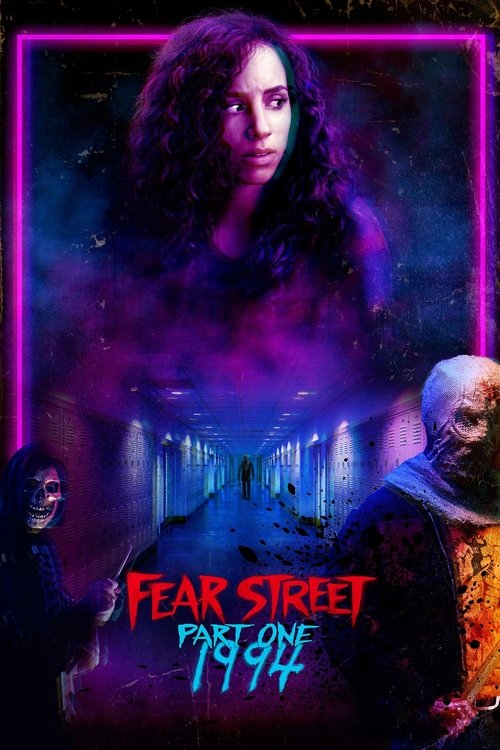
Fear Street: 1994
2021 · Leigh Janiak
When you want a proper slasher night — screams, kills, and adrenaline — without wading into bleak territory; ideal with friends and the lights off. Bonus if you're up for a trilogy binge, since this is chapter one of three.
What it's about
Shadyside, Ohio, 1994: a working-class town with a gruesome reputation, where massacres keep erupting generation after generation while its wealthy neighbor Sunnyvale stays untouched. After a brutal killing at the local mall, teenager Deena, her younger brother Josh, and their friends realize the town's centuries-old curse — tied to the legend of a hanged witch named Sarah Fier — has fixed its attention on them, and killers from Shadyside's bloody past begin hunting them down.
The experience
Fast, gory, and gleefully nineties — needle-drops, mall fluorescents, and slasher set pieces stacked on top of each other — but with a real emotional core in a queer teen romance the whole story bends around. It plays like a page-turner: propulsive, jumpy, and openly having fun with its own body count.
Performances
Kiana Madeira anchors the mayhem as Deena, giving the teen-scream material a raw, lovesick urgency that makes the stakes feel personal rather than disposable.
The craft
Director Leigh Janiak treats the R.L. Stine source material as a launchpad for something bloodier and more ambitious: one story conceived and shot as a three-film unit, each installment in a different era. The 1994 chapter commits hard to its period — soundtrack, mall geography, VHS-era texture — and stages its kills with genuine slasher-movie snap.
Why it matters
Released on consecutive weeks by Netflix in July 2021, the trilogy became a template for the streaming-era 'event' release and helped prove that unapologetically R-rated, queer-led teen horror had a big audience.
Horror · Slasher · Teen horror · Witchcraft. A propulsive, gory 90s teen slasher with mall-neon kills, a needle-drop soundtrack and a queer romance at its heart; chapter one of three.
Snapshot
Fear Street: 1994 is the opening chapter of a three-film horror event that Netflix released on consecutive weeks in July 2021, adapting the long-running young-adult book series by R.L. Stine. Directed by Leigh Janiak, it establishes the fictional Ohio town of Shadyside — a working-class community plagued for three centuries by recurring massacres and haunted by the legend of a hanged "witch," Sarah Fier — and contrasts it with its prosperous neighbor, Sunnyvale. The film follows Deena (Kiana Madeira), her younger brother Josh (Benjamin Flores Jr.), and their friends as a supernatural force begins resurrecting the town's historical killers to hunt them. The most distinctive thing about the project is its structure: rather than a single feature, it is one movement of a trilogy conceived and shot as a unit, each installment set in a different decade (1994, 1978, 1666) and pitched as an homage to the horror idiom of its period. 1994 is the "modern slasher" panel, self-consciously modeled on the post-Scream teen-horror cycle. Its cultural footprint rests less on individual acclaim than on the novelty of its release model and its foregrounding of a queer teen romance at the center of a mainstream American slasher.
Industry & production
The trilogy's production history is inseparable from a corporate upheaval. The project was developed at 20th Century Fox with Chernin Entertainment as a theatrical enterprise, with Janiak attached to direct all three films back-to-back — an unusual commitment that let the productions share cast, crew, sets, and a single continuous shoot rather than being greenlit sequentially on the strength of a first film's returns. The three films were photographed consecutively, primarily in the Atlanta metropolitan area of Georgia, standing in for small-town Ohio.
The Disney acquisition of 21st Century Fox, completed in 2019, disrupted the theatrical plan. The trilogy ultimately migrated to Netflix, which acquired distribution rights and released the films as a weekly event across July 2021 — 1994 on July 2, 1978 on July 9, and 1666 on July 16. This staggered rollout was a deliberate experiment in appointment viewing on a platform otherwise associated with all-at-once "binge" releases, converting the trilogy's serialized structure into a marketing engine: each film ended on a cliffhanger that the next week resolved. The model has since been read as an early example of streaming services rediscovering the value of scheduled, episodic anticipation.
The economics of the specific arrangement — the acquisition price, budget, and viewership figures — are not something I can state with confidence, and I will not invent numbers. What is clear is that shooting three period features simultaneously offered real efficiencies of scale that a conventional sequel structure could not.
Technology
1994 was produced as a contemporary digital feature and does not represent a notable technical departure; its interest lies in how it deploys conventional tools toward period pastiche. The film leans heavily on practical gore effects and prosthetics in the tradition of the slasher subgenre it emulates, favoring physical makeup and stunt work over conspicuous digital augmentation for its kills. Where the trilogy's craft is most visible technologically is in its color and lighting design, which uses the affordances of digital grading to give each installment a distinct palette — 1994 trafficking in the neon-and-shadow register associated with '90s-nostalgia media. Any account of specialized rigs or unusual capture techniques would be speculative, and the public record on the film's technical pipeline is thin.
Technique
Cinematography
The cinematography, by Caleb Heymann, commits to a nostalgic, saturated palette — pools of colored light (reds, sickly greens, sodium-vapor oranges) that recall both the giallo-inflected slasher and the "'80s/'90s revival" look popularized by streaming-era nostalgia media. The camera is mobile and stalker-adjacent in the horror set pieces, exploiting the geography of a shopping mall and suburban streets for suspense. The opening sequence in particular is staged as a bravura genre callback, using the layout and after-hours emptiness of a mall bookstore to build a Scream-style prologue.
Editing
The film's editorial signature is its rhythm of set-piece and needle-drop: kills are cut to be percussive rather than lingering, and montage is used to compress the ensemble's investigation. The trilogy also depends on editing to sustain its cross-film architecture, planting and later paying off reveals across three features. I am not able to reliably attribute the picture editor by name, and rather than guess I will flag that the crew credit is not something I can confirm here.
Mise-en-scène / staging
Production design is doing heavy thematic labor: Shadyside is dressed as a decaying, blue-collar town of strip malls, chain stores, and worn houses, while Sunnyvale gleams. The 1994 setting is signaled through dense period texture — clothing, hairstyles, mall signage, consumer detritus — that functions both as pleasure and as class marker. The staging of violence favors recognizable slasher iconography (masked killers, bladed weapons) drawn from the town's rogues' gallery of historical murderers.
Sound
The most assertive element of the film's soundscape is its curated 1990s soundtrack. 1994 is wall-to-wall with period alternative and grunge-era needle drops used both diegetically and as ironic counterpoint to carnage; the song choices are a primary vehicle of the film's nostalgia and are integral to its identity. The original score is credited to Marco Beltrami working with collaborators (including Brandon Roberts); I am less certain of the full composing team across the trilogy, so I will not enumerate names I cannot verify. The score complements the licensed tracks with more traditional stalk-and-slash tension cues.
Performance
The ensemble skews young and naturalistic. Kiana Madeira anchors the film as Deena with a guarded, angry interiority; Olivia Scott Welch plays Sam, the ex-girlfriend whose relationship with Deena is the emotional spine of the trilogy. Benjamin Flores Jr. supplies the lore-obsessed younger-brother energy, Julia Rehwald and Fred Hechinger round out the friend group with comic register, and Ashley Zukerman appears as Sheriff Nick Goode. Gillian Jacobs enters as the adult survivor C. Berman, a bridge to the 1978 chapter. The performances are calibrated to the teen-horror mode: heightened enough for genre, grounded enough to make the central romance land.
Narrative & dramatic mode
1994 operates in the ensemble teen-slasher mode but frames it inside a larger mystery-and-curse structure that only fully resolves across three films. As a standalone chapter it is a self-contained siege narrative — a group of teenagers besieged by resurrected killers over roughly a single night — but it functions dramatically as exposition for the trilogy, establishing the rules of the Sarah Fier curse and ending on an unresolved beat that hands off to the next installment. The dramatic mode blends horror with the coming-of-age register: the "final girl" logic is retooled around a protagonist whose motivating stakes are romantic and personal rather than purely survivalist. Genre self-awareness — characters who understand horror conventions — is deployed knowingly but does not tip into full parody.
Genre & cycle
The film belongs to the post-Scream self-reflexive slasher, filtered through the 2010s–2020s nostalgia-horror revival. It sits within two overlapping cycles: the streaming-era horror event (serialized, binge-adjacent) and the "decade cosplay" trend in which contemporary genre media reconstructs a specific past era as both setting and aesthetic. Within the trilogy, 1994 is explicitly the slasher panel, with the subsequent films shifting toward the summer-camp slasher (1978, in the Friday the 13th lineage) and the folk-horror/period register (1666). This decade-by-decade cycling of subgenres is the trilogy's organizing conceit.
Authorship & method
Leigh Janiak is the trilogy's authorial center. She came to the project from the well-received low-budget feature Honeymoon (2014) and television work in the horror space, and her decision to direct all three films consecutively is the defining method here: it makes the trilogy a single directorial statement rather than a franchise assembled piecemeal. Janiak co-wrote the films; 1994's screenplay is credited to Janiak and Phil Graziadei, with a story credit involving Kyle Killen — I am confident of Janiak and Graziadei as the principal writers, and less certain of the precise apportioning of story credit, which I will not overstate.
Key collaborators include cinematographer Caleb Heymann, whose period-palette lighting is central to the film's texture, and Marco Beltrami as composer (with co-composers I cannot fully confirm). The editorial credit I am unable to verify and decline to invent. Chernin Entertainment served as the producing entity carried over from the project's Fox origins. The overall method — one director, one continuous shoot, three period pastiches — is the trilogy's most scholarly-notable creative decision.
Movement / national cinema
This is mainstream American commercial horror, produced within the Hollywood studio system (originating at Fox, landing at Netflix). It does not belong to a formal film movement, but it is a clear artifact of the streaming era's reshaping of American genre production — specifically the moment when a studio's theatrical pipeline could be diverted wholesale to a subscription platform, and when platforms began experimenting with release cadence. Its aesthetic lineage is domestic: the American slasher tradition and the American nostalgia-media wave.
Era / period
Two "periods" are in play. The film is set in 1994 and reconstructs that year as a densely coded pop-cultural surface. It was made in the late-2010s/early-2020s streaming boom and reflects that industrial moment — the post-Fox/Disney consolidation, the rise of Netflix original horror, and the vogue for nostalgia. The gap between the two is part of the film's meaning: 1994 is rendered as a knowing period reconstruction for a 2021 audience, its music and iconography selected as recognizable signifiers rather than neutral background.
Themes
Beneath the slasher machinery, 1994 is preoccupied with class and place. The Shadyside/Sunnyvale opposition literalizes economic inequality as a supernatural curse: the poor town suffers cyclical violence while its affluent neighbor thrives, and the trilogy ultimately interrogates who benefits from that arrangement — a critique of structural inequity dressed in genre clothing. Determinism and inherited fate are central: characters are marked by a curse they did not choose, and the drama concerns whether that inheritance can be resisted. The film also foregrounds queer love as a redemptive, life-driving force; the Deena–Sam relationship is not incidental but the narrative's emotional engine, a notable centering of a lesbian romance within a mainstream slasher. Nostalgia itself is arguably a theme — the pleasures and distortions of remembering a decade — though the film treats it more as texture than object of critique.
Reception, canon & influence
Critically, Fear Street: 1994 was received as a promising, energetic opening chapter — praised for its craft, its soundtrack, its queer representation, and the ambition of the trilogy format, while some reviewers found it derivative by design, more a curated compendium of slasher references than an innovation. It is best assessed as one third of a whole; the trilogy as a unit drew more substantive appraisal than any single film, and 1994 is generally read as strong scene-setting rather than the trilogy's dramatic peak.
The influences on the film (backward) are worn openly: the Scream cycle (the reflexive mall/bookstore prologue), the broader '80s–'90s slasher canon (Halloween, A Nightmare on Elm Street, Friday the 13th), late-'90s teen horror such as I Know What You Did Last Summer, and the nostalgia-horror template popularized by Stranger Things — plus, foundationally, R.L. Stine's Fear Street novels, whose lore and Shadyside setting the films adapt.
Its influence forward (legacy) is chiefly industrial and representational. The weekly-release event model demonstrated an alternative to all-at-once streaming drops and is cited as evidence that serialized anticipation retains value in the on-demand era. The trilogy also stands as a prominent example of centering LGBTQ+ characters within commercial horror. Because the films are recent, their longer-term canonical standing is still unsettled, and any claim about lasting influence should be held provisionally. A direct continuation was subsequently pursued in the Fear Street screen franchise, indicating the property's ongoing commercial life, though the specifics of later entries fall outside this chapter's scope.
A Deleuzian reading
A mall after closing.
The full Deleuzian reading of Fear Street: 1994 →
Reception
Landed in summer 2021 as a genuine Netflix event — three films dropped over three consecutive weeks — and was warmly received; since then it's settled in as modern comfort-slasher canon, with the trilogy's queer central romance a big part of why people keep returning to it.
How Fear Street: 1994 was received, from release to now →
How to watch Fear Street: 1994: what to notice on a first viewing
- Watch the empty mall before anything actually happens. Janiak opens on a closed bookstore lit only by signage, holding the camera on empty aisles and a woman working alone before any threat becomes visible. The dread here comes from watching and waiting, not from anything actually happening yet.
- Notice the reds and sickly greens soaking every scene. Caleb Heymann floods interiors and streets with pools of colored light, reds, sickly greens, sodium-vapor orange, so the color itself carries the film's mood rather than just decorating the space. A location stops feeling like a real place and starts feeling like a condition you are trapped inside.
- Notice how much shabbier Shadyside looks than Sunnyvale. Production design dresses Shadyside in strip malls, chain stores, and worn houses, then lets the neighboring town gleam, making class difference visible before anyone explains the curse. You can read which town is supposed to suffer just from how each one is dressed and lit.
- Listen for a pop song playing right through the violence. The film stays wall-to-wall with period alternative and grunge tracks, letting a familiar song run straight through a kill instead of dropping out for tension. The music refuses to treat the carnage as special, which makes the carnage feel even stranger.
- Watch Deena's face stay guarded even around her friends. Kiana Madeira plays Deena with a closed-off, angry interiority from her very first scenes, holding back long before the film tells you what she is actually protecting herself from. Her guardedness is set up early as a personal wound, not just a genre attitude.
The whole guide to watching Fear Street: 1994, with the keys for a rewatch →
Influences: the films it descends from and the films it influenced
- Scream (1996) — Provides the self-aware mall/bookstore cold-open in which a masked killer stalks a victim through consumer-lit aisles while the film winks at slasher conventions — Fear Street: 1994 replicates this reflexive prologue almost beat-for-beat, down to the ironic pop needle-drop under a stabbing.
- Halloween (1978) — Establishes the Shape-style expressionless masked stalker whose stiff, relentless gait and unkillable persistence Janiak lifts wholesale for the Skull Mask killer's siege staging and slow-advance geometry.
- A Nightmare on Elm Street (1984) — Model for the town-curse mythology in which a communal historical sin (the Nightmares' burned child; Shadyside's witch) returns to murder teenagers, giving Fear Street its 'inherited-fate' supernatural engine rather than a lone-psycho motive.
- Friday the 13th (1980) — Supplies the summer-camp/rural-community body-count template and the practical-gore money-shot (the bread-slicer decapitation echoes Tom Savini's arterial, tactile splatter over digital kills).
- I Know What You Did Last Summer (1997) — Late-'90s teen-slasher blueprint of a photogenic, class-mixed friend group hunted by a guilt-linked killer, whose glossy WB-adjacent casting and hook-and-slash rhythm Fear Street's naturalistic teen ensemble directly inherits.
- Stranger Things (2016) — Codifies the streaming-era nostalgia-horror grammar — meticulous period-year reconstruction, wall-to-wall era needle-drops, and kid/teen ensemble against small-town supernatural rot — that is the operating template for the trilogy's whole aesthetic.
- It Follows (2014) — Precedent for the saturated synth-scored, deliberately un-fixable-period suburban horror and the inexorable slow-walking pursuer, whose neon-and-dread palette informs Heymann's period lighting and Beltrami's pulsing cues.
- Honeymoon (2014) — Janiak's own debut, where she developed the two-hander intimacy and body-horror dread that carry into Fear Street's foregrounding of a central relationship (Deena and Sam) as the emotional spine of a genre exercise.
- Carrie (1976) — Source for the class-coded high-school cruelty and the drenched-in-viscera set piece as social payback, feeding Fear Street's grocery-store finale and its curse-as-class-inequality thesis.
- Fear Street: 1978 (2021) — The trilogy's middle panel, shot back-to-back by Janiak as one continuous directorial statement, switching pastiche register from Scream-slasher to Friday-the-13th camp massacre while extending the shared Shadyside curse mechanics seeded in 1994.
- Fear Street: 1666 (2021) — Closes the trilogy-shot-as-a-unit by resolving 1994's cliffhanger, recasting the same ensemble as period colonists to reveal the witch-mythology origin — the payoff structure that makes the three films one film.
- X (2022) — Post-Fear-Street period-slasher that likewise reconstructs a specific year (1979) with fetishistic texture and needle-drops, treating the retro slasher as a deliberate craft object and vehicle for foregrounded sexuality rather than pastiche alone.
- Bodies Bodies Bodies (2022) — Extends the naturalistic queer-centered teen-ensemble siege into A24 territory, keeping Fear Street's neon-lit single-location body-count staging and class-antagonism subtext but swapping earnest nostalgia for satire.
- Totally Killer (2023) — Streaming-era nostalgia-slasher that leans on period-year reconstruction and pop needle-drops around a masked town-history killer, directly working the Fear-Street/Stranger-Things vein of retro-slasher-as-legacy-media.
- Fear Street: Prom Queen (2025) — The franchise's direct continuation, inheriting the Shadyside lore, period-reconstruction conceit, and class-coded high-school slasher staging Janiak established, now handed to a new director as ongoing property rather than single-auteur statement.
- The Faculty (1998) — Companion Kevin Williamson-era teen-horror that fuses a period-marked soundtrack and archetype-savvy high-school ensemble with genre-pastiche plotting, the same 'curated-references' construction critics flagged in Fear Street.
- Freaky (2020) — Contemporary post-Scream teen slasher that pairs percussive, practical-effects kills with a queer-inclusive high-school ensemble, sharing Fear Street's project of updating the '90s slasher's representational politics while preserving its splatter craft.
Similar films
- Fear Street: 1666 (2021) — influence & lineage · same viewing thread
- Fear Street: 1978 (2021) — influence & lineage · same viewing thread
- X (2022) — influence & lineage · same viewing thread
- Scream (1996) — influence & lineage
- A Nightmare on Elm Street (1984) — influence & lineage
- Halloween (1978) — influence & lineage
- Freaky (2020) — influence & lineage
- Friday the 13th (1980) — influence & lineage
All the films related to Fear Street: 1994 →
Watch it with: curated runs of related films
- Slashers That Know the Rules — A run of body-count films that know their own genre: requels, camp-slasher love letters, Ti West's X trilogy and outright parodies, all reworking the masked killer, the final girl and the cursed summer camp, so each one sharpens the jokes and scares in the next.
- Hexes, Covens and Curses — A run through horror's oldest fear, the witch and the curse she leaves behind, from Häxan's silent lecture and Bava's masked revenant through the Polanski coven and Argento's dance academy to Eggers' Puritan forest and Cregger's vanished schoolchildren; watch them near each other to see how each era recasts the same…