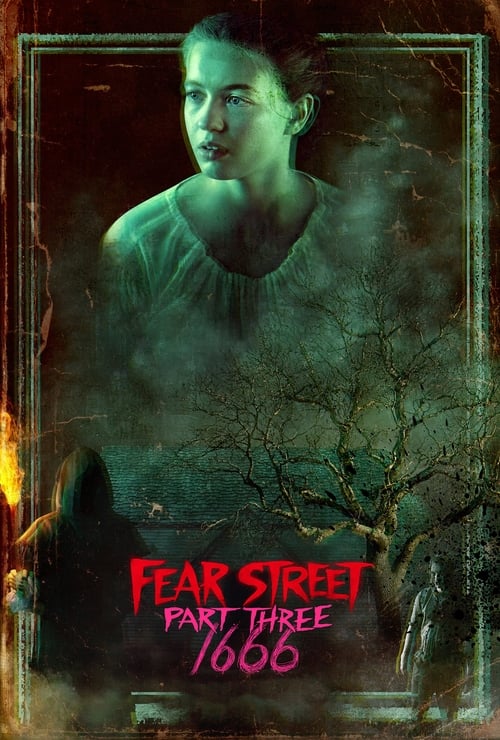
Fear Street: 1666
2021 · Leigh Janiak
For when you're bingeing a horror saga and want the finale to actually land — best watched close on the heels of the first two chapters, ideally in one greedy weekend. It's a crowd-pleaser scare, not a punishing one.
What it's about
The trilogy-closer jumps back to 1666, where a colonial settlement turns on itself in a witch-hunt that will poison the town for three centuries. The same young cast from the modern-day chapters plays their own Puritan ancestors, living out the original sin behind the curse — before the story snaps back to 1994, where a handful of teenagers get one last chance to end it for good.
The experience
It plays in two registers: a slow-burning folk-horror dread of candlelight, sermons, and neighbors turning accuser, then a sprint of neon-lit slasher momentum for the finale. Paranoia does most of the scaring in the first stretch; the last act is pure cathartic payoff.
The craft
Leigh Janiak's boldest structural swing of the series: recasting her 1994 leads as their own ancestors turns the whole trilogy into one braided story about inherited blame. The colonial section trades the earlier films' needle-drops for mud, torchlight, and hushed accusation before the style whiplashes back to mall-slasher brightness. Watch it loud with the lights off.
Why it matters
Capping Netflix's experiment of releasing a horror trilogy on three consecutive weeks, it helped prove the binge-model event movie could work for genre fans and turned R.L. Stine's teen-horror brand into grown-up slasher material.
Horror · Folk horror · Slasher · Teen horror. A candlelit Puritan witch-hunt of creeping paranoia whiplashes into a neon mall-slasher finale — a crowd-pleasing saga closer, best binged.
Snapshot
Fear Street: 1666 is the concluding chapter of Leigh Janiak's Fear Street trilogy, three feature-length films adapted loosely from R.L. Stine's long-running young-adult horror series and released by Netflix on consecutive weeks in July 2021 (1994 on July 2, 1978 on July 9, 1666 on July 16). Where its predecessors paid homage to the 1990s meta-slasher and the 1970s summer-camp slasher respectively, 1666 pivots into colonial folk horror before circling back to a present-tense climax. Its structural conceit is the trilogy's most ambitious: the first two-thirds transport the 1994 cast into a Puritan-era witch-hunt, with the same actors playing ancestors of their modern characters, before the final act returns to 1994 to resolve the three-century curse the whole series has been excavating. It is best understood not as a standalone film but as the keystone of a single serialized narrative shot back-to-back and engineered for binge-adjacent weekly release — an artifact of the streaming era as much as a horror picture.
Industry & production
The trilogy originated at Chernin Entertainment in partnership with 20th Century Fox, developed as a theatrical event: three films shot consecutively as one production, an unusual gamble that treated the slasher not as a single release but as a franchise delivered in a compressed burst. Principal photography took place largely in and around Georgia (Atlanta and surrounding areas standing in for the fictional twin towns of Shadyside and Sunnyvale). Following Disney's acquisition of 21st Century Fox and the disruption of theatrical distribution during the 2020 pandemic, the completed films were sold to Netflix, which reformatted the theatrical-event concept into a streaming event — three weekly drops that functioned as appointment viewing on a platform built for on-demand consumption.
That release architecture is the production's defining industrial fact. Shooting all three films at once let the trilogy maintain a single cast, crew, and design language across three centuries and genres, and let 1666 deploy its ancestor-casting payoff without recasting or aging effects. It also meant the third film could withhold its central revelation — the truth about the "witch" Sarah Fier — for two full films before delivering it. Netflix, characteristically, released no verified box-office figures (the films bypassed wide theatrical release), and viewership claims should be treated cautiously; the public record on precise audience numbers is thin and I will not invent them.
Technology
Fear Street: 1666 was produced with conventional digital cinema tools of the late 2010s and carries no notable technological innovation at the level of capture or post-production; its interest is aesthetic rather than technical. The trilogy's craft challenge was tonal engineering across formats — making a 1666 colonial idiom, a 1978 grain-and-halation look, and a 1994 neon-slasher palette feel like one authored world. The most consequential "technology" here is organizational: the back-to-back shoot and the ancestor-casting gimmick, which substitute continuity of personnel for digital de-aging or replacement effects. Practical gore and prosthetic makeup do the heavy lifting in the horror set pieces rather than heavy visual-effects compositing, consistent with the trilogy's throwback ethos.
Technique
Cinematography
The trilogy was shot by Caleb Heymann, and 1666's photography executes the sharpest tonal handoff of the three. The colonial passages favor low-key, candle-and-hearth naturalism — desaturated earth tones, close and often handheld framing that traps the viewer inside the paranoia of a sealed community — deliberately evoking the muted, overcast palette associated with contemporary Puritan-era horror. When the film snaps back to 1994 for its third act, the image reverts to the trilogy's signature glossy, saturated register: hard color, mall fluorescents, the lurid greens and reds of a self-aware slasher. The contrast is the point. Heymann uses two visual grammars to dramatize the film's argument that the same violence recurs across centuries wearing different clothes.
Editing
Editorially, 1666 carries the heaviest structural burden in the trilogy: it must function as an origin flashback, resolve the mystery seeded across two prior films, and then execute a genre and period shift into a present-day climax without losing momentum. The film is built as two movements welded together — a slow-burn folk-horror first act and a kinetic slasher finale — and the cut has to manage that gearshift. (Precise editorial credits for the individual installments are not something I can attribute confidently here, so I flag the record as thin rather than guess.) The recurrent device of intercutting present against past — recognitions triggered when a modern character's face dissolves into an ancestor's — is the trilogy's central rhyming mechanism, and it climaxes in this film.
Mise-en-scène / staging
Production design carries the film's thesis. The colonial village of Union — later split into prosperous Sunnyvale and cursed Shadyside — is staged as a claustrophobic settlement of timber, mud, and communal surveillance, where private desire is criminalized and difference is fatal. Costume and set dressing observe a plausible Puritan austerity. The staging of the witch-hunt leans on the visual vocabulary of the American colonial imagination: the meeting house, the hanging tree, the mob with torches. When the film returns to 1994, the key location is the Shadyside mall built atop the original village ground — a literalization of the theme that modern consumer America is constructed over a buried history of scapegoating. The bright, branded interior becomes the killing floor, collapsing 1666 and 1994 into one continuous crime scene.
Sound
The trilogy is notable for its aggressively anachronistic 1994 needle-drops — a wall-to-wall alt-rock and hip-hop jukebox that scores the modern sequences. 1666 pointedly withholds that texture during its colonial stretch, relying instead on sparse ambience, diegetic sound, and orchestral scoring to sell the period, before the pop soundtrack roars back for the mall climax. The original music was handled by a team associated with composer Marco Beltrami (with additional collaborators credited across the trilogy); I'd rather flag the exact division of composing credits as something I can't verify precisely than misattribute it. Functionally, the score's job in 1666 is to sound nothing like the previous two films until the film chooses to reconnect them.
Performance
The film's boldest performance demand is doubling. Kiana Madeira, who anchors the trilogy as 1994's Deena, here plays Sarah Fier — the woman falsely mythologized for three centuries as the witch who cursed the town — and must carry the emotional revelation that reframes the entire series. Olivia Scott Welch likewise doubles as Sarah's forbidden love, tying the queer romance of the modern film to its colonial mirror. Ashley Zukerman's dual role is the trilogy's structural hinge: the sympathetic modern sheriff Nick Goode and his ancestor Solomon Goode, the film's true villain, whose bargain is the actual source of the curse. The ensemble's task is to make audiences read familiar faces as different people separated by three centuries, so that recognition itself becomes a dramatic event.
Narrative & dramatic mode
1666 operates as a revelation narrative — the withheld-truth structure of a mystery resolved at the latest possible moment. For two films the audience has been told, with the town, that Sarah Fier is a witch whose curse produces Shadyside's serial killers. 1666 discloses that Sarah was innocent: a young woman scapegoated for a moral panic and for her love of another woman, while the real pact-maker, Solomon Goode, escaped and passed the bargain down his bloodline. The film thus works as both origin story and exoneration, retroactively re-scripting every death in the prior installments as the consequence of a lie. Dramatically it is a two-part structure: a tragedy in period dress followed by a redemptive action-horror coda in which the modern protagonists, now in possession of the truth, break the cycle. The mode is melodrama in the precise sense — a moral universe of concealed villainy and vindicated innocence — grafted onto slasher mechanics.
Genre & cycle
The trilogy is a curated tour through American horror's subgeneric history, and 1666 completes the syllabus by reaching back before the slasher to its deeper source: the folk-horror and witch-hunt tradition. Its colonial half draws on the lineage of Puritan-panic narratives — the dramatic tradition of The Crucible and the recent arthouse resurgence of colonial folk horror — while its modern half snaps back into the self-aware slasher established in 1994. In doing so 1666 argues a genealogy: that the American slasher's disposable-victim logic descends from the older machinery of the witch-hunt, the community that must periodically produce a monster to purify itself. The film participates in the 2010s–2020s "elevated"/revivalist horror cycle that treats genre history as text, alongside the broader nostalgia economy of streaming-era franchise horror.
Authorship & method
Leigh Janiak is the trilogy's presiding author, directing all three films and sharing screenplay credit (her frequent collaborator Phil Graziadei is credited across the trilogy, with additional story contributors on the individual installments; I'd treat the exact per-film writing breakdown as something to verify rather than assert). Janiak came to the project from the indie horror feature Honeymoon (2014) and television work in the genre, and the Fear Street trilogy is her signature statement: a director's argument that horror's periods are legible as a single continuous history. Her method here is pastiche as thesis — each film adopts the grammar of a specific era so that the trilogy can trace horror's evolution while telling one story. Key collaborators — cinematographer Caleb Heymann and the Beltrami-associated music team — are enlisted precisely to execute that period-hopping fluency. The back-to-back production model is itself an authorial choice, giving Janiak unified control over a triptych most franchises would have splintered across years and hands.
Movement / national cinema
This is thoroughly American genre cinema, and 1666 is its most explicitly Americanist chapter: it locates the country's horror in its founding — the Puritan settlement, the witch trial, the scapegoat hanged so the community can prosper. The trilogy belongs to no formal movement but sits within a recognizable streaming-era wave of nostalgia-driven American horror produced for platforms rather than theaters, in which genre history is mined as both content and comfort. Its sensibility is continuous with the American independent horror renaissance of the 2010s, importing that cycle's interest in dread-as-craft into a commercial franchise frame.
Era / period
As an object, 1666 is a 2021 streaming production — a pandemic-rerouted theatrical package repurposed as an event drop, emblematic of the moment when Netflix was aggressively acquiring and scheduling would-be tentpoles. As a text, it is a period film twice over: it reconstructs 1666 and then 1994, staging its own present (2021) implicitly through the machinery of nostalgia. The trilogy's release strategy — three films over three weeks — is itself a period marker, a specific experiment in serialized streaming distribution that treated a horror franchise as a limited event rather than a single title or a traditional sequel cadence.
Themes
The trilogy's governing theme, consummated in 1666, is the structural inequality of place: two towns, Sunnyvale's prosperity purchased by Shadyside's suffering, an arrangement sustained by a hidden bargain and a convenient scapegoat. 1666 reveals this as an allegory of class and social sorting — some communities are engineered to absorb violence so others can thrive — and of the scapegoat mechanism itself, the persecution of the outsider (here a young woman, and a queer one) to launder collective guilt. Sarah Fier's story reframes the "witch" as a victim of misogyny and homophobia, making the film's central act one of historical correction: recovering the truth erased by those who profited from the lie. The queer romance is not incidental but load-bearing — the love the town criminalized in 1666 is the same love the trilogy centers and vindicates in 1994. Underneath runs a thesis about history as recurrence: the same crime, restaged across centuries, until someone finally refuses the bargain.
Reception, canon & influence
Critically, the Fear Street trilogy was received as a well-executed and unusually cohesive piece of genre revivalism, praised for its ambition as a serialized experiment, its craft, and its foregrounding of a queer teenage romance within a mainstream slasher framework; I'll characterize the reception in these general terms rather than cite specific aggregate scores or figures I can't verify. 1666 specifically was read as the payoff chapter whose success depended on whether its long-withheld revelation justified two prior films — its exoneration of Sarah Fier landing as the trilogy's thematic and emotional core.
Influences on the film run backward through American horror's own archive: the colonial-panic dramatic tradition and the recent arthouse folk-horror revival for the 1666 material; the summer-camp and meta-slasher canons channeled by the trilogy's earlier installments; and the ancestor-doubling device, which recalls the multi-era, same-actor casting of literary and cinematic reincarnation narratives. R.L. Stine's Fear Street books supply the Shadyside mythology and tone, though the trilogy invents its own throughline rather than adapting specific volumes.
Its legacy forward is bound up with its form. The trilogy stands as one of the more visible proofs-of-concept for the "release a completed film series in rapid succession" streaming strategy, and for treating horror-genre history as a franchise's organizing principle. Within LGBTQ+ genre representation it earned a durable place as a mainstream horror event built around a queer love story with a happy, curse-breaking resolution — a notable inversion of the "bury your gays" convention the genre had long been criticized for. Whether the trilogy's specific structural gambit becomes widely imitated remains an open question, and I won't overstate a legacy still being written; but as a self-contained experiment in serialized, history-conscious streaming horror, Fear Street: 1666 is the chapter where that experiment either paid off or didn't — and most accounts hold that it did.
A Deleuzian reading
A face you already know, in a linen cap, in 1666.
The full Deleuzian reading of Fear Street: 1666 →
Reception
The trilogy capper of Netflix's July 2021 three-week 'event horror' experiment, 1666 landed as the redemption arc — reviews that were lukewarm on Part Two warmed up for the finale, and the trilogy has since settled in as beloved comfort-slasher viewing rather than disposable streaming content.
How Fear Street: 1666 was received, from release to now →
How to watch Fear Street: 1666: what to notice on a first viewing
- Watch the image shift from candlelit grain to glossy neon. Heymann shoots the colonial scenes in desaturated, handheld naturalism, then snaps back to the trilogy's hard-lit, saturated 1994 slasher look. Two completely different visual languages argue that the same violence just wears different clothes.
- Watch for a familiar 1994 face appearing in colonial dress. The same actors who played the modern cast now play their own ancestors, with no de-aging or lookalike casting to soften the recognition. Recognizing a face becomes an event in the story, not just a casting trick.
- Notice the soundtrack go quiet once the story reaches 1666. The trilogy's wall-to-wall alt-rock jukebox drops out entirely for the colonial stretch, replaced by sparse ambience and orchestral scoring. The silence itself signals you have left the modern film's world completely.
- Watch the meeting house, the hanging tree, and the torches. The colonial village is staged with the familiar vocabulary of the American witch-hunt, timber and mud and a community that watches itself constantly. You can feel the town closing ranks before anyone accuses a single person of anything.
- Notice a modern character's face dissolve into an ancestor's. The film moves between eras by joining a face in one time to a face in another. The past keeps surfacing inside the present's own faces.
The whole guide to watching Fear Street: 1666, with the keys for a rewatch →
Influences: the films it descends from and the films it influenced
- The Witch (2015) — 1666's colonial half adopts Eggers' arthouse folk-horror register — period-accurate diction, candlelit/natural-light framing, and an isolated devout community whose piety curdles into the horror engine itself.
- The Crucible (1996) — Supplies the scapegoat-mechanism dramaturgy: a spurned accusation metastasizing into communal witch-hunt, which 1666 inverts into Sarah Fier's exoneration-origin — the same false-accusation social-sorting machinery run backward.
- Witchfinder General (1968) — Founded the folk-horror witch-hunt subgenre — 17th-century rural persecution staged in real landscape with ordinary neighbors as executioners — the direct template for Fier's village mob turning on her.
- The Wicker Man (1973) — Model for the village-as-antagonist staging the facets flag as 'village-over-mall': a self-enclosed community whose collective ritual, not a lone killer, is the threat.
- Häxan (1922) — Fixed the foundational cinematic iconography of the witch trial and the accused woman — torchlit accusation, the devil's pact, the persecuted body — that 1666's Puritan sequences reanimate.
- Scream (1996) — Twofold debt: the meta-slasher self-awareness that treats slasher history as quotable text (the trilogy's organizing thesis), plus Marco Beltrami's scoring lineage, whose associated team the film hires for its music.
- Friday the 13th (1980) — The summer-camp slasher grammar and masked-stalker iconography pastiched wholesale by the trilogy's 1978 installment, whose Camp Nightwing set-piece Shadyside's killers descend from.
- Halloween (1978) — The suburban-stalk slasher grammar — the implacable 'shape,' the small-town evil returning across time — that the possessed Shadyside killers structurally reprise.
- Cloud Atlas (2012) — The ancestor-doubling device: casting the same actors across historical eras so reincarnation and moral continuity read visually — exactly the Fier/Deena doubling and recurring ensemble Janiak deploys across 1666 and 1994.
- The Fountain (2006) — Multi-era same-actor structure that intercuts centuries to resolve a single love story across time, prefiguring 1666's two-movement past/present cut and its curse-breaking romance.
- Marie Antoinette (2006) — The anachronistic needle-drop technique — contemporary pop laid over a rigorously period setting to collapse historical distance — which the trilogy weaponizes across its era-hopping soundtrack.
- Fear Street: 1994 (2021) — Closes the trilogy-shot-as-a-unit by resolving 1994's cliffhanger, recasting the same ensemble as period colonists to reveal the witch-mythology origin — the payoff structure that makes the three films one film.
- Sleepy Hollow (1999) — Colonial-American gothic that unpacks a present-day curse through a flashback witch origin — the withheld-revelation, exoneration-of-the-accused-witch structure 1666 formalizes.
- Stranger Things (2016) — The Netflix genre-nostalgia machine that makes period-precise needle drops and era-pastiche the organizing aesthetic, and shares the streaming horror-event production model 1666 exemplifies.
- The Haunting of Hill House (2018) — Netflix serialized prestige horror built on intercut timelines and a family tracked across eras — the same back-to-back, structurally-unified event model as the Fear Street triptych.
- It / It Chapter Two (2017) — Period-set town-curse horror split across timelines with a coming-of-age ensemble confronting a recurring town evil — Derry's cyclical predation mirrors Shadyside's generational curse.
- Midsommar (2019) — The A24 daylight folk-horror revival — pagan communal ritual and scapegoat sacrifice staged in bright open space — that 1666's witch-hunt sequences draw their contemporary arthouse texture from.
- Fear Street: 1978 (2021) — The folk-horror origin chapter that closes the nested-flashback framing device 1978 is embedded within, completing the trilogy's continuous mythology.
Similar films
- Scream (1996) — influence & lineage
- Halloween (1978) — influence & lineage
- Fear Street: 1994 (2021) — same viewing thread
- Fear Street: 1978 (2021) — same viewing thread
- Midsommar (2019) — influence & lineage · same viewing thread
- The Witch (2016) — same viewing thread
- Scream VI (2023) — same viewing thread
- The Ritual (2017) — same viewing thread
All the films related to Fear Street: 1666 →
Watch it with: curated runs of related films
- Slashers That Know the Rules — A run of body-count films that know their own genre: requels, camp-slasher love letters, Ti West's X trilogy and outright parodies, all reworking the masked killer, the final girl and the cursed summer camp, so each one sharpens the jokes and scares in the next.
- Folk Horror's New Harvest — A run of modern folk horror in which grieving or rootless outsiders step onto old land (a Swedish commune, a Puritan forest edge, an Icelandic farm, an English village) and find the pagan past still hungry; they rhyme on ritual, landscape and the dread of belonging.