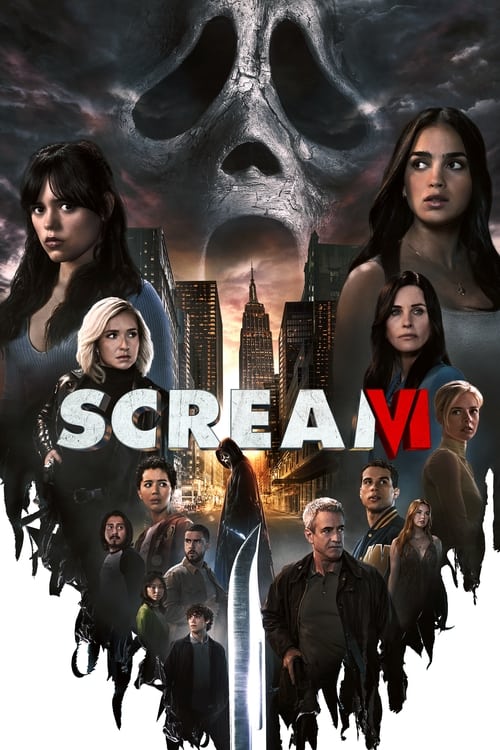
Scream VI
2023 · Matt Bettinelli-Olpin
For a Halloween-season group watch or any night you want a big, loud whodunit slasher that keeps you guessing — comfort horror with a sharpened edge. Friday-night popcorn with a body count.
What it's about
The four survivors of the last Ghostface massacre — sisters Sam and Tara Carpenter and the Meeks-Martin twins — have fled their haunted hometown for a fresh start at college in New York City. Then a new Ghostface starts hunting them through subways, bodegas, and crowded streets, and the anonymity of the big city stops feeling like safety. The killer knows the old rules; so do they.
The experience
Relentless and mean in the fun way — the city setting turns familiar stalk-and-chase scenes claustrophobic and public, and several set pieces will have you holding your breath. The trademark self-aware humor is still there, but the violence hits harder than you expect.
Performances
Melissa Barrera and Jenna Ortega anchor the mayhem as sisters bound by trauma, with Ortega's mix of vulnerability and bite standing out even mid-chase.
The craft
Radio Silence stage some of the franchise's most inventive set pieces by weaponizing New York itself — a subway car full of Halloween costumes, cramped apartments, nowhere private to run. The kills are staged with real geographic clarity, and the whodunit structure keeps the mechanics of the mystery ticking between scares.
Why it matters
It carried a nearly thirty-year-old franchise into a new era without its original heroine and proved the series could keep reinventing itself, cementing the legacy-sequel revival as a going concern.
Horror · Slasher · Teen horror. A loud, self-aware whodunit slasher that drags a masked killer through crowded New York — mean, funny, and brutal in its set pieces.
Snapshot
Scream VI is the sixth entry in the slasher franchise that Wes Craven and screenwriter Kevin Williamson launched in 1996, and the second directed by the filmmaking collective Radio Silence — Matt Bettinelli-Olpin and Tyler Gillett, working with producer Chad Villella. (Though this dossier is filed under Bettinelli-Olpin, the two direct as a pair; the record consistently credits both.) Released by Paramount Pictures in March 2023, roughly a year after Radio Silence's franchise-reviving Scream (2022), the film relocates the survivors of the previous Woodsboro massacre — sisters Sam and Tara Carpenter and the Meeks-Martin twins — to New York City, where a new Ghostface begins hunting them. Its defining production fact is an absence: Neve Campbell, whose Sidney Prescott had anchored every prior installment, did not return, having publicly cited a compensation dispute. Scream VI is therefore the first film in the series without its original final girl, a structural gamble that reorganizes the franchise around a new lead in Melissa Barrera's Sam. The result is the most scale-forward, thriller-inflected film in the cycle, trading small-town claustrophobia for an urban canvas.
Industry & production
The film sits inside a specific late-2010s/2020s pattern: the reactivation of dormant horror IP through "legacy sequels" produced by rights-holders seeking reliable theatrical performers in a streaming-pressured market. The 2022 Scream had proven the franchise commercially viable a decade after Scream 4 (2011) and after Craven's death in 2015; Scream VI was greenlit and produced quickly on that momentum, a compressed cadence more typical of studio horror than of the original quadrilogy's multi-year gaps. Production was mounted through Spyglass Media Group and Project X Entertainment with Paramount distributing. Kevin Williamson remained attached as an executive producer, preserving a line of continuity to the franchise's authorship even as the creative reins stayed with Radio Silence and screenwriters James Vanderbilt and Guy Busick.
Two industry frictions shaped the film's public identity. First, Campbell's exit foregrounded the widening conversation about pay equity for legacy talent in reboot economics. Second — and after the film's release — Melissa Barrera was dropped from the planned seventh installment amid controversy over social-media posts regarding the Israel–Gaza war, and Ortega also departed the follow-up; those events postdate Scream VI but retroactively frame it as the high-water mark of a cast configuration that did not survive. The picture was widely reported to have opened strongly for the series, though this dossier avoids citing specific grosses it cannot verify.
Technology
Scream VI is a contemporary digital production, and its technological interest lies less in any novel apparatus than in how it deploys standard tools for scale. Where the original Scream was a film-shot suburban picture, Scream VI uses modern large-format digital capture and extensive rigging to stage set pieces — a bodega, a subway car, a fire-escape ladder bridging two apartment windows, a convenience-store aisle — that depend on precise lighting control and stabilization the earlier films' technology would have made costlier. The franchise's signature technological motif also updates: the killer's phone calls, once landline and corder-tapped voice-changer gags in 1996, are now smartphone-native, and the film incorporates surveillance, doorbell cameras, and the ambient documentation of urban life as tools both killer and victims exploit. This continues a franchise habit of indexing its era's communication technology — a through-line from the 1996 voice-changer to the 2022 film's smart-home and streaming references.
Technique
Cinematography
Brett Jutkiewicz, who shot Radio Silence's Ready or Not (2019) and the 2022 Scream, returns as director of photography, and the visual grammar is his most confident in the series. The New York setting licenses a colder, more saturated palette than Woodsboro's warm suburbia — sodium and neon sources, wet streets, the fluorescent flatness of a bodega. Jutkiewicz favors sustained handheld and Steadicam moves through constricted spaces, using architecture (narrow apartment hallways, a stalled subway car, a stairwell) to compress the frame and control what the audience can and cannot see around Ghostface. The camera repeatedly withholds the killer at the edge of the frame or in soft background focus, a suspense strategy inherited directly from Craven and, behind him, from the Carpenter/Hitchcock lineage the franchise self-consciously cites.
Editing
The cutting emphasizes the franchise's characteristic rhythm of misdirection: false scares, whip-pans to empty doorways, and the sudden collapse of safe distance. The subway sequence is the clearest showcase, intercutting masked Halloween revelers so that any of a dozen costumed strangers might be Ghostface, letting the editing itself become the source of dread. I cannot confirm the specific editor credited on Scream VI from reliable memory and so decline to attribute it; what is observable is that the film sustains longer suspense builds than the quick-cut norm of much contemporary studio horror, holding on approach and threat before releasing into violence.
Mise-en-scène / staging
The film's most discussed staging is its escalation of physical brutality and spatial ingenuity. Ghostface here is written and blocked as more overtly aggressive — using a shotgun, pursuing victims through public space — which the mise-en-scène supports by moving the action out of homes and into transit and commerce. A late set piece in a "shrine" — a private collection of every previous Ghostface costume and franchise artifact — is a purely designed space, a diegetic museum of the series that turns production design into meta-commentary on fandom and the franchise's own accumulation of history.
Sound
Brian Tyler, who scored the 2022 film, returns, working from and around Marco Beltrami's original Scream themes; the score braids the familiar motivic material into denser, more orchestral urban-thriller textures. Sound design leans on the city — subway rumble, crowd noise, the muffling of a killer's approach beneath ambient din — to weaponize the very density that supposedly offers the survivors anonymity and safety.
Performance
Melissa Barrera carries the film as Sam Carpenter, playing trauma, suspicion, and the character's fraught inheritance (she is written as the secret daughter of original killer Billy Loomis). Jenna Ortega's Tara, arriving mid–breakout after Wednesday, plays the counter-note of a survivor determined to reclaim normal life. Jasmin Savoy Brown's Mindy Meeks-Martin inherits the franchise's "rules" expositor role once held by Randy Meeks, delivering the self-aware meta-monologues, while Mason Gooding's Chad supplies physical stakes. Courteney Cox returns as Gale Weathers, the sole legacy lead present, and Hayden Panettiere reprises Kirby Reed from Scream 4, now recast as an FBI agent — a performance that doubles as fan-service and structural continuity. Samara Weaving and Dermot Mulroney feature in key supporting roles.
Narrative & dramatic mode
Scream VI operates in the franchise's established dual mode: a functioning slasher-thriller and a running commentary on its own form. The 2022 film introduced the concept of the "requel"; Scream VI advances the meta-conversation to the "franchise" — Mindy's rules speech explicitly diagnoses the danger of an ongoing series in which no legacy character is safe and anyone can be a target, and where the killers' motives now derive from the franchise's own prior installments. Dramatically, the film is a survivor-group narrative: rather than a single final girl, it distributes protagonism across the "Core Four," which changes the suspense calculus, since the audience genuinely cannot assume who is protected. The mystery-plot machinery — the whodunit reveal, the third-act unmasking and motive monologue — remains intact, resolving on the Bailey family as the killers, avengers of Richie Kirsch, the villain of the 2022 film. This motive engine, in which each film's killers are the aggrieved survivors of the last, is itself the franchise's most self-perpetuating narrative device.
Genre & cycle
The film is a slasher, the subgenre Scream both revived and critiqued in 1996. But Scream VI is notably genre-hybrid, tilting harder toward the urban thriller and even action-thriller than any prior entry — the shotgun-wielding Ghostface, the pursuit through public infrastructure, and the sustained siege sequences push it beyond the stalk-and-slash template. Within the meta-slasher cycle Scream founded, Scream VI represents a late, self-reflexive stage: a series so aware of its own conventions that it stages a literal shrine to them. It belongs to the broader 2018–2023 wave of "elevated" and legacy-driven horror reboots (Halloween, Candyman, Texas Chainsaw Massacre) in which the reactivation of a classic property is itself part of the text's subject.
Authorship & method
Radio Silence's method — established on Ready or Not and continued through both their Scream films — favors kinetic camerawork, tonal balance between genuine dread and comic self-awareness, and set pieces engineered around a single strong spatial idea. Bettinelli-Olpin and Gillett direct collaboratively, an unusual co-authorship for a major studio horror franchise. Screenwriters James Vanderbilt and Guy Busick supply the whodunit architecture and the meta-textual rule-setting that is the franchise's signature; Vanderbilt also produces through Project X. Cinematographer Brett Jutkiewicz provides visual continuity across the Radio Silence duology. Composer Brian Tyler carries the score, in dialogue with Beltrami's foundational themes. On the editor, I decline to name a credit I cannot verify. Standing behind all of them is the franchise's originating authorship — Kevin Williamson (executive producer) and the late Wes Craven, whose direction of the first four films established the visual and tonal template every successor negotiates.
Movement / national cinema
This is American studio genre filmmaking, situated in the commercial horror tradition rather than any art-cinema movement. Its lineage runs through the American slasher (Carpenter's Halloween, 1978; the Friday the 13th and Nightmare on Elm Street cycles) and the self-referential turn that Scream itself inaugurated in the 1990s. Its NYC setting places it, superficially, in a long tradition of horror that reads the city as predatory space, but the film's sensibility is franchise-national rather than regional — it belongs to the ecosystem of contemporary Hollywood IP more than to any place-based cinema.
Era / period
Scream VI is a document of early-2020s Hollywood: post-pandemic theatrical horror as a dependable draw, the legacy-sequel economy at its peak, and the accelerating churn of streaming-adjacent franchise management. Its content registers its moment too — anxieties about online identity, doxxing, conspiracy communities, and the toxic dimensions of fandom feed directly into the killers' motives, updating the franchise's long-standing interest in how media consumption shapes violence (the 1996 film's "movies don't create psychos" thesis; the 2022 film's turn toward toxic fandom). The film also captures a specific casting-era transition, arriving at the crest of Jenna Ortega's mainstream breakout.
Themes
The film's central theme is inheritance — of trauma, of guilt, and of violence passed down bloodlines and franchises alike. Sam Carpenter's arc concerns whether identity is destiny: she is the daughter of a killer, haunted (literally, in her visions) by Billy Loomis, and the film asks whether she can refuse that lineage. Parallel to this runs the theme of the survivor community as both refuge and target, and the question of found family versus given family — set against killers who are themselves a corrupted family unit. At the meta level, Scream VI interrogates fandom and franchise as forms of obsession: the shrine of Ghostface artifacts literalizes the way devotion curdles into entitlement and grievance, extending the previous film's critique of possessive fan culture. Undergirding all of it is the series' perennial subject — the relationship between mediated culture and real violence.
Reception, canon & influence
Critically, Scream VI was generally received as a confident, propulsive entry — often praised for its set pieces (the bodega and subway sequences drew particular attention) and for making Ghostface feel newly dangerous, while some critics registered franchise fatigue and questioned the escalating scale and the strain of continuity without Sidney Prescott. It was widely treated as one of the stronger sequels in the series, alongside broad acknowledgment that Campbell's absence was felt.
Influences on the film (backward): it inherits directly from Craven and Williamson's four originals — the rules-based meta-structure, the opening-scare gambit, the two-killer twist tradition — and from the slasher canon those films themselves cite (Carpenter's Halloween above all). Its urban-thriller staging draws on the broader lineage of city-set horror and pursuit thrillers. Radio Silence's own Ready or Not informs its blend of dread and dark comedy.
Legacy (forward): Scream VI's most consequential effects were industrial rather than aesthetic. Its success confirmed the franchise's ongoing viability and directly set up a planned Scream 7, whose development was then reshaped by the departures of Barrera and Ortega and by later reported changes in creative direction — making Scream VI the last film of its particular ensemble era. It also intensified the franchise's meta-conversation to the point of self-museumization, a move later slasher-legacy projects can draw on as a template for how a long-running series can narrativize its own accumulated history. Its longer-term influence on the wider genre remains to be seen and, on the honest record, is not yet settled.
A Deleuzian reading
A stalled subway car on Halloween night.
The full Deleuzian reading of Scream VI →
Reception
Landed in 2023 with the franchise's biggest opening weekend and a rep as the most brutal, confident Ghostface outing yet — then the Scream VII meltdown (Melissa Barrera fired, Jenna Ortega gone) retroactively turned it into the bittersweet high point of the 'Core Four' era.
How Scream VI was received, from release to now →
How to watch Scream VI: what to notice on a first viewing
- Watch the subway car scene intercut between a dozen costumed strangers. The editing moves among masked Halloween revelers at the exact rhythm that usually signals a killer, without ever confirming which one it is. Deleuze calls an act that could belong to two situations at once an index of equivocity, and any reveler here could be the killer.
- Notice Ghostface stay at the edge of the frame. The camera repeatedly keeps the killer partially visible rather than fully in view, especially in narrow hallways and stairwells. Withholding a clear view of the threat keeps you scanning the frame instead of resting on it.
- Compare the sodium and neon city light to Woodsboro's warm suburbia. The New York setting is shot in a colder, more saturated palette, wet streets and fluorescent bodegas replacing Woodsboro's warm daylight. The shift in color scheme announces this entry has traded small-town claustrophobia for urban anonymity.
- Notice the action moving out of homes and into public transit and commerce. Ghostface pursues victims through a subway car, a bodega, and other public spaces rather than isolated houses. Moving the violence into crowded public space undermines the assumption that a crowd offers safety.
- Watch Mindy deliver her rules speech about franchises rather than horror movies. She updates the series' familiar exposition device to address the dangers specific to an ongoing franchise, where no legacy character is guaranteed to survive. The film tells you directly which old assumptions about who's safe no longer apply.
The whole guide to watching Scream VI, with the keys for a rewatch →
Influences: the films it descends from and the films it influenced
- Halloween (1978) — Its unbroken Steadicam killer-POV opening — the camera BECOMING the murderer so his identity stays withheld behind subjective framing — is the exact grammar Scream VI's handheld, withheld-killer stalking descends from.
- Psycho (1960) — The shower-scene's cut-based misdirection montage plus the shock of butchering the presumed protagonist early are the editing devices the franchise's opening-scare gambit and misdirection cutting inherit wholesale.
- Peeping Tom (1960) — It fused the first-person lens to the act of killing, inventing the subjective killer-gaze that Ghostface's camera weaponizes every time the frame withholds who is behind the mask.
- Black Christmas (1974) — The anonymous phone-caller taunts and killer-POV prowling inside a shared urban dwelling are the template Scream VI's apartment-and-bodega stalking and phone menace extend into a whole city.
- When a Stranger Calls (1979) — Its telephone-as-weapon prologue — dread built entirely from a ringing phone and a disembodied voice — is the set-piece architecture Williamson codified into the series' opening kills.
- The Bird with the Crystal Plumage (1970) — Giallo's gloved unseen assailant and its planted false-identity misdirection are the plotting DNA behind the whodunit reveal and the two-killer switcheroo the franchise runs.
- Wes Craven's New Nightmare (1994) — Craven's self-reflexive move of a franchise narrativizing its own history and mythology is the direct precursor to Scream VI's franchise-shrine and self-museumizing meta-text.
- Scream (1996) — The rules-based meta-structure, the star-killed cold open, and the two-killer twist are literally the source code every sequel including this one negotiates.
- Scream 2 (1997) — It invented the 'rules of sequels' meta-commentary and the ensemble-survivor continuity that Scream VI escalates while stress-testing its cast's inheritance.
- A Nightmare on Elm Street (1984) — Craven's authorship of a rule-bound, mythos-driven killer established the internal-logic scaffolding the franchise later turned self-aware and continues to police.
- Scream (2022) — The immediate predecessor by the same duo and DP Brett Jutkiewicz, it set the legacy-sequel visual continuity — the core-four ensemble framing and requel structure — Scream VI extends.
- Bodies Bodies Bodies (2022) — Its whodunit weaponizes smartphones, group chats, and surveillance among a young ensemble, extending Scream VI's surveillance-smartphone motif into a fully phone-native staging of paranoia.
- Ready or Not (2019) — Radio Silence's own prior film established their method — kinetic handheld, set pieces built around one strong spatial idea, dread braided with dark comedy — that they carry directly into their Scream work.
- You're Next (2011) — Its home-invasion whodunit reveals the masked attackers as intimates and family, marrying mumblegore dark comedy to slasher mechanics the way Radio Silence balances dread and jokes.
- The Cabin in the Woods (2011) — Goddard and Whedon's rule-cataloguing deconstruction of horror machinery is the parallel meta-genre-museum impulse that Scream VI's self-referential shrine-building shares.
- Happy Death Day (2017) — A Blumhouse meta-slasher that runs a masked-campus-killer whodunit with winking self-awareness, extending the Scream reveal-game into a new tonal register.
- Halloween (2018) — It codified the legacy-sequel economy — reviving a dormant slasher around returning survivors and long-buried trauma — the same industrial template Scream VI operates inside.
- Abigail (2024) — It shares writer Guy Busick, editor Michael P. Shawver and composer Brian Tyler, and it stages kills in confined, set-piece interiors with the same mix of comic aside and brutal practical effects.
Similar films
- Scream (2022) — influence & lineage · same viewing thread
- Scream (1996) — influence & lineage
- Scream 2 (1997) — influence & lineage
- Halloween (1978) — influence & lineage
- Scream 4 (2011) — same viewing thread
- Final Destination Bloodlines (2025) — same viewing thread
- Five Nights at Freddy's (2023) — same viewing thread
- Fear Street: 1978 (2021) — same viewing thread
All the films related to Scream VI →
Watch it with: curated runs of related films
- Fresh Blood: 2020s Studio Horror — A run of the decade's mainstream fright machine — abduction shockers, franchise revivals, and one arthouse throwback — best watched back-to-back to feel how modern horror hunts its prey.
- Slashers That Know the Rules — A run of body-count films that know their own genre: requels, camp-slasher love letters, Ti West's X trilogy and outright parodies, all reworking the masked killer, the final girl and the cursed summer camp, so each one sharpens the jokes and scares in the next.