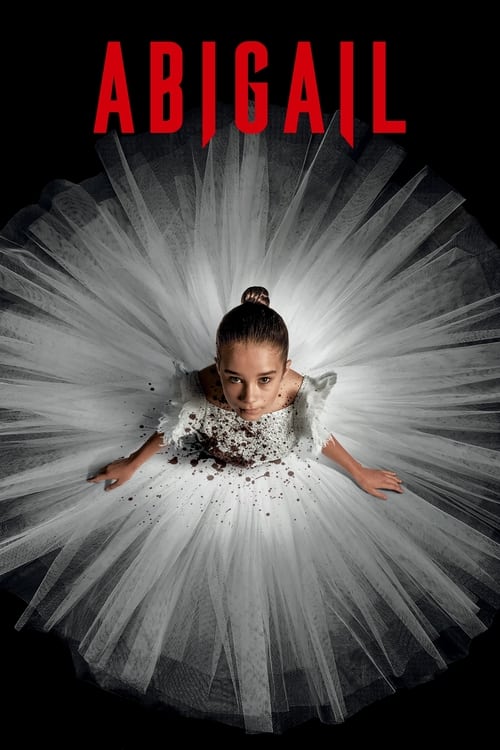
Abigail
2024 · Tyler Gillett
Ideal for a rowdy movie night when you want horror that's fun first — pizza, friends, and cheering at the carnage. A comfort watch for gorehounds, light on actual dread.
What it's about
A crew of hired criminals kidnaps the twelve-year-old ballerina daughter of a feared underworld boss and holes up in an isolated mansion to wait out one night until a $50 million ransom lands. The girl, it turns out, is nothing like an ordinary child — and the kidnappers slowly realize they're the ones who've been locked in with a predator.
The experience
A gory, fast-moving good time that flips from crime thriller to monster mayhem and never looks back — equal parts laughs, splatter, and ensemble bickering. It's gleefully excessive, with bodies that go off like water balloons full of red paint.
Performances
Alisha Weir is the whole show as Abigail, pirouetting between delicate hostage and centuries-old menace with unnerving ease, while the criminal ensemble — including Melissa Barrera and Kathryn Newton — keeps the banter crackling between kills.
The craft
Radio Silence's signature setup — one location, a bickering ensemble, a lurking threat — gets its purest workout here, with the gothic mansion shot for both elegance and chaos. The ballet motif pays off in genuinely inventive kill choreography, and the practical gore effects are extravagant enough to reward a crowd and good speakers.
Why it matters
It sharpened Radio Silence's reputation as the reliable house for crowd-pleasing ensemble horror-comedy and rode the 2020s wave of vampire movies that play the mythology for laughs as much as scares.
Snapshot
Abigail is a horror-comedy and a home-invasion story turned inside out. A crew of hired criminals kidnaps the twelve-year-old daughter of a powerful underworld figure. They take her to an isolated mansion to wait out a single night until a $50 million ransom is paid. Then they find they are locked in with something far more dangerous than they are. The girl, Abigail, is a centuries-old vampire, and the "job" was a trap set for her amusement.
Tyler Gillett co-directed the film with Matt Bettinelli-Olpin. They are two of the three members of the filmmaking collective Radio Silence and share directing credit on all their features. Guy Busick and Stephen Shields wrote the screenplay, and Universal Pictures released the film in April 2024. It is the clearest statement yet of the Radio Silence house style: a single location, an ensemble that dies off one by one, a sudden change of genre partway through, and a finale soaked in deliberately excessive gore. Critics generally welcomed it as a well-made and very funny genre piece. It earned a modest theatrical gross. Its place in film history is less as a turning point than as a well-defined example of mid-2020s studio horror and of a director team's signature approach.
Industry & production
The film began as part of Universal's long effort to revive its classic monster library. That effort stopped being a centralized shared universe after The Mummy (2017) and moved toward separate, mid-budget, filmmaker-driven projects. In the trade press, Abigail was first reported as a new take on Dracula's Daughter (1936), Universal's sequel to Tod Browning's Dracula. The finished film keeps only a loose thematic link to that source: a vampire daughter living in the shadow of a monstrous father. It contains no direct adaptation of the 1936 story.
Project X Entertainment produced the film, with producers including James Vanderbilt, William Sherak and Tripp Vinson, the team that had backed Radio Silence's Scream (2022) and Scream VI (2023). That gave the directors a working relationship already tested on a big franchise. Principal photography took place in Ireland, in and around Dublin, in 2023. Ireland's production incentives and its experienced crews had made it a common base for mid-budget American genre films.
The cast includes Angus Cloud, best known for HBO's Euphoria. He died in July 2023, before the film was released, and Abigail was dedicated to his memory. The reported production budget was in the high-$20-millions. Worldwide box office was reported at just over $40 million. That is a respectable result, though not a breakout, for an original R-rated horror-comedy without a franchise behind it. Universal's marketing showed the vampire twist openly in its trailers and posters, a choice reviewers discussed at length (see Reception).
Technology
Abigail was shot digitally, which is standard for a studio genre film of its size and period. The film's technical interest lies mainly in how it combines practical effects with digital enhancement for its gore. Radio Silence's signature image is a body that does not simply bleed but bursts: vampires killed in this film explode into large sprays of blood. The same idea ended Ready or Not (2019). These bursts were built from practical blood rigs on set, extended and multiplied digitally. Contemporary reports and interviews stressed the sheer volume of fake blood used on set, with performers repeatedly drenched. Specific quantities quoted in publicity should be read as promotional framing rather than verified record.
Abigail's vampire features are a prosthetic and digital hybrid: an extended, multi-row jaw of teeth, a pallid complexion when she feeds, and wire-assisted movement for her more acrobatic attacks. The ballet she performs is wired into these action scenes, so her fighting looks like choreography rather than brawling. The detailed breakdown of which effects were practical and which digital is documented mainly in promotional featurettes, not independent technical writing.
Technique
Cinematography
Aaron Morton shot the film. He had worked with Radio Silence before and was also the cinematographer on the Evil Dead Rise (2023). His camera presents the mansion as a decaying, gothic interior lit in warm amber pools and deep shadow. The look owes more to the classic Universal and Hammer monster tradition than to the cold, desaturated style common in contemporary horror. Moving camera work in the long corridors builds the sense of a maze. In the action scenes the framing stays wide enough for the audience to follow both the physical comedy and the gore, so the jokes and the violence read clearly.
Editing
Michael P. Shawver edited the film; he is another regular Radio Silence collaborator. The structure is built on a deliberate change of gear. The opening act is a tightly cut heist: the kidnapping happens in a brisk, almost wordless sequence set against a ballet performance. A slower stretch of waiting and character introduction follows, then an escalating series of set pieces. The editing places comic beats inside the moments of horror rather than alternating between the two modes. A gruesome discovery is often immediately undercut by a character's deadpan reaction, a rhythm Radio Silence developed in Ready or Not.
Mise-en-scène / staging
The mansion is the film's central organizing device. It is a sealed, gothic, many-roomed space whose locked doors and barred windows turn the kidnappers' safehouse into a cage. The production dresses it with taxidermy, antique furniture, a ballroom and cellars, using the iconography of the vampire's castle. Visually, the film plays the sleek modern crime genre (tactical clothing, burner phones, aliases) against an older gothic register, and the clash between the two is the source of its tension.
Abigail's ballet tutu and slippers are the defining costume elements. A stained white tutu becomes her signature image: innocence and violence in the same figure.
Sound
Brian Tyler composed the score. It mixes orchestral horror writing with propulsive action-thriller rhythms. The most striking feature of the soundtrack is its use of Tchaikovsky's Swan Lake, which frames the opening performance and returns as Abigail's motif. The ballet is a story of enchantment, a doubled identity and a cursed girl, which makes it a fitting counterpoint. Sound design emphasizes wet, visceral effects in the kills, and diegetic music plays ironically against the carnage, a common strategy in horror-comedy since the 1980s.
Performance
The ensemble is built around contrasting types. Melissa Barrera, a veteran of Radio Silence's Scream films, plays Joey, the crew's medic and its moral centre. She is a recovering addict and estranged mother whose bond with Abigail drives the emotional story. Dan Stevens plays Frank, the self-appointed leader, and moves from smooth menace into manic villainy; his performance continues the gleeful genre turns of The Guest (2014). Kathryn Newton plays Sammy, a hacker, and gives the film much of its comic energy. Kevin Durand plays Peter, a dim-witted muscleman, with physical comedy. William Catlett plays Rickles, a quiet former soldier, and Angus Cloud plays Dean, the getaway driver. Giancarlo Esposito plays Lambert, the fixer who assembles the crew, and his association with Breaking Bad's Gus Fring brings ready-made menace. Matthew Goode appears briefly as Abigail's father.
Alisha Weir, who starred in Roald Dahl's Matilda the Musical (2022), plays the title role and is the film's main showcase. She moves between a frightened child, a capricious playful predator, and an ancient being performing childhood. Her dance-trained movement carries much of that change. Her performance belongs to the line of "child who is not a child" roles, the most celebrated being Kirsten Dunst's Claudia in Interview with the Vampire (1994) and Lina Leandersson's Eli in Let the Right One In (2008).
Narrative & dramatic mode
The narrative follows a strict three-movement structure. First comes the heist: a clean, professional crime. Second is the waiting game. Lambert gives the crew Rat Pack aliases (Frank, Sammy, Dean, Peter, Joey, plus the comic Rickles) and tells them not to share personal details, and the plot plays as a closed-room thriller. Third is the reveal: crew members are killed, Abigail's nature is exposed, and the story becomes a survival horror in which the hunters are the hunted.
The dramatic mode is ironic and reversible. Every power relationship turns over. The captors become captives. The child becomes the oldest and strongest figure in the house. The crew's leader turns out to be the most treacherous. The film also reveals that each criminal was chosen because they had wronged Abigail's father in some way, which turns the setup into an "And Then There Were None" scenario of judgment. The ending moves away from pure nihilism toward a wary bond between Joey and Abigail, linked by their troubled relationships with their parents and children. It ends on a sardonic, open note rather than a tragic one.
Genre & cycle
Abigail belongs to several overlapping cycles. The most immediate is the genre-switch film, in which a crime thriller turns into a supernatural horror partway through. The model is From Dusk Till Dawn (1996), directed by Robert Rodriguez from Quentin Tarantino's script, which ambushed its audience with a similar heist-to-vampires shift. Abigail's marketing gave away this switch, changing its effect from shock to anticipation.
It also belongs to the one-location ensemble horror-comedy that flourished in the late 2010s and 2020s: Ready or Not, Bodies Bodies Bodies (2022), Barbarian (2022), and the "eat the rich" and "ensemble massacre" films of the same years. Finally, it is a vampire film from a period of renewed vampire activity in studio cinema. That activity included Universal's own Renfield (2023) and The Last Voyage of the Demeter (2023), was followed by Robert Eggers's Nosferatu (December 2024) and Ryan Coogler's Sinners (2025), and arrived after the long shadow of Twilight and True Blood. Among these, Abigail is the most openly comic and the most interested in the vampire as a mischievous figure rather than a tragic or erotic one.
Authorship & method
The film's authorship is collective. Radio Silence was formed by Matt Bettinelli-Olpin, Tyler Gillett and Chad Villella, who began making online videos in the late 2000s. They first gained genre attention with the "10/31/98" segment of V/H/S (2012) and the anthology Southbound (2015). The directing pair shares credit on every feature, and Villella has typically served as executive producer. Treating Gillett as sole author would misdescribe how the film was made.
Their recognizable method includes:
- Single-location setups that turn a domestic or familiar space into a place of ordeal.
- Ensemble casts stocked with comedic character actors.
- A female protagonist who survives through endurance, usually caught between her loyalties to a family.
- Gore escalated to the point of comedy, culminating in exploding bodies.
- A blend of horror and comedy that rarely undercuts the stakes.
Writer Guy Busick co-wrote Ready or Not (with R. Christopher Murphy) and both Radio Silence Scream films (with James Vanderbilt). His presence makes Abigail a continuation of a tight team. Stephen Shields is an Irish writer; his earlier credits are less widely documented, and accounts of how the work was divided between the two writers are thin in the public record. Cinematographer Aaron Morton, editor Michael P. Shawver and composer Brian Tyler complete a group of collaborators whose overlap with Radio Silence's other projects reinforces the films' house style.
Movement / national cinema
Abigail is an American studio production. It is not part of any national movement or critical "wave." Its Irish production base is an industrial fact, not an aesthetic one. Ireland supplied crews, locations and tax incentives, but the film does not engage with Irish cinema or settings in any meaningful way. The mansion is presented as a placeless gothic space. Its best context is the American "elevated" versus "fun" horror debate of the 2010s and 2020s. Radio Silence is strongly identified with the "fun" side, which values genre craft, humour and audience participation over the art-house tone of A24-associated horror.
Era / period
The film belongs to the post-pandemic recovery of theatrical horror, when mid-budget original genre films were among the few reliable non-franchise theatrical offerings. It was released after the 2023 Hollywood strikes had disrupted the production pipeline. Its reliance on a recognizable ensemble from prestige TV (Euphoria, Breaking Bad, Downton Abbey) and from Radio Silence's Scream films reflects the period's casting habits. Its Rat Pack aliases are an ironic nod to an older, cooler model of crime cinema, the Ocean's 11 tradition. The film sets that model up only to let it collapse into gothic horror.
Themes
- Parenthood and abandonment. The emotional core is a reflection on parents and children. Joey is a mother separated from her son. Abigail is a child who has lived for centuries in the shadow of a demanding father. The bond that forms between them, sceptical and transactional at first and finally genuine, gives the film its moral weight.
- Predation and power reversal. The film keeps asking who is hunting whom. The criminals see themselves as predators and turn out to be prey. Their leader sees himself as a hunter and becomes a monster himself. The film's moral world is predatory, but it permits limited forms of decency and solidarity.
- Performance and innocence. The ballet frames Abigail's whole identity as performance. Her childhood is a role played to manipulate adults, and Swan Lake's story of doubled identity fits the theme.
- Judgment and guilt. Because the crew was chosen to answer for past crimes against Abigail's father, the night becomes a kind of trial. This links the film to the "And Then There Were None" tradition of retribution in a closed space.
- Addiction and recovery. Joey's past as an addict, mirrored in the vampire's thirst, adds a slight but noticeable thematic thread about compulsion and control.
Reception, canon & influence
Critical reception. Reviews were mostly positive. Critics praised the energy of the ensemble, Alisha Weir's performance and the gleeful excess of the gore, while often finding the film a variation on Radio Silence's earlier work rather than a step forward. The most common reservation concerned the marketing: because trailers and posters revealed that Abigail is a vampire, the film's first half builds tension around a twist audiences already knew. Some critics argued that the film is better for it, since the dramatic irony makes the early scenes play as suspense rather than surprise. Others found the runtime somewhat long for the material. Its commercial performance was modest. It recovered its costs across theatrical and home-video windows, but it did not become a breakout comparable to Barbarian or M3GAN.
Influences on the film (backward). The clearest lines are:
- Dracula's Daughter (1936), the nominal starting point within Universal's monster library.
- From Dusk Till Dawn (1996), the template for the heist-to-vampires genre switch.
- Reservoir Dogs (1992), for the crew of criminals with code names in a confined space and the paranoia that grows among them.
- Agatha Christie's And Then There Were None and the closed-circle mystery tradition.
- Interview with the Vampire (1994) and Let the Right One In (2008), for the ancient child vampire.
- Orphan (2009), for the child who is not what she appears.
- Radio Silence's own Ready or Not, for its structure, its tone and its exploding-body finale.
Legacy (forward). It is too early to assess the film's long-term influence with confidence. Its clearest documented effect is consolidating the Radio Silence brand. By 2024 the team's films had become recognizable products with a predictable tone, and Abigail was widely received as confirmation of that identity. The directors next returned to Ready or Not for a sequel, Ready or Not 2: Here I Come, which reunited them with Busick and brought Kathryn Newton back into their company. In the broader cycle, Abigail sits at the comic end of a mid-2020s vampire revival whose more ambitious works, Nosferatu and Sinners, took the form in very different directions. Whether Abigail lasts as more than a well-made example of its moment will depend on later critical attention. That record is still being written.
Influences: the films it descends from and the films it influenced
- Dracula's Daughter (1936) — Abigail began as a Universal reboot of this film, and it keeps the figure of a vampire's daughter trying to break free of her father's legacy, which becomes the closing Abigail–Valentin power struggle.
- From Dusk Till Dawn (1996) — Its mid-film rug-pull, where a crime picture about professional criminals becomes a vampire siege, is the structural model Abigail uses for its heist-to-vampire turn.
- Reservoir Dogs (1992) — A crew of strangers given alias names waits in a single holding space, and suspicion about an informer breaks them apart. Abigail's rat-pack aliases and its 'who's the rat' first act come straight from this setup.
- And Then There Were None (1945) — Guilty strangers are gathered in a sealed house by an unseen host and killed off one by one. Abigail's mansion-as-tribunal structure, where the crew discovers they have been chosen for judgment, follows this closed-circle model.
- Interview with the Vampire (1994) — Kirsten Dunst's Claudia set the performance template of a centuries-old adult mind behind a child's face, and Alisha Weir's register shifts between little girl and ancient predator are built on it.
- Let the Right One In (2008) — Eli is the child vampire who mixes intimacy and slaughter and is filmed in eerie stillness before bursts of violence. Abigail's quieter manipulation scenes with Joey follow that alternation.
- Orphan (2009) — Its reveal that the child is really an adult predator, and the performance that plays to the audience over the other characters' heads, are what Abigail's dramatic irony relies on, since its marketing gave away the twist.
- Suspiria (1977) — It links ballet training to supernatural horror and ornate gothic interiors, and Abigail's ballerina killer, dance-studio prologue and saturated mansion design draw on that association.
- Black Swan (2010) — It uses Swan Lake as a body-horror leitmotif, turning Tchaikovsky's score and a dancer's movement vocabulary into signs of monstrous transformation, as Abigail does with its pirouetting kills.
- The Evil Dead II (1987) — Raimi's slapstick gore, with practical fluid volumes pushed until they become physical comedy, is the source of Radio Silence's comic beats inside horror and its geysers of blood.
- Ready or Not (2019) — The team's own template: a single mansion as a deathtrap, a dark comic ensemble, a heroine who survives by endurance, and a finale of literally exploding bodies, which Abigail repeats with practical and digital blood bursts.
- Southbound (2015) — Radio Silence's 'The Way Out' bookends showed early on the collective's interest in criminals punished by a supernatural power that has trapped them in a space they cannot leave.
- Ready or Not 2: Here I Come (2026) — Radio Silence's follow-up reunites Busick and Kathryn Newton and carries forward Abigail's tuned balance of ensemble comedy and gore along with its exploding-body payoff.
- Scream VI (2023) — It shares writer Guy Busick, editor Michael P. Shawver and composer Brian Tyler, and it stages kills in confined, set-piece interiors with the same mix of comic aside and brutal practical effects.
- M3GAN (2022) — Another child-sized killer whose violence is choreographed as dance. Its viral hallway-dance kill parallels Abigail's ballet-trained stunt choreography for a small body overpowering adults.
- Sinners (2025) — A mid-2020s vampire film that makes the same genre switch, where a crime-and-business story becomes a single-location vampire siege at dusk, which places both films in the From Dusk Till Dawn line.
Similar films
- Ready or Not (2019) — influence & lineage
- Scream VI (2023) — influence & lineage
- Evil Dead Burn (2026) — shared sensibility
- Lisa Frankenstein (2024) — shared sensibility
- The Ugly Stepsister (2025) — shared sensibility
- Barbarian (2022) — shared sensibility
- When Evil Lurks (2023) — shared sensibility
- Strange Darling (2024) — shared sensibility