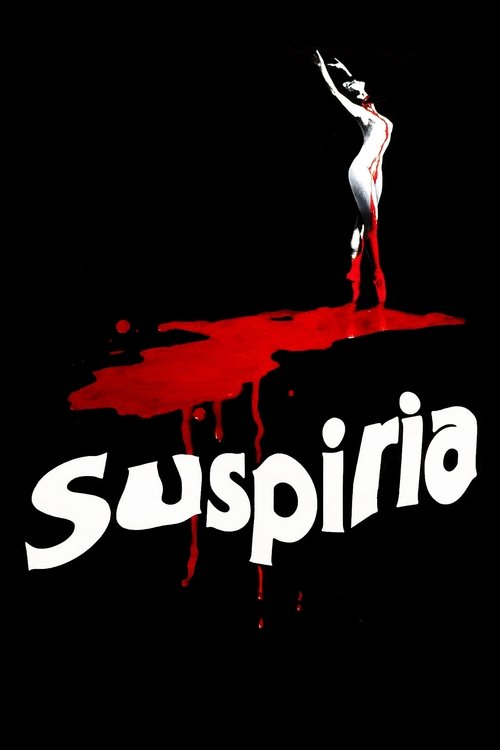
Suspiria
1977 · Dario Argento
For when you're craving a real scare with style to burn — a lights-off, sound-up horror night where atmosphere matters more than plot. It's an intense sensory ride, closer to a haunted-house dream than to slasher realism.
What it's about
Suzy, a young American dancer, arrives at a prestigious German ballet academy on a night of torrential rain, just as another student flees the building in terror. Grisly deaths follow, the staff behave with smiling strangeness, and Suzy begins to sense the school is a front for something ancient and malevolent. The plot is nursery-tale simple on purpose — an innocent walking deeper into a beautiful, wicked house.
The experience
Less watched than absorbed: screaming reds and blues, a score that whispers and pounds at you, deaths staged like horrible ballets. It's frightening in a feverish, irrational way — the logic of a nightmare rather than a mystery — and it leaves the colors ringing in your head for days.
Performances
Jessica Harper anchors the delirium with a wide-eyed, delicate presence that makes the surrounding menace feel even more predatory.
The craft
One of the most gorgeous horror films ever made: saturated candy-poison colors, sets like wicked storybook illustrations, and a legendary prog-rock score by Goblin that hisses, chants, and thunders. It absolutely demands the biggest screen and loudest speakers you can manage — the sound alone does half the frightening.
Why it matters
A landmark that pushed horror away from rational mystery toward pure sensory delirium, influencing generations of style-forward filmmakers and eventually inspiring a high-profile modern remake.
Snapshot
Suspiria is the film in which Dario Argento abandoned the rational scaffolding of the giallo and stepped fully into the irrational. An American ballet student, Suzy Bannion, arrives at the Tanz Akademie in Freiburg on a storm-lashed night, just as a terrified girl flees into the woods to be spectacularly murdered. What follows is less a mystery than a descent: the academy is revealed as the hiding place of a witches' coven presided over by an ancient sorceress, the "Mother of Sighs." Argento and co-writer Daria Nicolodi drew the conceit from Thomas De Quincey's prose-poem cycle Suspiria de Profundis, and the film became the first panel of what Argento would later complete as the "Three Mothers" trilogy. Its reputation rests not on plot — which is deliberately thin, dreamlike, almost nursery-simple — but on a total sensory assault: hallucinatory Technicolor reds and blues, baroque set-piece killings, and a relentless prog-rock score by Goblin. It is among the most influential horror films ever made and a touchstone for the idea that horror can operate as pure aesthetic delirium rather than as suspense.
Industry & production
Suspiria was produced by Seda Spettacoli, the family firm through which Argento and his father Salvatore worked, and it arrived after Argento had established himself with the international success of The Bird with the Crystal Plumage (1970) and Deep Red (1975). It was a comparatively well-resourced Italian genre production of its moment, conceived for export, and shot largely in West Germany — the academy exteriors at the Haus zum Walfisch in Freiburg, with additional German locations, and interiors constructed on soundstages (the studio work is generally placed at Bavaria Studios in Munich, with post-production in Rome).
The film was made in the standard Italian fashion of the era: shot without live sync sound, with international cast members performing in their own languages and the whole post-synchronized, so that the "original" language is itself a construction. Casting reflected a canny commercial and cinephile instinct — Argento surrounded the young American lead with faded Hollywood and European prestige, lending the academy an aura of decayed grandeur. The production's most consequential industrial decision was photochemical: Suspiria was processed using Technicolor's dye-transfer (imbibition) printing, and it is frequently cited as one of the last European films to use that process before the relevant facilities were retired — a fact that is central to why the film looks the way it does and why its color has been so difficult to reproduce in later video and digital transfers.
Technology
The film's technological signature is its color. Argento and cinematographer Luciano Tovoli set out to evoke the saturated, unreal palette of early three-strip Technicolor — Tovoli has repeatedly cited Disney's Snow White and the Seven Dwarfs as a reference — at a time when contemporary cinema had moved toward naturalistic, lower-saturation stocks. To get there they worked the image at every stage: heavily gelled lighting in primary hues, colored fabrics and stained glass built into the sets, and a dye-transfer release print that could hold dense, unbroken fields of red, green, and blue without muddying. The result is color used as light rather than as description — walls and faces washed in chromatic gels that have no naturalistic source.
The other technological pillar is the sound recording and the score's production, treated below under Sound and Authorship. Together, the dye-transfer color pipeline and the pre-composed, on-set musical playback make Suspiria a film whose "effects" are not optical tricks but a coordinated manipulation of the basic technologies of image and sound.
Technique
Cinematography
Tovoli's photography is the film's most analyzed element. Beyond the Technicolor-inspired palette, his camera is mobile and intrusive — gliding through the academy's art-nouveau corridors, craning over the famous double murder, prowling in ways that detach the camera's perspective from any single character. Light sources are frankly impossible: a corridor bathed in red bleeding into an adjacent blue, faces lit from below or from off-screen colored panels. Tovoli and Argento were after a fairy-tale unreality, and the lighting design refuses the logic of motivated, realistic illumination at almost every turn. The framing favors symmetry, ornamental detail, and architecture that dwarfs the human figures, so that the building itself reads as a malign organism. The opening sequence — the airport, the rain, the taxi, and the first killing — is a sustained demonstration of how composition, color, and camera movement can manufacture dread in advance of any actual threat.
Editing
Franco Fraticelli, Argento's regular editor, cuts the film for shock and for rhythm rather than for continuity in the classical sense. The murder set pieces are assembled as crescendos — accelerating inserts of detail (a beating heart, a blade, breaking glass) timed to the music — while the connective scenes are often becalmed and stately by contrast. This oscillation between languor and frenzy is part of the film's dream structure: narrative information is doled out sparingly and the cutting frequently privileges sensation over clarity, lingering on texture and color where a more conventional thriller would cut for explanation.
Mise-en-scène / staging
The production design — ornate art-nouveau and Bavarian-baroque interiors, stained glass, patterned wallpaper, deep saturated surfaces — is the stage on which everything else performs. A widely repeated account, originating with Argento, holds that he initially conceived the students as much younger girls and, when forced to age the characters up to young women, retained design choices meant to suggest a child's scale and a fairy-tale logic — including door handles placed unusually high. Whether or not every such detail is verifiable, the intent is legible on screen: rooms feel slightly oversized, thresholds slightly wrong, the world tilted toward the menacing storybook. Staging tends toward the tableau, with figures arranged against decorative backgrounds, and the set pieces — the stained-glass ceiling collapse, the room of coiled razor wire, the maggot infestation — are choreographed as self-contained spectacles.
Sound
Sound in Suspiria is inseparable from the Goblin score and is arguably the film's true subject. The music — driven by bouzouki, tabla, Moog synthesizer, bells, and a layer of hissed, whispered vocals (the breathy "witch") — was largely composed before and during shooting and, by the band's and Argento's accounts, played loudly on set to pitch the actors' performances and to fuse image and sound at the level of conception rather than as a later overlay. The mix pushes the score to the foreground until it ceases to function as accompaniment and becomes an active aggressor, frequently louder and more present than dialogue. Argento exploits the post-synchronized Italian sound tradition to denaturalize the entire audio field: footsteps, breathing, and ambient noise are stylized rather than realistic, deepening the sense that we are inside a nightmare rather than observing a place.
Performance
The performances are calibrated to the film's anti-naturalism. Jessica Harper, cast as Suzy on the strength of her work in Brian De Palma's Phantom of the Paradise, plays the newcomer with a wide-eyed, slightly affectless watchfulness that suits a protagonist who is essentially a figure moving through a hostile dream. Around her, Argento deploys veterans for iconic weight: Joan Bennett — a Hollywood star of the 1930s–40s and a Fritz Lang collaborator — as the imperious Madame Blanc, and Alida Valli (The Third Man, Senso) as the severe instructor Miss Tanner, whose brittle, theatrical menace is one of the film's pleasures. Udo Kier appears as a psychiatrist in the expository mid-film passage. Because the film is post-dubbed, "performance" here is a composite of body and a separately recorded voice, which contributes to the uncanny, marionette quality many viewers register.
Narrative & dramatic mode
Suspiria's narrative is famously, intentionally slight. Its dramatic mode is closer to fairy tale or nightmare than to the investigative thriller: a young woman enters an enclosed, enchanted institution, senses wrongness, and gradually uncovers a supernatural secret before a climactic confrontation. Argento strips psychological interiority and naturalistic motivation almost entirely; characters exist to be threatened, to deliver a fragment of exposition, or to die. The mid-film "explanation" scenes — occult lore relayed by experts — function less as detective-story clue-gathering than as incantation, ritual recitations that move the heroine toward the final reckoning. This is the decisive break from Argento's earlier giallo work, where a rational solution and a repressed-memory mechanism ultimately anchored the violence. Here causality is magical, and the film asks to be experienced rather than solved.
Genre & cycle
The film sits at a hinge in horror history. Argento built his name on the giallo — the Italian thriller subgenre of black-gloved killers, stylish murders, and amateur-sleuth investigation — and Suspiria carries over the giallo's set-piece violence and visual flamboyance while jettisoning its rationalism for outright supernatural horror. It thereby helped open a vein of occult, witchcraft-centered European horror. Within Argento's own work it inaugurated the "Three Mothers" cycle, continued in Inferno (1980) and completed, much later and to far weaker reception, in Mother of Tears (2007). More broadly it belongs to the international 1970s wave of stylized supernatural horror, sitting alongside the period's preoccupation with covens, the demonic, and institutions harboring evil, while remaining sui generis in its commitment to spectacle over story.
Authorship & method
Suspiria is a strong case for collaborative authorship organized around a singular directorial vision. Dario Argento is the controlling sensibility — the architect of the film's color, violence, and dream logic — but several collaborators are constitutive rather than incidental. Daria Nicolodi, Argento's partner and co-writer, is credited with shaping the story; she has said it drew on a family tale of a relative's encounter with a school of black magic, and she pointed Argento toward De Quincey's "Mothers." The degree of her authorship has at times been contested in subsequent accounts, and the honest position is that her contribution to the concept was substantial and central. Luciano Tovoli translated Argento's color ambitions into a coherent photographic system. Franco Fraticelli shaped the rhythm. Giuseppe Bassan's production design built the world. And Goblin — Claudio Simonetti, Massimo Morante, Fabio Pignatelli, and Agostino Marangolo — supplied a score so integral that it is hard to imagine the film as a silent object. Argento's method, by repeated account, was to compose the film's sensory totality up front — designing kills as spectacles, having the music written early and played on set — so that meaning emerged from sound, color, and movement rather than from script.
Movement / national cinema
The film is a product of Italian popular cinema's golden age of genre filmmaking, the same robust commercial-artisanal system that produced spaghetti westerns, poliziotteschi, and the giallo. Its most important domestic ancestor is Mario Bava, whose gothic chillers and color-drenched thrillers (Black Sunday, Blood and Black Lace, Kill, Baby... Kill!) established the Italian template of style-forward horror in which atmosphere and visual design outrank narrative coherence. Suspiria also reaches back to German Expressionism — the warped architecture and chiaroscuro lineage of The Cabinet of Dr. Caligari and Murnau — appropriately, given its German setting and its old-world fairy-tale sources. The film thus stands at a confluence: Italian genre craft, German Expressionist inheritance, and the broader European art-horror impulse to treat the screen as a space of subjective derangement.
Era / period
Made and released in 1977, Suspiria belongs to a fertile, transitional moment for horror. The genre internationally was moving between the literary-occult prestige horror of the early 1970s and the slasher cycle that would dominate the following years. Within Italy, the dye-transfer Technicolor process that defines the film's look was already obsolescent, which lends Suspiria the quality of a last flowering — a film that uses a dying technology at the peak of its expressive possibility. It also captures a specific late-1970s European genre confidence: ambitious, export-minded, and willing to subordinate storytelling to a unified aesthetic program in a way that mainstream Hollywood of the period generally would not.
Themes
Beneath its spectacle, Suspiria circulates a consistent set of preoccupations. Foremost is the fairy tale turned malign: an innocent young woman crosses into an enchanted house ruled by a wicked matriarch, and the film mines the Grimm-and-Disney substrate of childhood fear — abandonment, the untrustworthy adult institution, the body in danger. Allied to this is a thematics of female power and the coven: authority in the academy is female, ancient, and monstrous, and the film stages a confrontation between a young woman and a gerontocracy of witches that critics have read variously as misogynist nightmare and as a coded fascination with female potency; the text supports more than one reading and resolves none. There is also a strong current of institutional rot — the prestigious school as a façade over predation — and a pervasive sense that perception itself is unreliable, that color and sound conspire to make the world unreadable. The film is finally about sensation as meaning: it argues, through its form, that dread is an aesthetic state.
Reception, canon & influence
Early reception was divided and shaped by the film's violence; like much Argento, it circulated internationally in variously censored forms and was received in some quarters as a notorious shocker rather than as art. Over the following decades its standing rose dramatically, and it is now widely enshrined as one of the central horror films of its era and a canonical example of horror-as-pure-style. Detailed contemporaneous box-office figures are not something I can state reliably here, and I won't invent them; the more secure historical claim is the trajectory from genre notoriety to critical canonization.
Influences on the film (backward): Thomas De Quincey's Suspiria de Profundis supplied the title and the "Mothers" mythology; Daria Nicolodi's family lore supplied the story's seed; Mario Bava's color-gothic Italian horror supplied the stylistic license; German Expressionism supplied the architecture of unease; and Disney's Snow White, with the broader Grimm fairy-tale tradition, supplied the palette and the storybook menace. Argento's own giallo filmography is the immediate background against which Suspiria defines itself by departure.
Legacy (forward): Suspiria's DNA is visible across later stylized horror. Its conviction that saturated color and an aggressive score can carry a film has informed directors such as Hélène Cattet and Bruno Forzani (Amer), Peter Strickland (Berberian Sound Studio, an explicit homage to Italian genre sound), Nicolas Winding Refn (The Neon Demon), and Panos Cosmatos, while Goblin's score helped legitimize the prog-and-synth horror soundtrack as an art form in its own right and prefigured the synthesizer-horror revival of recent decades. Luca Guadagnino's 2018 Suspiria reimagined the material in a deliberately anti-Argento register — muted color, expanded politics, a Thom Yorke score — a tribute by inversion that testifies to the original's stature. More diffusely, Suspiria is the proof-of-concept most often cited for the proposition that horror can be a fundamentally aesthetic, even abstract, mode — a film experienced as a fever rather than followed as a story.
A Deleuzian reading
The airport's automatic doors hiss open and Suzy Bannion steps into a wall of rain and red.
The full Deleuzian reading of Suspiria →
Reception
Dismissed by many English-language critics in 1977 as gorgeous nonsense — all style, no story — Suspiria has been fully canonized since, now routinely ranked among the greatest horror films ever made and treated as the definitive proof that style IS substance.
How Suspiria was received, from release to now →
Influences: the films it descends from and the films it influenced
- Snow White and the Seven Dwarfs (1937) — Argento and Tovoli explicitly keyed Suspiria's storybook color-blocking — flat fields of jewel-toned red, blue, and green washing whole rooms — to Disney's Technicolor fairy-tale palette, treating the witches' academy as a Grimm illustration.
- The Red Shoes (1948) — Provides the model of dye-transfer Technicolor as expressionist sensation in a fairy-tale-of-the-arts horror, where saturated color and a heightened score override naturalism to render a young woman's destruction as ravishing spectacle.
- The Cabinet of Dr. Caligari (1920) — Suspiria inherits its 'architecture of unease' from German Expressionism — painted, geometrically aggressive Art-Nouveau sets that externalize derangement, so the building itself menaces the heroine rather than any realistic space.
- Blood and Black Lace (1964) — Bava's color-gothic giallo licensed Argento's unmotivated colored-gel lighting and the conception of each murder as a designed set-piece spectacle staged for chromatic beauty rather than plot function.
- Kill, Baby... Kill! (1966) — Pioneers the supernatural color-gothic where green and amber light have no diegetic source and a ghostly girl haunts decaying Art-Nouveau interiors — the unmotivated-color, dream-logic template Suspiria amplifies.
- The Bird with the Crystal Plumage (1970) — Argento's own debut establishes the prowling, subjective stalking camera and the trapped-female-witness structure that Suspiria carries over while abandoning the giallo's rational whodunit.
- Deep Red (1975) — The immediate predecessor: Argento's first collaboration with Goblin, whose prog-rock score-as-aggressor and the mobile, gliding camera over fetishized objects are refined into Suspiria's wall-to-wall sensory assault.
- Black Narcissus (1947) — Luciano Tovoli shot on genuine three-strip Technicolor — one of the format's last uses — specifically to emulate Black Narcissus's expressionist saturation; female institutional Gothic space becomes psychological horror through the same principle of color-as-affect rather than color-as-description.
- Juliet of the Spirits (1965) — Luciano Tovoli's supersaturated color design — crimson and emerald pushed to abstraction — directly inherits Juliet's total production design logic, transposing it into genre horror while preserving its function as spatial psychological destabilization.
- Morgiana (1972) — Inherits the art-nouveau-into-horror aesthetic: fairy-tale color gels, ornate villa architecture as threat, and subjective camera untethered from realism.
- Inferno (1980) — The direct sequel in the Three Mothers trilogy, extending Suspiria's primary-color-gel lighting and music-driven, anti-naturalist set-piece deaths to an even more dissolved, story-as-pretext structure.
- Amer (2009) — A near-dialogue-free reconstruction of Argento/Bava grammar — saturated gel lighting, extreme macro fetish cutting, and post-synchronized denaturalized sound — turning Suspiria's surface technique into the film's entire subject.
- Berberian Sound Studio (2012) — An explicit homage to Italian-genre post-production sound, dramatizing exactly the post-synchronized, denaturalized Foley-and-scream process that gives Suspiria its marionette-like dubbed unreality.
- Beyond the Black Rainbow (2010) — Builds an entire film from Suspiria's proof-of-concept — a wordless mood of throbbing analog-synth score and monochrome-saturated light, horror experienced as a fever-state rather than a plot.
- The Neon Demon (2016) — Refn transplants Suspiria's witchy female-coven horror into fashion, reusing unmotivated saturated color washes and a pulsing electronic score-as-aggressor that carries the film where dialogue and story recede.
- Mandy (2018) — Extends Argento's red-drenched unmotivated lighting and music-first construction into a hallucinatory revenge fever-dream, the image deliberately abstracted into pure saturated color as emotional weather.
- Suspiria (2018) — A tribute-by-inversion that proves the original's craft by negating it — muted desaturated palette, naturalistic sound, and a Thom Yorke score — defining itself against Argento's saturated-color, score-as-aggressor method exactly as Argento defined Suspiria against the giallo.
- Black Swan (2010) — Horror organized around a dance academy where female bodies undergo occult transformation, using chromatic saturation — deep reds bleeding into shadow — to signal psychic rupture as spatial contamination; the chromatic deterioration device (Nina's world desaturating except for red and black) is Aronofsky's inheritance of Argento's color grammar.
- Only God Forgives (2013) — The saturation of interior space with primary-color artificial light — red corridors as psychological rather than naturalistic description, color functioning as emotional atmosphere rather than environmental realism — is the immediate color grammar; Refn and Smith explicitly reproduced and intensified Argento's palette in Bangkok's red-lit spaces.
- The Substance (2024) — Primary-color chromatic saturation — red, blue, green — deployed as a systematic emotional-register coding rather than naturalistic choice, treating the production palette as a formal language; extreme Foley amplification of bodily sounds as a horror instrument in its own right.
- Petrov's Flu (2021) — Giallo-horror's irrational, supernaturally-charged set-pieces supply the genre grammar behind Petrov's eruptions of fevered horror logic.
- Midsommar (2019) — Supplies the saturated-color total-environment as worldview — a coven whose architecture and palette are the threat — and a score (Goblin) that seduces rather than warns, anticipating Krlic's disorienting beauty.
- Phenomena (1985) — Continues Suspiria's young-girl-at-a-sinister-boarding-school premise scored by Goblin/Simonetti, with the score deployed as a hyperactive aggressor over dream-logic horror set-pieces.
- Hausu (1977) — A parallel 1977 experiment in fairy-tale horror as pure aesthetic delirium — schoolgirls devoured in a haunted house rendered through candy-colored anti-naturalism and collage-like shock montage rather than narrative logic.
- The Ice Tower (2025) — Fairy-tale horror staged as symmetrical friezes of artificed décor, with the dance/performance academy as an enclosed institution governing young women's bodies.
- The Shining (1980) — Built terror from saturated symbolic color and architecture-as-trap with abrasive modernist sound, the same 'horror as formal design' impulse running parallel to Kubrick's Overlook.
- Carrie (1976) — A contemporaneous experiment in horror as virtuoso formal exercise, matching Carrie's expressionist saturated lighting and operatic prog-rock score deployed as emotional excess over a young woman's ordeal.
- The Cook, the Thief, His Wife & Her Lover (1989) — Uses practical saturated primary-color lighting as architecture, treating each room as a chromatic stage set — the same painterly-horror approach to color design.
- Santa Sangre (1989) — Shares the giallo-horror palette of saturated, unmotivated primary-color lighting — pooled deep reds and blues as expressionist emotional weather — that Daniele Nannuzzi's photography deploys across Santa Sangre's interiors.
- Titus (1999) — Luciano Tovoli's own precedent: hyper-saturated color and architecture deployed as engulfing, oppressive force around the figure — the widescreen-space-as-threat cinematography he brings to Titus.
- House (1977) — Same-year twin using fairy-tale gel color (primary-red and blue washes) and a wall-of-sound prog score to turn a girls'-school horror into a lurid design object.
- Crimson Peak (2015) — Extends Bava's symbolic gel color into hyper-saturated primary lighting as emotional architecture, the parallel branch of the same Italian-Gothic color lineage Laustsen draws on.
Similar films
- Blood and Black Lace (1964) — influence & lineage · often watched together
- The Red Shoes (1948) — influence & lineage · same viewing thread · often watched together
- Suspiria (2018) — influence & lineage
- Deep Red (1975) — influence & lineage
- The Bird with the Crystal Plumage (1970) — influence & lineage
- The Conformist (1971) — often watched together
- The Cabinet of Dr. Caligari (1920) — influence & lineage · often watched together
- Mandy (2018) — influence & lineage · often watched together
All the films related to Suspiria →
Watch it with: curated runs of related films
- Drunk on Design — Watch these together for the rush of maximalist, color-drenched cinema where a woman is made, remade, or consumed by an art form — ballet, fashion, gothic desire — and the production design does half the storytelling.