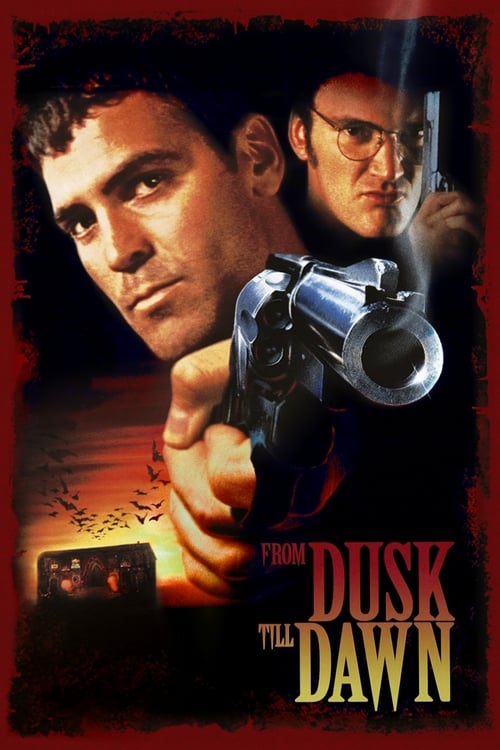
From Dusk Till Dawn
1996 · Robert Rodriguez
For a late night with friends and zero pretensions — when you want pulp, gore, and a movie that audibly does not care about good taste. Pure grindhouse party viewing.
What it's about
Two bank-robbing brothers — one coolly professional, one dangerously unhinged — take a lapsed preacher and his two kids hostage and run for the Mexican border. The plan is to lie low until morning at a remote desert roadhouse. The bar's clientele turns out to be a much bigger problem than the law, and the night collapses into an all-out fight for survival against creatures straight out of legend.
The experience
A movie famous for changing its mind halfway through: the first half is a tense, nasty fugitive thriller, and then it gleefully rips off the mask and becomes a gonzo vampire siege full of splatter, slapstick, and improvised weaponry. It's crude, funny, and relentless — a drive-in double feature crammed into one film.
Performances
George Clooney, in his first major film lead, is all coiled movie-star confidence as the saner brother, while Quentin Tarantino makes his skin crawl as the unstable one; Harvey Keitel gives the mayhem unexpected weight as a preacher wrestling with his faith.
The craft
Written by Tarantino and directed by Robert Rodriguez at full early-career velocity, it pairs crackling hostage-thriller dialogue with a second half built on practical creature effects and gallons of latex. The genre handbrake-turn is executed with total commitment — the swerve is the design, not an accident.
Why it matters
A cult landmark of the nineties Tarantino–Rodriguez axis, it became the reference point for films that switch genres mid-stream and later spawned its own television series.
Snapshot
A crime picture that gets eaten alive by a horror picture. For roughly its first fifty minutes, From Dusk Till Dawn is a lean, mean fugitive thriller: two bank-robbing brothers, a hostage family, a run for the Mexican border. Then the survivors reach a roadhouse called the Titty Twister, and the film's genre floor gives way. The strippers are vampires, the bar is built on an Aztec pyramid, and the remaining forty minutes are a siege splatter comedy in the Romero–Raimi line, staged with slapstick invention and gallons of latex.
The swerve is the point. Written by Quentin Tarantino from a story by makeup-effects artist Robert Kurtzman, directed by Robert Rodriguez at the peak of his early velocity, and released by Dimension Films in January 1996, the film compresses an all-night drive-in double bill into a single ninety-eight-minute program. Its title is a horror-host phrase — the dusk-to-dawn marathon — and its structure is that marathon's structure: feature one, then feature two, no intermission. It also made George Clooney a movie star, gave Salma Hayek her most indelible American image, and became the connective tissue between Rodriguez and Tarantino that would run through Kill Bill to Grindhouse.
Industry & production
The project's origins sit outside both credited authors. Robert Kurtzman, a founding partner of the makeup house KNB EFX Group, developed the story as a vehicle for his company's creature work and hired the then-unknown Tarantino to write the screenplay — reportedly for a nominal fee, in the period around Reservoir Dogs, on which KNB provided effects. The script sat while Tarantino became Tarantino. By 1995, with Pulp Fiction having reordered the independent landscape, the property was suddenly worth making.
Rodriguez was the natural director because the two men had already fallen in together: they met on the 1992 festival circuit, when El Mariachi and Reservoir Dogs were both breaking, and had just collaborated on the anthology Four Rooms (1995). Rodriguez arrived with Desperado (1995) freshly released and a reputation — cemented by his book Rebel Without a Crew — as the fastest, cheapest competent filmmaker in America.
The film was produced through Lawrence Bender's orbit and released by Dimension, the genre arm Bob Weinstein ran under the Miramax umbrella. This matters: 1996 was Dimension's consolidation year, bookended by From Dusk Till Dawn in January and Wes Craven's Scream in December. Between them, the label established a house identity — horror made with above-average craft, marketed on knowingness — that defined studio genre filmmaking for the rest of the decade.
The budget was modest by mid-nineties studio standards (reported at roughly $19 million), and the theatrical return was respectable rather than spectacular, with the film's real commercial life arriving on video and cable, where it became a fixture. Production was centered in California, with desert exteriors standing in for the border country and the Titty Twister built as a purpose-designed set — a controlled environment the second half needed, since it had to be systematically destroyed.
The casting is a study in leverage. Clooney was two seasons into ER and had never carried a feature; the role of Seth Gecko was a bet on television heat converting to the big screen, and it paid off completely. Around him Rodriguez assembled a genre-historical roll call: Harvey Keitel, Juliette Lewis, Tarantino himself as the brother Richie, Cheech Marin in three separate parts, Danny Trejo, Michael Parks, Salma Hayek, and — as walking citations — Tom Savini, Fred Williamson, and John Saxon.
Technology
The film sits on a hinge in production technology, and Rodriguez was standing on both sides of it. The creature work is overwhelmingly practical: KNB's prosthetics, animatronics, appliance makeups, pumped blood, and mechanical rigs, with digital tools used sparingly to assist transformations and clean up composites rather than to generate performances. This was the last moment when a mid-budget horror film could plausibly choose latex over pixels and gain something by it — the vampires have weight, they occupy the same light as the actors, and the gore behaves like matter.
Rodriguez's own technological signature is on the post side. He cut the film himself on nonlinear systems at a time when many directors still delegated, and his self-taught, multi-hyphenate practice — the "one-man film crew" ethos formalized in Rebel Without a Crew — depended on digital editing to make speed possible. From Dusk Till Dawn is effectively his last major film made wholly inside the photochemical paradigm; within a few years he would become Hollywood's loudest evangelist for digital acquisition, shooting Once Upon a Time in Mexico (2003) on high-definition video and building Sin City (2005) almost entirely on green screen. The practical carnage here reads, in retrospect, as a farewell.
Technique
Cinematography
Guillermo Navarro's photography does the structural work the script implies. The first half is arid and legible — hard desert sun, wide flat compositions, a palette of dust and chrome that recalls the Southwest thriller tradition more than horror. Interiors like the liquor store are staged in relatively long, patient takes that let dread accumulate in the frame rather than in the cutting.
Once the film crosses into the Titty Twister, Navarro switches registers: saturated reds and sick greens, hard sidelight, smoke, neon, the deep shadows of a Universal or Hammer picture retrofitted with cantina color. The camera becomes mobile and aggressive, whip-panning with the violence. Navarro's presence is also a bridge to another cinema entirely — he had shot Guillermo del Toro's Cronos (1993), would shoot Tarantino's Jackie Brown (1997), and would later win an Academy Award for Pan's Labyrinth — and the film's fluency with Mexican gothic iconography is partly his.
Editing
Rodriguez edits his own films, and his cutting here is best described as comic-book grammar: emphatic close-ups on objects and eyes in the Leone manner, quick punch-ins, in-camera and optical wipes, and a willingness to cut on impact for percussive effect. The first half is patient by his standards; the second half is a machine-gun. The single most consequential edit in the film is the one that isn't marked at all — the transition into the bar is not signposted as a genre shift, which is precisely why the reveal lands as a rupture rather than a twist.
Mise-en-scène / staging
The Titty Twister is one of the great single-location designs of nineties genre cinema, and the film's spatial logic is built around a slow revelation of what it is. It begins as a sleazy but comprehensible roadhouse; it becomes a killing floor; and in the final crane shot it is revealed as the exposed tip of a Mesoamerican pyramid, ringed by a canyon of wrecked cars — decades of victims, unremarked. The trap was always older than the travelers.
The siege staging is Romero and Carpenter by way of Chuck Jones. Weapons are improvised from set dressing and body parts: a pneumatic drill becomes a stake, a condom becomes a holy-water balloon, a shotgun is strapped to a crotch. Cecilia Montiel's production design keeps the space readable enough that the audience always knows where the doors, the stage, and the bar are — a prerequisite for siege comedy, which depends on geography.
Sound
The film's most important sonic decision is to make its score largely diegetic. Tito & Tarantula, the Chicano rock band led by Tito Larriva, appear onscreen as the house band, and their music — "After Dark" scoring Hayek's snake dance chief among it — functions as the bar's own nervous system. Around this, the soundtrack works as a curated pulp jukebox: the Blasters' "Dark Night" under the opening, ZZ Top's "She's Just Killing Me," a run of roots-rock and border blues. Graeme Revell, an industrial musician turned genre composer whose The Crow had been a 1994 landmark, supplies the orchestral and textural underscore for the horror half, where the source music finally stops.
The sound design of the vampire attacks favors wet, tactile detail — tearing, snapping, spraying — consistent with the practical effects. When the film wants comedy, it lets the sound go cartoonish; when it wants a shock, it goes silent first.
Performance
Clooney's Seth Gecko is a genuinely constructed star performance: competence as charisma, an ex-con's economy of movement, and a running tension between professional calm and lethal impatience. He plays the second half straight, which is what allows the absurdity around him to be funny.
Keitel, cast hard against his own iconography, plays Jacob Fuller as a pastor whose faith has been hollowed out by grief, and his arc — from a man who cannot pray to a man who kills with prayer — is the film's only real interior journey. Tarantino's Richie is the most divisive element: a deliberately repellent, whining psychosexual wreck, effective as a threat, uneven as acting. Juliette Lewis moves Kate from frightened passenger to competent survivor without ever quite becoming an action heroine. Hayek's Santanico Pandemonium is almost wordless and entirely iconographic — a performance of presence, and one that made her internationally recognizable. Savini, Williamson, Trejo, Saxon, and Parks each function as both character and reference.
Narrative & dramatic mode
Structurally the film is a bifurcated hostage thriller welded to a chamber siege. Act one is pursuit and containment: the Geckos' escape, the liquor-store standoff, the motel, the hostage-taking of the Fullers, the border crossing. It is written in Tarantino's suspense mode — long conversational scenes in which violence is deferred until the deferral itself becomes unbearable, most purely in Michael Parks's Texas Ranger monologue.
Act two abandons that method wholesale. Dialogue contracts to shouted tactics and one-liners; character development is replaced by attrition; the dramatic question shifts from will they get away to who is still alive at sunrise. Critics who dislike the film usually locate the problem here — the first half's investments go unpaid — while its defenders argue that the betrayal of narrative expectation is the film's actual subject. Both readings are correct about what happens; they disagree about whether the drive-in bill is a form.
Genre & cycle
The film belongs to at least four cycles at once. It is a late entry in the post-Pulp Fiction crime wave, complete with the wisecracking professionals and pop-culture chatter that defined 1994–97. It is part of the nineties vampire revival that ran from Bram Stoker's Dracula (1992) and Interview with the Vampire (1994) toward Blade (1998) and Buffy the Vampire Slayer — though it pointedly rejects that cycle's romantic aristocracy in favor of shrieking, bat-faced ghouls. It is a siege film in the lineage running from Rio Bravo through Night of the Living Dead and Assault on Precinct 13. And it is a splatstick comedy descended from The Evil Dead and Re-Animator, where extreme gore is played for delight.
Its most durable generic contribution is the mid-film hard swerve — a structure with precedents (Psycho being the ancestor of all bait-and-switch) but few examples so brazenly executed. The film also revives the Mexican horror tradition explicitly: Hayek's character name is a direct nod to the 1975 Mexican film Satánico Pandemonium.
Authorship & method
The film has three plausible authors and no single one. Kurtzman supplied the concept as an effects showcase; Tarantino supplied the dialogue, structure, and the audacity of the swerve; Rodriguez supplied the direction, the editing, the tempo, and the tonal decision to play it as fun rather than nihilism.
Rodriguez's method is the "mariachi" ethos scaled up: small crews, multiple credited jobs for himself, prep that anticipates the cut, and a preference for solving problems in camera. His key collaborators here are the ones he kept — Navarro (also Desperado), Montiel on design, and a bench of Mexican and Chicano performers and musicians who give the film a cultural specificity its premise doesn't require. Revell's score is the least Rodriguez-like element, and it is telling that in later films Rodriguez would compose much of his own music.
Tarantino's authorship is legible mainly in the first half, which plays as an unfilmed early draft of his sensibility — closer to True Romance than to Jackie Brown. His character Earl McGraw, the Texas Ranger, would recur in Kill Bill Vol. 1 and both halves of Grindhouse, always played by Michael Parks, making this film a load-bearing node in the shared-universe game the two directors played for the next fifteen years.
Movement / national cinema
From Dusk Till Dawn is a border film made by a Tejano director in an era when Mexican and Mexican-American filmmakers were beginning to reshape genre cinema on both sides of the line. Its personnel overlap directly with the wave that produced Guillermo del Toro: Navarro shot Cronos three years earlier, and the film's fusion of Catholic iconography with pre-Columbian myth is recognizably part of the same imaginative economy.
That said, the film's politics are genuinely contested. Its plot depends on Mexico-as-underworld — cross the river and monsters eat you — a trope with a long, ugly Hollywood history. Rodriguez complicates it by staffing the film with Mexican artists, by making its Anglo protagonists criminals and its most competent survivor a lapsed American preacher, and by locating the horror in an indigenous structure that predates both nations. Whether that constitutes critique or merely stylish reuse remains an open question in the scholarship, and it is worth stating plainly rather than resolving.
Era / period
January 1996 places the film precisely: post-Pulp Fiction, pre-Scream, at the height of video-store cinephilia and just before DVD arrived to reorganize how catalog films were consumed. The independent-to-studio pipeline Miramax had built was operating at full throttle, and the film is a product of that specific arrangement — genre material made with auteur personnel and marketed on directorial brand.
It is also a film about the pre-digital body. Its pleasures are those of a craft moment about to end: things built, worn, blown apart, and photographed.
Themes
Faith is the spine. Jacob Fuller has lost his wife and his belief, and the film restores the second by making it literally operational — holy water works, crosses burn, prayer is ordnance. It is a joke and it is not: the film argues that belief is validated by efficacy, which is a very pulp theology.
Appetite is the second thread, and the strip club is its engine. The Titty Twister presents women as consumable, then reveals them as consumers; the male gaze is punished by being answered. This is a familiar horror move, and the film both indulges and inverts it, holding on Hayek's dance long enough that the reversal has something to reverse.
Beneath both sits the theme of thresholds — the border, the door, sunset and sunrise, the family that must become a fighting unit and then dissolve. Kate's ending, alone at the wheel with her share of stolen money, is the film's one note of desolation, and it is placed immediately before the pullback that reveals how many others never left at all.
Reception, canon & influence
Contemporary reviews split roughly along the seam of the film itself. Critics who valued the first half's control often found the second half a squandering; critics who read the whole as a deliberate drive-in stunt praised its energy, craftsmanship, and comic timing. Clooney's performance drew near-universal approval and effectively launched his film career, which within three years included Out of Sight and Three Kings. The film was recognized within the genre community, taking the Saturn Award for best horror film. Commercially it performed adequately and then became genuinely popular on home video, where its reputation has steadily improved; it is now widely treated as a canonical nineties genre film rather than a curiosity.
Its backward influences are worn openly: Romero's siege architecture, Raimi's splatter slapstick, Carpenter's Assault on Precinct 13, Fulci's wetness, Hammer's vampire physics, Mexican horror and lucha-adjacent exploitation, blaxploitation and drive-in casting, and — through Tarantino — the crime-on-the-run tradition of the Southwest thriller. Savini, Williamson, and Saxon are not just actors here; they are the film citing its sources in person.
Forward, the film's legacy runs on several tracks. It cemented the Rodriguez–Tarantino partnership that produced the Grindhouse project (2007), which is essentially From Dusk Till Dawn's structural joke expanded to a full double bill. It launched or consolidated star personas for Clooney, Hayek, and Danny Trejo — whose Razor Charlie is a direct ancestor of the Machete character Rodriguez would later build a franchise around. It spawned two direct-to-video follow-ups in 1999, Texas Blood Money and the prequel The Hangman's Daughter, and a television series (2014–2016) that Rodriguez produced for his own El Rey Network, expanding the Aztec-vampire mythology the film left as a single crane shot.
Most broadly, it standardized the mid-film genre rupture as a usable device. Later films that pivot violently at the midpoint — and the critical vocabulary used to discuss them — routinely invoke From Dusk Till Dawn as the reference case. That is an unusual legacy for a picture whose stated ambition was to be two B-movies for the price of one, and it suggests the stunt was better designed than its detractors allowed.
A Deleuzian reading
The last thing the film shows you is a parking lot.
The full Deleuzian reading of From Dusk Till Dawn →
Reception
In 1996 critics mostly shrugged it off as a trashy grindhouse goof — a weird detour for post-Pulp Fiction Tarantino and TV-star Clooney — and it did modest box office. Thirty years on it's a beloved cult classic, with its audacious halfway-point gear-shift now celebrated as the whole point rather than the problem.
How From Dusk Till Dawn was received, from release to now →
How to watch From Dusk Till Dawn: what to notice on a first viewing
- Watch the hard desert sun in every daylight scene. Navarro shoots the opening stretch arid and legible: wide flat compositions, a palette of dust and chrome, no horror shadow anywhere in it. It looks like a Southwest thriller. The film sets its rules in plain daylight, and it wants you to accept them completely.
- Count how long the liquor store scene runs before any violence. Rodriguez cuts his own films and holds this sequence in long patient takes. The dread accumulates inside the frame rather than in the cutting, with the violence deferred and deferred. The deferral itself becomes the pressure, and that is the method the whole first stretch runs on.
- Watch how little Seth moves when he threatens someone. Clooney builds the part out of competence and an ex-con's economy of movement. He never raises his energy to match the room, and he plays every scene straight. The straight playing is load-bearing. Everything wilder around him only works because he refuses to join in.
- Listen for where the music in this film is coming from. Most of it plays inside the scene: the Blasters over the opening, roots-rock and border blues off radios and jukeboxes, and later a band standing on a stage. The soundtrack belongs to the rooms the characters are standing in, so the picture never sounds like it has a narrator.
- Watch Keitel's hands and voice when Jacob talks about God. Keitel plays a pastor whose faith has been hollowed out by grief, cast hard against his own iconography. The belief is already gone when the film starts. He is the one character with an interior journey, so track what he can and cannot bring himself to say.
The whole guide to watching From Dusk Till Dawn, with the keys for a rewatch →
Influences: the films it descends from and the films it influenced
- Horror of Dracula (1958) — Hammer's rule-bound vampire physics — crucifix contact as visible chemical burn, staking as surgical carpentry, sunlight as literal solvent — is the mechanical grammar Rodriguez plays straight and then escalates, turning holy water into a squirt-gun payload and a stake into an improvised power-tool.
- Psycho (1960) — The template for the mid-film rupture: an audience is trained to follow a crime-on-the-run plot with a stolen-money engine, then that plot and its protagonist are executed at the midpoint and a different genre takes over the same location.
- El Santo vs. the Vampire Women (1962) — Mexican lucha-horror's subterranean vampire lair beneath a mundane commercial front, plus vampire combat staged as physical wrestling rather than gothic menace — the DNA of the Titty Twister's Aztec-temple reveal and of Sex Machine and Frost brawling rather than fleeing.
- Night of the Living Dead (1968) — Supplies the siege architecture the second half runs on: a single boarded-up interior, monsters as an attritional swarm with discoverable rules, and survivor infighting that kills as efficiently as the creatures do.
- Assault on Precinct 13 (1976) — Carpenter's fortified-building blueprint — criminal and lawman forced into the same defensive line, faceless attackers who die anonymously and endlessly, and armaments improvised from whatever the building contains — is directly transposed to the bar, with Seth and Jacob as Wilson and Bishop.
- Dawn of the Dead (1978) — Tom Savini's latex-and-pump workshop method — appliance gags built for a specific camera angle and blown practically on set — is the effects tradition Kurtzman and KNB extend here, with Savini himself cast so the film cites its own makeup lineage on screen.
- The Beyond (1981) — Fulci's wetness — gore held in close-up long past narrative necessity, faces and eyes treated as liquid surfaces, dissolution shot as texture rather than shock — licenses the film's willingness to linger on melting vampire heads instead of cutting away.
- Evil Dead II (1987) — Splatstick timing: geysering fluid choreographed to comic beats, whip-pans and low-mounted rushing camera as punchline delivery, and a body part weaponized after mutilation — the exact register Rodriguez chooses when Sex Machine's crossbow-crotch and Jacob's shotgun-stake arrive as gags first, threats second.
- Near Dark (1987) — The 80s–90s revisionist vampire — no capes, an outlaw gang working the Southwest highway grid — and above all the roadhouse-massacre set piece, in which a bar's ordinary clientele is slaughtered by predators who were already sitting at the tables: the Titty Twister's direct forebear.
- El Mariachi (1992) — Establishes the method the film scales up: prep that pre-visualizes the cut so coverage is minimal, problems solved in camera rather than in post, and a director who also shoots and edits — the reason Rodriguez can build the entire vampire act around effects he already knows how to cover.
- True Romance (1993) — The nearest relative of Tarantino's first-half script: fugitive lovers-and-cash structure, motel rooms as pressure chambers, and long dialogue standoffs where the threat is in the courtesy — a Tarantino screenplay directed by someone else, exactly the arrangement here.
- Desperado (1995) — The immediate production ancestor: Navarro's saturated Mexican-interior palette, the cantina shootout as a blocking problem solved with bar geography and thrown objects, and the Trejo/Hayek/Marín bench Rodriguez recruits again for the Titty Twister.
- Blade (1998) — Builds its opening on the same reveal — a nightclub full of ordinary patrons is in fact a vampire abattoir and the human guest is the meal — and extends the film's insight that vampire kills can be staged as action-movie choreography rather than horror suspense.
- Feast (2005) — The purest structural heir: one bar, one night, monsters whose rules must be learned by fatal trial, and a cast whose apparent leads are killed off in the wrong order — the FDTD survivor-attrition joke run as the whole film.
- Planet Terror (2007) — Expands the two-B-movies-for-one stunt into an actual double bill, and pushes the improvised-prosthetic-weapon gag to its endpoint — Cherry's machine-gun leg is the crossbow-crotch and jackhammer-stake logic taken as a design premise rather than a punchline.
- Machete (2010) — Grows a franchise out of Razor Charlie: Trejo's mute, blade-scarred bar enforcer becomes a lead persona, and the film keeps the same principle that the weapon should be whatever is physically at hand in the room.
- Bone Tomahawk (2015) — Runs the mid-film rupture as a slow fuse — a patient, dialogue-led western that crosses a geographic threshold and becomes an extreme-gore siege picture with different rules — and is routinely defended in the critical vocabulary this film standardized.
- Sinners (2025) — Rodriguez executes a hard generic pivot midway through the film — crime drama becomes supernatural siege without dissolving either genre's integrity — establishing the formal device of the pivot that Sinners inherits and reinterprets: where Rodriguez uses the shift as genre provocation, Coogler uses it to argue that the horror was always already latent in the crime.
- Barbarian (2022) — Precedent for the mid-film genre detonation that reboots the movie into a different film entirely, bisecting the runtime so the audience must re-orient to new rules.
- Manjummel Boys (2024) — Archetype of the two-movement rug-pull structure whose editing lets a loose, comic first half detonate into a tense, constricted second half.
- Kill Bill Vol. 1 (2003) — Continues the shared-universe game by recalling Michael Parks's Earl McGraw as the film's first cop, and repeats the structural move at the House of Blue Leaves, where a controlled dialogue picture ruptures into a fluid-drenched grindhouse set piece with different physics.
Similar films
- True Romance (1993) — influence & lineage
- Night of the Living Dead (1968) — influence & lineage
- Django (1966) — shared sensibility
- Django Unchained (2012) — shared sensibility
- Sin City (2005) — shared sensibility
- Reservoir Dogs (1992) — shared sensibility
- Fear and Loathing in Las Vegas (1998) — shared sensibility
- Sinners (2025) — shared sensibility