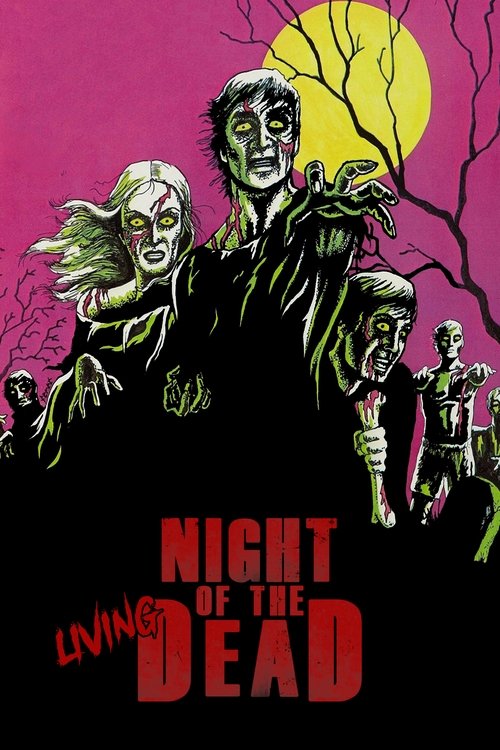
Night of the Living Dead
1968 · George A. Romero
When you're craving a real scare with teeth — not a fun haunted-house ride but the kind of horror that follows you to bed. Perfect for Halloween season or any night you want the genuine article.
What it's about
After a shocking attack in a rural Pennsylvania cemetery, a handful of strangers barricade themselves inside an isolated farmhouse as the recently dead rise and begin feeding on the living. Over one long night, the real battle turns out to be inside the house: a traumatized young woman, a capable man named Ben who takes charge, and a hostile father sheltering his family in the cellar, all arguing over how to survive while the dead press in.
The experience
Raw, relentless, and genuinely frightening even now — the grainy black and white makes it feel like a newsreel from a nightmare. It starts as a siege movie and slowly becomes something bleaker, tightening until you realize there's no comfort coming.
Performances
Duane Jones gives Ben a commanding, no-nonsense intelligence — a Black actor cast as the unquestioned hero of a 1968 American film, which was quietly revolutionary and still reads as the movie's moral center.
The craft
Shot on a shoestring by a Pittsburgh crew from regional TV, and the poverty became the style: harsh black-and-white photography, jagged editing, and a documentary plainness that makes the impossible feel like it's actually happening. It proves how far craft and conviction can stretch a tiny budget.
Why it matters
The founding text of the modern zombie movie — it invented the rules every zombie story since has followed or broken — and one of the most influential independent films ever made in America.
Snapshot
Night of the Living Dead is the founding text of the modern zombie film and one of the most consequential independent features ever made in the United States. Across a single claustrophobic night, a handful of strangers — Barbra, traumatized into near-catatonia after her brother is killed in a cemetery; the resourceful Ben, who takes charge of the defense; the belligerent Harry Cooper and his family sheltering in the cellar; the young couple Tom and Judy — barricade themselves inside a rural Pennsylvania farmhouse against a slowly multiplying horde of reanimated, flesh-eating dead. Made for a reported budget in the low six figures by a Pittsburgh company whose principals came out of regional television and industrial-commercial filmmaking, the picture transformed the staid "living dead" of folklore and Caribbean voodoo lore into the shambling, cannibalistic, contagious ghoul that would dominate horror for the next half-century. Directed by George A. Romero from a script he wrote with John Russo, shot in stark 35mm black-and-white, and released in October 1968, it is at once a landmark of low-budget guerrilla cinema, a notorious test case in the collapse of the old censorship regime, and — by accident and by design — one of the most politically charged American horror films of its era. Its closing movement, in which a Black protagonist survives the night only to be shot dead by a posse of white men, gave the film a resonance its makers have always described as partly unintended and that audiences have never been able to unsee.
Industry & production
The film was produced by Image Ten, a Pittsburgh-based partnership assembled by Romero, John Russo, Russell Streiner, and other associates of Romero's commercial production house, The Latent Image, together with the industrial-film outfit Hardman Associates. The financing was famously piecemeal: the partners and a circle of local investors each put in money, and the production drew on the personnel, equipment, and locations available to a small Pittsburgh advertising and industrial-film community. Budget figures cited in the literature cluster in the range of roughly $100,000–$114,000; I won't fix a precise number, but the picture was unambiguously a shoestring regional production made outside the studio system. Shooting took place largely in rural Pennsylvania (the Evans City area), much of it on nights and weekends, using a farmhouse that was slated for demolition. Cast and crew doubled up on duties — investors and crew members appear as ghouls, and several principals worked behind as well as in front of the camera.
The film's distribution history is itself a chapter of industry lore. It was picked up by the Walter Reade Organization and released through its Continental Distributing arm. In the process of retitling — the project had been known as Night of the Flesh Eaters before becoming Night of the Living Dead — the distributor's handling of the copyright notice on the prints resulted in the film entering the public domain, a clerical catastrophe that cost the filmmakers untold royalties but also guaranteed the picture's ubiquity, since anyone could duplicate, broadcast, and sell it freely. That accident is inseparable from the film's outsized cultural penetration. The picture became one of the most profitable independent films of its generation relative to cost, a staple of late-night television, drive-ins, and eventually home video.
Technology
Technologically the film is a study in disciplined scarcity. It was shot on 35mm black-and-white stock — a choice driven partly by economy and by the crew's documentary and newsreel-adjacent experience, but one that became central to the film's aesthetic identity. By 1968, black-and-white already read as austere and "real," aligning the film with news footage of war and civil unrest rather than with the saturated color of contemporary Hammer horror. The production relied on available and improvised equipment from the Pittsburgh industrial-film world; lighting was lean, camera support frequently handheld or minimally rigged. The gore effects — among the most explicit American audiences had yet seen — were achieved with cheap practical means: chocolate syrup standing in for blood on monochrome stock (a trick the black-and-white photography made convincing), animal entrails sourced locally for the cannibalism scenes, mortician's wax and simple makeup for the ghouls. There is no optical spectacle here; the technology of the film is the technology of resourceful regional filmmaking turned to horror, and its rawness is the point.
Technique
Cinematography
Romero, who served as his own principal cinematographer alongside collaborators from his commercial work, built the film's look from high-contrast black-and-white, canted angles, and a restless, frequently handheld camera. The visual grammar borrows openly from documentary, newsreel, and cinéma vérité — the grainy immediacy that, by 1968, audiences associated with war reportage and televised civil disturbance. Compositions tilt and tighten as the siege intensifies; deep shadow swallows the farmhouse interiors; the ghouls are often shot in stark, flat light or backlit silhouette at the windows. The opening cemetery sequence establishes the strategy immediately, with off-kilter framing and an exposed, overcast Pennsylvania landscape. The much-discussed final sequence shifts register entirely into grainy still photographs over the end credits — a deliberate evocation of news photography and lynching imagery that retroactively reframes the whole film as reportage.
Editing
The cutting, credited to Romero (who edited as well as directed and shot), is one of the film's most underrated achievements. The picture accelerates from the eerie, drawn-out cemetery prologue into an increasingly fragmented, percussive style as the dead overwhelm the house. The celebrated set pieces — the truck explosion and its aftermath, the cellar climax, Barbra's final scenes — are built through rapid, sometimes near-subliminal cutting that intensifies the violence while working around the limits of the effects. The montage of news-style stills under the closing credits is an editorial coup, converting the protagonist's death into a frozen, evidentiary record. The rhythm throughout alternates dread-laden stillness with bursts of chaos, a structure later zombie cinema would inherit wholesale.
Mise-en-scène / staging
The film is essentially a siege drama, and its staging exploits the geography of a single house: the boarded windows, the contested cellar, the radio and then the television as the survivors' fragile link to the outside. Romero stages the human conflict — Ben versus Harry Cooper, upstairs versus cellar — as a spatial argument about where safety lies, an argument the ending answers with savage irony (the cellar, derided by Ben, proves to be the only place anyone survives, and then only as a ghoul-infested tomb). The ghouls are staged as a slow, encroaching mass pressing at every threshold, their numbers swelling at the edges of the frame. The farmhouse becomes a pressure cooker in which the real threat is repeatedly shown to be the living survivors' inability to cooperate.
Sound
The soundtrack was assembled largely from library/stock music — pre-existing production-music cues licensed cheaply, a common economy in low-budget filmmaking of the period — rather than an original composed score. Far from a handicap, the disjunctive, sometimes incongruous cues lend the film an unsettling, alienated quality. Equally important is the diegetic sound: the radio and television bulletins that deliver the film's exposition (and its sardonic civic commentary) in the flat cadence of emergency broadcasting, the moans of the dead, the hammering of boards, the screams. The sound design's documentary plainness reinforces the newsreel aesthetic; the film sounds like a national emergency relayed through cheap speakers.
Performance
The cast was drawn largely from Pittsburgh theater and the production's own circle, and the performances range from naturalistic to broad — a uneveness typical of regional independent work that the film's rawness largely absorbs. Duane Jones, a stage actor and educator, gives the central performance as Ben: composed, intelligent, authoritative, and — crucially — cast in a role written without specific reference to race. Jones's gravity anchors the film and makes its ending unbearable. Judith O'Dea plays Barbra's descent into shock; Karl Hardman and Marilyn Eastman play the combative Coopers (Hardman also produced); Russell Streiner (also a producer) appears as Barbra's doomed brother Johnny, whose graveyard taunt — "They're coming to get you, Barbra" — became one of horror's most quoted lines. Kyra Schon's turn as the Coopers' infected daughter supplies the film's most shocking domestic horror.
Narrative & dramatic mode
Structurally the film is a near-real-time siege narrative of escalating entrapment, beginning with a deceptively quiet prologue and tightening relentlessly toward annihilation. Its dramatic mode is bleak, ironic, and anti-cathartic. Romero systematically denies the consolations of classical Hollywood horror: the nominal heroine is incapacitated for much of the film; cooperation fails; the radio and television promise rescue that never meaningfully arrives; and the most competent, sympathetic character is killed in the final minute not by monsters but by the human authorities ostensibly restoring order. The exposition is delivered obliquely, through fragmentary broadcasts that gesture at causes (a returning space probe's radiation is floated, never confirmed) without ever resolving them — a refusal of explanation that became a genre convention. The dominant tone is one of mounting futility, and the ending's irony is total: survival is meaningless, order is indistinguishable from the horde.
Genre & cycle
Night of the Living Dead effectively invented a genre. The "zombie" before Romero was the will-less, voodoo-enslaved laborer of films like White Zombie (1932) and I Walked with a Zombie (1943). Romero — who pointedly called his creatures "ghouls," not zombies — fused that figure with the contagion-and-siege logic of Richard Matheson's novel I Am Legend to produce something new: the slow, cannibalistic, infectious, collectively unstoppable reanimated corpse, dispatched only by destroying the brain, whose bite turns the living into more of the dead. Every defining rule of the modern zombie originates or crystallizes here. Within the horror landscape of 1968 the film belongs to a wave of low-budget, transgressive, "modern Gothic" horror that pulled the genre out of period castles and into contemporary America. It launched Romero's own …of the Dead cycle (Dawn of the Dead, 1978; Day of the Dead, 1985; and later entries) and seeded an entire industry of imitators, sequels, and eventually a globalized zombie boom.
Authorship & method
The film is the foundational statement of George A. Romero as an authorial voice, and it establishes the method he would refine for decades: regional, independent, Pittsburgh-based production made deliberately outside Hollywood, using genre horror as a vehicle for social critique. Romero functioned as director, co-writer, cinematographer, and editor — a true low-budget auteur shaped by his apprenticeship in commercials and industrial shorts. The screenplay was written with John A. Russo, who shared story and writing duties and would later become a contentious figure in the franchise's tangled rights history (his separate continuation produced the Return of the Living Dead line). Key collaborators came from the same Pittsburgh circle: Karl Hardman and Russell Streiner as producers (and actors), with Hardman and Marilyn Eastman also overseeing makeup and effects. There was no original composer; the "score" was assembled from stock music. The collaboration is genuinely communal — an investor-and-friends production in which nearly everyone wore several hats — but the controlling sensibility, the bleak irony and documentary rawness, is recognizably Romero's, and the film inaugurates the thematic preoccupations (consumerism, militarism, social breakdown, the failure of institutions) that run through his entire body of work.
Movement / national cinema
The film stands at the headwaters of the modern American independent horror movement and, more broadly, of the regional independent cinema that flourished outside Los Angeles in the late 1960s and 1970s. It is a quintessential product of American filmmaking at the moment the Production Code was collapsing into the MPAA ratings system (instituted that same year, 1968), and it exploited the new permissiveness more aggressively than almost any contemporary. Its aesthetic kinship is less with Hollywood than with documentary and underground film; its influence helped license a generation of independent horror auteurs — Wes Craven, Tobe Hooper, and others — who would similarly use cheap, raw, regional production to deliver visceral social horror (The Last House on the Left, The Texas Chain Saw Massacre). It is American cinema's demonstration that a genre landmark could be made entirely from the margins.
Era / period
Night of the Living Dead is saturated with the anxieties of 1968 — arguably the most turbulent year of the American postwar era. It was released months after the assassinations of Martin Luther King Jr. and Robert F. Kennedy, amid the Vietnam War, televised urban uprisings, and the violent contestation of the civil rights movement. The film's newsreel aesthetic, its imagery of armed posses and burning bodies, its radio-and-television bulletins, and above all its ending — a Black man who survives the dead only to be shot by a white search party and dragged onto a pyre with meat hooks, the act recorded in still photographs evoking lynching documentation — were instantly legible to 1968 audiences in the language of contemporary racial violence and wartime atrocity reportage. Romero has consistently maintained that Duane Jones was cast as the best actor who auditioned and that the racial reading of the ending was not the original intent, but the filmmakers have equally acknowledged that, released into that year, the film could not help but mean what audiences took it to mean. It is among the most powerful inadvertent-or-not political horror films of its moment, a period document of American crisis.
Themes
The film's governing themes are social breakdown and the failure of cooperation: the survivors destroy themselves through fear, ego, and division as surely as the dead destroy them, with the Ben–Cooper conflict dramatizing a society unable to unite against a common threat. Closely related is the collapse and untrustworthiness of institutions — the official broadcasts that mislead and reassure, the armed authorities whose restoration of "order" is indistinguishable from murder. Race is the theme the film cannot escape: a Black protagonist's competence and authority across the night, and his casual execution at dawn, read as a devastating allegory whatever the makers' intentions. The film also inaugurates horror's enduring use of the zombie as a figure of consumption, contagion, and the loss of the human — the dead as a mindless mass that was recently us. The family turned monstrous (the infected child killing her mother) and the home as failed sanctuary complete a thematic field of total institutional and domestic collapse. Above all the film insists on futility: there is no rescue, no meaning, no redemptive survival.
Reception, canon & influence
Backward — influences on the film. The decisive literary source is *Richard Matheson's I Am Legend** (1954), whose lone-survivor-besieged-by-the-contagious-dead premise Romero openly acknowledged adapting and inverting into a collective siege. Behind the ghouls lie the older voodoo-zombie films (White Zombie, I Walked with a Zombie) that Romero transformed beyond recognition, the EC horror comics of the 1950s with their gleeful gore and ironic cruelty, and the Gothic and science-fiction-invasion traditions. The aesthetic debt runs to documentary, newsreel, and the vérité* sensibility of 1960s reportage.
Initial reception. The film was greeted with alarm as much as acclaim. Its explicit cannibalism and gore — screened, notoriously, at unsupervised children's matinees before the ratings system fully took hold — provoked outrage; Variety and the critic Roger Ebert wrote pointedly about the trauma it inflicted on young audiences. Early critical reaction was sharply divided between revulsion and recognition that something new and serious had arrived. Over the following years, particularly through European exhibition and revival screenings, critical opinion turned decisively toward seeing it as a landmark.
Forward — legacy and reassessment. The film's influence is almost incalculable. It created the rules and the figure that govern the entire modern zombie genre, from Romero's own sequels through The Return of the Living Dead, 28 Days Later, Shaun of the Dead, the global success of The Walking Dead, and a worldwide flood of films and games. Its guerrilla, regional, independent method became a template for 1970s horror auteurs and for American independent filmmaking generally. Its fusion of visceral horror with explicit social and political critique established that the genre could be a serious vehicle for commentary — a lineage that runs straight to contemporary "elevated" social horror. The film has been selected for preservation in the Library of Congress National Film Registry and is widely taught and canonized as one of the most important American films of the 1960s. Its public-domain status, the result of the distributor's copyright blunder, made it one of the most reproduced and widely seen films in history while denying its makers their due — an irony fitting for a film whose subject is the failure of the systems meant to protect us.
A Deleuzian reading
Dawn.
The full Deleuzian reading of Night of the Living Dead →
Reception
Dismissed on release as tasteless drive-in gore — Variety called it an 'orgy of sadism' and a young Roger Ebert wrote about traumatized kids at a matinee — it's now enshrined in the Library of Congress National Film Registry and treated as the founding text of modern horror.
How Night of the Living Dead was received, from release to now →
Influences: the films it descends from and the films it influenced
- The Last Man on Earth (1964) — The first I Am Legend adaptation supplies the exact staging Romero collectivized: a survivor boarding up the house each night while slow, contagious dead shamble against the barricades and claw at the windows.
- White Zombie (1932) — Established the screen zombie as a shuffling, will-less revenant — the figure Romero stripped of its voodoo causation and pointedly refused to explain.
- I Walked with a Zombie (1943) — Val Lewton-school suggestive shadow-horror whose silent, vacant-eyed walker advancing through darkness prefigures the wordless, deliberate ghoul.
- Carnival of Souls (1962) — A regional industrial-film director shooting a feature in stark high-contrast black-and-white with pale, staring revenants — the low-budget documentary-eerie template Romero's Pittsburgh production followed.
- Invasion of the Body Snatchers (1956) — Supplies the paranoid-invasion architecture in which ordinary neighbors become an implacable assimilating mass, sustaining anti-cathartic dread of being numerically overrun.
- Psycho (1960) — Documentary-grade B&W and the mid-film murder of the apparent protagonist licensed Romero's killing of nominal heroes and his graphic, taboo-breaking violence.
- The Birds (1963) — Romero adopts The Birds' complete staging grammar for the domestic siege: windows boarded against iterative assault, exits cataloged as structural vulnerabilities, the house's architectural logic inverted from shelter into trap — transposing The Birds' besieged Bodega Bay farmhouse into the template for all subsequent zombie-siege cinema.
- The Texas Chain Saw Massacre (1974) — Extends Romero's regional guerrilla method and grainy verité rawness into a relentless, comfort-denying assault shot like found reportage.
- The Last House on the Left (1972) — Inherits the cinéma-vérité grain and deliberately anti-cathartic, unrelieved cruelty, treating low budget as an instrument of documentary brutality.
- The Evil Dead (1981) — Carries forward the regional-independent single-location siege with canted angles and shambling possessed assailants overwhelming a boarded-up cabin.
- Dawn of the Dead (1978) — Romero's own sequel scales the siege architecture into a shopping mall while making the consumerist social critique that was implicit in the original explicit.
- The Return of the Living Dead (1985) — The John Russo rights-split continuation that forks Romero's premise, mutating the slow ghoul into the brain-craving, speaking zombie.
- 28 Days Later (2002) — Reboots the form with DV-video verité handheld and the depopulated-institution imagery, repurposing Romero's broadcast-of-collapse and failure-of-order themes.
- Shaun of the Dead (2004) — Built explicitly on Romero's rules — slow ghouls, refusal of explanation, and the barricaded single-location siege — affectionately preserved even while parodied.
- Get Out (2017) — Fulfills Romero's fusion of genre horror with explicit social critique and his unremarked casting of a Black lead (Duane Jones), turning racial subtext into structure.
- REC (2007) — Translates the besieged-building structure into found-footage, with diegetic broadcast framing and trapped occupants overrun inside a single sealed location.
- 28 Years Later: The Bone Temple (2026) — Source of the siege-of-the-living structure and the newsreel-raw, reportage monochrome that the infection genre still cites as its documentary-horror posture.
- The Thing (1982) — Romero's structural innovation of centering the horror on internal group trust-collapse rather than the external threat — farmhouse occupants destroying themselves through paranoia and bad decisions — is the direct architectural template for the Antarctic station's social disintegration.
- I Am Legend (2007) — Romero's siege architecture — survivors barricaded inside a domestic structure while infected masses test the perimeter, the building's windows and thresholds as the survival boundary — is the genre template I Am Legend inherits for its fortified-domestic-space staging, UV barriers replacing boarded glass as the operative threshold technology.
- Assault on Precinct 13 (1976) — Openly transposes the Night siege — anonymous, motiveless attackers swarming a barricaded building defended by an interracial pair forced into uneasy alliance.
- War of the Worlds (2005) — Originates the ground-level apocalypse confined to a single besieged dwelling — the chamber-piece siege in the basement with strangers — that the Ogilvy cellar sequence explicitly echoes.
Similar films
- The Texas Chain Saw Massacre (1974) — influence & lineage · same viewing thread
- [REC] (2007) — influence & lineage · same viewing thread
- Dawn of the Dead (1978) — influence & lineage
- The Return of the Living Dead (1985) — influence & lineage
- 28 Days Later (2002) — influence & lineage
- Shaun of the Dead (2004) — influence & lineage
- 28 Years Later: The Bone Temple (2026) — influence & lineage
- Invasion of the Body Snatchers (1956) — influence & lineage
All the films related to Night of the Living Dead →
Watch it with: curated runs of related films
- Nowhere Left to Hide — Watch these when you want pure primal terror — ordinary people cornered by something relentless, from open water to a silent farmhouse to a stairwell in Barcelona.