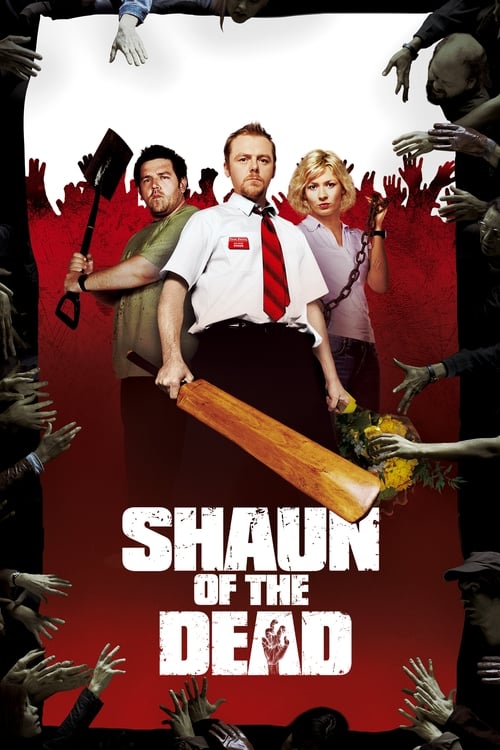
Shaun of the Dead
2004 · Edgar Wright
The perfect pick when you want to laugh hard without switching your brain off — ideal with friends, pizza, and a pint, and just scary enough to count as Halloween viewing for the horror-averse.
What it's about
Shaun is a genial North London slacker whose life runs on rails between his girlfriend, his mom, and his beloved local pub — until the dead rise and start snacking on ordinary Londoners, and he barely notices at first. The zombie apocalypse becomes the intervention his arrested development always needed, as he rounds up loved ones and heads for the safest place he knows: the pub.
The experience
Fast, joke-dense, and endlessly rewatchable — whip-pans and needle drops turn a trip to the corner shop into an action sequence — but it sneaks in real blood, real stakes, and a surprising amount of heart between the laughs.
Performances
Simon Pegg and Nick Frost's lived-in best-mate chemistry, honed over years of working together, is the film's engine — the friendship is so real that the comedy and the emotion both land.
The craft
Edgar Wright's style is all velocity — whip-pans, crash-zooms, errands cut to percussion — with sight gags and setups that pay off so densely a second viewing feels mandatory. Beneath the parody runs genuine love for classic zombie cinema: the satire is honored, not spoofed, and the genre beats are played straight when it counts.
Why it matters
It invented the 'rom-zom-com,' launched Edgar Wright and Simon Pegg internationally, and kicked off their beloved Cornetto trilogy — earning the blessing of zombie godfather George A. Romero himself.
Edgar Wright's 'rom-zom-com' announced one of the most distinctive comic stylists of his generation. Grown from the DNA of Spaced, the cult Channel 4 sitcom Wright made with Simon Pegg and Nick Frost, it drops a genial North London slacker — pub-bound, drifting, allergic to adulthood — into a full-scale zombie outbreak he barely notices at first. The joke is structural: apocalypse as the ultimate intervention for arrested development. Wright's signature is all velocity — whip-pans, crash-zooms, errands cut to percussion — a technique that treats the mundane trip to the corner shop with the grammar of an action sequence, so that when actual mayhem arrives the style barely has to change. Beneath the gags runs real affection for George A. Romero, whose social-satire zombies are honored rather than spoofed; Romero returned the compliment by casting Pegg and Wright as ghouls in Land of the Dead. The first panel of the Three Flavours Cornetto triptych, and still the one where the emotional stakes — a mom, a best mate, a pint — cut deepest.
A Deleuzian reading
A bus stop in north London, morning.
The full Deleuzian reading of Shaun of the Dead →
Reception
A hit with critics and horror fans from day one — Roger Ebert and even zombie purists embraced it — and two decades on it's only climbed, now routinely called one of the best comedies of the 2000s and the gold standard for horror-comedy.
How Shaun of the Dead was received, from release to now →
Influences: the films it descends from and the films it influenced
- Night of the Living Dead (1968) — Establishes the slow-shambling, headshot-only ghoul and the single-building siege that Shaun replays beat-for-beat as the boarded-up Winchester standoff.
- Dawn of the Dead (1978) — Codifies the zombie-as-consumerist-satire staged in a banal retail setting, which Wright inverts in the opening 'shuffling commuters' montage where the living already move like the dead.
- An American Werewolf in London (1981) — Templates the specifically British fusion of deadpan comedy with wet practical gore, plus the ironic upbeat needle-drop scored over carnage that Wright echoes killing a zombie to 'Don't Stop Me Now.'
- Evil Dead II (1987) — Source of the 'splatstick' camera grammar — frantic whip-pans, crash-zooms into faces and undercranked slapstick violence — that Wright adopts as his kinetic visual signature.
- Braindead (Dead Alive) (1992) — Pioneers comedic domestic-siege gore in which household objects (here the pool cue and pub fittings) are improvised into weapons for the undead onslaught.
- Spaced (1999) — The direct proving ground for the Pegg-Frost arrested-development flatmate duo and the rapid pop-culture-referencing cut-and-whip-pan style, incubating Shaun's entire authorial voice.
- Once Upon a Time in the West (1968) — Model for the crash-zoom into extreme close-up and rhythmically hard-cut reaction shots that Wright deploys to make mundane pub banter feel like a showdown.
- GoodFellas (1990) — Blueprint for the propulsive percussive montage that renders trivial routine as breathless action — Wright quotes it directly in the twinned, identical 'walk to the corner shop' sequences.
- Assault on Precinct 13 (1976) — Supplies the besieged-by-a-faceless-relentless-horde structure and the ragtag defenders barricading a single location that shapes the Winchester's third act.
- Withnail & I (1987) — A quotable British flatmate cult comedy whose afterlife is sustained by communal quotation and ritual, the cult-comedy reception model Withnail established.
- Monty Python and the Holy Grail (1975) — Wright's British genre-parody built by a comedy troupe uses cut-on-the-joke, sketch-rhythm editing as its comic motor, a direct descendant of Python's TV-bred cut-on-the-punchline pacing.
- The Evil Dead (1982) — Converts Raimi's percussive whip-pan-and-hard-sound-cut grammar into a comic engine — the sound effect lands the joke and the cut lands the beat — and stages its third act as a boarded-in siege by attrition.
- Scott Pilgrim vs. the World (2010) — Extends Wright's editing-to-sound-effect method, hard-cutting on onomatopoeic beats and match-cutting scene transitions that grew out of Shaun's percussive rhythm.
- Baby Driver (2017) — Perfects the music-synced cutting that Shaun previews in the jukebox-scored fight, timing every edit and action to the beat of the soundtrack.
- Zombieland (2009) — Carries the comedic rules-of-survival zombie apocalypse forward with on-screen kinetic text and needle-drop set-pieces cut in the Wright percussive mode.
- The Cabin in the Woods (2012) — Inherits Shaun's affectionate meta-deconstruction of horror mechanics, playing genre rules for comedy while still delivering the siege payoff.
- Warm Bodies (2013) — Directly develops the 'rom-zom-com' hybrid Shaun coined, grafting a romantic-comedy arc onto Romero-rules zombie apocalypse.
- Hot Fuzz (2007) — Second Cornetto-trilogy entry applying the same whip-pan/crash-zoom match-cut montage grammar to genre pastiche, foregrounding mundane-as-action editing.
- The World's End (2013) — Closes the Cornetto trilogy reusing the pub-crawl-as-apocalypse framework and Pegg-Frost dynamic, with percussive cutting driving the choreographed bar brawls.
- Attack the Block (2011) — Shares the British working-class-estate genre-comedy register — ordinary young Londoners weaponizing everyday objects against an invading threat with deadpan humor.
- What We Do in the Shadows (2014) — Shares the affectionate horror-comedy method of playing genre mechanics dead straight while mining the mundane domestic friction around them, love letter rather than parody.
- One Cut of the Dead (2017) — Genre-affectionate zombie comedy built on precise comic timing and craft rather than gore, prioritizing affection for the form over shock.
- Hundreds of Beavers (2024) — Ruthless setup/payoff editing where throwaway early lines and background props return as precisely-timed callbacks, the Chekhov's-gun cutting rhythm Beavers runs on.
Similar films
- Dawn of the Dead (1978) — influence & lineage · same viewing thread
- Zombieland (2009) — influence & lineage · same viewing thread
- Hot Fuzz (2007) — influence & lineage
- Night of the Living Dead (1968) — influence & lineage
- Scott Pilgrim vs. the World (2010) — influence & lineage
- The Return of the Living Dead (1985) — same viewing thread
- One Cut of the Dead (2017) — same viewing thread
- What We Do in the Shadows (2014) — same viewing thread
All the films related to Shaun of the Dead →
Watch it with: curated runs of related films
- The Undead, Played for Laughs — A run of horror comedy — vampire flatmates bickering over the dishes, slackers fumbling through the zombie apocalypse — set against the Romero classic they're all winking back at.