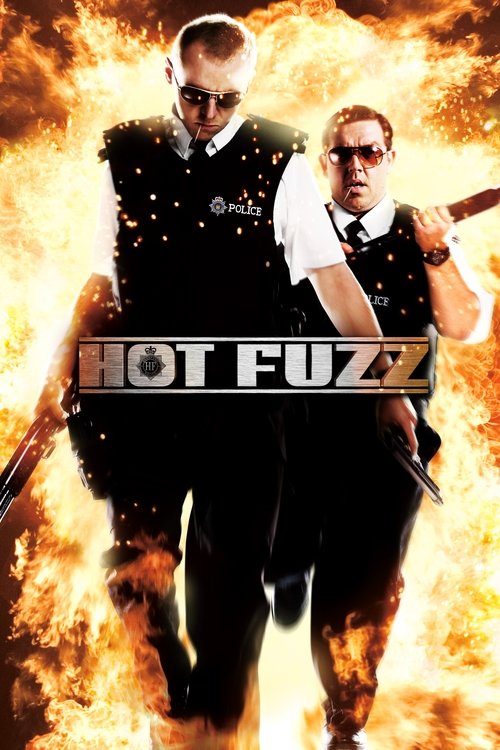
Hot Fuzz
2007 · Edgar Wright
When you want to laugh hard AND get a proper action climax — ideal for a rewatch-friendly night with friends, and it genuinely gets funnier the second time.
What it's about
Nicholas Angel, a London supercop so good he makes everyone else look bad, is exiled to the sleepy English village of Sandford, where the biggest crime seems to be an unlicensed street performer and his new partner is a well-meaning oaf raised on American action movies. Then a series of suspiciously grisly 'accidents' starts piling up, and Angel begins to smell something rotten under the hanging baskets.
The experience
Whip-fast, endlessly quotable, and constructed like a Swiss watch — nearly every throwaway line in the first hour detonates as a payoff in the last act. It starts as a droll fish-out-of-water comedy and escalates into gloriously overblown action, with a genuine streak of eerie village menace underneath.
Performances
Simon Pegg plays the humorless supercop with total commitment, and Nick Frost gives the lovable-oaf partner real sweetness; their double act is the film's heart.
The craft
Edgar Wright treats comedy as a craft of construction: whip-pans, crash zooms, and needle-drops give paperwork montages the same percussive glee as gunfights, and the editing itself is a running joke. Turn the speakers up — the sound design and cutting are half the punchlines.
Why it matters
The middle panel of Wright's Cornetto trilogy, it became a modern comedy landmark and the gold standard for parody that works as a genuine example of the genre it's spoofing.
The middle panel of Edgar Wright's Three Flavours Cornetto trilogy transplants the grammar of Bruckheimer-era action cinema — whip-pans, crash zooms, needle-drops, gunfights staged with cathedral seriousness — into a picture-postcard English village where the gravest crime is an unlicensed street performer. Simon Pegg plays a London supercop exiled to Sandford for the sin of competence; Nick Frost is the local constable who has watched Point Break too many times. What elevates the film beyond parody is Wright's belief that comedy is a craft of construction: virtually every throwaway line in the first hour detonates in the last act, and the editing treats paperwork montages with the same percussive glee as shootouts. Beneath the pastiche of Bad Boys II runs an older, stranger English tradition — the village-conspiracy unease of The Wicker Man, complete with a cast of beloved character actors (Timothy Dalton, Jim Broadbent, Edward Woodward himself) weaponizing their own cosiness. Wright storyboarded the mayhem so densely that the film rewards freeze-frame study; few comedies of its decade are built with such watchmaker precision.
A Deleuzian reading
A hand brings a rubber stamp down on a form.
The full Deleuzian reading of Hot Fuzz →
Reception
A hit on arrival in 2007, but time has been even kinder: what was once 'the follow-up to Shaun of the Dead' is now regularly argued to be the best film in the Cornetto trilogy — and one of the most rewatchable comedies of its decade.
How Hot Fuzz was received, from release to now →
Influences: the films it descends from and the films it influenced
- The Wicker Man (1973) — Supplies the folk-horror village-conspiracy architecture — an isolated English community whose respectable elders quietly murder to keep the town 'the model village' — which Hot Fuzz restages as the Neighbourhood Watch Alliance and its hooded ritual reveal.
- Bad Boys II (2003) — The explicit template for the climax's grammar: Bay's whip-pan hero framing, circling low-angle 'walk toward camera' shots and bombastic multi-angle gunfight coverage are quoted almost shot-for-shot (and literally screened on Danny's DVD).
- Point Break (1991) — Source of the earnest cop-bromance register and the 'fire your gun into the air in frustration' beat, both cited on-screen and reproduced as sincere action-movie iconography rather than mere spoof.
- Hard Boiled (1992) — The 'heroic bloodshed' two-handed gunplay — sliding, akimbo pistols, balletic slow-motion dive-and-fire — is the choreographic vocabulary the Sandford shootout lovingly deploys.
- A Fistful of Dollars (1964) — Leone's extreme-close-up crash zooms and town-square showdown staging drive the finale, where Angel strides into the village green like a spaghetti-western gunslinger for a high-noon confrontation.
- Evil Dead II (1987) — Raimi's kinetic crash-zooms, whip-pans and percussive insert-montages of mundane actions (loading, pouring, stamping) are the core Wright visual idiom used to make paperwork and pub-visits feel like action sequences.
- Straw Dogs (1971) — Establishes the eruption of graphic siege violence within a quaint English rural community, the tonal collision Hot Fuzz weaponizes when Sandford's cozy exterior detonates into carnage.
- Dirty Harry (1971) — Provides the loose-cannon supercop archetype and the by-the-book/renegade friction that defines Nicholas Angel, down to the fetishized big-gun iconography and 'too good at the job' setup.
- Snatch (2000) — Wright adopts and codifies the formal principle that Ritchie and Harris developed in Snatch: editing locked to sound design, every cut motivated by a foley effect or musical beat, exaggerated foley used as comic punctuation — extending this from stylistic tendency into a systematic grammar that defines Wright's entire mature aesthetic.
- Galaxy Quest (1999) — Carries forward the 'play the genre completely straight while loving and skewering it' mode, executed through the same propulsive comic-timing editing that snaps between parody and sincere set-piece.
- Kiss Kiss Bang Bang (2005) — Extends the mode Black licensed — affectionate annotation of a formula executed with enough craft that the formula still works — including the freeze-frame/whip-cut grammar and a mismatched pair whose competence gap is the engine of both the comedy and the actual case.
- Scott Pilgrim vs. the World (2010) — Pushes Hot Fuzz's sound-synced cutting and comic setup-and-payoff into a full comic-panel/video-game grammar where every edit lands on a diegetic sound effect.
- Baby Driver (2017) — Takes the needle-drop-as-choreography further, cutting gunfire, footsteps and car stunts precisely to the downbeats and lyrics of the soundtrack — the apotheosis of Wright's music-driven montage.
- Kingsman: The Secret Service (2014) — Shares the project of importing hyperkinetic American action grammar into a pointedly English milieu, delivering a single-location choreographed massacre cut to a needle-drop, much like the Sandford church-fete rampage.
- The Nice Guys (2016) — Black's mismatched buddy-cop comedy runs on the same meticulous Chekhov's-gun engineering, where every throwaway early gag detonates as a plot mechanism in the finale.
- Bullet Train (2022) — Extends the comedic-hyperviolence lineage with percussive edit-driven fight comedy and elaborate running-gag setup-and-payoff structure built into the action beats.
- Kingsman: The Golden Circle (2017) — Modeled the British whip-pan/smash-cut kinetic editing grammar applied to affectionate genre parody, the editorial idiom Eddie Hamilton's cutting shares.
- Shaun of the Dead (2004) — The first Cornetto film that codifies Wright's grammar — crash-zoom triplets, sound-cued match cuts, whip-pan gags and rigorous Chekhov's-gun setup-and-payoff scripting — that Hot Fuzz refines to clockwork density.
- The World's End (2013) — Closes the Cornetto trilogy by reusing the identical machinery: a pub-culture Englishness, a small-town conspiracy of replaced-townsfolk 'community', and percussive fight editing scored to a needle-drop.
- Attack the Block (2011) — A fellow Spaced-adjacent British filmmaker applying Hollywood genre craft — tight action staging, precise setup-payoff plotting — to a parochial, class-specific UK setting.
- Raising Arizona (1987) — Wright's hyper-kinetic comic montage — whip-pans, snap zooms, and percussive cut-on-action rhythm that turn mundane business into action-cartoon velocity — descends from the Raimi/Coen rushing-camera lineage Arizona codified.
- On Probation (2005) — An outside-Hollywood homage that self-consciously imports American buddy-cop grammar into a national context — the same 'genre mechanics as borrowed common property' gesture Szifron makes for Argentina.
Similar films
- Shaun of the Dead (2004) — influence & lineage
- The Nice Guys (2016) — influence & lineage
- Baby Driver (2017) — influence & lineage
- Hard Boiled (1992) — influence & lineage · often watched together
- What We Do in the Shadows (2014) — often watched together
- The Sheep Detectives (2026) — shared sensibility
- Zootopia 2 (2025) — shared sensibility
- Wallace & Gromit: The Curse of the Were-Rabbit (2005) — shared sensibility