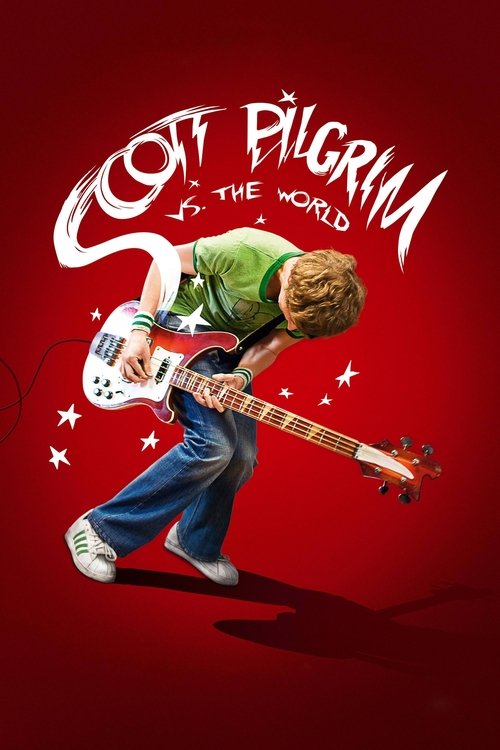
Scott Pilgrim vs. the World
2010 · Edgar Wright
For when you want pure fun at full speed — a pizza-and-friends movie, an infinitely rewatchable comfort blast. Zero homework required, though gamers and comics readers get bonus points.
What it's about
Scott Pilgrim is a Toronto slacker and garage-band bassist who falls hard for the mysterious Ramona Flowers — only to learn that dating her means defeating her seven evil exes, each showdown staged as a full-blown video-game boss fight. Band drama, roommate drama, and ex drama all collide at maximum volume.
The experience
A sugar rush — joke-dense, hyperkinetic, edited within an inch of its life, with sight gags stacked on sound gags stacked on cuts. It's exhausting in the best way and practically demands rewatching to catch everything.
Performances
Michael Cera and Mary Elizabeth Winstead anchor a supporting cast that's a time capsule of imminent stardom — Brie Larson, Anna Kendrick, Aubrey Plaza, and Chris Evans all swinging for the fences in roles sized exactly right for them.
The craft
Edgar Wright imports the grammar of comics and arcade games wholesale into live action — whip-pans, match cuts, onomatopoeia blazing across the frame, life bars and combo counters — with a loud, great soundtrack to match. It rewards a big screen and good speakers; the whole film is built on visual and sonic punchlines.
Why it matters
A box-office disappointment that became a defining cult classic, and a style so complete that editors and music-video directors have been chasing it ever since.
Edgar Wright's adaptation of Bryan Lee O'Malley's graphic novels drops a Toronto slacker-bassist into a courtship that plays by arcade rules: to win Ramona Flowers, Scott must defeat her seven evil exes, each battle staged as a full-blown boss fight. Wright, arriving off Shaun of the Dead and Hot Fuzz, treats the material as a laboratory for his hyperkinetic grammar — whip-pans, match cuts, onomatopoeia blazing across the frame, combo counters and life bars imported wholesale from video games into live action. No one had synthesized comics, gaming, and pop cinema this completely before; a generation of editors and music-video directors has been chasing it since. The cast is a time capsule of imminent stardom — Michael Cera and Mary Elizabeth Winstead flanked by Brie Larson, Anna Kendrick, Aubrey Plaza, Chris Evans — and the garage-rock songs were written by Beck, with Radiohead producer Nigel Godrich scoring. A famous flop in 2010, it was rehabilitated within years into one of the era's defining cult objects. Underneath the pixels sits a sneakily rueful comedy about the exes we carry, and the ones we become.
A Deleuzian reading
A fist connects and the word arrives with it.
The full Deleuzian reading of Scott Pilgrim vs. the World →
Reception
Famously flopped in August 2010 — opening the same weekend as The Expendables and Eat Pray Love — before pulling off one of the decade's cleanest flop-to-cult-classic arcs, complete with anniversary theatrical re-releases and the entire main cast reuniting to voice the 2023 Netflix anime Scott Pilgrim Takes Off.
How Scott Pilgrim vs. the World was received, from release to now →
Influences: the films it descends from and the films it influenced
- A Hard Day's Night (1964) — Established pop-cinema's music-driven kineticism—cutting image to the beat with jump cuts and playful undercranking—the rhythmic grammar Wright hangs the whole film on.
- Batman (1966) — Literalized comic-book sound effects as on-screen typographic overlays ('POW!' 'BIFF!'), the direct source of Scott Pilgrim's onomatopoeia bursts during fights.
- The Warriors (1979) — Built its plot as an episodic gauntlet of themed rival gangs, a level-by-level, boss-by-boss progression that prefigures the seven-evil-exes video-game structure.
- Run Lola Run (1998) — Imported video-game logic into narrative form—reset/respawn runs, animated inserts, and pulse-driven cutting—treating consequence as something you replay.
- Fight Club (1999) — Pioneered diegetic on-screen graphics and label overlays that annotate the frame, the reality-breaking HUD device Wright turns into pee bars and combo counters.
- Amélie (2001) — Fused whimsical live-action with animation overlays to externalize a character's interior state, licensing Scott Pilgrim's cartoon-annotated emotional reality.
- Hulk (2003) — Translated the comic page directly to screen via multi-panel split-screen paneling, a fidelity-to-the-source formal move Wright echoes in his frame divisions.
- Kill Bill: Vol. 1 (2003) — Structured revenge as chapter-carded, boss-by-boss duels punctuated with an anime interlude—genre-pastiche fight staging Scott Pilgrim inherits wholesale.
- Shaun of the Dead (2004) — Same author's signature whip-pan/match-cut 'visual gag' grammar, where mundane actions are edited into rapid rhythmic montages.
- Hot Fuzz (2007) — Extends Wright's hyperkinetic editing—snap zooms, whoosh-scored inserts, action beats cut to sound cues—the same toolkit weaponized in Scott Pilgrim.
- High Fidelity (2000) — Organizes its romance through a literal list-driven structure (the seven exes) around a pop-music-obsessed slacker narrator, inheriting the top-five/list-as-unit-of-feeling architecture.
- Survive Style 5+ (2004) — Inherits the comic-book/advertising kinetic grammar — on-screen graphics, sound-effect text, hyper-saturated maximalist staging — as the native syntax of a live-action pop-surreal romance.
- Deadpool (2016) — Extends the comic-adaptation self-awareness into fourth-wall address and on-screen graphic gags, treating the frame as an annotatable comic page like Wright.
- Baby Driver (2017) — Takes Scott Pilgrim's music-synced action to its endpoint, choreographing every cut, gunshot, and gesture to the beat of the diegetic soundtrack.
- Spider-Man: Into the Spider-Verse (2018) — Fully animates the comic-book HUD vocabulary—onomatopoeia overlays, thought captions, halftone dots, panel splits—Scott Pilgrim smuggled into live action.
- Free Guy (2021) — Literalizes the video-game HUD conceit into diegesis—health bars, XP, respawns as narrative reality—extending Scott Pilgrim's arcade-rules courtship.
- Everything Everywhere All at Once (2022) — Inherits the hyperkinetic pop-editing and game-logic rule-set (button-combo 'verse-jumping,' onscreen prompts) as an engine for emotional reckoning.
- Nimona (2023) — Translated comic panels to live action with on-screen onomatopoeia titles, video-game HUD graphics and percussive match-cut editing — the kinetic comic-to-screen punctuation Nimona's punk editing descends from.
- The Running Man (2025) — Treats counters, captions and graphic overlays as diegetic image layers that can be whip-panned and match-cut through, with Marcus Rowland's sets built to receive them — the ancestry of the broadcast HUD sitting inside the frame.
- Sin City (2005) — Pushed panel-perfect comic adaptation—recreating Miller's frames as literal shots—part of the mid-2000s wave of hyper-faithful comics-to-screen translation Wright riffs on.
- Speed Racer (2008) — Rendered anime's candy-colored maximalism in live action with layered digital compositing, the same synthesis of pop-media surface Wright pursues.
- Kingsman: The Golden Circle (2017) — Renders comic-panel maximalism through digital compositing and hyper-kinetic editing, the same translate-the-page-literally impulse driving Kingsman's Millar/Gibbons adaptation.
- Kamikaze Girls (2004) — Fuses live action with manga/anime cutaways, on-screen graphic sound-effect text, and video-game inserts, the Western twin of Nakashima's live-action-meets-anime editing grammar.
- Spider-Man: Across the Spider-Verse (2023) — Embeds native comics devices — onomatopoeia lettering, gutter panels, and graphic sound-effect overlays — directly into the live-action frame as diegetic visual language, the same fusion of print and motion Spider-Verse formalizes.
- Hundreds of Beavers (2024) — Imports video-game logic — lives, points, level-boss progression, on-screen UI — into live-action editing, the narrative/video-game-logic scaffolding Beavers structures its trapping around.
- Zombieland (2009) — Extends Zombieland's video-game logic literally, rendering combat with on-screen HUD scores, kinetic typography, and level-up structure.
- (500) Days of Summer (2009) — Composites hand-drawn comic and video-game graphics into live action at music-video pace, applying the same graphic-overlay stylization to a self-deluding indie-romance protagonist.
Similar films
- Deadpool (2016) — influence & lineage
- Spider-Man: Into the Spider-Verse (2018) — influence & lineage
- Shaun of the Dead (2004) — influence & lineage
- Lady Bird (2017) — shared sensibility
- Superbad (2007) — shared sensibility
- Megamind (2010) — shared sensibility
- The Lego Batman Movie (2017) — shared sensibility
- Five Nights at Freddy's (2023) — shared sensibility
All the films related to Scott Pilgrim vs. the World →