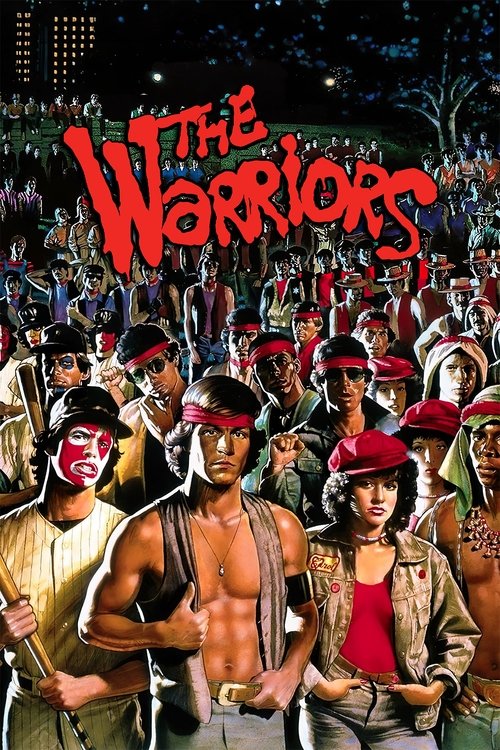
The Warriors
1979 · Walter Hill
For a late-night action fix with style to spare — when you want something fast, iconic, and a little disreputable. An ideal watch-with-friends cult movie.
What it's about
Every gang in New York sends delegates to a massive nighttime summit in the Bronx, where a charismatic leader proposes a citywide truce — and is promptly assassinated. A small Coney Island crew called the Warriors is framed for the killing, and with every gang and every cop in the city hunting them, they have to fight their way home through the subways and streets before dawn.
The experience
A lean, propulsive night-run — one long chase broken into stylized skirmishes, each rival gang stranger than the last. It's tense, pulpy, and weirdly beautiful, with a comic-book unreality that makes the menace feel mythic rather than grim.
Performances
David Patrick Kelly's live-wire turn as the film's chief tormentor produced one of the most imitated taunts in movie history — a small role that became immortal.
The craft
Walter Hill strips the story to pure momentum — the film is essentially one extended pursuit — and dresses each gang in outlandish costumes that turn New York into a tribal fantasy map. The neon-and-graffiti night photography and driving electronic score make the subway system feel like an underworld; it plays great loud.
Why it matters
Notorious on release for violence around screenings, it survived the scandal to become one of American cinema's durable cult objects, absorbed into hip-hop, video games, and fashion — the template for the stylized urban-gauntlet movie.
Snapshot
A gang summit in the Bronx, a leader assassinated, a frame-up, and one long night's run home to Coney Island: The Warriors compresses a whole city into a single nocturnal gauntlet. Walter Hill's third feature took Sol Yurick's bleak 1965 novel — itself a transposition of Xenophon's Anabasis, the march of ten thousand Greek mercenaries back to the sea — and stripped it to a series of stylized encounters between tribes distinguished chiefly by their costumes. Released by Paramount in February 1979, it was immediately notorious: reports of violence at and around screenings led the studio to pull advertising and offer exhibitors release from their bookings. The film survived that scandal to become one of the durable cult objects of American cinema, absorbed into hip-hop iconography, video games, fashion, and the vocabulary of countless later action films. Its reputation rests on a paradox: a movie about street reality that is almost entirely artificial, a New York film in which New York has been repainted as a comic-book underworld.
Industry & production
The film was produced by Lawrence Gordon for Paramount, in a period when the studio under Barry Diller and Michael Eisner was willing to back cheap, hard-edged genre pictures aimed at young urban audiences. Gordon had produced Hill's directorial debut Hard Times (1975) and The Driver (1978); the relationship gave Hill unusual latitude for a director with no commercial hit to his name. The screenplay is credited to David Shaber and Hill, Shaber having written earlier drafts before Hill rewrote toward the elliptical, near-wordless idiom he preferred. Yurick's novel, written by a former New York City welfare department caseworker as a corrective to romantic myths about gangs, was substantially reconceived: the book's grim sociology of children playing at war gives way to a fable of warriors moving through a mythic landscape.
Production was famously arduous. The picture was shot almost entirely at night on location across the five boroughs over roughly two months in the summer of 1978, on a budget modest even by the standards of the day — the economics are frequently described as a low-budget picture that returned a healthy multiple of its cost, though precise figures vary between sources and are best treated with caution. Filming in the subway system required extensive negotiation with transit authorities and off-hours access; sequences were staged on platforms, in tunnels, and aboard moving trains. The production employed local young men as extras and background gang members, and accounts from cast and crew consistently describe a tense, improvisatory atmosphere on the street, with real neighborhood territoriality shadowing the fictional kind. The famous fight in a station men's room, the Baseball Furies chase through park greenery, and the final walk along the Coney Island boardwalk beneath the Wonder Wheel were all captured in situ rather than on studio sets.
The release then generated its own history. Following incidents at theaters in several states in the weeks after opening, Paramount withdrew television and radio spots, paid for additional security at some venues, and permitted exhibitors to cancel engagements. The controversy did what controversy usually does: it fixed the film in public memory and guaranteed its second life on cable and home video, where its reputation was actually made.
Technology
The Warriors was shot on 35mm in anamorphic Panavision, framed at roughly 2.35:1 — a wide, horizontal canvas that Hill and cinematographer Andrew Laszlo used to hold whole gangs in single frames, ranks of bodies stretched across the image like a frieze. The scope format is central to the film's mythic register; it turns groups into formations.
The technical problem was light. In 1978, available color negative was slow by later standards, which meant that night exteriors could not simply be shot by existing street illumination. Laszlo's solution was to light large tracts of city — parks, platforms, entire blocks — with generator-fed units, supplementing and overwhelming the sodium-vapour ambience of New York streetlamps and station fluorescents. The consequence is aesthetic as much as practical: the film's blacks are dense and its highlights are hot and colored, so that a park at night becomes a stage flat and a subway platform an aquarium of green-white glare. Where documentary realism would have produced murk, the technological constraint pushed the image toward theater.
Lightweight reflex cameras of the Panaflex generation made handheld anamorphic work feasible inside cars, on trains, and during running shots, which is why the film can move fluidly between composed tableau and kinetic pursuit without changing formats.
A later technological intervention altered the film itself. For the 2005 "Ultimate Director's Cut," Hill added digitally created comic-book panel transitions and an opening title card making the Anabasis debt explicit — realizing, he said, an intention the original production could not afford. The cut remains contested among admirers, many of whom prefer the leaner theatrical version, but it is a rare instance of a director using digital tools to retrofit a stylistic frame rather than to fix effects.
Technique
Cinematography
Andrew Laszlo — Hungarian-born, a veteran of television and of location shooting — gives the film a palette organized around saturated primaries against black. Each gang arrives with its own color scheme: the Furies' pinstripes and greasepaint, the Orphans' drab, the Lizzies' warm interior reds, the Punks' denim under fluorescent white. Compositions favour symmetry and frontality; gangs are introduced in formal lineups, staged head-on, held long enough to be read as emblems. Camera movement is generally motivated and unshowy — dollies along corridors, pans that follow a running body — with handheld reserved for combat. Laszlo's night work here directly anticipates the heightened urban expressionism he would bring to Streets of Fire (1984), effectively Hill's companion piece.
Editing
The film was cut by a team, among them David Holden and Freeman Davies, the latter becoming Hill's regular editor across the following decade. The cutting is notably lean in exposition and expansive in action: whole plot mechanics are conveyed in seconds, while fights are extended, broken into short impacts and reaction beats. Hill's Peckinpah apprenticeship — he wrote The Getaway (1972) — shows in the percussive assembly of violence, though the film largely forgoes Peckinpah's slow motion in favour of hard, rhythmic cuts. The structure is episodic by design: a chain of discrete encounters, each with its own tempo, strung along a single vector.
Mise-en-scène / staging
This is the film's signature achievement. Hill treats New York as a series of arenas — a park, a station, a bathroom, a boardwalk — each entered, contested, and exited. Costume does the work of characterization: the Baseball Furies never speak, and do not need to. The gangs function as heraldry, a design logic borrowed openly from comics and from the pageantry of the Western. Nothing in the film's world is explained sociologically; the city has been emptied of ordinary life so that only the tribes remain, which is precisely what distances the picture from the grimy naturalism of its 1970s New York contemporaries.
Sound
Barry De Vorzon's score is largely electronic — pulsing synthesizer patterns, sparse percussion, motifs that function as territorial markers. It belongs to the same moment as John Carpenter's self-composed scores and Tangerine Dream's film work, and it helped establish the synthesizer as the default sound of urban menace for the decade to follow. Around the score, the sound design leans on the city itself: train rumble, wheels on track, the hiss of doors, wind on the boardwalk. Presiding over all of it is the radio DJ played by Lynne Thigpen, seen only as a pair of lips at a microphone, dedicating songs to the Warriors and relaying the manhunt across the airwaves — a Greek chorus made of pop radio. The soundtrack's bookends do considerable thematic work: a cover of "Nowhere to Run" (performed by Arnold McCuller) at the start, Joe Walsh's "In the City" — co-written with De Vorzon — over the final walk, and Desmond Child's "Last of an Ancient Breed" closing the picture.
Performance
Hill cast mostly unknown young actors and directed them toward stance rather than psychology. Michael Beck's Swan is watchful and nearly affectless, a leader defined by economy; James Remar's Ajax supplies the aggression Swan withholds; Deborah Van Valkenburgh's Mercy is the film's only sustained female presence and its only character who articulates a want. David Patrick Kelly's Luther is the outlier — a jittery, grinning performance whose bottle-fingered taunt of "Warriors, come out to play" became the film's most quoted moment and was, by Kelly's account, his own invention. Roger Hill's Cyrus is pure oratory, a two-minute appearance that supplies the film's political charge. Mercedes Ruehl appears briefly as a plainclothes officer, an early screen credit. Beck's own later remark that The Warriors opened doors for him which Xanadu promptly closed has become part of the film's lore.
Narrative & dramatic mode
The film observes an almost classical unity: one night, one journey, one objective — get from the Bronx to Coney Island. It is a nostos, a homecoming narrative, and the Anabasis template supplies both its shape and its fatalism. Dramatically it operates in the mode of romance rather than realism: trials in sequence, each a discrete test, with the protagonists' identity fixed rather than developing. Character arcs are minimal by design; what changes is the group's composition as members are lost. Dialogue is functional and terse, and large stretches proceed on movement and image alone. The DJ's interjections externalize the plot the way a chorus reports offstage events, and Cyrus's speech — a call for the gangs to recognize their collective numbers against the police — plants a political reading the film then declines to develop, leaving it as a road not taken.
Genre & cycle
The Warriors sits at the junction of several lines. It descends from the juvenile-delinquency picture (The Wild One, Blackboard Jungle, Rebel Without a Cause) and from West Side Story's choreographed gang warfare, which its formations and non-naturalistic staging openly echo. It belongs to the late-1970s cycle of films treating New York as a failed state — Death Wish, Taxi Driver, The Taking of Pelham One Two Three, and, shortly after, Fort Apache, The Bronx and Escape from New York. And it is, in Hill's own persistent framing, a Western: a band of outnumbered men crossing hostile territory toward a frontier that turns out to be the sea. The film's genre promiscuity is the point; it is exploitation cinema executed with the formal seriousness of an art film.
Authorship & method
Walter Hill came to directing through the writers' and assistant directors' route — second-unit and AD work, then screenplays including The Getaway for Peckinpah — and his authorial signature is a commitment to genre as a formal system rather than a container for social comment. Across Hard Times, The Driver, The Warriors, The Long Riders, Southern Comfort, and Streets of Fire he pursues the same interests: professional men under pressure, minimal dialogue, ritualized violence, landscapes emptied of bystanders. He has repeatedly described his films in terms of myth and of the Western, and The Warriors is the clearest statement of that program. (During this same period he was, with Gordon and David Giler, a producer on Alien.)
The key collaborators are legible in the result. Laszlo's photography supplies the color-block expressionism; Freeman Davies's cutting supplies the action grammar Hill would refine through 48 Hrs.; De Vorzon's electronics supply the mood; the costume department's gang designs — credited to Bobbie Mannix — do more characterization than the script. Shaber's screenplay provided the structural adaptation of Yurick that Hill then compressed. It is a genuinely collaborative stylization rather than a director imposing a look on neutral material.
Movement / national cinema
The film arrives at the closing edge of New Hollywood, when the auteur-driven studio cinema of the early 1970s was giving way to the blockbuster and to a revived, self-conscious B-picture. Hill belongs to the cohort — with Carpenter, Kathryn Bigelow slightly later, and others — who treated low-budget genre filmmaking as a site for formal ambition rather than a stepping-stone. The Warriors is also unmistakably an American film about American anxieties: race, urban decay, tribal loyalty, the collapse of public order. Its stylization, though, has more in common with European and Japanese genre traditions — the ritual gangs of Suzuki or Melville — than with the naturalism dominant in American crime film of the period.
Era / period
1979 New York is the film's unavoidable substrate: post-fiscal-crisis, two years after the 1977 blackout and its looting, with a graffiti-covered subway system that the film photographs as found production design. The picture's gangs are fictions, but the perception of a city ceded to them was widespread and politically potent. Simultaneously — and this is the era's great irony — the Bronx was generating hip-hop, and the film's release coincided almost exactly with rap's arrival on record. The visual grammar of The Warriors (colors, crews, vests, names) and that of early hip-hop culture proved mutually legible, and the film was adopted by that culture with a completeness few Hollywood pictures achieve.
Themes
The dominant theme is home as an idea more powerful than any place: the Warriors fight all night to reach a beach that Swan, arriving, appraises as barely worth it. Around that sits a cluster of concerns — tribalism and the manufacture of enemies; the city as labyrinth, its subway map a route through an underworld; the seduction and cost of belonging; and the class solidarity Cyrus proposes and his murder forecloses. The film is also, unavoidably, about masculinity as performance: the gangs are costume and posture, their violence largely ceremonial until it isn't. Its treatment of women is the aspect that has aged least well and drawn the most sustained criticism — Mercy is written largely as a prize and a provocation, the Lizzies are a trap, and the Ajax subplot turns an attempted assault into a plot mechanism. That criticism is fair and has been made consistently since release.
Reception, canon & influence
Contemporary reviews split along predictable lines. Defenders — Roger Ebert notably among them, and Pauline Kael, who responded to the film's visual command — recognized a genuine stylist at work and read the artificiality as intention rather than failure. Detractors found it empty, juvenile, or irresponsible, and the reported violence surrounding early screenings supplied ammunition for the last charge; the ensuing debate about whether the film incited or merely depicted became a template for later moral panics around Colors, New Jack City, and Boyz n the Hood.
Backward, its debts are clear: Xenophon by way of Yurick; West Side Story's stylized gang choreography; the Western's journey-through-hostile-country structure; the American comic book, which Hill has always named as a primary reference; and Peckinpah, under whom Hill learned to build violence as rhythm.
Forward, its reach is disproportionate to its original commercial standing. Hill himself extended its rock-mythic mode into Streets of Fire. Carpenter's Escape from New York shares its vision of Manhattan as an ungoverned zone. Its costume-as-identity logic and its arena-by-arena structure recur throughout later action and video-game design — most directly in Rockstar's well-regarded 2005 game adaptation, which Hill was involved with and which expanded the film's world backward in time. Its lines and imagery are permanently embedded in music and popular speech, "Can you dig it?" and "Warriors, come out to play" among the most sampled and quoted in American film. Later adaptations and homages have continued to appear, including a 2024 concept album reimagining of the story by Lin-Manuel Miranda and Eisa Davis, and periodic announcements of remakes and series versions. The record on some of those projects remains genuinely unsettled, and it is worth saying plainly that the film's afterlife is easier to trace in influence than in adaptation.
What secures its place is the coherence of its stylization. The Warriors proposes that a genre picture can abandon plausibility entirely and gain rather than lose force — that a city repainted as myth can say something about the real one that documentary could not.
Reception
In February 1979 it was a scandal, not a movie — reports of violence at screenings got it linked to real gang trouble, theaters beefed up security, and Paramount pulled its ads. Decades later it's a beloved cult classic and a midnight-movie fixture, remembered with pure affection.
How The Warriors was received, from release to now →
How to watch The Warriors: what to notice on a first viewing
- Notice each gang has its own distinct color scheme. The Furies wear pinstripes and greasepaint, the Lizzies warm interior reds, the Punks denim under fluorescent white, and Laszlo keeps each identity legible through color alone. You can read which gang you're watching before anyone says a word.
- Watch how each gang is lined up head-on for you. New gangs are staged in formal, frontal formations held long enough to be read like an emblem or crest rather than a group of people. The film treats gangs as heraldry first and people second, closer to a Western than a crime picture.
- Listen for the radio DJ tracking the Warriors' route. She's seen only as a pair of lips at a microphone, dedicating songs and relaying the manhunt across the airwaves through the whole night. Pop radio does the job a chorus does in an old play, reporting what the gangs can't see.
- Notice how empty the city looks outside the gangs themselves. Each stop, a park, a subway platform, a bathroom, a boardwalk, functions as its own arena entered, contested, and exited, with almost no ordinary bystanders anywhere. The city here has been cleared out until only the tribes are left to fill it.
The whole guide to watching The Warriors, with the keys for a rewatch →
Influences: the films it descends from and the films it influenced
- The Wild One (1953) — Establishes the club jacket, insignia and painted lettering as the primary characterization device — costume doing the work the script won't, the exact logic Bobbie Mannix's gang designs extend into heraldry.
- The Searchers (1956) — Supplies the hostile-territory journey built as a chain of discrete encounters in landscapes emptied of bystanders, plus the frontal doorway/threshold framing Hill converts into gang lineups.
- Sweet Smell of Success (1957) — James Wong Howe's generator-lit night Manhattan exteriors — hard sourcing, deep blacks, wet asphalt as reflector — are the photographic template Andrew Laszlo works from for the subway-and-street shooting.
- West Side Story (1961) — Choreographs gangs as troupes moving in unison through pre-dawn emptied New York streets, with the color-coded frontal confrontation — the stylized rumble staged as ritual formation rather than brawl.
- The Wild Bunch (1969) — The school where Hill (later Peckinpah's writer on The Getaway) learned violence as cut rhythm — multi-speed coverage assembled percussively so a fight reads as tempo and beat count, not as choreography recorded.
- A Clockwork Orange (1971) — Uniformed droogs staged in wide-angle frontal symmetry against a synthesized score, establishing the grammar of ritualized gang violence performed for the lens rather than observed.
- Assault on Precinct 13 (1976) — Anamorphic scope plus a minimal analog synth pulse over a depopulated night city, with the gang as an anonymous heraldic force rather than characters — the sonic and spatial model De Vorzon's electronics answer.
- The Driver (1978) — Hill's own immediate precedent: characters named by function, dialogue stripped to operational minimum, performance built from stance and stillness, all staged in night exteriors where the city holds no civilians.
- Escape from New York (1981) — Takes Manhattan-as-ungoverned-arena and the tribal-costume crowd, shot by Dean Cundey in scope with the same sodium-and-generator night palette and a driving synth score over a one-night deadline structure.
- 48 Hrs. (1982) — Freeman Davies's action grammar refined — the percussive, short-hold cutting patterns worked out on the subway and Baseball Furies sequences become the template for the mainstream American action beat.
- 1990: The Bronx Warriors (1982) — A near-literal transposition: rival crews defined entirely by costume gimmick (roller-skating tap dancers, hockey-stick riders) and turf negotiated arena by arena across a depopulated borough.
- Rumble Fish (1983) — Pushes gang life fully into expressionist abstraction — hard-sourced smoke-and-shadow rumbles staged as ritual, Stewart Copeland's percussion score keeping time as a metronome for the cutting.
- Streets of Fire (1984) — Hill's explicit extension of the rock-mythic mode — 'another time, another place,' perpetual rain-slicked night, saturated color-block lighting, and a gang leader whose menace is entirely posture and wardrobe.
- Attack the Block (2011) — A single night's gauntlet through a housing estate treated as linked arenas — corridor, lift, walkway — with the crew read in uniform silhouette and a Carpenter-descended synth-and-bass score marking each encounter.
- Dredd (2012) — Anthony Dod Mantle's color-block comic-panel lighting applied to a floor-by-floor tower ascent, each level a discrete arena with its own adversary set — Hill's episodic encounter structure made architectural.
- Tokyo Tribe (2014) — Divides a city into color-coded wards whose gangs are pure heraldry, then traverses them in long frontal lateral takes scored to a continuous beat — the DJ-chorus device turned into an MC narrator running the whole film.
- Scott Pilgrim vs. the World (2010) — Built its plot as an episodic gauntlet of themed rival gangs, a level-by-level, boss-by-boss progression that prefigures the seven-evil-exes video-game structure.
- Good Time (2017) — A single-night journey across a stylized, hostile nocturnal New York, borough by borough, prefigures Good Time's geographic single-night odyssey through the city's outer edges.
- John Wick: Chapter 4 (2023) — A declared source: the episodic gauntlet across a stylized nocturnal city populated by themed factions, narrated by an omniscient diegetic radio DJ — the exact device JW4 borrows for its broadcast contract-bounty announcer.
- Kaithi (2019) — A group must cross hostile night-city terrain besieged by faceless gangs to reach safety by dawn — the nocturnal-gauntlet-against-the-clock shape Kaithi adopts.
- The Wanderers (1979) — Adapts a Bronx gang novel the same year using identical costume-as-crest logic — the Fordham Baldies, the Ducky Boys — with gangs introduced as comic-book plates in frontal group compositions.
- Southern Comfort (1981) — Transposes the anabasis intact: a squad crossing hostile ground in episodic ambush encounters, adversaries kept as silhouettes, tension carried by a sparse instrumental drone rather than dialogue.
Similar films
- The Driver (1978) — influence & lineage
- Escape from New York (1981) — influence & lineage
- Rumble Fish (1983) — influence & lineage
- The Searchers (1956) — influence & lineage · often watched together
- GoodFellas (1990) — often watched together
- Scarface (1983) — often watched together
- Heat (1995) — often watched together
- King of New York (1990) — shared sensibility