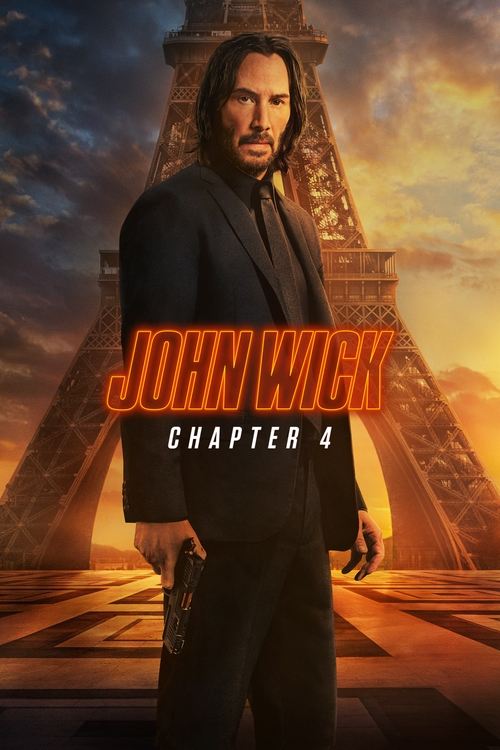
John Wick: Chapter 4
2023 · Chad Stahelski
For when you want spectacle — the movie you put on the biggest screen you can find, sound up, phone away, ready to be floored. Zero homework required beyond knowing who John Wick is.
What it's about
With the bounty on his head climbing ever higher, John Wick finds one last path to freedom: an old rule that could force the High Table to release him, if he can survive long enough to invoke it. Standing in his way is a new adversary with global reach and the power to turn Wick's oldest friends against him. The fight sprawls from Osaka to Berlin to a long night in Paris, staged as a series of escalating duels.
The experience
Nearly three hours of pure momentum — operatic, gorgeous, and exhausting in the best way, with action sequences that keep topping themselves until you're laughing in disbelief. Underneath the mayhem runs a surprising vein of melancholy about loyalty and what freedom costs.
Performances
Keanu Reeves does more with weary silence and physical commitment than pages of dialogue could, and Donnie Yen nearly steals the film as a blind assassin whose every fight is equal parts lethal and playful. Bill Skarsgård makes aristocratic villainy genuinely hateable.
The craft
Chad Stahelski's stunt-team pedigree shows in every frame: long, wide takes that let you see real bodies doing real choreography, a top-down sequence staged like nothing else in the genre, and a Paris finale built around one of cinema's most punishing staircases. The neon-drenched cinematography and thundering sound mix make this a definitive big-screen, good-speakers film.
Why it matters
The commercial and artistic peak of a franchise that reshaped modern action cinema, cementing the long-take, choreography-first style as the standard a generation of imitators now chases.
Snapshot
John Wick: Chapter 4 is the fourth and longest entry in the franchise built around Keanu Reeves's grieving, near-mythic assassin, and it functions as both a summation of the series' formal experiments and its most self-consciously operatic statement. Where the first film (2014) was a lean revenge picture, Chapter 4 is a sprawling, roughly 169-minute international odyssey that moves from a desert reckoning through Osaka, New York, Berlin and finally Paris, structured less as a plot than as a sequence of escalating ritual combats. Directed by former stuntman Chad Stahelski, it consolidates the "gun-fu" house style — long-take, wide-framed, choreography-forward action — while pushing it toward the abstraction of the video game and the ceremonial grandeur of the samurai duel and the spaghetti western. It is the franchise's most ambitious and, by broad critical consensus, its most fully realized action showcase.
Industry & production
The film was produced by Basil Iwanyk's Thunder Road Pictures alongside Erica Lee, with 87Eleven Action Design — the stunt-and-action company Stahelski co-founded with David Leitch — central to its physical production. Lionsgate distributed. The John Wick films have been, for Lionsgate, a rare wholly-owned tentpole property that grew from a modest genre release into a flagship franchise, and Chapter 4 represents the studio's largest investment in the world to date, with a production that expanded location shooting across Europe and Japan.
Production spanned multiple countries, with major sequences staged in Berlin, Paris and Japan, and an arid desert opening. The scale — a large ensemble of international performers, extended vehicular and crowd choreography, and practical set-piece construction — reflects a deliberate strategy of physical spectacle over digitally-generated action. The exact budget and box-office totals are matters of public record I won't reproduce here to avoid misstating figures, but the film was positioned as, and performed as, the commercial high point of the series and directly seeded further franchise expansion (the spin-off Ballerina and the Continental television project). The production was also marked by the death of Lance Reddick shortly before release; his performance as Charon became a valedictory one.
Technology
Chapter 4 is notable for foregrounding practical, in-camera technique in an era of heavy digital augmentation. The action was built primarily around real stunt performers, live squib-and-blank gunplay aesthetics, real vehicles, and physical fire effects rather than fully synthetic set pieces. The most-discussed technical achievement is the "Dragon's Breath" sequence — a Parisian shootout captured largely in an overhead, top-down bird's-eye framing as Wick clears rooms with an incendiary shotgun. This required specialized rigging to sustain the elevated camera through continuous action and careful coordination of practical fire effects, and it explicitly imports the visual grammar of the twin-stick shooter or God's-eye video game into live-action.
Digital tools were used, as they are everywhere in contemporary action, for stitching, cleanup, wire removal and environmental extension, but the film's identity rests on visible, verifiable physical performance. The Arc de Triomphe roundabout sequence, staging sustained combat amid moving traffic, similarly depends on precision vehicle stunt work and camera cars rather than simulation. This commitment to legibility — the audience seeing that a real body performed a real action — is itself the franchise's central technological argument.
Technique
Cinematography
Dan Laustsen, returning from Chapters 2 and 3, shoots in a saturated, high-contrast neon idiom that has become the series' signature: pools of colored light — cyan, magenta, gold — cutting through darkness, wet reflective surfaces, and deep, glossy blacks. His work draws on a lineage of stylized nocturnal cinema and on his own collaborations with Guillermo del Toro. Crucially, Laustsen frames action wide and holds it, keeping full bodies in frame so choreography reads clearly; this is the antithesis of the fragmented, close-cut action orthodoxy of the 2000s. The Osaka Continental glows amber and jade; the Berlin nightclub is bathed in club-light strobe and water; the Paris finale moves from the top-down incendiary reds to the cold blue of a dawn duel. The camera is mobile and elegant but rarely frenetic — its movement clarifies rather than obscures.
Editing
The film is credited to editor Nathan Orloff. Its editorial logic is inseparable from its cinematography: cuts tend to come at the ends of complete actions rather than within them, preserving the spatial and physical continuity that lets the audience track cause and effect. Despite its considerable length, the film's rhythm is built on the buildup-and-release structure of set pieces, with quieter ceremonial passages (the recitations of High Table protocol, the negotiations) pacing the combat. The overhead Paris sequence is a particular editorial feat, sustaining tension across a long, continuous-feeling traversal of rooms.
Mise-en-scène / staging
Staging is the true auteur signature here. Stahelski's background as a fight and stunt coordinator means action is choreographed and blocked with the density of dance. Environments are designed as arenas — the mirrored Osaka rooms, the trafficked roundabout, the 222 steps of the Sacré-Cœur staircase that Wick must ascend for the climactic duel. The staircase becomes an almost allegorical space: progress measured in falls and re-climbs. Costume and world-design reinforce the ritual: bespoke bulletproof suits are treated as armor, the villain Marquis is dressed in dandyish couture, and the Continental hotels function as neutral temples with their own liturgy. Recurring motifs — the ceremonial marker coins, the tattooed switchboard operators, the ossuary of assassin culture — build a coherent parallel society.
Sound
The score is by the franchise's established composers, Tyler Bates and Joel J. Richard, blending pulsing electronic textures with orchestral swell; music is frequently diegetically motivated (club DJs, radio broadcasts). A memorable device is the pirate-radio DJ who narrates the manhunt over the airwaves, an homage to Walter Hill's The Warriors that turns the city itself into a soundstage announcing Wick's bounty. Sound design privileges the percussive specificity of gunfire, impact and breaking glass, and the film uses silence and the labored sound of Wick's own exhaustion — his breathing, his falls — as emotional punctuation.
Performance
Keanu Reeves gives a performance defined by economy and physical endurance; John Wick speaks little, and Reeves conveys grief, resolve and fatigue through movement and stillness. The film's great addition is Donnie Yen as Caine, a blind assassin bound by obligation, who brings both martial-arts virtuosity and a wry, melancholy humanity that nearly rebalances the film around him. Bill Skarsgård plays the Marquis de Gramont as a preening, cruel aristocrat, a bureaucratic embodiment of the High Table. Shamier Anderson's Tracker (Mr. Nobody) and his dog add a mercenary counter-melody; Hiroyuki Sanada lends gravitas as Shimazu; Rina Sawayama makes a notable acting debut as Akira; Scott Adkins is nearly unrecognizable under prosthetics as Killa. Ian McShane (Winston), Laurence Fishburne (the Bowery King) and Lance Reddick (Charon) reprise their roles, Reddick's for the last time.
Narrative & dramatic mode
The dramatic mode is mythic and ritualistic rather than psychological. Chapter 4's plot is a quest for release: Wick seeks to end his war with the High Table, and the mechanism the film settles on is not escape but the oldest of narrative resolutions — a formal duel. The screenplay by Shay Hatten and Michael Finch organizes the film around codes, debts and challenges, so that violence is always framed as the settling of obligation. This gives the film the shape of a chivalric romance or a samurai tale: the hero must observe protocol, secure a champion's right, and meet his adversary at an appointed dawn. Character interiority is externalized into ceremony. The result is emotionally legible without being verbose — the stakes are freedom, honor, and rest, and the film treats Wick's exhaustion as its true subject.
Genre & cycle
The film sits at the apex of the 2010s neo-action cycle that the first John Wick helped inaugurate — a movement (advanced by 87Eleven alumni including David Leitch's Atomic Blonde and the Deadpool films) that reasserted clear, choreographed, stunt-driven action against the shaky-cam and quick-cut conventions of the preceding decade. Chapter 4 is also a deliberate anthology of genres: the samurai film (chanbara), the Hong Kong heroic-bloodshed picture, the spaghetti western, and the martial-arts tournament film. Its concluding dawn duel is pure Leone; its Osaka and Caine material is chanbara and wuxia; its rhythmic gunplay descends from John Woo. The film knowingly synthesizes these traditions into a single late-franchise statement.
Authorship & method
Chad Stahelski is an action auteur in the most literal sense: a former stunt performer (including as Reeves's stunt double on The Matrix) and stunt coordinator whose authorship is expressed through choreography, blocking and physical world-building rather than dialogue or conventional dramaturgy. His method — developed at 87Eleven with co-founder David Leitch, who co-directed the first film uncredited — centers on extensive pre-visualization through "previs" stunt rehearsal, in which fight sequences are fully worked out and filmed by the stunt team before principal photography. This makes the action the script's true draft.
His key collaborators form a stable authorial unit: cinematographer Dan Laustsen (the neon-noir look), composers Tyler Bates and Joel J. Richard (the electronic-orchestral pulse), editor Nathan Orloff, and writers Shay Hatten and Michael Finch (the ritual-legalistic world). Reeves is a co-author in practice, having trained extensively in firearms, judo and jiu-jitsu to perform the action himself, which is the precondition for the wide-framed style. The consistency of this team across entries is what gives the franchise its unusually coherent formal identity.
Movement / national cinema
Though an American studio production, Chapter 4 is programmatically transnational, both in setting and in aesthetic debt. It is best understood as the product of a global action lineage: American stunt-craft culture (Hollywood's stunt community, from which Stahelski emerged) fused with Hong Kong action cinema, Japanese samurai and jidaigeki tradition, and Italian and Hollywood western form. The casting of Donnie Yen and Hiroyuki Sanada, and the extended Japanese sequence, are not decoration but an explicit homage to those cinemas. The film thus belongs to a contemporary hybrid action idiom rather than to a single national school — a synthesis characteristic of 87Eleven's globally-sourced approach.
Era / period
Chapter 4 is a document of early-2020s blockbuster filmmaking at a pivotal moment: the reassertion of the theatrical event film and of practical, spectacle-driven action after a period in which such craft was often subordinated to digital spectacle or franchise homework. It arrived as audiences returned to cinemas following the pandemic-era disruption, and it was widely read as evidence that legible, physically-executed action could still command a large theatrical audience. It also crystallizes the decade's taste for elaborate franchise "world-building" — the High Table mythology functions like the lore-scaffolding common to the era's genre properties, even as the film uses that scaffolding to earn a genuinely classical, closed ending.
Themes
The film's abiding themes are freedom and its cost, honor and obligation, and exhaustion as the price of survival. Wick's entire arc is a bid to convert an endless cycle of violence into a single decisive, rule-bound reckoning that can finally purchase rest. Ritual and code are everywhere: the High Table is a bureaucracy of death, and the film's tension lies between the humanity of individual killers (Caine's paternal love, Wick's grief for his late wife) and the impersonal machinery that binds them. The recurring image of the man of violence longing for peace — for a way out that is not simply more killing — gives the spectacle a melancholy undertow. The staircase climax literalizes the theme: freedom lies at the top, reached only through repeated falling and rising.
Reception, canon & influence
Chapter 4 was received by the majority of critics as the strongest entry in the series and among the most accomplished pure-action films of its moment, praised especially for the clarity, invention and sustained ambition of its set pieces (the top-down Paris shootout, the Arc de Triomphe traffic battle, and the Sacré-Cœur staircase duel were singled out repeatedly). Common critical reservations concerned its considerable length and the thinness of its plotting relative to its spectacle. I'll avoid quoting specific aggregate scores or box-office totals to prevent misstatement, but the qualitative consensus was strongly positive and the commercial performance was the franchise's best.
Backward, the film's influences are its declared inspirations: the duels of Sergio Leone, the heroic-bloodshed gunplay of John Woo, the samurai cinema of Akira Kurosawa and the chanbara tradition, the martial-arts film (Enter the Dragon and Yen's own wuxia lineage), Walter Hill's The Warriors, and the top-down aesthetics of video games (frequently compared to titles like Hotline Miami). Forward, its legacy is twofold: it immediately expanded the franchise into spin-off and television territory (Ballerina, The Continental), and it further entrenched the wide-framed, choreography-first, stunt-authored action style — championed by Stahelski and the broader 87Eleven diaspora — as the reigning benchmark for the form. Its most lasting influence may be as proof-of-concept: that the action director-as-auteur, working from physical craft rather than spectacle-by-committee, can produce work of genuine formal ambition.
Reception
Arrived in 2023 as the best-reviewed and biggest-grossing entry in the franchise, hailed as a maximalist action landmark. Since then it's become Exhibit A in the case for stunt work as art — routinely cited in the push that led the Academy to finally announce a stunt design Oscar.
How John Wick: Chapter 4 was received, from release to now →
How to watch John Wick: Chapter 4: what to notice on a first viewing
- Watch how far back the camera stays during fights. Laustsen and Stahelski hold wide shots through entire exchanges, rarely cutting inside a punch or gunshot, so every move stays visible. This lets you see the choreography as choreography, not just impact.
- Notice the cyan, magenta and gold light flooding each room. Laustsen bathes each location in a different saturated color, from Osaka's amber-jade glow to Berlin's strobing club light. The color coding gives you a visual map of Wick's journey without dialogue.
- Listen for the pirate-radio DJ narrating the manhunt over the airwaves. The DJ's broadcasts turn the whole city into an audience watching Wick's bounty rise, echoing the crowd narration of The Warriors. It makes the manhunt feel public and total, not just a private chase.
- Watch how little John Wick speaks and how much he breathes. Reeves carries grief and fatigue through posture, breath and stillness rather than lines, especially as the film wears him down. His exhaustion becomes the film's real emotional register, more than any dialogue.
- Notice that cuts land only after a move fully finishes. Editor Nathan Orloff waits until an action completes before cutting, preserving the physical continuity of every strike and fall. You always know exactly what just happened to whom.
The whole guide to watching John Wick: Chapter 4, with the keys for a rewatch →
Influences: the films it descends from and the films it influenced
- The Matrix (1999) — Stahelski was Reeves's stunt double here and absorbed Yuen Woo-ping's doctrine of drilling the star until combat can be shot in held wide masters — the readable, uncut full-body performance that became John Wick's founding rule.
- Hard Boiled (1992) — Woo's sustained teahouse-and-hospital gunfights, choreographed as continuous balletic movement with reloads and body-mechanics kept in frame, are the direct template for JW4's 'gun-fu' as dance rather than montage.
- The Killer (1989) — Establishes heroic-bloodshed grammar — the two-gun stance, the professional killer bound by a sacrificial code, and the sacred/church shootout — that JW4 restages almost devotionally in its ritual duels.
- The Good, the Bad and the Ugly (1966) — Leone's ritualized standoff — escalating cross-cuts between eyes, hands, and holsters before a single decisive report — is the editing DNA of JW4's Sacré-Cœur staircase duel and its dawn confrontation.
- Yojimbo (1961) — The chanbara ideal of the lone wanderer whose swordsmanship resolves in one clean, instantaneous cut supplies JW4's chanbara-inflected rhythm of long patience punctured by a single terminal strike.
- Le Samouraï (1967) — Melville's near-silent, ritual-bound hitman — minimal dialogue, procedural gesture, an underworld governed by codes — is the performance and world-building blueprint for Wick's exhausted, near-mute professionalism.
- The Warriors (1979) — A declared source: the episodic gauntlet across a stylized nocturnal city populated by themed factions, narrated by an omniscient diegetic radio DJ — the exact device JW4 borrows for its broadcast contract-bounty announcer.
- Enter the Dragon (1973) — Supplies the tournament-gauntlet architecture and, via Donnie Yen's Bruce Lee lineage, the insistence on framing an authentic martial artist head-to-toe so technique reads as craft, not cutting.
- Ip Man (2008) — Yen's Wing Chun screen-persona — economical, wide-framed close-quarter chain-punching performed in-camera — is imported wholesale into Caine, whose blind swordplay extends Yen's full-body-in-frame method.
- Hotline Miami (2012) — The neon top-down massacre videogame directly informs JW4's overhead bird's-eye Paris apartment shootout, whose god's-eye tracking and Dragon's-Breath muzzle flares translate a game's spatial logic into cinema.
- Nobody (2021) — Written by JW creator Derek Kolstad, it transplants the ritual-legalistic underworld and bruising, endurance-based close-quarters brawling (the bus fight) directly out of the Wick playbook.
- Drunken Master III (1994) — Rebuilds action around long lateral takes and full-figure framing that refuse to hide technique inside cutting — an explicit revival of the Shaw-era grammar DM3 represents in its last unprotected form.
- Extraction (2020) — Hargrave, an 87Eleven stunt coordinator turned director, extends the diaspora's faux-continuous action into an eleven-minute stitched 'oner,' the stunt-team-as-authors model JW4 canonized.
- Monkey Man (2024) — Patel's neo-action revenge picture openly inherits JW's knife-and-gun-fu vocabulary and the exhausted-hero physicality, filtered through Indian mythology — the action-auteur model proliferating post-Wick.
- Ballerina (2024) — The direct franchise spin-off operationalizes JW4's proof-of-concept — the 87Eleven previs-rehearsal pipeline, neon-noir Laustsen palette, and ritual-world staging — as a transplantable house style.
- Atomic Blonde (2017) — Leitch (Stahelski's 87Eleven co-founder) built the stairwell 'oner' that foregrounds fatigue and stumbling recovery — the same physical-endurance realism, staged in unbroken wide takes, that JW4 pushes further.
- The Raid 2 (2014) — Evans's kitchen and car-chase set pieces prove the choreography-first thesis — action pre-designed as the film's true script and shot to let silat read cleanly in wide frame — that JW4 shares as parallel gospel.
- Kingsman: The Secret Service (2014) — The church massacre's whip-panned, speed-ramped single-take gun-fu is a contemporaneous experiment in continuous choreographed gunplay staged for legibility, kin to JW's long-take doctrine.
- Mad Max: Fury Road (2015) — Miller's commitment to practical, in-camera vehicular stunt spectacle — real bodies and rigs over CGI — is the stunt-authored ethos JW4 mirrors in its Arc de Triomphe traffic battle.
Similar films
- The Raid 2 (2014) — influence & lineage
- The Matrix (1999) — influence & lineage
- Hard Boiled (1992) — influence & lineage
- The Killer (1989) — influence & lineage
- John Wick (2014) — shared sensibility
- The Furious (2026) — shared sensibility
- The Villainess (2017) — shared sensibility
- The Raid (2012) — shared sensibility
All the films related to John Wick: Chapter 4 →
Watch it with: curated runs of related films
- Real Machines, Real Stunts — A run of blockbusters that strap the camera to actual jets, cars, rigs and bodies — watch them together for the vertigo of action done for real.