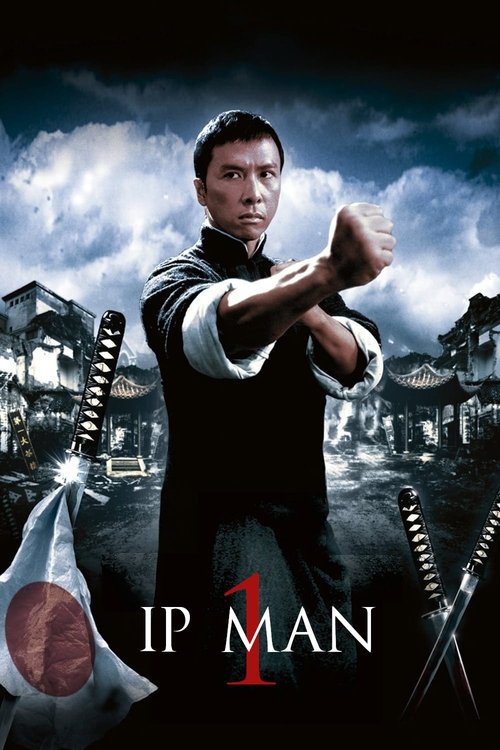
Ip Man
2008 · Wilson Yip
For when you want a crowd-pleaser with a spine — thrilling fights wrapped around a story of quiet dignity under pressure. Comfort viewing for action fans, with just enough history to make the cheering feel earned.
What it's about
Foshan in the 1930s is a city crowded with martial arts schools, and its most respected fighter is Ip Man — a wealthy, unfailingly polite family man who practices Wing Chun for love, not glory, and refuses to take students. Then the Japanese occupation arrives, and the war strips him of his home, his comfort, and nearly his dignity, forcing a gentle master to decide what his art is actually for.
The experience
The first half is warm and almost playful, full of good-humored sparring; the second turns somber and furious, and the fights start to carry real moral weight. The action is fast, clean, and legible — you feel every strike land — and the film builds to confrontations that are genuinely rousing.
Performances
Donnie Yen gives the role a stillness and courtesy that makes his explosions of speed startling — it's the performance that redefined his career, a fighter played as a gentleman first.
The craft
Sammo Hung's fight choreography is the star of the making: rapid-fire chain punches, close-quarters exchanges shot so you can follow every beat, escalating from friendly duels to desperate combat. The period recreation of pre-war and occupied Foshan is handsome and specific, and the action rewards a big screen where the speed reads clearly.
Why it matters
It became one of the biggest Hong Kong hits of its decade, launched a four-film franchise, revived global interest in Wing Chun, and turned Donnie Yen into an international star.
Snapshot
Wilson Yip's Ip Man is a semi-biographical martial arts epic set against the Japanese occupation of Foshan during the Second Sino-Japanese War, tracing the early life of Wing Chun grandmaster Yip Man — who would later teach Bruce Lee — from his comfortable pre-war existence as a gentleman-scholar of combat through the humiliations and moral crucibles of occupation. Starring Donnie Yen in a career-defining performance and featuring fight choreography by Sammo Hung, the film welds the classical Hong Kong kung fu picture to the patriotic historical drama that had found commercial traction in post-handover mainland China co-productions. It became one of the highest-grossing Hong Kong films of its decade, launched a franchise of four sequels, and reanimated global interest in Wing Chun as a martial art and in Donnie Yen as an international action star.
Industry & production
Ip Man was produced by Raymond Wong's Mandarin Films in co-production with China Film Group Corporation, a structure that positioned it explicitly for simultaneous release in Hong Kong and on the mainland — a commercial calculus that was reshaping the Hong Kong industry throughout the 2000s. The post-1997 integration of the two markets had opened mainland theatrical access to Hong Kong productions that met certain content and co-production criteria, and Mandarin Films had become adept at navigating those requirements. The choice of the Second Sino-Japanese War as a backdrop was far from accidental: stories of Chinese resistance to Japanese aggression enjoy broad audience sympathy and cultural prestige across both markets, and the historical frame provided ideological shelter for what might otherwise have been a more parochially Cantonese cultural product.
The project emerged from a long creative partnership between Wilson Yip and Donnie Yen, who had already collaborated on SPL: Sha Po Lang (2005) and Flash Point (2007), films that had revitalized Hong Kong action cinema through a gritty, MMA-inflected approach to hand-to-hand combat. Ip Man represented a deliberate pivot toward period classicism — the kung fu biopic — while retaining the technical and kinetic ambitions of that earlier work. The screenplay was written by Edmond Wong, who worked from historical research on Yip Man's documented biography while exercising considerable creative license over character and event, particularly in dramatizing confrontations with Japanese forces for which no documentary record exists. The filmmakers consistently acknowledged the film's status as dramatization rather than biography.
Sammo Hung was brought in as action director, giving the project immediate legitimacy within the Hong Kong martial arts tradition. Hung, a second-generation product of the China Drama Academy and one of the architects of Hong Kong's New Wave action cinema, brought both technical mastery and historical credibility: as a filmmaker who had worked with Bruce Lee and co-founded the "Lucky Stars" school of physical comedy-action, his presence signaled continuity with the very tradition Yip Man had partly seeded.
Technology
Ip Man was shot on 35mm using anamorphic lenses, a choice that aligned the production with prestige period filmmaking and allowed for the wide compositional framing necessary to capture Wing Chun's close-range spatial dynamics without losing context. The film predates the industry's wholesale migration to digital acquisition; its grain and tonal warmth are organic to the medium rather than artificially imposed in post. Digital intermediate color grading was used to push the film's palette — a warm amber-sepia dominates the pre-war Foshan sequences, while the occupation period shifts toward cooler, more desaturated tones that carry unspoken emotional weight without editorial comment.
The action sequences required exceptional camera coordination to render Wing Chun legibly. The art's emphasis on the centerline, on chi sao (sticky-hands sensitivity drills), and on rapid chain-punching at close range is inherently difficult to photograph — too close and the geometry collapses; too far and the specificity of technique is lost. Yip and cinematographer O Sing-pui deployed a flexible strategy: sustained wide shots in key confrontations to honor the choreography's spatial logic, punctuated by selective close inserts of hands, forearms, and foot placement to reinforce technical specificity. The use of high-speed photography (overcranked slow-motion) is restrained, deployed for emphasis in climactic moments rather than as a default aesthetic mode, which gives those moments heightened weight.
Technique
Cinematography
O Sing-pui, a longtime collaborator of Wilson Yip, photographs Foshan as a city of warm interiors and shallow depth — a society of close relationships and contained pleasures. The pre-war sequences favor lamplight and diffuse day-light filtering through latticed windows, giving the domestic world a golden fragility. As occupation takes hold, the visual grammar opens outward into bleaker, more exposed spaces: the converted factory where laborers are kept, the Japanese military compound, the rain-slicked streets of deprivation. The camera is predominantly stable and observational in dramatic scenes, reserving dynamic movement for the choreographed sequences. In the film's most celebrated set piece — Ip Man's one-against-ten match against Japanese black belts — the camera occupies a position of respect, holding in medium-wide shots long enough for the viewer to read Yen's spatial mastery before cutting into tighter coverage.
Editing
Cheung Ka-fai's editing orchestrates a dual tempo: the drama portions move with stately deliberateness appropriate to a period prestige picture, while the action sequences deploy faster cutting that nonetheless respects rather than conceals the performers' technique. Hong Kong action editing of the 1980s and 1990s had occasionally descended into a cut-every-second obscurantism that prioritized kinetic sensation over legibility; Ip Man makes a principled correction, frequently holding shots long enough that Donnie Yen's movement can be traced and comprehended. The intercutting in the climactic fight against General Miura draws on classical dramatic editing — tension by parallel montage — but grounds the emotional stakes in the physical reality of the bodies in the frame.
Mise-en-scène / staging
Production designer Kenneth Mak reconstructed a Foshan of the late Republican period that is readable as prosperous and culturally coherent before the war strips it of those qualities. The Yip household — spacious, lightly furnished, expressive of a genteel martial culture — establishes Ip Man's social position without exposition. The decision to stage the one-against-ten fight in a large open hall under cold fluorescent-adjacent light is striking: it removes the warmth of the pre-war spaces and places Ip Man in an arena context that aestheticizes his resistance while also exposing its isolation. Sammo Hung's choreographic staging uses the hall's depth intelligently, drawing opponents in waves from multiple quadrants to emphasize the centripetal logic of Wing Chun — the art designed to handle multiple attackers by controlling space and angles.
Sound
Kenji Kawai's score is a notable aesthetic choice: the Japanese composer, best known internationally for Mamoru Oshii's Ghost in the Shell (1995), brings a spare, atmospheric quality to the film's dramatic underscore. His music avoids the obvious heroic swells that might have characterized a more conventional patriotic epic, favoring restrained string figures and occasional solo instruments that keep emotional temperature just below the surface. The sound design for the Wing Chun sequences emphasizes the percussive crack and thud of chain-punching against body and wooden dummy — sounds specific to the art that function as authenticating detail while also providing rhythmic drive. The film's audio mix is careful not to aestheticize violence into abstraction; the physicality of impact is always present.
Performance
Donnie Yen's performance as Yip Man is the film's central achievement. Prior to Ip Man, Yen had been understood primarily as an action performer — formidably skilled but associated with a harder, more contemporary screen presence. Here he plays Confucian restraint: Ip Man is a man of almost excessive modesty and courtesy, whose willingness to fight is purely reactive, and whose violence, when it finally erupts, registers as the expression of moral principle rather than aggression. Yen calibrates the gradation from quiet domestic contentment to grief-stricken fury with considerable care; the one-against-ten sequence is devastating partly because it is preceded by so much stillness. Simon Yam brings warmth and a certain sorrow to the cotton mill owner Zhou Qingquan, grounding the film's social world. Hiroyuki Ikeuchi as General Miura — a soldier who genuinely respects martial arts — resists caricature, presenting an antagonist whose decency is constrained by institutional violence, a choice that adds moral complexity to an otherwise straightforward nationalist narrative.
Narrative & dramatic mode
Ip Man is structured as a classical rise-fall-redemption arc across two tonal registers. The first third operates as a light domestic comedy of manners: the great master surrounded by devoted students, gently embarrassing his wife through excessive hospitality to challengers, effortlessly sublime. The Japanese occupation collapses this world with abrupt cruelty, and the film transitions into a resistance narrative in which the personal loss of comfort and dignity is mapped onto collective historical humiliation. The dramatic engine is not suspense — the outcome is never in serious doubt — but rather moral escalation: each confrontation intensifies the stakes of what it means to resist, and the film explicitly frames Ip Man's final match against Miura as a performance of national dignity, witnessed and recognized as such by Chinese laborers in the gallery. The biopic convention of "showing the famous man before his fame" is adapted here to show the ethical formation of a figure whose later significance (as Bruce Lee's teacher) is gestured toward in the closing titles.
Genre & cycle
Ip Man belongs to a specific and durable genre cycle within Hong Kong cinema: the kung fu biopic or "martial saint" (wuxia adjacent) picture centered on a historical or legendary master. The cycle's most prominent antecedent in the sound era is Tsui Hark's Once Upon a Time in China series (1991–1997), which transformed Wong Fei-hung from a regional folk hero into a vehicle for anxieties about Chinese modernization and national identity. Jet Li's performance in those films established a template — the master as reluctant, philosophically grounded resister — that Ip Man both inherits and refines. More directly proximate is Corey Yuen's Fist of Legend (1994), which placed a Chinese martial artist in direct competition with Japanese challengers and engaged seriously with the ethics of combat and cultural exchange. Ip Man operates within this cycle while updating it for a post-handover, co-production-era market: the nationalism is less ambivalent, more assured, and the Wing Chun specificity gives it a documentary texture that the mythologized Wong Fei-hung never quite required.
Authorship & method
Wilson Yip emerged from Hong Kong's early 1990s genre workshop as a director of efficient, commercially astute entertainments before finding a more distinctive voice through his collaborations with Donnie Yen. His authorial signature is not immediately legible in the auteurist sense — he is not a stylist in the manner of Wong Kar-wai or Johnnie To — but his films share a consistent interest in male restraint under pressure and in the ethical dimensions of physical force. Ip Man is his most fully realized statement of these concerns. Edmond Wong's screenplay is central to the project's tonal coherence; his decision to ground the Japanese antagonist in a genuine respect for martial arts prevents the film from collapsing into propaganda, a choice Yip honors in his casting of Ikeuchi. Sammo Hung's action direction is not merely technical but interpretive: his choreography for Donnie Yen emphasizes economy and precision over spectacle, encoding the Confucian ethics of the character in the kinetics of his body. Kenji Kawai's score completes the aesthetic system by resisting triumphalism, keeping the emotional register simultaneously stirred and reflective.
Movement / national cinema
Ip Man occupies a complicated position within Hong Kong national cinema. Its production infrastructure, theatrical ambitions, and co-production structure make it a product of post-handover Hong Kong's integration into the mainland industry; its story, set in Guangdong and centered on a Cantonese cultural practice (Wing Chun is a southern Chinese art), expresses a regional identity that is absorbed rather than erased within a broader pan-Chinese nationalism. The film reflects the tension that has characterized Hong Kong filmmaking since 1997: the need to address mainland audiences and censors without entirely effacing the Hong Kong-specific cultural sensibility that gives its cinema its distinctiveness. The resolution in Ip Man is essentially to locate Hong Kong identity within a Chinese national framework rather than in opposition to it — the Foshan of the 1930s and the Hong Kong of Wing Chun practice share a Cantonese cultural substrate that the film treats as continuous with Chinese civilization rather than particular within it.
Era / period
The film was released in December 2008, at a moment of significant flux for Hong Kong cinema. The industry had been contracting since the mid-1990s, and the opening of the mainland market through co-production arrangements had created both opportunity and constraint. The global kung fu cinema revival that Bruce Lee had seeded and Jackie Chan and Jet Li had sustained was at something of a commercial ebb; The Dark Knight was the dominant action-cinema discourse internationally. Ip Man's commercial and critical success — it was among the top Hong Kong productions at the box office that year — demonstrated that period martial arts drama with high production values could still find a mass audience, and specifically that Donnie Yen, long a respected but not bankable figure, could carry a major production. The film appeared in the same year as The Wrestler and Slumdog Millionaire, suggesting the range of prestige filmmaking from which it sought to distinguish itself; within Chinese-language cinema, it competed with and outlasted numerous productions chasing the same co-production model.
Themes
The film's primary thematic preoccupation is dignity — specifically, the conditions under which dignity can be maintained in the face of material dispossession and cultural humiliation. Ip Man retains his moral center not through anger but through a Confucian composure that the film codes as the highest expression of martial virtue. The Wing Chun philosophy of simultaneous defense and offense — never initiating, always responding — becomes a structuring metaphor: resistance is ethical only when it is reactive, restrained, and in service of principle rather than ego.
National and ethnic pride function as the film's most legible and commercially calculated theme: the confrontation between Chinese martial arts and Japanese militarism is staged in explicitly symbolic terms, and the one-against-ten sequence is unambiguous as a set piece of national fantasy. Yet the film is most interesting where it complicates this register — in the figure of Miura, whose admiration for Wing Chun is genuine, and in the quiet acknowledgment that the real casualties of occupation are not martial duels but starvation and exploitation. Class inflects the narrative throughout: Ip Man is a wealthy man reduced to poverty, and his willingness to share martial arts knowledge with the laboring poor (rather than the established schools) is the film's most radical gesture, though it is not developed with the rigor it might have sustained.
Reception, canon & influence
Ip Man was a major commercial success upon release, earning strong returns in Hong Kong and performing well on the mainland — exact figures vary by source and the record is not consistently documented in accessible English-language scholarship, so precise claims should be treated cautiously. Critical reception was broadly enthusiastic, particularly for Donnie Yen's performance and Sammo Hung's choreography; the film was recognized by the Hong Kong Film Awards in multiple categories. English-language critical reception was favorable in genre circles, and the film found substantial second-life audiences through home video and streaming, becoming a reference point in discussions of martial arts cinema alongside the classic Shaw Brothers and Golden Harvest productions.
Looking backward, Ip Man draws on a long chain of influences: the Shaw Brothers period martial arts films of the 1960s and 1970s (particularly those directed by Chang Cheh and Lau Kar-leung); the kung fu revival cycle of the early 1990s centered on Jet Li; and the gritty contemporary action work that Yip and Yen had developed together in SPL and Flash Point. The presence of Sammo Hung links the production to the physical and pedagogical tradition of the Peking opera schools that produced Bruce Lee's generation of Hong Kong performers.
Looking forward, the film's influence is measurable and substantial. It directly generated three sequels from Wilson Yip (Ip Man 2, 2010; Ip Man 3, 2015; Ip Man 4: The Finale, 2019), each expanding the geographical and historical scope of the character's story, and a satellite industry of competing Ip Man productions including The Legend Is Born: Ip Man (2010) and Herman Yau's Ip Man: The Final Fight (2013). Most significantly, it prompted Wong Kar-wai to complete his long-gestating The Grandmaster (2013), which addresses the same biographical subject from a radically different aesthetic and philosophical position — effectively, the art cinema response to Ip Man's genre cinema. Beyond Yip Man specifically, the film is credited with a renewed international interest in Wing Chun as a practice, with enrollment in Wing Chun schools reportedly increasing in several countries following its release. Donnie Yen's profile was transformed: he became a genuinely international star, eventually joining the Star Wars franchise (Rogue One, 2016) in part on the strength of recognition built through Ip Man. The film stands, alongside Crouching Tiger, Hidden Dragon (2000) and Hero (2002), as one of the defining works of Chinese-language martial arts cinema in its contemporary phase.
A Deleuzian reading
Remember the stillness first.
The full Deleuzian reading of Ip Man →
Reception
A blockbuster in Hong Kong and China on release (it won Best Film at the 2009 Hong Kong Film Awards), it has since grown from local hit into the definitive modern kung fu movie — the film that relaunched the genre, spawned a whole franchise, and turned Donnie Yen into a global star in his mid-forties.
How Ip Man was received, from release to now →
Influences: the films it descends from and the films it influenced
- Once Upon a Time in China (1991) — Ip Man inherits wholesale the martial-saint-biopic structure Hark codified here: a historical kung fu master whose tournament victories against foreign opponents encode national dignity, with physical mastery standing in for civilizational pride under occupation — the same template transplanted from Wong Fei-hung to Ip Man.
- The Prodigal Son (1981) — Sammo Hung's own Wing Chun origin film establishes centripetal, simultaneous-block-and-strike economy as the correct kinetic language for the style — the choreographic grammar he applies directly, as action director, to Donnie Yen's body in Ip Man.
- Fist of Fury (1972) — Lo Wei's Bruce Lee film establishes the Sino-Japanese resistance narrative in kung fu cinema — Chinese martial artist defeating Japanese aggressors to avenge national humiliation — as the generic template Ip Man explicitly reactivates and expands into biopic form.
- Heroes Two (1974) — Chang Cheh's parallel montage intercutting a protagonist's escalating solo combat trials against sustained sequences of social humiliation, plus his overcranked slow-motion for martyrdom shots, supply the editorial architecture Ip Man's Japanese occupation passages directly inherit.
- The 36th Chamber of Shaolin (1978) — Lau Kar-leung's signature structure — progressive mastery of technique as moral formation, each physical discipline encoding a virtue — directly informs Ip Man's treatment of Wing Chun as ethical philosophy embodied in movement rather than mere martial skill.
- Ghost in the Shell (1995) — Kenji Kawai establishes his compositional restraint here — spare, ritual-inflected writing deliberately withheld from melodramatic crescendo — which Ip Man transplants intact: Kawai refuses to sonically glorify the Grandmaster's violence, preserving the Confucian emotional register against the nationalist pull of the narrative.
- SPL: Sha Po Lang (2005) — The Yip-Yen collaboration's foundational action grammar — cuts that prioritize showing the viewer exactly which body part strikes where — is the technical foundation Sammo Hung extends into Wing Chun's specific simultaneous-defense-attack mechanics in Ip Man.
- Drunken Master II (1994) — The highest synthesis of the early-1990s kung fu revival cycle: authentic southern Chinese technique filmed for anatomical legibility in a period setting, demonstrating that Lau Kar-leung's pedagogy-as-character-formation philosophy and populist spectacle could coexist — the commercial precedent Ip Man returns to in a serious key.
- Flash Point (2007) — Ip Man's immediate predecessor in the Yip-Yen collaboration tests MMA-inflected close-quarters combat edited for mechanical clarity — the legibility-first action philosophy that Ip Man then refines by applying it to Wing Chun's centerline economy rather than mixed-style brawling.
- Ip Man 2 (2010) — Extends the national dignity frame from Japanese occupation to British colonial Hong Kong, retaining Sammo Hung's Wing Chun choreographic language while substituting the political antagonist from Japanese general to British boxing champion — a structural test of the template's transportability that confirms the formula's logic.
- Legend of the Fist: The Return of Chen Zhen (2010) — Directly prompted by Ip Man's resistance-cinema template: Donnie Yen in the same national-dignity register — Bruce Lee's Chen Zhen fighting Japanese occupation — using the warm amber period palette and parallel montage structure established in Ip Man to signal heroic Chineseness in the post-handover coproduction market.
- Ip Man: The Final Fight (2013) — Satellite production using the same Wing Chun visual language but shifting to a melancholy register through Anthony Wong's aged performance — a tonal correction to Yip's heroic framing that demonstrates how the martial-saint template can be deflected toward elegy while retaining the same choreographic grammar.
- Master Z: The Ip Man Legacy (2018) — Yuen Woo-ping continues Sammo Hung's centripetal Wing Chun choreographic tradition but migrates it from sepia period cinematography to neon-drenched nocturnal urbanism, demonstrating that Ip Man's physical grammar persists across register and color-palette shifts as a transferable formal language.
- Rogue One: A Star Wars Story (2016) — Donnie Yen's casting as Chirrut Îmwe transplants centripetal Wing Chun economy and Confucian-restraint performance mode directly into Hollywood blockbuster space — his staff combat sequences apply Ip Man's legibility-first choreographic grammar to a genre context otherwise governed by wire-enhanced chaos.
- The Furious (2026) — Yen's rapid Wing Chun chain-punch cadence and centerline efficiency, a rhythmic template for the seed's economy-of-motion hand-to-hand.
- John Wick: Chapter 4 (2023) — Yen's Wing Chun screen-persona — economical, wide-framed close-quarter chain-punching performed in-camera — is imported wholesale into Caine, whose blind swordplay extends Yen's full-body-in-frame method.
- Fearless (2006) — The closest generic sibling: Jet Li as Huo Yuanjia employs the same martial-saint-biopic template — historical master defending national dignity against foreign fighters, rise-fall-redemption arc, overcranked heroic slow-motion — constituting the competing model against which Ip Man's more restrained Confucian register is legible.
- The Grandmaster (2013) — The art-cinema counterpart addressing identical biographical material: where Yip uses chronological biography and legible centripetal choreography, Wong applies fragmented memory structure and extreme temporal dilation, staging a formal debate about how to render Wing Chun on screen — each film's aesthetic choices are only fully intelligible against the other.
Similar films
- The Grandmaster (2013) — influence & lineage
- Once Upon a Time in China (1991) — influence & lineage
- The 36th Chamber of Shaolin (1978) — influence & lineage
- Drunken Master III (1994) — often watched together
- Duel to the Death (1983) — shared sensibility
- Kung Fu Panda (2008) — shared sensibility
- Kung Fu Hustle (2004) — shared sensibility
- Dragon Inn (1967) — shared sensibility