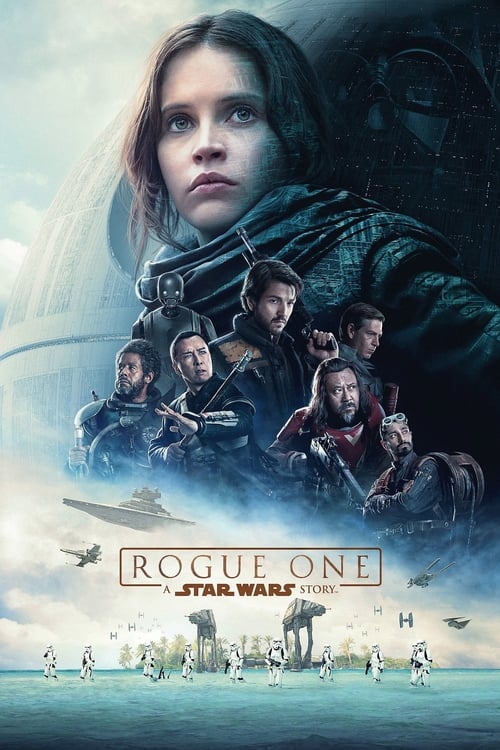
Rogue One: A Star Wars Story
2016 · Gareth Edwards
When you want blockbuster spectacle with real weight — a mission movie where the cost feels honest. Reach for it when regular franchise comfort food isn't enough.
What it's about
A galaxy away from farm boys and destiny, a reluctant loner named Jyn Erso is pulled into the Rebel Alliance and teamed with a hardened intelligence officer, a blind warrior-monk, a defected pilot, and a bluntly honest reprogrammed droid. Their mission: steal the plans to the Empire's planet-killing battle station. It's the story of the ordinary, expendable people whose work makes the famous victories possible.
The experience
Grim, tense, and grounded for a galaxy far away — this is a war movie first and a space adventure second, and it earns its stakes. The final act is a sustained, spectacular battle that leaves you wrung out in the best way.
Performances
Felicity Jones gives Jyn a flinty, guarded resolve; Ben Mendelsohn is silkily hateful as an ambitious Imperial officer; Alan Tudyk's droid K-2SO delivers the film's best lines with perfect deadpan; and Donnie Yen brings genuine physical grace and warmth as the blind believer Chirrut.
The craft
Gareth Edwards shoots the war handheld and ground-level, so Star Destroyers and walkers loom the way they would over an actual soldier. The beach-assault finale intercuts ground combat and space battle with bravura clarity, and Michael Giacchino's score honors the classic themes while going somewhere darker. It demands the biggest screen and best sound you can find.
Why it matters
It proved a standalone story could thrive inside the biggest franchise in film, brought an adult war-movie bleakness to a brand built on hope, and sparked an industry-wide debate about digitally recreating deceased actors.
Snapshot
Rogue One is the first standalone "Anthology" film in the Star Wars franchise, engineered to slot into a single sentence of the 1977 original's opening crawl: the story of how the Rebel Alliance stole the plans to the Death Star. Released in December 2016 under Disney-era Lucasfilm and directed by Gareth Edwards, it is a war-and-heist picture wearing space-opera costume — grittier, grimmer, and more morally shaded than the saga films it serves. Its ensemble of misfits fights and, almost to a person, dies to deliver a technical read-out that becomes the seed of A New Hope. The film is remembered for three things above all: a bleak, unusually adult tone for the brand; a technically bravura final act on the beaches of Scarif; and its digital resurrection of Peter Cushing's Grand Moff Tarkin, one of the most discussed visual-effects gambits of the decade.
Industry & production
Rogue One was the second film released after Disney's 2012 acquisition of Lucasfilm, arriving a year after The Force Awakens (2015). It was conceived to prove that the franchise could sustain a parallel line of self-contained "story" films outside the numbered Skywalker saga. The concept originated with John Knoll, the veteran Industrial Light & Magic visual-effects supervisor, who had pitched a Death-Star-plans heist idea years earlier; he receives a story credit alongside Gary Whitta, with the screenplay credited to Chris Weitz and Tony Gilroy.
The production is one of the more openly discussed cases of a modern tentpole reshaped in post. After principal photography, Lucasfilm ordered substantial reshoots in 2016, with Tony Gilroy brought in to rewrite and help restructure the film, particularly its third act and ending. Trade and press coverage at the time reported extensive changes; early marketing contained shots and beats absent from the finished film, which is a matter of public record even where the internal decision-making is not fully documented. The salient, verifiable outcome is that the released film commits fully to killing its principal cast — an ending widely understood to have been solidified through the reshoot-and-recut process rather than fixed from the first draft. Edwards remained the credited director; the collaboration with Gilroy is best described as a substantial creative rescue-and-consolidation, the precise division of labor between them not being something the public record settles cleanly.
Commercially the film was a major success, grossing more than one billion dollars worldwide, making it one of the highest earners of its year. That performance retroactively validated the Anthology model, even as Lucasfilm later paused the standalone line after the more troubled release of Solo (2018).
Technology
Rogue One is a landmark of large-format digital capture. Cinematographer Greig Fraser shot it substantially on the ARRI Alexa 65, a 65mm-sensor digital camera, giving the film an oversized, textured image with the shallow depth and heft associated with big-format photography. That choice served Edwards's ambition to make Star Wars feel physically present and photographed rather than assembled.
The most publicized technology, however, was character-based visual effects. ILM digitally recreated Grand Moff Tarkin, played in 1977 by Peter Cushing (who died in 1994), as a full performing CG character, using a live actor's on-set performance as the physical and motion basis and rebuilding Cushing's likeness over it. A comparable but briefer digital youthening produced a closing-shot Princess Leia in the image of a young Carrie Fisher. These were among the most ambitious "digital human" recreations attempted in a mainstream release to that point, and they became a durable reference point in debates about the uncanny valley and the ethics of resurrecting deceased performers. Reception of the effect was genuinely split — impressive as engineering, unsettling to many viewers — and the film is now routinely cited in discussions of posthumous digital performance.
Technique
Cinematography
Fraser's photography is the film's signature. He works in a naturalistic, war-reportage register — handheld coverage, longer lenses that flatten and crowd the frame, smoke and haze that lend atmosphere and scale. The large-format sensor produces a tactile, slightly documentary image at odds with the cleaner classicism of the saga films. Locations were shot for real where possible — Jordan's Wadi Rum for Jedha, the Maldives and other tropical exteriors for Scarif, Iceland for Eadu — and Fraser lights to preserve the sense that these are places, not backdrops. The result is a Star Wars that looks bombed-out and weathered.
Editing
The film is credited to three editors — John Gilroy, Colin Goudie, and Jabez Olssen — a division that reflects its heavily reworked post-production. The editing carries the film's most consequential creative decisions: the restructuring that produced its relentless, cascading finale and its unusually unsentimental death sequence, in which the ensemble is picked off in a chain of successive sacrifices. The cutting in the Scarif battle is dense and cross-cut across three theaters of action — ground assault, orbital dogfight, and the tower data-heist — sustaining momentum through a long, escalating climax.
Mise-en-scène / staging
Edwards stages for scale and human smallness. His recurring compositional idea, carried over from Monsters (2010) and Godzilla (2014), is the tiny figure dwarfed by the enormous object — troopers beneath a Star Destroyer, Jyn framed against the Death Star's silhouette rising over a horizon. Production design leans deliberately toward the "used future" and the direct visual continuity of the 1977 film: the costumes, control panels, and hardware are built to hand off seamlessly into A New Hope. Jedha's occupied holy city and the tropical-military incongruity of Scarif give the picture a lived-in, colonial-war texture.
Sound
Sound is central to the film's war-movie identity; it earned an Academy Award nomination for sound mixing. The climactic battle layers small-arms fire, the low registers of capital-ship maneuvers, and the franchise's established sonic vocabulary. The film also stages Darth Vader's most physically overwhelming sequence — a corridor slaughter near the end — in which sound design (breath, lightsaber, bodies) does much of the dramatic work.
Performance
The ensemble is intentionally spread and short on conventional arcs, a consequence of the film's war-movie premise that these are soldiers, not chosen heroes. Felicity Jones plays Jyn Erso as a hardened, reluctant recruit; Diego Luna's Cassian Andor is the film's moral center of gravity, a rebel operative introduced committing a cold execution, complicating the saga's usual clean heroism. Ben Mendelsohn's Orson Krennic supplies a mid-level-bureaucrat villainy — ambition thwarted by superiors — that is more careerist than mythic. Donnie Yen's blind, Force-devout Chirrut Îmwe and Jiang Wen's Baze Malbus form the film's emotional and physical anchor; Riz Ahmed's defector pilot Bodhi Rook and Forest Whitaker's damaged extremist Saw Gerrera round out the fringe. The standout is Alan Tudyk's motion-captured K-2SO, a reprogrammed Imperial droid whose deadpan candor carries most of the film's humor. Mads Mikkelsen plays Galen Erso, the reluctant Death Star engineer whose sabotage — a deliberate design flaw — is the hinge on which the entire saga's plot turns.
Narrative & dramatic mode
Structurally the film is a heist-and-suicide-mission war story whose ending is foreordained by a forty-year-old movie: the plans must be stolen and transmitted, and the audience knows they succeed. Its dramatic mode is tragic-instrumental. Rather than building toward triumph, it builds toward sacrifice, extracting suspense not from whether but from at what cost. This gives Rogue One an unusual shape for a blockbuster — a downbeat, ensemble tragedy in which nearly every named protagonist dies, and the "victory" is the mere transfer of information into the hands of characters we already know from 1977. The film pointedly omits the traditional opening crawl and John Williams's fanfare, signaling from the first frame its intent to sit slightly outside the saga's ritual grammar.
Genre & cycle
Rogue One belongs less to space opera than to the war film — specifically the men-on-a-mission and doomed-commando tradition of The Guns of Navarone, The Dirty Dozen, and the platoon picture, with a beach assault that consciously evokes World War II combat cinema and the visceral register of Saving Private Ryan. Critics also noted debts to Akira Kurosawa (a longstanding Star Wars lineage) in Chirrut and Baze's warrior-monk pairing. Within the franchise it inaugurated the "Anthology" cycle — self-contained genre exercises set in the established universe — a model that promised range (heist, war, western) before the line was suspended.
Authorship & method
Gareth Edwards came to the film from independent and mid-budget filmmaking — Monsters, made with tiny resources and self-supervised effects, and the American Godzilla — and his authorial fingerprint is the awe-and-scale sensibility both films share: naturalistic photography, human figures overwhelmed by vast objects, a preference for atmosphere over exposition. That sensibility survives strongly in the imagery even as the film's narrative architecture was reworked by others.
The key collaborators are unusually load-bearing here. Greig Fraser (cinematographer) defined the film's textured, large-format look and would go on to shoot Dune and The Batman, carrying a similar tactile aesthetic. Tony Gilroy (co-writer and creative force in reshoots) reshaped the film's spine and later became the defining author of its spin-off television series. The three-editor team executed the restructuring. And composer Michael Giacchino wrote the score under severe time pressure after Alexandre Desplat, originally attached, departed the project amid the schedule changes; Giacchino's music, reportedly composed in a matter of weeks, gestures toward Williams's idiom while introducing its own material — a workmanlike act of franchise stewardship under duress rather than a fully personal statement.
Movement / national cinema
The film is a product of the Hollywood-Disney tentpole system at its most globally calibrated, but it is notable for a deliberately international, multi-ethnic ensemble — Mexican, Chinese, British-Pakistani, and Danish leads among them — and for casting two major stars of Chinese-language cinema, Donnie Yen and Jiang Wen, in roles pitched partly at the global (and specifically Chinese) market. It is not the product of a national-cinema movement so much as an instance of globalized Hollywood consciously diversifying its faces and shooting on real international locations to sell a sense of a lived-in galaxy.
Era / period
Rogue One is a quintessential mid-2010s franchise object: made in the confident early stretch of Disney's Star Wars revival, shaped by the era's appetite for "gritty," morally grayer takes on established properties, and enabled by the period's leaps in large-format digital capture and digital-human effects. It also belongs to a moment of intense fan scrutiny and reshoot-driven tentpole filmmaking, in which troubled post-production became a semi-public genre of its own. Its adult, war-movie tone reads as a deliberate corrective to accusations that franchise cinema had grown weightless.
Themes
The film's controlling theme is sacrifice in the service of a cause whose reward the sacrificers will never see — hope as an act of faith rather than a guaranteed outcome, crystallized in its repeated insistence that rebellions are built on hope. Around this it develops the moral cost of resistance: Cassian's introductory murder, Saw Gerrera's corrosive extremism, and the Alliance's internal timidity all refuse the saga's usual clean line between light and dark. Faith is literalized through Chirrut's devotion to the Force as belief rather than power, since he wields none. Complicity and conscience run through Galen Erso, the engineer who builds the weapon in order to secretly doom it. And overarching all of it is the theme of the small and nameless — soldiers, pilots, a droid — whose anonymous deaths make the mythic victories of others possible.
Reception, canon & influence
Critically, Rogue One was received well though not rapturously: reviewers widely praised its final act, its visual scale, its tonal daring, and the K-2SO and Chirrut/Baze pairings, while a recurring reservation held that its ensemble was thinly characterized and its first two acts choppy — a criticism often read, fairly, as a symptom of its reworked structure. The digital Tarkin drew the most divided response, admired as a technical feat and rejected by many as uncanny. The film received Academy Award nominations for Visual Effects and Sound Mixing.
Its influences run backward to the WWII combat and doomed-mission film, to Kurosawa's warrior archetypes, and above all to the visual and narrative fabric of A New Hope (1977), into which it was engineered to dovetail frame-for-frame. Its forward legacy is substantial. It proved a Star Wars film could be a downbeat, R-adjacent war tragedy and still gross a billion dollars, expanding the perceived tonal range of the brand. It made Diego Luna's Cassian Andor a franchise cornerstone and directly seeded Andor (2022–2025), the Tony Gilroy–led series widely regarded as among the finest work the franchise has produced and a full flowering of Rogue One's political, morally serious sensibility. Its Vader corridor sequence became an instantly canonical fan touchstone. And its digital resurrections made it a permanent reference in the ongoing debate over synthetic and posthumous performance — a debate that has only intensified since. For a film whose plot is merely the delivery of a file, Rogue One left an outsized mark on both its franchise and the wider conversation about what film technology should be allowed to do.
A Deleuzian reading
A horizon on a desert moon, and something rising over it that is not a moon.
The full Deleuzian reading of Rogue One: A Star Wars Story →
Reception
Reviews in 2016 were solid but a shade cautious — 'good, not great' spinoff — yet it's since climbed to consensus best-of-Disney-era status, a reappraisal turbocharged when Andor retroactively made it the ending of prestige TV's favorite Star Wars story.
How Rogue One: A Star Wars Story was received, from release to now →
How to watch Rogue One: A Star Wars Story: what to notice on a first viewing
- Watch how small Edwards keeps people beside big objects. Troopers under a Star Destroyer. Jyn on a ridge with the Death Star coming up behind her. Edwards did this in Monsters and Godzilla, and he repeats it in almost every location here. Nobody has to explain the stakes. The composition tells you what these people are standing in front of.
- Notice the haze, the handheld shake, the crowded frames. Greig Fraser shoots on a 65mm sensor, handheld, with long lenses that flatten a street. Jedha was shot in Wadi Rum, Eadu in Iceland. Smoke and dust sit in the air. The grammar is war reporting. The film is buying the feeling that somebody stood in these places with a camera.
- Look at the switches, panels and uniforms in Imperial rooms. The hardware is built to hand off into the 1977 film without a seam: the same toggles, the same helmets, the same scuffed gray. Everything looks used and repaired. The design commits to a galaxy with a maintenance budget, and it sets up the film this one has to run into.
- Watch what Cassian does in his very first scene. Luna introduces Andor on a gantry with an informant. He gets what he needs, makes sure the man cannot talk, and walks away. The film gives him no speech about it afterward. You are told immediately that this rebellion does not run on clean hands, and nothing later walks that back.
- Notice that the film opens without a crawl or fanfare. No yellow text scrolling into space, no Williams brass over the title. Michael Giacchino's score gestures at that idiom but begins somewhere else. The ritual is skipped on purpose. The film announces in its first minute that it sits outside the saga's ceremony even while it serves it.
The whole guide to watching Rogue One: A Star Wars Story, with the keys for a rewatch →
Influences: the films it descends from and the films it influenced
- Star Wars (1977) — Reverse-engineered to dovetail frame-for-frame into its opening, replicating the blockade-runner interiors, X-wing squadron markings, model-and-miniature texture, and even splicing in reused deleted footage and matched costuming.
- The Hidden Fortress (1958) — Supplies the 'lowly figures smuggle the vital MacGuffin' structure Lucas borrowed, which Rogue One literalizes as expendable nobodies physically carrying the stolen Death Star plans.
- Seven Samurai (1954) — Source of the warrior-monk and doomed-band-of-fighters archetypes — Chirrut Îmwe's blind-swordsman spiritual discipline and the ragtag squad's willingness to die descend directly from Kurosawa's men.
- The Guns of Navarone (1961) — Template for the infiltration-commando-destroys-an-impregnable-superweapon plot; Scarif transposes its saboteur-squad architecture whole.
- The Dirty Dozen (1967) — Establishes the morally compromised, expendable commando unit sent on a one-way suicide mission in which the entire team is killed off.
- The Battle of Algiers (1966) — Newsreel-grammar handheld urban-guerrilla combat photography; the Jedha insurgent ambush borrows its documentary reportage staging of street fighting.
- Saving Private Ryan (1998) — The desaturated palette, tuned-shutter handheld chaos, and visceral concussive war sound mix that Rogue One's Scarif beach assault directly emulates.
- Black Hawk Down (2001) — Geographically immersive, chaotic modern-battlefield handheld coverage of soldiers pinned on a beachhead, a grammar the Scarif ground war adopts wholesale.
- Gladiator (2000) — Completed a dead actor's role (Oliver Reed) by grafting a CG face onto a double — the founding technical precedent for the fully digital Tarkin resurrection.
- The Curious Case of Benjamin Button (2008) — Pioneered photoreal CG heads driven by facial performance capture that fully replace the live actor, the pipeline lineage Tarkin and Leia were built on.
- Monsters (2010) — Edwards' own foundational method — naturalistic available-light photography, human figures dwarfed by vast forms, atmosphere privileged over exposition — carried straight into Rogue One's imagery.
- Godzilla (2014) — Perfects the tiny-figure-against-vast-object staging and awe-of-scale framing that becomes Rogue One's signature (the Star Destroyer over Jedha, the walkers on Scarif).
- Andor (2022) — Directly seeded by Rogue One's Cassian and reshoot architect Gilroy, who extends the film's grounded, morally serious political-resistance realism into long-form drama.
- Dune (2021) — Greig Fraser carries forward the Rogue One large-format tactile look — Alexa 65 capture, textured naturalism, human specks against monumental architecture.
- The Batman (2022) — Extends Fraser's Rogue One aesthetic of heavy shadow, practical-source available light, and large-format grain into noir register.
- The Rise of Skywalker (2019) — Reconstructs Carrie Fisher's Leia posthumously, extending Rogue One's synthetic-resurrection practice into performance assembled from archival material.
- The Mandalorian (2020) — Inherits Rogue One's lived-in, war-worn Star Wars texture and deploys the same digital-resurrection toolset to reconstruct a de-aged Luke Skywalker.
- Jurassic World Rebirth (2025) — Edwards's weathered tentpole texture and long-lens placement of a small ensemble on a one-way mission against vast hardware is the grounded blockbuster grammar Rebirth applies to dinosaurs.
- The Irishman (2019) — Parallel high-profile push in synthetic performance — full-face digital de-aging — that intensified the same debate over posthumous and manipulated actors that digital Tarkin opened.
- Jurassic World (2015) — Michael Giacchino applies the identical scoring approach he used here — original themes interwoven with direct Williams quotations — making the franchise-stewardship score a shared method.
- Star Wars: The Force Awakens (2015) — Extends the same Disney-era Lucasfilm commitment to practical models, in-camera miniatures, and weathered used-universe texture established as house style by TFA.
- Alien: Romulus (2024) — Pioneered the digital-resurrection of a deceased actor (Peter Cushing) for franchise continuity — the precise VFX technique and its 'ghoulish/uncanny' controversy that Romulus repeats with Ian Holm's Ash.
- Blade Runner 2049 (2017) — Sets the immediate technical and ethical precedent for the digital recreation of a performer — Tarkin's CGI resurrection one year before 2049's de-aged Rachael.
Similar films
- Star Wars (1977) — influence & lineage · same viewing thread
- Dune (2021) — influence & lineage
- The Hidden Fortress (1958) — influence & lineage
- Star Wars: The Force Awakens (2015) — same viewing thread
- The Empire Strikes Back (1980) — same viewing thread
- Star Wars: Episode II - Attack of the Clones (2002) — same viewing thread
- War for the Planet of the Apes (2017) — same viewing thread
- Star Wars: Episode I - The Phantom Menace (1999) — same viewing thread
All the films related to Rogue One: A Star Wars Story →
Watch it with: curated runs of related films
- The Blockbuster Sci-Fi Canon — A run of the effects-driven epics that taught modern audiences what a movie could feel like — from the desert planets of Star Wars to the rain of Blade Runner and the sands of Arrakis.