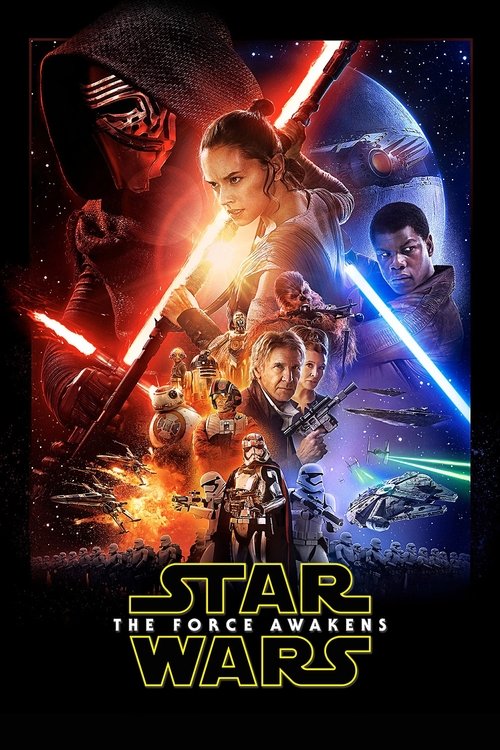
Star Wars: The Force Awakens
2015 · J.J. Abrams
For when you want pure popcorn adventure done with heart — a big, friendly crowd-pleaser you can watch with kids, parents, or anyone who's ever made a lightsaber noise. Comfort viewing on a blockbuster scale.
What it's about
Three decades after the fall of the Empire, a new menace has risen from its ashes, and the fight begins again. A scavenger scraping by on a desert planet and a stormtrooper who wants out find themselves carrying something the whole galaxy is hunting, while old heroes — Han Solo among them — are pulled back into the war. At the center of the storm is Kylo Ren, a masked enforcer with a volatile temper and a heavy legacy.
The experience
Fast, warm, and openly nostalgic — it moves like a serial adventure, cracks jokes mid-dogfight, and keeps landing beats that make a full theater cheer. Underneath the fun there's a real ache about time passing and old heroes grown older.
Performances
Daisy Ridley is an instantly winning discovery — scrappy, open-faced, easy to root for — and Adam Driver makes his villain fascinatingly unstable, more wounded than icy. Harrison Ford, back as Han Solo, gives the film its soul, playing the swagger with a new weariness.
The craft
Abrams shot for texture: real deserts, built sets, puppets and practical creatures alongside the digital spectacle, so the galaxy feels handmade again. John Williams returns with new themes woven into the old ones, and the dogfights — a freighter screaming through a wrecked star destroyer — are made for the biggest screen and loudest speakers you can find.
Why it matters
It relaunched Star Wars for a new generation and became one of the highest-grossing films ever made, proving a dormant franchise could be revived by returning to what people loved about it in the first place.
Snapshot
The Force Awakens was the first Star Wars feature produced under Disney's ownership of Lucasfilm, and the first not shepherded creatively by George Lucas. As such it functions less as a sequel than as a reset and reconsecration: a deliberate return to the textures, rhythms, and mythic grammar of the original 1977 film after the divisive prequel trilogy of 1999–2005. Directed by J.J. Abrams from a script he co-wrote with Lawrence Kasdan (co-writer of The Empire Strikes Back and Return of the Jedi) and Michael Arndt, the film reintroduces the saga's surviving original cast — Harrison Ford, Carrie Fisher, Mark Hamill — while building its narrative around new leads Daisy Ridley, John Boyega, Oscar Isaac, and Adam Driver. Its central project is continuity: re-establishing the franchise as a viable, recurring theatrical event after a decade's dormancy. The film was an enormous commercial success and a reference point for how legacy franchises could be revived, even as critics and fans debated whether its fidelity to the 1977 template constituted homage or repetition.
Industry & production
The film is inseparable from the corporate event that produced it: Disney's acquisition of Lucasfilm in 2012, announced alongside plans for a new trilogy. Kathleen Kennedy, installed as Lucasfilm president, oversaw the relaunch, with Abrams brought on to direct after Michael Arndt's early drafts. The production was a Bad Robot / Lucasfilm venture distributed by Walt Disney Studios.
Two production decisions defined the film's identity. First, Abrams committed publicly to a return to practical effects, location shooting, and physical creature and set work — a corrective to the heavily digital prequels. Principal photography took place at Pinewood Studios in England and on location, including desert exteriors in Abu Dhabi (standing in for the planet Jakku) and locations in Ireland and Iceland. Second, the production foregrounded the return of original-trilogy talent both in front of and behind the camera — most notably Kasdan's involvement, which signaled an intent to recover the screenwriting sensibility of the saga's most admired entry.
The film was a tentpole in the most literal sense: its release was a calculated re-establishment of Star Wars as an ongoing franchise feeding films, television, parks, and merchandising. It performed at the very top of the global box office; precise figures should be confirmed against the studio record, but it stands among the highest-grossing films of its era and was at the time among the largest domestic openings in history. Its success effectively validated Disney's acquisition strategy and launched the sequel trilogy plus standalone "Story" films.
Technology
The Force Awakens was shot largely on 35mm film, with select sequences captured in 65mm/IMAX — a choice consistent with both Abrams's stated preference for celluloid and the franchise's photochemical heritage. Cinematographer Daniel Mindel shot on Kodak stock, and the film's promotional discourse emphasized the use of large-format and film-based capture as a marker of authenticity against an industry trend toward digital acquisition.
Technologically the film is notable less for innovation than for synthesis: it married twenty-first-century digital compositing and CGI (handled principally by Industrial Light & Magic) with old-fashioned animatronics, puppetry, miniatures, and built sets. The droid BB-8 became the emblem of this approach — realized substantially as a practical rolling puppet on set rather than as a purely computer-generated character, which gave performers something physical to react to. Creature work by Neal Scanlan's team revived the hand-built alien aesthetic of the originals. The film thus represents a hybrid production methodology characteristic of the mid-2010s blockbuster: digital tools deployed in service of, and blended with, tangible photographed elements.
Technique
Cinematography
Daniel Mindel's photography pursues a deliberately tactile, naturalistic look: real desert light, anamorphic framing, and visible lens flares (an Abrams signature) that lend the image a sense of being photographed in a physical space rather than rendered. The film favors handheld and shoulder-mounted camerawork in action and combat, lending immediacy to lightsaber duels and the Jakku sequences, and it reserves wider, more composed framings for the planetary vistas. The desert exteriors recall the high-contrast clarity of the 1977 film's Tatooine, a visual rhyme that is part of the movie's broader strategy of recall.
Editing
Cut by Mary Jo Markey and Maryann Brandon — longtime Abrams collaborators — the film moves at a brisker, more propulsive pace than the original trilogy, reflecting contemporary blockbuster rhythm. The editing favors momentum and overlapping action threads, cross-cutting between the new protagonists' arcs. Critics have noted that this velocity, while effective, sometimes compresses moments of reflection; the film's structure hits the beats of A New Hope in roughly parallel sequence, and the editing reinforces that familiar escalation toward an assault on a planet-destroying superweapon.
Mise-en-scène / staging
Production design by Rick Carter and Darren Gilford reconstructs the "used universe" aesthetic — weathered, lived-in technology, scavenged hardware, grime and rust — that distinguished the original films from gleaming science-fiction convention. The downed Star Destroyer and crashed walkers on Jakku literalize the franchise's own history as ruin and relic, staging the new story amid the wreckage of the old. Costuming and set dressing consistently quote the originals while introducing the First Order's fascist-inflected design language, an escalation of the Empire's iconography.
Sound
John Williams returned to score the film, the only original-trilogy creative principal to work on every saga episode. His score reprises established leitmotifs — the Force theme, the main title — while introducing new material, notably "Rey's Theme" and the menacing motif associated with Kylo Ren and the First Order. Sound design by Skywalker Sound preserves the franchise's iconic palette (lightsaber hums, blaster fire, droid vocalizations) while extending it; Kylo Ren's crossguard lightsaber received a distinctively unstable, crackling sonic treatment that became one of the film's signature audio identities.
Performance
The film balances two performance registers. The returning cast — Ford especially, as a wearier, more rueful Han Solo — supplies continuity and emotional ballast, with Han's relationship to the new characters serving as the bridge between trilogies. Among the newcomers, Daisy Ridley's Rey anchors the film with an open, physically committed performance; John Boyega brings nervous comic energy and moral urgency to Finn, a defecting stormtrooper; and Adam Driver's Kylo Ren is the film's most discussed performance — a deliberately petulant, volatile antagonist whose insecurity inverts the implacable menace of Darth Vader. Oscar Isaac's Poe Dameron supplies a classic flyboy charisma.
Narrative & dramatic mode
Dramatically the film operates in the saga's established mythic-adventure mode: a hero's-journey structure, clear moral stakes dressed in fantasy archetype, and a tone that braids earnest mythology with quippy humor. Its narrative is openly cyclical — a desert orphan of mysterious parentage, a hidden map, a droid carrying vital information, a cantina of aliens, a superweapon to be destroyed — a structure many observers read as a near-recapitulation of A New Hope. The film foregrounds questions left deliberately open (Rey's lineage, the identity and history of Supreme Leader Snoke, the circumstances of Luke's exile), functioning as the first act of a serialized trilogy rather than a self-contained drama. Its emotional climax — the confrontation between Han Solo and his son Kylo Ren — converts franchise nostalgia into genuine dramatic weight, using the audience's history with the character as the source of the scene's devastation.
Genre & cycle
The Force Awakens belongs to the space-opera tradition Star Wars itself codified, and within that to the specific late-2010s cycle of legacy-sequel "requels" — films that revive dormant franchises by pairing returning veterans with new leads and consciously echoing the original's structure (a cycle that includes entries across the Jurassic, Mad Max, Blade Runner, and later Star Wars properties). It is a paradigmatic example of the franchise-revival blockbuster, and arguably the most influential in establishing the template: honor the original closely enough to satisfy nostalgia, while installing a new generation to carry the property forward.
Authorship & method
Authorship here is corporate and collaborative as much as individual. J.J. Abrams, the director, is an avowed Star Wars devotee whose method — practical effects, mystery-driven plotting (his "mystery box" approach), lens flares, and a reverent magpie's relationship to the films of his youth — shaped the project's sensibility. His prior revival of Star Trek (2009) made him the natural choice to resurrect a beloved property, and his approach to The Force Awakens is consistent: reverent reconstruction over reinvention.
The screenplay's most significant authorial presence is Lawrence Kasdan, whose return connected the film directly to the writing of The Empire Strikes Back; Michael Arndt's earlier story work fed into the eventual Abrams–Kasdan script. Daniel Mindel (cinematographer) and editors Mary Jo Markey and Maryann Brandon were Abrams regulars, ensuring stylistic continuity with his earlier work. John Williams (composer) provides the deepest line of authorship across the entire saga. Kathleen Kennedy, as Lucasfilm president, exercised producorial authorship over the franchise's overall direction. The film is best understood as the product of this constellation — a self-conscious act of stewardship in which the dominant creative principle was fidelity to an inherited style.
Movement / national cinema
The film is a Hollywood studio blockbuster, though physically a transnational production: financed and distributed by an American studio (Disney) but principally shot in the United Kingdom at Pinewood, with British craft labor and international locations. It belongs to no art-cinema movement; rather it sits within the global-industrial mode of the contemporary American tentpole, in which "Hollywood" filmmaking is materially produced across British and other facilities. Its aesthetic lineage is the American science-fiction and adventure cinema of the late 1970s that Star Wars itself helped define.
Era / period
Released in December 2015, the film is a document of mid-2010s franchise culture — an era defined by the consolidation of intellectual property under a few major studios (Disney's acquisitions of Lucasfilm, Marvel, and Pixar), the dominance of the shared-universe and serialized-saga model, and a marketplace organized around pre-sold properties. The Force Awakens both reflected and accelerated these conditions, demonstrating the commercial power of legacy revival at a scale that shaped studio strategy for the remainder of the decade.
Themes
The film's thematic preoccupations are, fittingly, inheritance and the burden of the past. Its characters are defined by lineage and legacy — Kylo Ren's anxiety of influence toward his grandfather Darth Vader, Rey's mysterious origins and longing for absent family, the older generation's failure passed down to the young. Abandonment and the search for belonging run through Rey and Finn alike. On a meta level, the film thematizes its own situation: it is a movie about the seductive, dangerous pull of the past, made by filmmakers grappling with the seductive, dangerous pull of their own franchise's history. The struggle between light and dark, the temptation of power, and the recurrence of conflict across generations restate the saga's foundational moral architecture.
Reception, canon & influence
Critical reception was broadly positive, with particular praise for the new cast (Ridley, Boyega, Driver), the return to practical filmmaking, and the film's energy and warmth — a relief after the prequels' coldness. The most persistent critical reservation, voiced widely, concerned the film's heavy structural reliance on A New Hope: reviewers and fans debated whether its closeness to the original was a virtue of restoration or a failure of imagination. This tension — nostalgia as both the film's greatest strength and its central limitation — has remained the dominant frame for its critical legacy.
Backward influences ON the film: most directly, the original Star Wars trilogy (1977–1983), whose plot architecture, visual design, and tone it reconstructs. Beyond that lie the same sources Lucas drew upon and that Abrams inherited at second hand — the serial adventure, the Western, Kurosawa, and Joseph Campbell's monomyth — now mediated through the franchise's own established conventions. Abrams's own Star Trek revival served as the proximate methodological model for reviving a legacy property.
Forward legacy / what it shaped: the film launched the Disney-era sequel trilogy, directly setting up The Last Jedi (2017, Rian Johnson) — which pointedly interrogated the nostalgia The Force Awakens embraced — and The Rise of Skywalker (2019, Abrams again). More broadly it became the defining commercial proof-of-concept for the legacy-sequel strategy, influencing how studios across the industry approached the revival of dormant franchises with veteran-plus-newcomer casting and structural echoes of beloved originals. Its commercial scale helped entrench the franchise-tentpole as the organizing logic of 2010s Hollywood. The full critical reappraisal of the film continues to evolve in dialogue with the trilogy it began, and its ultimate standing in the saga's canon remains contested rather than settled.
A Deleuzian reading
Begin with the wreck.
The full Deleuzian reading of Star Wars: The Force Awakens →
Reception
In 2015 it landed as a triumphant homecoming — rapturous reviews, record-shattering box office, a franchise resurrected. The retrospective take turned cooler: 'too safe,' 'a remake of A New Hope,' and its standing kept shifting as the divisive sequels recoloured what it set up.
How Star Wars: The Force Awakens was received, from release to now →
Influences: the films it descends from and the films it influenced
- Star Wars (1977) — TFA reconstructs its plot architecture wholesale — desert-orphan, secret map hidden in a droid, cantina menagerie, trench-run climax against a planet-killer — and inherits its 'used universe' production design and Williams leitmotif grammar.
- The Empire Strikes Back (1980) — Lawrence Kasdan's co-writing of TFA carries forward the same screenwriting voice and parentage-reveal structure he authored here, the direct line of saga authorship.
- Raiders of the Lost Ark (1981) — Kasdan's serial-adventure scene construction and breathless cliffhanger-to-cliffhanger set-piece pacing feed TFA's propulsive editing rhythm.
- Star Trek (2009) — Abrams's proximate methodological playbook — anamorphic lens flares, handheld kineticism, mystery-box plotting, and rebooting a dormant property with a young ensemble — is transplanted directly onto Lucasfilm.
- Super 8 (2011) — Abrams's own practical-effects-and-lens-flare Amblin-nostalgia mode, with child-eye wonder shot on anamorphic film, is the immediate stylistic rehearsal for TFA.
- The Hidden Fortress (1958) — The low-status-companion POV (peasants/droids) and graphic screen-wipe transitions Lucas borrowed are re-inherited by Abrams at second hand, structuring exposition through BB-8 and the wipe cuts.
- The Searchers (1956) — Ford's Western horizon staging — the lone figure framed against vast desert and the doorway-to-wilderness composition — informs the Jakku vistas and the homestead-orphan iconography.
- Alien (1979) — The grimy, lived-in 'used universe' of functional, weathered spacecraft interiors and practical model/creature work is a core debt of TFA's tactile design philosophy.
- Silent Running (1972) — The functional service-droid reimagined as a non-verbal emotional companion is the design lineage behind R2-D2 and BB-8's practical, expressive puppetry.
- Mission: Impossible III (2006) — Drives its plot on mystery-box withholding (Rey's parentage, the map fragment) as structural engine — the same 'pure unexplained object' storytelling first mass-deployed in III.
- The Last Jedi (2017) — Continues the trilogy TFA launched while pointedly interrogating the nostalgia-recapitulation engine Abrams built, subverting the legacy-requel grammar from within.
- The Rise of Skywalker (2019) — Abrams returns to double down on TFA's cyclical recapitulation and mystery-box deferral, closing the saga with the same fidelity-over-reinvention method.
- Top Gun: Maverick (2022) — Perfects the legacy-requel formula TFA commercially proved: a veteran star mentoring newcomers, plot beats echoing the original, and aggressively practical in-camera filmmaking.
- Blade Runner 2049 (2017) — A decades-later legacy-sequel that reactivates a dormant property with reverent design fidelity and analog-leaning practical craft, riding the revival wave TFA legitimized.
- Pacific Rim: Uprising (2018) — Mindel's anamorphic photography again, paired with the legacy-sequel structure of handing a beloved franchise to a charismatic young lead (Boyega himself) under a returning-mythology template.
- Spider-Man: No Way Home (2021) — Blueprints the legacy-sequel nostalgia economy: resurrecting original-cast figures as the film's core emotional payload and marketing surprise.
- Rogue One: A Star Wars Story (2016) — Extends the same Disney-era Lucasfilm commitment to practical models, in-camera miniatures, and weathered used-universe texture established as house style by TFA.
- Creed (2015) — Same-year exemplar of the legacy-requel template — torch-passing from an aging icon to a newcomer protagonist, with the new film structurally mirroring the franchise original.
- Jurassic World (2015) — Same-year proof of the dormant-IP revival strategy: reactivating a beloved blockbuster through nostalgic callbacks, returning iconography, and a fresh lead cast.
- Mad Max: Fury Road (2015) — Shares the 2015 practical-effects revival ethos — real stunts, physical vehicles, and in-camera spectacle privileged over CG — that TFA marketed as its central virtue.
- Doctor Sleep (2019) — Codified the legacy-sequel template of reverent iconographic callback and recast-icon reunion that Doctor Sleep applies to the Overlook's returning figures.
- Twisters (2024) — Cinematographer Dan Mindel's large-format anamorphic action-photography method — flare-laden widescreen practical shooting integrated with digital — carries directly into his lensing of Twisters' storm sequences.
Similar films
- Star Wars (1977) — influence & lineage · same viewing thread
- Rogue One: A Star Wars Story (2016) — influence & lineage · same viewing thread
- The Empire Strikes Back (1980) — influence & lineage · same viewing thread
- Star Trek (2009) — influence & lineage
- Jurassic World (2015) — influence & lineage
- Mad Max: Fury Road (2015) — influence & lineage
- Blade Runner 2049 (2017) — influence & lineage
- Raiders of the Lost Ark (1981) — influence & lineage
All the films related to Star Wars: The Force Awakens →
Watch it with: curated runs of related films
- The Blockbuster Sci-Fi Canon — A run of the effects-driven epics that taught modern audiences what a movie could feel like — from the desert planets of Star Wars to the rain of Blade Runner and the sands of Arrakis.