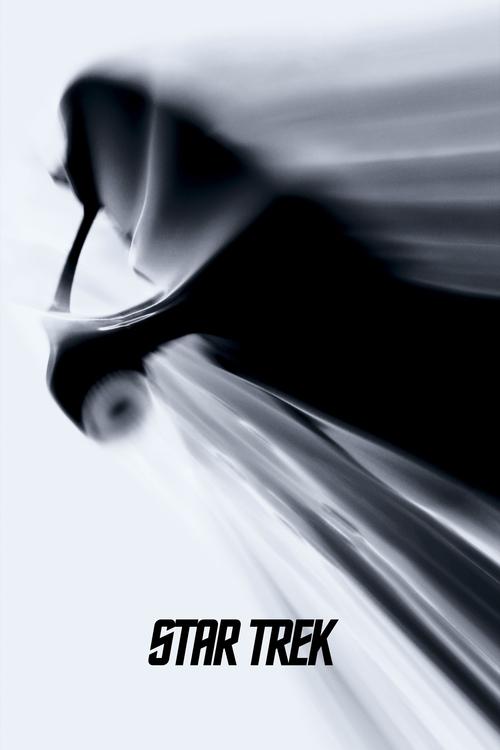
Star Trek
2009 · J.J. Abrams
When you want big, bright, crowd-pleasing space adventure — the kind of movie for a group night or a pick-me-up. Zero homework required: it's built to welcome people who've never seen a minute of Star Trek.
What it's about
A thrill-seeking Iowa farm boy named James Kirk and a half-Vulcan outsider named Spock — one all instinct, the other all logic — collide as cadets just as a vengeful threat from the future puts the galaxy in danger. Thrown together aboard a brand-new starship Enterprise, these bitter rivals have to become a crew, fast. It's an origin story for the most famous friendship in science fiction, rebuilt from the ground up.
The experience
Pure momentum — funny, emotional, and staged like a rollercoaster, with barely a scene that isn't driving somewhere. It's a blockbuster engineered to make both lifelong fans and total newcomers grin.
Performances
Chris Pine and Zachary Quinto pull off the near-impossible: inhabiting Kirk and Spock as their own without doing impressions, and their friction gives the film its heartbeat.
The craft
J.J. Abrams shoots space like it's dangerous again — handheld urgency, blinding lens flares, sound design that makes the ship feel massive — and Michael Giacchino's score gives it a genuine, soaring theme. The opening sequence alone is a masterclass in blockbuster emotion; this one earns the biggest screen and loudest speakers you can find.
Why it matters
It resurrected a franchise that had gone commercially dormant, converted millions of newcomers, and became the template for how studios reboot beloved properties — honoring the myth while restaging it in modern blockbuster form.
Snapshot
J.J. Abrams's Star Trek is the eleventh feature film in the Star Trek franchise and its first full reboot — a time-travel-enabled alternate-timeline origin story that recasts the original crew of the USS Enterprise as young adults and ignites a new franchise cycle. Releasing in May 2009 after the property had lain commercially dormant since Star Trek: Nemesis (2002) and the cancellation of the television series Enterprise (2005), the film achieved the difficult trick of serving longtime fans while converting millions of newcomers. It did so by treating the original series not as sacred canon to be slavishly reproduced but as mythological raw material — character archetypes, dramatic tensions, and a tonal promise of adventure — to be restaged inside contemporary blockbuster grammar. The result is a film about inheritance: of stories, of roles, of identity, and of the responsibility that comes with each.
Industry & production
By the mid-2000s, Paramount Pictures faced a franchise in genuine crisis. The declining box-office returns of the Next Generation film cycle, culminating in Nemesis, and the low ratings of Enterprise signaled audience exhaustion. Paramount and CBS Television Studios (which had separately retained television rights after Viacom's corporate restructuring) needed a solution that could attract a generation of viewers who had grown up after the height of Trek mania without alienating the franchise's passionate base.
The studio turned to J.J. Abrams and his production banner Bad Robot, then riding high on the success of the television series Lost and Alias and the feature Mission: Impossible III (2006). Abrams, by his own repeated admission, had been only a casual Trek viewer — a fact that became central to the film's conception. His outsider relationship to the mythology freed the production from the obligation of fidelity that had made the Next Generation films feel increasingly insular. The script was developed by Roberto Orci and Alex Kurtzman, longtime collaborators who also worked on Transformers (2007) and the television series Fringe, with story input from Damon Lindelof, Abrams's co-creator on Lost. Leonard Nimoy's participation as "Spock Prime" — the original series's Spock transported from the future — was secured early and proved pivotal, both narratively and symbolically, as an explicit blessing from the franchise's past.
The production was large by any standard. Sets were built practically at Paramount and at locations including the Budweiser plant in Van Nuys, California, which became the Enterprise's engineering section — a pragmatic choice that also introduced an industrial, retro-futurist visual texture that production designer Scott Chambliss leaned into deliberately. Filming took place through 2007 and into 2008, with the film ultimately released in May 2009 to wide commercial and critical success. It grossed well over $350 million worldwide against a reported production budget in the range of $150 million, reviving the franchise as a theatrical property and setting up a new trilogy.
Technology
Star Trek (2009) was shot on 35mm film using anamorphic lenses — a format choice that reinforced the film's self-conscious relationship to cinematic spectacle. Cinematographer Daniel Mindel, an Abrams regular who had also shot Mission: Impossible III, favored Super 35 alongside anamorphic capture, giving the film a widescreen grandeur and a grain structure that distinguishes it from the cleaner, more antiseptic digital aesthetic that was already encroaching on studio filmmaking. Mindel used vintage and modified lenses that produced pronounced optical aberrations.
The most discussed — and eventually most parodied — technical signature of the film is its deliberate deployment of lens flares, introduced by practical light sources positioned just off-axis from the camera. Abrams has acknowledged in interviews that the flares were consciously engineered: Mindel and the crew would sometimes physically hold lights near the lens during takes to generate the effect. The intent was to convey energy, dynamism, and a sense of a world that exists beyond the camera's frame — a photographic argument that the Enterprise is a working vessel flooded with light and activity. The technique was subsequently criticized for excess (including, self-deprecatingly, by Abrams himself in the run-up to his sequels), but in the original film it functions as a consistent visual rhetoric: the Enterprise interior feels luminous and kinetic rather than the blue-gray institutional coldness of the Next Generation era sets.
Visual effects were handled primarily by Industrial Light & Magic, which produced the film's space sequences, planetary destruction, and the Romulan mining vessel Narada — a design deliberately jagged and organic to contrast with the Enterprise's smooth Starfleet geometry. The film won the Academy Award for Best Makeup for the Romulan prosthetics applied to Eric Bana and his crew.
Technique
Cinematography
Mindel's approach is kinetic even by the standards of 2009 blockbuster filmmaking. The camera rarely rests; handheld movement is frequent even in dialogue scenes, and Abrams encouraged the sense that the crew was filming a world already in motion. The anamorphic format lends compositions a horizontal sweep that flattens depth slightly and makes the starfield backgrounds read as painterly rather than photographic. Key dramatic moments — particularly the death of George Kirk in the film's prologue and Vulcan's destruction — are staged and lit with a stylized boldness that draws as much from the aesthetics of science fiction book illustration as from documentary naturalism. The color palette is warm and saturated inside the Enterprise, contrasting with the cold blues and blacks of deep space.
Editing
The film was edited by Maryann Brandon and Mary Jo Markey, both of whom continued working with Abrams on subsequent projects. The edit is confident and commercially calibrated: action sequences are cut tight, dialogue scenes are paced faster than most dramatic films of the period, and the film moves through a great deal of expository and mythological setup — Spock's childhood, Kirk's delinquency, the Romulan incursion on the Kelvin — without losing narrative momentum. The prologue, which covers the birth of Kirk and the death of his father within approximately twelve minutes, is a particularly well-constructed sequence: it establishes emotional stakes, introduces the antagonist's motivation, and seeds the film's central father-son theme in compressed, economical form.
Mise-en-scène / staging
The film is staged with a theatrical self-consciousness about the weight of its iconography. Characters are frequently introduced through iconographic beats before being fully identified — Bones with a flask and a complaint, Scotty in a frozen outpost, Chekov via a deliberately absurd Russian accent — because Abrams is working with archetypes the audience either already knows or can recognize immediately as types. The bridge of the Enterprise is bright to the point of overexposure, a deliberate contrast to the utilitarian darkness of the Kelvin and the Narada. Space itself is rendered with a specific grandeur: planets are large and present in the frame in a way that recalls classic science fiction illustration.
Sound
The sound design by Mark Stoeckinger and the supervising sound editors works within the franchise's established audio vocabulary — the transporter effect, the phaser, the door chime — while updating their texture and presence for theatrical exhibition. The Enterprise's engines are given a weight and subterranean rumble that earlier productions' television-optimized mixes could not achieve. Michael Giacchino's score is an essential component of the film's emotional architecture (discussed further below) and is woven into the sound design so that the two reinforce rather than compete.
Performance
Casting young actors to play roles defined by original performances of considerable cultural specificity was the film's greatest creative risk. Chris Pine's Kirk is deliberately distanced from William Shatner's iconic interpretation: where Shatner played Kirk as a man of heroic certainty and occasional grandiosity, Pine plays him as a reckless, wounded young man whose bravado is transparently compensatory. The performance is calibrated to generate audience identification rather than admiration, and it works because Pine is willing to play Kirk as frequently wrong, easily goaded, and genuinely frightened. Zachary Quinto's Spock is the more complex challenge: Leonard Nimoy's fifty-year-old characterization is the standard against which Quinto's performance is measured in real time within the film, given that Nimoy appears alongside him. Quinto navigates this by playing Spock's suppressed emotionality at the surface, making the Vulcan training feel like an effort rather than a natural condition. Karl Urban's Dr. McCoy is closest to impressionism — a loving evocation of DeForest Kelley — and is all the stronger for its unapologetic affection for the source.
Narrative & dramatic mode
The screenplay uses time travel not as a plot mechanism but as a licensing device: the arrival of the Romulan Nero from a future in which Spock failed to prevent his planet's destruction creates an alternate timeline (later officially designated the "Kelvin Timeline") that retroactively frees the film from the obligation to reproduce established events. This is a structurally elegant solution to the rebooting problem because it acknowledges the original timeline's existence — canonizes it, via Nimoy's presence — while granting the new films narrative autonomy.
The dramatic engine of the film is less the antagonist's scheme (Nero is a relatively thin villain, motivated by grief and rage) than the relationship between Kirk and Spock. The film stages their conflict as a collision of epistemic styles: instinct versus logic, improvisation versus calculation. The dramatic argument is that both are incomplete without the other, and the film's climax requires each character to adopt something of the other's mode — Spock abandoning logical assessment for emotional commitment, Kirk subordinating impulse to strategy. This dynamic descends directly from the original series' three-way balance of Kirk, Spock, and McCoy (representing will, reason, and feeling), here compressed into a two-person dialectic.
Genre & cycle
Star Trek (2009) belongs to the franchise revival cycle that dominated Hollywood from roughly 2005 to 2015 — a period defined by studios' recognition that intellectual property with established audience recognition could be rebooted for new demographics rather than continued for diminishing existing ones. The cycle includes Batman Begins (2005), Casino Royale (2006), and would subsequently encompass The Amazing Spider-Man (2012), Star Wars: The Force Awakens (2015), and others. What distinguishes Star Trek within this cycle is its explicit use of continuity — the presence of Nimoy — rather than a clean break, a strategy that acknowledges rather than erases the earlier films and series.
Within genre, the film is nominally science fiction but operates as space opera in the tradition of Star Wars (1977) — concerned less with speculative ideas than with adventure, spectacle, and character. This was a deliberate tonal choice and a point of some contention among franchise loyalists for whom Trek's science fiction credential — its willingness to engage with ideas about society, ethics, and technology — was the property's defining quality.
Authorship & method
J.J. Abrams operates as a producer-director whose signature is less a distinctive visual style than a particular kind of controlled energy: films that feel spontaneous and fleet-footed while being extensively planned. His primary aesthetic commitments are to momentum, emotional legibility, and withheld revelation (the "mystery box" he discussed in a well-known TED talk). His background in television — the rapid-turnaround, serialized narrative demands of Alias and Lost — produced a director unusually skilled at economical character establishment and at sustaining multiple plot threads simultaneously.
Daniel Mindel, cinematographer, contributed the film's physical texture and optical personality. His willingness to introduce optical "defects" — flares, aberrations — as expressive tools places him in a lineage of cinematographers who treat the camera as a subjective instrument rather than a neutral recorder.
Michael Giacchino, composer, is among the most important contributors to the film's emotional register. Giacchino, who had collaborated with Abrams on Lost and Mission: Impossible III, produced a score that accomplishes the difficult task of introducing new thematic material while incorporating Alexander Courage's original Star Trek fanfare in a way that feels earned rather than nostalgic. The main theme is built for a film that wants to announce itself as a fresh beginning — it is propulsive, brass-forward, and deliberately heroic. Giacchino won the Academy Award for Best Original Score for Up the same year, which speaks to his range.
Roberto Orci and Alex Kurtzman's screenplay is structurally accomplished and characterologically economical but has been noted by critics as relatively thin in thematic depth — particularly in its treatment of Nero, whose villainy is motivated but underdeveloped. The alternate timeline conceit, however, is a genuinely clever piece of franchise writing, and the script's discipline in moving through a great deal of setup without losing the audience's grip is considerable.
Maryann Brandon and Mary Jo Markey as co-editors shaped the film's commercial rhythm and deserve credit for a film that introduces approximately a dozen significant characters across two timelines in under two hours without confusion.
Movement / national cinema
The film is a product of the Hollywood franchise system at its most self-conscious and strategically sophisticated. It reflects the post-Lord of the Rings, post-Harry Potter recognition that franchise building requires the simultaneous satisfaction of existing communities and the expansion of the audience base. In this sense, it participates in a specifically American industrial formation: the tentpole picture as cultural event, engineered to dominate a release window, generate international gross, and establish sequel infrastructure.
Era / period
Star Trek (2009) arrives at a moment of genuine anxiety about the franchise studio picture's relationship to the audience. The late 2000s saw the collapse of several large-scale franchise attempts (The Golden Compass, 2007; The Mummy: Tomb of the Dragon Emperor, 2008) alongside the consolidation of the Marvel Cinematic Universe (Iron Man, 2008). Abrams's film is contemporaneous with the MCU's founding and shares its understanding that origin stories need not be slow or dutiful — that establishing a character's mythology can itself be the source of cinematic pleasure rather than a necessary tax paid before the "real" stories can begin.
Themes
The film's primary thematic concern is the tension between determinism and freedom — played out through the alternate timeline structure as well as through its two protagonists. Spock believes, initially, that the logically optimal path can be identified and followed; Kirk acts as though the future is always available to be made differently than fate would have it. The film endorses Kirk's position — the alternate timeline itself is proof that even cosmic fate can be rerouted — but without dismissing the value of Spock's rigor.
Closely related is the theme of fatherhood and absent or inadequate male inheritance. Kirk's father dies in the film's first minutes, leaving Kirk with a heroic template he can never inhabit in the same terms; his delinquency is explicitly connected to this absence. Spock's relationship with Sarek (Ben Cross) is strained across the fault line of Spock's half-human nature — Sarek's emotional distance is framed as a wounding masquerade. Both protagonists are, in different registers, sons who must determine what to inherit and what to refuse from their fathers, and the film suggests that true identity emerges not from inheritance alone but from the choices made under pressure.
The film also engages, more obliquely, with grief as motivation. Nero's destruction of Vulcan — an act of revenge that kills billions including Spock's mother (Winona Ryder) — mirrors in miniature the logic of the franchise itself: a man so destroyed by loss that he tries to unmake the past. The film does not fully develop this parallel, but it gives the antagonist a human legibility that elevates him slightly above genre function.
Reception, canon & influence
Critical reception was strongly positive upon release. Reviewers praised the energy of the performances, the effectiveness of the reboot strategy, and Giacchino's score. Some critics noted the film's relative thinness as science fiction — its preference for action and character over the speculative ideas that distinguished the best of the original series — but this was generally positioned as a feature rather than a flaw for a film attempting to enlarge the franchise's audience. Rotten Tomatoes aggregated near-universal critical approval. The film secured Academy Award nominations beyond its Makeup win, and its commercial performance confirmed the viability of the new franchise direction.
Influences on the film are layered. Most directly, it inherits from the original series and its films, particularly The Wrath of Khan (1982) and The Search for Spock (1984), both of which established the emotional and dramatic templates for character relationships that the 2009 film reactivates. The influence of Star Wars is present and acknowledged: Abrams has spoken openly about Star Wars as the formative science fiction experience of his generation, and the 2009 film's energy — its prioritization of adventure and visual spectacle over hard SF ideas — aligns it with Lucas's space opera rather than the more cerebral tradition of 2001: A Space Odyssey (1968) or the original Trek's television aspirations. The franchise revival playbook draws on Batman Begins (2005) and Casino Royale (2006) as immediate precedents.
Legacy and forward influence is substantial. The film established a three-picture Kelvin Timeline series (followed by Into Darkness, 2013, and Beyond, 2016) and confirmed Abrams as the director of choice for franchise resurrection — a reputation that led directly to his assignment on Star Wars: The Force Awakens (2015), which applies nearly identical strategic logic to an even larger property. The lens flare aesthetic became a recurring reference in discussions of Hollywood visual style, serving as a shorthand for a certain kind of kinetic, effects-heavy filmmaking. More broadly, the film's success contributed to the consolidation of the franchise-reboot as the dominant mode of studio picture-making across the 2010s: the template of young-cast origin story honoring existing mythology while establishing new narrative autonomy is now standard practice across the superhero, espionage, and fantasy genres. Whether the film itself belongs to the canon of great science fiction cinema is contested; that it changed the industrial logic of franchise filmmaking is not.
A Deleuzian reading
A streak of blue-white light rakes across the bridge of the Enterprise.
The full Deleuzian reading of Star Trek →
Reception
A genuine event in summer 2009 — rapturous reviews, a franchise everyone had written off suddenly cool again. Today it's remembered as the gold standard of the reboot era, even as the Kelvin timeline it launched quietly stalled out after two sequels.
How Star Trek was received, from release to now →
Influences: the films it descends from and the films it influenced
- Star Wars (1977) — Abrams explicitly modeled the film's adventure-first energy over hard-SF ideas on Lucas's original, adopting the anamorphic-35mm space opera grammar — practical sets, spectacle-driven momentum — that the Kelvin Timeline inherits wholesale, consciously departing from Trek's cerebral television tradition.
- The Empire Strikes Back (1980) — Established father-son revelation and confrontation as space opera's structural emotional spine, and codified the dialectical duo (Luke/Vader as complementary opposites whose split defines the franchise's ideological axis) as narrative engine — the formal template for Kirk/Spock's rearranged dynamic.
- Star Trek II: The Wrath of Khan (1982) — The compressed prologue's father-sacrifice structure mirrors and inverts Spock's self-sacrificial death here, and Meyer's template of grounding franchise stakes in intimate character duels rather than cosmic spectacle is the direct emotional blueprint the 2009 film reactivates.
- Superman (1978) — Established the franchise-performance grammar of impressionist embodiment: Reeve plays Superman not as imitation of prior versions but as fresh realization of essential qualities, the exact approach Pine and Quinto use to inhabit Kirk and Spock without caricature.
- Man on Fire (2004) — Cinematographer Daniel Mindel developed his lens-flare anamorphic grammar — deliberately introduced optical aberrations as expressive tools rather than technical errors to be corrected — working with Tony Scott here; Star Trek 2009 inherits that identical physical texture.
- Batman Begins (2005) — Provides the precise industrial blueprint for franchise reboot: origin story with young cast reconfiguring established mythology, tonal reset from prior excess, and narrative-continuity independence via timeline restart — adopted wholesale for the Kelvin Timeline.
- Mission: Impossible III (2006) — The first Abrams-Giacchino collaboration on a franchise action film established their shared method of fusing propulsive orchestral score directly into action-editing rhythms, with cues composed around specific cut points — the workflow Trek 2009 inherits directly.
- Casino Royale (2006) — Demonstrated that recasting a culturally iconic role via a stripped-back origin — performed as fresh embodiment rather than imitation of predecessors — is commercially viable; Pine and Quinto's impressionist homages to Shatner and Nimoy apply exactly this Daniel Craig template.
- Star Trek Into Darkness (2013) — Direct continuation sustaining Mindel's lens-flare anamorphic grammar and Giacchino's thematic score while deliberately inverting Wrath of Khan's sacrifice arc — the Kirk/Spock emotional template stress-tested by rearranging its sacrificial geometry.
- X-Men: Days of Future Past (2014) — Applies the Trek 2009 alternate-timeline mechanism as a franchise-reset tool — time travel used not for adventure but to dissolve prior continuity and grant narrative autonomy, extending the industrial logic Abrams introduced as a licensing strategy into the superhero genre.
- Star Wars: The Force Awakens (2015) — Abrams transplants the identical franchise-resurrection playbook — young cast inheriting iconic roles via impressionist recasting, mystery-box withheld revelation, kinetic handheld anamorphic photography with lens flares — from the Kelvin Timeline directly onto the Star Wars property.
- Jurassic World (2015) — Applies the post-Trek franchise-reboot structure — new cast inheriting established mythology, nostalgic callbacks woven into an origin narrative, compressed action prologue establishing emotional stakes before the title card — codifying the 2009 template as the dominant mode of studio franchise continuation.
- Spider-Man: Homecoming (2017) — Michael Giacchino's score carries the leitmotif architecture developed across the Kelvin Trilogy directly into the MCU, while Tom Holland's impressionist embodiment of Parker — fresh realization rather than imitation of prior versions — applies the Pine/Quinto recasting grammar at Marvel franchise scale.
- Pacific Rim: Uprising (2018) — Cinematographer Dan Mindel's signature bright anamorphic blockbuster look — wide spherical-feeling framing and clean high-key light — is the visual grammar he carries directly into Uprising.
- Iron Man (2008) — Released the same summer and sharing the same franchise-origin strategy — compressed action prologue, charismatic-lead reconfiguring of existing IP, commercially-paced editing subordinating visual style to character momentum — the superhero genre's concurrent reinvention of an identical reboot playbook.
- X-Men: First Class (2011) — Franchise reboot built around a dialectical duo (McAvoy/Fassbender as Xavier/Magneto whose complementary-opposites split mirrors Kirk/Spock) with a young-cast origin story and timeline reset as the mechanism for new continuity independence from prior entries.
- Transformers (2007) — Pushes anamorphic lens-flare-as-texture to a self-conscious extreme, part of the same late-2000s blockbuster flare vogue Bay's Transformers helped popularize.
- The Incredibles (2004) — Giacchino's brassy heroic main-title writing plus the aggressive anamorphic lens-flare image — the very flares the Incredibles simulated in CG — mark a shared house style.
Similar films
- Star Trek II: The Wrath of Khan (1982) — influence & lineage
- Star Wars: The Force Awakens (2015) — influence & lineage
- Star Wars (1977) — influence & lineage
- The Empire Strikes Back (1980) — influence & lineage
- Superman (1978) — influence & lineage
- Star Wars: The Last Jedi (2017) — same viewing thread
- Prometheus (2012) — same viewing thread
- Dune (2021) — same viewing thread
All the films related to Star Trek →
Watch it with: curated runs of related films
- Galaxies to Get Lost In — Watch these when you want to disappear into an entire built world — hostile planets, star empires, colonial expeditions gone wrong — at full blockbuster scale.