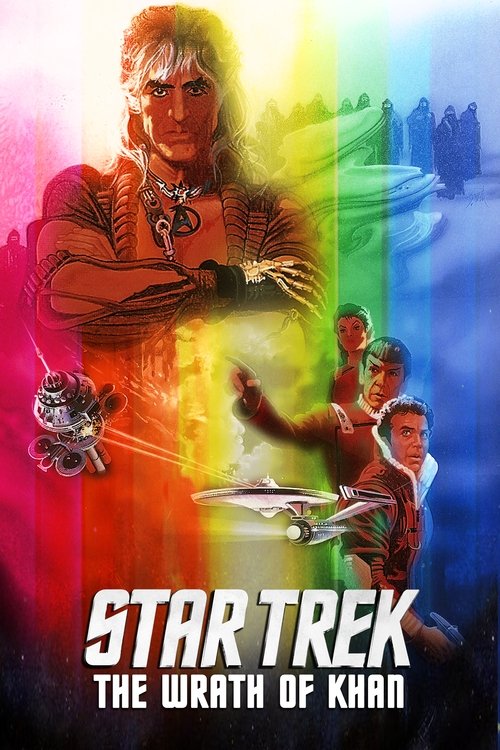
Star Trek II: The Wrath of Khan
1982 · Nicholas Meyer
For when you want an adventure with real stakes and a lump in your throat at the end — thrilling enough for a Friday night, substantial enough to sit with after. Works even if you've never watched a minute of Star Trek.
What it's about
An aging Admiral Kirk, restless behind a desk, takes the Enterprise out on a training cruise with a crew of green cadets — just as Khan, a genetically engineered superman Kirk marooned years earlier, escapes exile with revenge on his mind and a terraforming device called Genesis in his sights. It's a naval duel in space between two captains who never share a room, and a story about a man being forced to finally face the costs of the life he chose.
The experience
Tense, propulsive submarine-movie suspense wrapped around something unexpectedly moving — a blockbuster genuinely about aging, old debts, and sacrifice. It builds to an ending that has made grown adults cry for forty years.
Performances
Ricardo Montalbán plays Khan as wounded Ahab-like grandeur, chewing Melville and scenery with total conviction, and he drags the best performance of William Shatner's career out of him — Kirk here is vain, tired, grieving, and human.
The craft
Nicholas Meyer, working fast on a fraction of the first film's budget, strips the franchise down to naval adventure: crisp writing, literary allusion worn lightly, and ship-to-ship battles staged like submarine warfare. James Horner's swashbuckling score is a character in itself, and the Genesis sequence was a landmark of early computer imagery — turn the sound up.
Why it matters
It rescued Star Trek from an underwhelming first film and set the template the franchise still measures itself against; 'even-numbered Trek' as a compliment starts here.
Snapshot
Star Trek II: The Wrath of Khan is the film that rescued a franchise from itself. After the cold, expensive, effects-heavy Star Trek: The Motion Picture (1979) underwhelmed critics and executives despite strong returns, Paramount pulled the property away from creator Gene Roddenberry's direct control, handed it to television producer Harve Bennett on a far tighter budget, and eventually installed a director, Nicholas Meyer, who had never seen an episode of the original series. The result is leaner, warmer, and more dramatically legible than its predecessor: a naval-adventure revenge tragedy that reframes Star Trek as a story about aging, mortality, sacrifice, and the consequences of past choices. Built around the return of Ricardo Montalbán as the genetically engineered superman Khan Noonien Singh — a character from the 1967 series episode "Space Seed" — the film pits an older, self-doubting Admiral Kirk against a nemesis consumed by vengeance, and closes with the death of Spock. It is widely regarded as the strongest of the Star Trek features and the template every subsequent entry has measured itself against.
Industry & production
The production is best understood as a course-correction. The first film had been costly and its reception, while commercially viable, convinced Paramount that the property needed cheaper, more disciplined stewardship. Roddenberry was moved to a consulting role, and Harve Bennett — an experienced television producer with no prior Star Trek involvement — was brought in to make a sequel that would recover the series' storytelling energy at a fraction of the cost. Bennett screened the original series to learn the material and identified Khan as a villain with untapped dramatic potential.
The screenplay passed through multiple hands and drafts (writers including Jack B. Sowards and others contributed), a difficult development process that Meyer was hired to resolve. Meyer, coming off Time After Time (1979), famously assembled a workable shooting script quickly by synthesizing the strongest elements of the competing drafts. He directed without formal screenplay credit on the final film, an authorship wrinkle that reflects how contested the writing process was. The comparatively modest budget — substantially lower than the first film's — forced economy that arguably improved the movie: sets and effects were reused where possible (notably visual-effects and model work built for reuse across the era's Trek productions), and the story was scaled to character rather than spectacle.
The film was produced during a period when Paramount was reconceiving Star Trek as a durable, mid-budget commercial franchise rather than a prestige event picture. Its success validated that model and directly enabled the sequels that followed.
Technology
Technologically, The Wrath of Khan sits at a hinge point in effects history. It is best known for containing the Genesis Demonstration sequence — a fully computer-generated animation produced by Industrial Light & Magic's Computer Graphics division (the group whose members would later spin off to found Pixar). The sequence, depicting a dead planet being terraformed into a living world by the Genesis Device, is frequently cited as one of the earliest substantial uses of CGI in a feature film and an early demonstration of the particle-system technique for rendering fire and organic spread. This is a genuinely significant technical milestone.
Beyond that landmark, the film relied on the established optical and model-based effects craft of its era: physical starship models, motion-control photography, and optical compositing for the space battles. Much of this work was executed by ILM, and the production's economy meant leaning on existing assets from the first film where feasible. The visual-effects approach is otherwise conventional for early-1980s studio science fiction rather than groundbreaking; the Genesis sequence is the exception that earns the film its place in effects-technology histories.
Technique
Cinematography
Cinematographer Gayne Rescher shot the film with a darker, more shadowed, more theatrical palette than the bright, antiseptic look of the first feature. The Enterprise interiors feel like the working spaces of a warship; lighting is moodier and more directional. The visual grammar of the space combat draws deliberately on naval warfare, and the camera treats the ships as vessels navigating a three-dimensional sea. The film's most celebrated set-piece — the battle in the Mutara Nebula — uses the conceit of the nebula disabling sensors to justify a slow, blind, submarine-style duel, and the cinematography leans into obscured visibility, colored gas, and tense partial sightlines to build dread rather than dazzle.
Editing
The editing (William Paul Dornisch is credited on the film) serves the film's escalating suspense structure. The Mutara Nebula sequence is the editorial showpiece, cross-cutting between two crippled ships maneuvering blind, sustaining tension through anticipation and reaction rather than continuous spectacle. The film's overall rhythm is tighter and more forward-driven than its predecessor's, a pacing discipline that is part of why it reads as a rescue of the franchise's storytelling.
Mise-en-scène / staging
Meyer's staging repeatedly invokes the iconography of the age of sail and Napoleonic naval fiction — a sensibility Meyer openly favored. Kirk is framed as a ship's captain in the Hornblower mold; the bridge functions as a quarterdeck; battle is conducted through orders relayed down a chain of command. Meyer added texture Roddenberry disliked, including naval-style trappings and a more militarized Starfleet aesthetic, deepening the sense of the Enterprise as a functioning vessel with history and wear. The staging of the two ships' final confrontation as a contest of tactical patience — famously invoking two-dimensional versus three-dimensional thinking — is central to the film's meaning as well as its suspense.
Sound
James Horner's score is one of the film's defining elements and a breakout in his early career. It is more romantic, nautical, and swashbuckling than the first film's Jerry Goldsmith score, with a bold main theme and a distinct musical identity for the seafaring adventure Meyer was after. The score contributed heavily to the film's emotional register, particularly in the death of Spock, and established musical motifs that recurred across the subsequent films Horner scored.
Performance
Performance is where the film most decisively differs from its predecessor. William Shatner delivers one of his most controlled and affecting turns as Kirk, playing a man confronting age, regret, and the return of a son and a former lover. Leonard Nimoy, reportedly initially reluctant to return, gives Spock a valedictory gravity that pays off in the sacrifice at the climax. Ricardo Montalbán's Khan is the engine of the film: a grandiose, wounded, obsessive antagonist whose theatrical intensity — laced with literary quotation — supplies the tragic scale the story needs. The dynamic between Kirk and Khan, who never share physical space and confront each other only through viewscreens and transmissions, is a notable performance and staging choice that heightens the sense of two forces circling each other.
Narrative & dramatic mode
The dramatic mode is revenge tragedy overlaid on naval adventure. Meyer and Bennett explicitly built the film around literary reference — most prominently Melville's Moby-Dick, with Khan as an Ahab figure hurling defiance at the object of his hatred, and Charles Dickens's A Tale of Two Cities, whose opening and closing lines frame the film's meditation on sacrifice and renewal. Spock gives Kirk a copy of A Tale of Two Cities early in the film, seeding the "far, far better thing" of his eventual sacrifice. The narrative is organized around mirrored themes — youth and age, creation and destruction (the Genesis Device can make life or annihilate it), fathers and sons, the past returning to demand its due. The Kobayashi Maru "no-win scenario" that opens the film is a thematic thesis statement: the movie is fundamentally about how one faces death and inevitability, a question answered in the closing act.
Genre & cycle
The film belongs to the early-1980s cycle of studio science fiction operating in the long wake of Star Wars (1977), but it self-consciously pulls against pure spectacle toward character melodrama and adventure. Within the Star Trek franchise it inaugurates the mode that most subsequent films would adopt: a self-contained adventure driven by a strong antagonist and an emotional stake for the core characters. It also functions as a hybrid — a science-fiction film that is structurally a naval war picture and tonally a tragedy — and that generic layering is a large part of its distinctiveness within the cycle. It began a loose trilogy: its ending flows directly into Star Trek III: The Search for Spock (1984) and Star Trek IV: The Voyage Home (1986).
Authorship & method
The film is the product of a genuinely collaborative and somewhat contested authorship, and it is worth being precise about the record. Nicholas Meyer is the decisive creative voice: a novelist and filmmaker who approached the material as an outsider, imported a literary and naval sensibility, and imposed a tone at odds with Roddenberry's more utopian, technocratic vision. Meyer's shaping of the script (uncredited) and his direction are the primary reasons the film reads as it does. Harve Bennett conceived the project's direction as producer, identifying Khan and setting the disciplined, character-first mandate. On the writing, credit is complicated: several writers contributed drafts, and the final screenplay credit went to Jack B. Sowards, with story credit involving Bennett; the development history is knotted enough that flat attributions should be treated cautiously.
Among key collaborators: James Horner (composer) supplied a career-defining score; Gayne Rescher (cinematographer) established the darker visual style; William Paul Dornisch (editor) shaped the suspense pacing. Gene Roddenberry, though credited as consultant, was reduced to a limited role and reportedly disagreed with several of Meyer's choices, including the militarized tone and Spock's death.
Movement / national cinema
This is a work of the American commercial studio system, produced by Paramount as mainstream science-fiction entertainment. It is not affiliated with any art-cinema movement; its "tradition" is popular Hollywood genre filmmaking crossed with the studio's calculation about how to sustain a valuable property. Its meaningful lineage is intertextual and literary rather than national-cinematic: the seafaring-adventure tradition (Forester's Hornblower, Melville) and Victorian narrative (Dickens) that Meyer consciously grafted onto the franchise.
Era / period
The film is a document of early-1980s Hollywood's post–Star Wars science-fiction boom and of the emerging logic of the modern franchise. It arrives at the moment studios were learning to treat existing properties as renewable, mid-budget assets, and its success helped codify that approach for Star Trek specifically. Technologically it sits at the dawn of computer-generated imagery in features. Culturally it reflects a maturing of the Star Trek audience: the original series' viewers were now adults, and the film's themes of aging and mortality met them where they were, allowing the sixteen-years-older cast to become an asset rather than a liability.
Themes
The governing theme is mortality and how one confronts it — dramatized through the Kobayashi Maru's no-win scenario, Kirk's midlife reckoning, and Spock's climactic sacrifice ("the needs of the many outweigh the needs of the few"). Adjacent to it run creation and destruction, embodied literally in the dual-use Genesis Device; the return and cost of the past, in Khan's vengeance and in Kirk's rediscovered son; youth versus experience, staged in the young crew of trainees under a veteran command; and obsession as self-destruction, in Khan's Ahab-like ruin. The film treats death not as spectacle but as the central moral fact its characters must meet with dignity.
Reception, canon & influence
The Wrath of Khan was received far more warmly than the first film and is broadly credited with saving the Star Trek film series; over the decades it has hardened into critical consensus as the best of the Star Trek features and one of the more admired science-fiction sequels of its era. (Precise contemporary box-office and review tallies I won't quote here, to avoid inventing figures, but the qualitative record of a strong reception and rescue narrative is well established.)
Its influences run backward into literature and genre more than into cinema: Melville's Moby-Dick, Dickens's A Tale of Two Cities, and the Napoleonic naval-adventure tradition, plus the source material of the 1967 "Space Seed" episode that gave it Khan.
Forward, its legacy is large. Within the franchise it set the enduring template — a singular antagonist, personal stakes, a tightly bounded adventure — that later films repeatedly emulated and that Star Trek Into Darkness (2013) explicitly remade, restaging Khan and inverting the sacrifice scene. The film made Spock's death, the "KHAAAN!" cry, the Kobayashi Maru, and the "needs of the many" line into durable pop-cultural currency. Technologically, the ILM Genesis sequence is a recurring landmark in histories of computer graphics and a waypoint on the road to Pixar. And James Horner's score helped launch one of the most prominent film-composing careers of the following decades. Few franchise sequels have exerted as much gravitational pull on everything that followed them.
Reception
After the slow, chilly Motion Picture underwhelmed, this leaner, cheaper sequel was greeted in 1982 as the movie that saved Star Trek — and four decades on it's only calcified as the franchise's undisputed high-water mark, the one even Trek skeptics get told to watch.
How Star Trek II: The Wrath of Khan was received, from release to now →
How to watch Star Trek II: The Wrath of Khan: what to notice on a first viewing
- Watch how orders travel down the chain of command on the bridge. Meyer stages the Enterprise like a warship's quarterdeck, with Kirk framed as a naval captain relaying commands through his crew rather than acting alone. The formality turns space combat into command discipline, not solo heroics.
- Notice how dim and shadowed the ship's interiors are. Cinematographer Gayne Rescher lights the Enterprise darker and more directional than the bright first film, turning its corridors into a working battleship. The lighting makes the ship feel worn and lived in, not a showroom.
- Listen for the score turning nautical and swashbuckling. James Horner's music leans romantic and seafaring, giving Kirk, Khan, and the crew distinct musical identities across the film. The score carries emotional weight the dialogue leaves understated.
- Watch Kirk and Khan speak only through viewscreens, never sharing a room. Shatner and Montalban's characters confront each other exclusively through transmissions, circling without ever occupying the same space. The distance makes their rivalry a duel of will, not muscle.
The whole guide to watching Star Trek II: The Wrath of Khan, with the keys for a rewatch →
Influences: the films it descends from and the films it influenced
- Star Trek (2009) — The compressed prologue's father-sacrifice structure mirrors and inverts Spock's self-sacrificial death here, and Meyer's template of grounding franchise stakes in intimate character duels rather than cosmic spectacle is the direct emotional blueprint the 2009 film reactivates.
- Galaxy Quest (1999) — Supplies the naval-command bridge blocking and the swelling brass heroic score that Galaxy Quest reproduces 'played straight,' parodying the staging by reverently duplicating it rather than mocking it.
- Star Trek: The Motion Picture (1979) — The immediate ancestor Meyer corrected against — it reused the same Enterprise miniatures and Jerry Goldsmith's fanfare, but its slow, effects-contemplation pacing is exactly the cold formalism Khan replaces with character-first, low-key staging.
- Run Silent, Run Deep (1958) — Khan's Mutara Nebula battle is submarine warfare transplanted to space — silent running, blind sensor-denied maneuvering, and the fatal ambush from below the enemy's expected plane are lifted straight from the WWII sub-duel grammar.
- The Enemy Below (1957) — Supplies the dueling-commanders structure: two captains who never share a frame reading each other's minds across the void, an antagonism of mutual professional respect restaged as Kirk vs. Khan.
- Moby-Dick (1956) — Khan is written and played as Ahab — the film hands Montalbán Ahab's actual dying speech ('from hell's heart I stab at thee'), importing the monomaniacal-captain characterization wholesale.
- Forbidden Planet (1956) — Established the template of transplanting a canonical literary text (The Tempest) into a starship setting, the exact move Meyer extends by grafting Melville and Dickens onto the Enterprise.
- Captain Horatio Hornblower (1951) — The C.S. Forester Napoleonic naval-adventure idiom — ships of the line trading broadsides, tactical seamanship as character — is the genre chassis Meyer explicitly built Kirk's command style on.
- Star Wars (1977) — ILM's Dykstraflex motion-control camera, built for Star Wars, is the same rig that let Khan repeatably pan and track the Reliant/Enterprise miniatures for its composited ship combat.
- Battle Beyond the Stars (1980) — James Horner's breakout Corman score, whose surging brass-and-strings heroic idiom he transplanted almost directly into Khan, and whose effects unit fed talent and optical technique toward ILM.
- Time After Time (1979) — Meyer's own prior film establishes his authorial method — literate Victorian-diction dialogue and literary pastiche — which he then imposes on Trek against Roddenberry's technocratic register.
- Tron (1982) — Contemporary sibling in the early-CGI landmark race — released the same year, it pushed computer-generated imagery as full-screen spectacle while Khan's Genesis proved procedural CG could sell a photoreal effect shot.
- Star Trek III: The Search for Spock (1984) — Direct descendant that scales up ILM's Genesis particle-system rendering into a full planetary life-and-death lifecycle, continuing both the effects pipeline and the sacrifice arc.
- The Last Starfighter (1984) — Descendant of the Genesis proof-of-concept — it extended particle/CG rendering from a one-minute demo into fully computer-generated starships carrying whole action sequences.
Similar films
- Aliens (1986) — influence & lineage · same viewing thread
- Star Wars (1977) — influence & lineage · same viewing thread
- Forbidden Planet (1956) — influence & lineage
- The Hunt for Red October (1990) — influence & lineage
- The Empire Strikes Back (1980) — same viewing thread
- Terminator 2: Judgment Day (1991) — same viewing thread
- Planet of the Apes (1968) — same viewing thread
- Star Trek (2009) — shared sensibility
All the films related to Star Trek II: The Wrath of Khan →
Watch it with: curated runs of related films
- The Blockbuster Sci-Fi Canon — A run of the effects-driven epics that taught modern audiences what a movie could feel like — from the desert planets of Star Wars to the rain of Blade Runner and the sands of Arrakis.