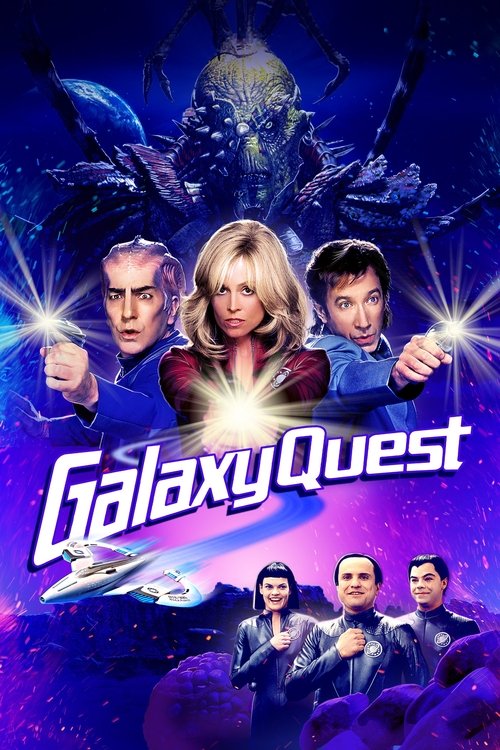
Galaxy Quest
1999 · Dean Parisot
For a night when you want to laugh without a drop of cynicism — perfect with friends, family, or anyone who's ever loved a show a little too much. Pure comfort with brains.
What it's about
Twenty years after their space-adventure TV show was canceled, its washed-up cast scrapes by on convention appearances and mutual resentment — until actual aliens show up. The gentle Thermians have intercepted the old broadcasts, mistaken them for 'historical documents,' and built their entire civilization around the show; now, under attack by a warlord, they need their heroes. The actors have to become, for real, the characters they only ever played.
The experience
Flat-out funny and unexpectedly warm — it plays as sharp showbiz satire for the first act, then sneaks up on you as a genuinely rousing space adventure with real stakes and real heart. It's the rare parody that leaves you feeling great.
Performances
Tim Allen nails the vain, past-his-prime captain, Sigourney Weaver has a ball sending up her own genre history, and Alan Rickman is sublime as a classically trained actor dying inside his alien prosthetic — every eye-roll is a masterclass.
The craft
The script pulls off a genuinely hard trick: every joke about the old show doubles as a working plot beat in a real adventure, so the parody and the thing being parodied land at once. The Thermian design, practical creature work, and committed straight-faced staging give the comedy an actual sci-fi movie to live inside.
Why it matters
Embraced by the very fandom it teased — famously beloved by Star Trek fans and cast members alike — it became a cult classic and the standard example of parody done with love.
Snapshot
Galaxy Quest is a science-fiction comedy that takes the relationship between a defunct television franchise and its devoted fandom as its literal premise. The washed-up cast of a canceled space-adventure series — modeled transparently on Star Trek and its convention circuit — are abducted by a gentle alien race, the Thermians, who have intercepted the show's broadcasts, mistaken them for "historical documents," and built their civilization in imitation of fictional heroics. The actors, accustomed to signing autographs and bickering over screen time, must become the characters they once merely played. Directed by Dean Parisot from a screenplay credited to David Howard and Robert Gordon, and released by DreamWorks Pictures, the film is at once an affectionate parody, a backstage comedy about typecast performers, and a sincere adventure in its own right. Its reputation has risen steadily since release: initially received as a modest, well-liked studio comedy, it is now widely regarded as one of the most intelligent films ever made about genre fandom, and is frequently embraced by the very Star Trek community it gently satirizes.
Industry & production
The film was produced and distributed by DreamWorks Pictures, then a young studio (founded 1994) still establishing its live-action identity. The project passed through a notable development phase: Harold Ramis was attached to direct at an earlier stage and departed, by widely reported accounts over creative and casting differences, before Dean Parisot — a director whose background lay largely in television and in award-winning short film — took the helm. The screenplay originated with David Howard, with substantial rewriting by Robert Gordon; the two share the screen credit while the story credit reflects Howard's originating concept.
A consequential production decision concerned tone and rating. The material was developed with sharper, more adult edges and was ultimately shaped toward a PG rating to reach the family and all-ages audience that genre adventure could command. The recutting and softening of certain elements is part of the film's lore, and the released version balances knowing adult comedy with broad accessibility. Casting drew on a mix of established stars and rising talent: Tim Allen, then at the height of his television and Toy Story fame, as the Shatner-esque leading man Jason Nesmith; Sigourney Weaver, cast against her Alien action-heroine type as the decorative, frustrated Gwen DeMarco; and Alan Rickman as the classically trained Alexander Dane, imprisoned by a catchphrase. The supporting ensemble proved a remarkable talent incubator — Tony Shalhoub, Sam Rockwell, Daryl Mitchell, Enrico Colantoni, Missi Pyle, and, in an early screen appearance, Justin Long as the teenage superfan. Precise budget and box-office figures should be treated with caution here; the film is generally understood to have been a moderate theatrical performer that found its larger, lasting audience on home video rather than a breakout opening-weekend hit.
Technology
Galaxy Quest arrived at a transitional moment in visual-effects practice, when computer-generated imagery had matured (the same year as The Matrix and on the heels of Star Wars: Episode I) but practical creature work remained prized for physical presence. The film's effects were accordingly a hybrid. Industrial Light & Magic handled the digital and optical spacecraft and environment work — the NSEA Protector, the alien vessels, space exteriors, and the show-within-the-show's deliberately cheaper-looking effects. Creature and makeup effects were realized by Stan Winston's studio, giving the Thermians their true cephalopod-like forms beneath their human disguises, the warlord Sarris his reptilian menace, and the planet's "rock monster" and pig-lizard their tangible weight.
A key technical and tonal challenge was the film's double register: it had to render both the cheap, episodic look of a 1980s television series and the convincing, large-scale reality the actors are thrust into. The production therefore designed effects that could read as deliberately shoddy in the "broadcast" footage and genuinely spectacular in the "real" sequences, an effect achieved through staging, set design, and the contrast between the two visual worlds.
Technique
Cinematography
Jerzy Zieliński photographed the film. The cinematography serves the comedy's central joke by distinguishing visual worlds: the flat, brightly lit, slightly tacky look associated with the television clips and convention floor against the more polished, dimensional photography of the "real" spacefaring sequences. The camera generally favors clear, classical coverage that keeps the ensemble legible — important in a comedy whose humor depends on reaction shots and on the audience reading several performers' panic at once — rather than showy stylization.
Editing
The film was edited by Don Zimmerman. Comic timing is the editorial through-line: the picture repeatedly cuts for the deflating beat, letting an actor's heroic posture collapse into bewilderment, and it manages a tricky structural balance between affectionate parody and a sincere adventure plot that must still generate suspense and payoff in its third act. The transitions between the convention-world of has-beens and the high-stakes alien conflict are handled so that the tonal shift accelerates without losing the human comedy.
Mise-en-scène / staging
Production design (by Linda DeScenna) is among the film's quiet achievements. The Protector and Thermian environments are designed to look like a fan's loving reconstruction of a television set made real — vast, functional, and just heightened enough to register as the literalization of a low-budget show. The convention sequences are dense with the iconography of fandom: costumed attendees, autograph tables, and the social hierarchy between stars and admirers. Staging consistently exploits the gap between how the characters once gestured for the camera and what those gestures cost when the dangers are real.
Sound
David Newman composed the score, which performs a delicate task: it must evoke the bombast of a Golden-Age space-adventure series while underscoring genuine peril and emotion without tipping wholly into mockery. The music, like the film, plays the heroic register straight enough that the climaxes land as real adventure. Sound design distinguishes the toy-like familiarity of the show's effects from the heavier, more immersive sonics of the genuine spacecraft and weaponry.
Performance
Performance is the film's richest layer because so much of its comedy is about acting. Tim Allen calibrates Nesmith as a vain leading man whose hammy reflexes gradually rediscover conviction. Alan Rickman's Alexander Dane — a Shakespearean talent humiliated by a prosthetic head and a signature line ("By Grabthar's hammer…") — is the film's most pointed portrait of the typecast actor, and Rickman plays the eventual sincerity of that line as the emotional summit of the picture. Sigourney Weaver's self-aware turn as an actress reduced to repeating the computer's words mocks the very objectification her own career had transcended. Sam Rockwell's Guy Fleegman, the bit-player terrified that he is the "expendable crewman" destined to die, weaponizes Star Trek's "redshirt" trope into a sustained existential gag. The ensemble's collective skill at playing bad actors becoming real heroes is what holds the film's two tones together.
Narrative & dramatic mode
The film operates in a mode of metafictional comedy grounded in a sincere hero's-journey structure. Its governing device is literalization: the clichés of a hokey space show are taken at face value by a credulous alien culture, so that catchphrases become creeds, set decoration becomes operational technology, and the actors' shame about their past becomes the obstacle they must overcome. Dramatically, the arc is conventional and deliberately so — disbelief, reluctant commitment, crisis, and earned heroism — and the film's sophistication lies in running that earnest arc and a steady stream of self-parody simultaneously without undercutting either. The recurring catchphrase "Never give up, never surrender" charts the movement from empty slogan to genuine resolve.
Genre & cycle
Galaxy Quest belongs to the lineage of Hollywood comedies in which performers are mistaken for the heroes they play and forced to make good — a premise it shares most directly with ¡Three Amigos! (1986), with which it is often compared. It also sits within the long tradition of Star Trek parody and homage, but distinguishes itself by extending its satire to fandom and to the actors' lives rather than merely lampooning the source text. As science fiction, it is a comedy that nonetheless honors the conventions of space adventure, qualifying as a genuine genre entry as much as a send-up. It thus straddles parody, affectionate pastiche, and sincere adventure film.
Authorship & method
Dean Parisot, whose earlier work included television and an Academy Award–winning live-action short ("The Appointments of Dennis Jennings"), directs with an emphasis on ensemble clarity and tonal control rather than authorial flourish; his later credits include Bill & Ted Face the Music (2020). The screenplay's authorship is layered — David Howard's originating concept reworked by Robert Gordon — and the finished film's intelligence about fandom is generally attributed to that collaborative development. Among key collaborators, cinematographer Jerzy Zieliński, editor Don Zimmerman, composer David Newman, and production designer Linda DeScenna each contribute to the film's defining strategy of holding two registers — the cheap and the spectacular, the parodic and the sincere — in stable tension. The creature work of Stan Winston's studio and the digital effects of ILM complete an authorship that is unusually distributed across craft departments, fitting for a film about the gap between performance and reality.
Movement / national cinema
The film is a product of mainstream American studio filmmaking at the turn of the millennium, with no affiliation to an art-cinema movement. Its relevant context is the late-1990s convergence of franchise culture, maturing effects technology, and an increasingly self-aware popular cinema that could address its own audiences and traditions directly.
Era / period
Released in 1999, the film is firmly of its moment: a period when Star Trek's television and film franchise was deeply embedded in American popular culture, when convention fandom had become visible enough to satirize warmly, and when the studios were learning to make movies that commented knowingly on the genres they sold. It precedes the full social-media amplification of fandom but anticipates its emotional dynamics with striking accuracy.
Themes
Its central theme is the dignity and danger of belief — the idea that fiction, taken seriously, can shape and even ennoble its believers. Surrounding this are the film's meditations on typecasting and the actor's relationship to a defining role (Dane's resentment, Nesmith's vanity, DeMarco's reduction to a function); on the value of fandom, treated not with contempt but as a form of devotion that turns out to be vindicated by the superfan whose obsessive knowledge saves the day; and on the redemption of has-beens who recover purpose by living up to an image they had dismissed as embarrassing. Beneath the comedy runs a sincere argument that earnest heroism and corny ideals are not to be sneered at.
Reception, canon & influence
Critically, Galaxy Quest was received warmly on release as a smart, good-natured comedy that exceeded the modest expectations its premise invited, with particular praise for the cast and for the film's affection toward its targets. Its larger cultural standing was secured afterward: it grew into a cult favorite, embraced notably by the Star Trek community itself, and is frequently cited in fan circles among the better entries in the broader Star Trek cultural orbit despite being a parody from outside the official franchise.
Looking backward, the film's influences are clear: the Star Trek television series and its film cycle as the object of homage; the convention-fandom culture that grew around them; and the actor-mistaken-for-hero comedy tradition exemplified by ¡Three Amigos! The meta-commentary on typecasting also resonates with the real cultural memory of Star Trek actors' ambivalence toward their iconic roles.
Looking forward, Galaxy Quest helped legitimize a strain of sincere-yet-self-aware genre comedy and of films explicitly about fandom and performance. Its DNA can be felt in later metafictional entertainments that mix parody with genuine affection for their source genres — Seth MacFarlane's television series The Orville is an evident descendant in its blend of Star Trek homage and comedy, and the broader vogue for films interrogating the actor-hero and the fictional-character-made-real (works such as Tropic Thunder and Free Guy) shares its preoccupations. Within film history it endures as the definitive comedy about what genre fandom means and what happens when a beloved fiction is believed completely. Where the documentary record of its production and exact commercial performance is thin or contested, those specifics are best left unstated; the film's significance rests securely on its craft and its afterlife rather than on its opening-weekend ledger.
A Deleuzian reading
Watch Alan Rickman kneel over a dying Thermian.
The full Deleuzian reading of Galaxy Quest →
Reception
A modest holiday-season performer in December 1999 that got warm reviews but middling box office — and has since been fully canonized, to the point where actual Star Trek fans voted it one of the greatest Star Trek films ever made.
How Galaxy Quest was received, from release to now →
Influences: the films it descends from and the films it influenced
- Star Trek II: The Wrath of Khan (1982) — Supplies the naval-command bridge blocking and the swelling brass heroic score that Galaxy Quest reproduces 'played straight,' parodying the staging by reverently duplicating it rather than mocking it.
- Star Trek: The Motion Picture (1979) — Established the TV-to-movie 'aesthetic upgrade' — cheap series sets reborn as effects-house spectacle — which is literally the cheap-vs-spectacular dual register Galaxy Quest builds its gag and its ILM transitions around.
- Star Trek IV: The Voyage Home (1986) — Proved the Trek ensemble could carry a comic register (fish-out-of-water beats among the established crew dynamic) — the affectionate-from-within tonal license the parody's ensemble inherits.
- ¡Three Amigos! (1986) — Originates the exact engine — screen actors mistaken for their heroic roles and forced to actually become them — that Galaxy Quest transplants from the Western to space opera.
- The Last Starfighter (1984) — Models the literalization device of an earthbound fan/player conscripted into a real version of the fiction they idolized, the structural template for the Thermians recruiting the cast.
- This Is Spinal Tap (1984) — Sets the precedent for parody built from insider affection and precise subcultural detail rather than contempt — the comic posture that lets Trek fans embrace the film as one of their own.
- The Purple Rose of Cairo (1985) — Pioneers the formal conceit of a fiction literally crossing into reality, the metafictional literalization Galaxy Quest stages when the show's episodes turn out to be real 'historical documents.'
- Tropic Thunder (2008) — Extends the actor-forced-to-live-his-screen-role premise into the war film, sustaining the same gap-between-performance-and-reality comedy with an ensemble of genre-typed players.
- Hot Fuzz (2007) — Carries forward the 'play the genre completely straight while loving and skewering it' mode, executed through the same propulsive comic-timing editing that snaps between parody and sincere set-piece.
- The Cabin in the Woods (2012) — Inherits the metafictional move of literalizing a genre's machinery on screen as both critique and tribute, the same affection-plus-deconstruction balance.
- Paul (2011) — Sci-fi fan-culture comedy that, like Galaxy Quest, treats its practical/CGI creature as a sincerely-rendered character rather than a punchline, blending effects craft with fandom homage.
- Free Guy (2021) — Extends the fictional-being-made-real-and-self-aware conceit into the video-game space, pairing the literalization premise with the same kind of big-budget digital spectacle treated earnestly.
- Bill & Ted Face the Music (2020) — Parisot himself reapplies his signature method — ensemble tonal control and sincere genre-comedy that lets aging actors play earnest heroes without irony undercutting them.
- Galaxy Quest's sibling — Free Enterprise (1998) — Shares the turn-of-millennium fixation on Trek fandom and an actor's ambivalent bond to an iconic role (casting Shatner as himself) — the same typecasting subject treated from the fan side.
- Mystery Men (1999) — Same-year sincere-yet-self-aware genre ensemble comedy that holds affectionate parody and earnest heroics in stable tension, the dual-register strategy rather than pure spoof.
- Scream (1996) — The late-90s meta turn — characters fluent in their genre's rules — that legitimized self-aware filmmaking which loves and lampoons its source simultaneously, the cultural permission Galaxy Quest operates within.
- G.O.R.A. (2004) — Shares the affectionate-rather-than-cruel mode of genre parody, in which cheap effects and fan-culture clichés become both the joke and the emotional core.
Similar films
- Star Trek II: The Wrath of Khan (1982) — influence & lineage
- This Is Spinal Tap (1984) — influence & lineage
- Star Trek (2009) — shared sensibility
- Guardians of the Galaxy (2014) — shared sensibility
- Aliens (1986) — shared sensibility
- Alien (1979) — shared sensibility
- Ghostbusters (1984) — shared sensibility
- Toy Story 2 (1999) — shared sensibility