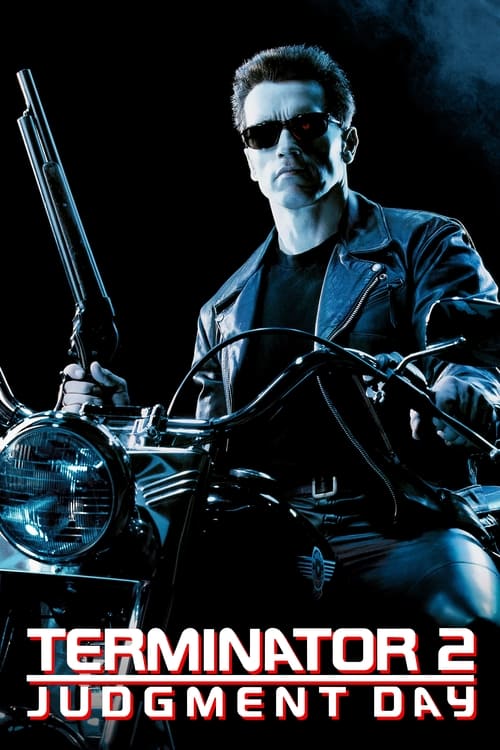
Terminator 2: Judgment Day
1991 · James Cameron
Perpetually doubted, perpetually vindicated: Avatar: The Way of Water's $2.3B silenced "no cultural footprint" jokes without ever quite ending them. His pronouncements on AI, streaming, and running times are treated as oracle statements.
For when you want the perfect action movie — big, loud, endlessly rewatchable comfort food that still has teeth. Ideal for a crowd or a night when only maximum spectacle will do.
What it's about
Ten years after a killing machine failed to end her family, Sarah Connor is locked in a mental institution and her son John is a delinquent kid in foster care — the future leader of a human resistance nobody believes in. Two machines arrive from that future: one sent to kill the boy, one reprogrammed to protect him, and the chase to prevent a nuclear judgment day begins.
The experience
Relentless — a two-hour-plus chase that somehow keeps topping itself, with real emotional weight riding under the chrome. It's thrilling and surprisingly moving: a film about doom that plays like a rush.
Performances
Arnold Schwarzenegger's deadpan protector became iconic, Linda Hamilton's transformation into a hardened, haunted warrior gave the franchise its soul, and Robert Patrick's gliding, expressionless T-1000 is one of cinema's great villains.
The craft
James Cameron fused groundbreaking liquid-metal computer effects with colossal practical stunts, and the seams still barely show decades later. It won four Academy Awards for its craft, and its steel-and-fire soundscape was built to shake a room.
Why it matters
It proved what digital effects could do and effectively opened the CGI era of blockbusters, while setting the bar for the sequel that surpasses its original.
Snapshot
Released on July 3, 1991, Terminator 2: Judgment Day stands as one of the defining industrial and aesthetic events in late-twentieth-century Hollywood cinema. A sequel to James Cameron's own low-budget 1984 breakthrough The Terminator, it reversed the moral valence of its central machine — Arnold Schwarzenegger's T-800, now sent back as protector rather than assassin — while deploying computer-generated imagery on a scale and with a fluency that had not been seen before. Its liquid-metal antagonist, the T-1000, rendered by Industrial Light & Magic, made the synthetic body into a site of genuine ontological unease rather than mere spectacle. The film grossed heavily worldwide and won four Academy Awards. More durably, it served as a proof-of-concept for the digital effects era and set the template for the modern franchise blockbuster.
Industry & production
T2 was produced by Carolco Pictures, the independent company that had also bankrolled the Rambo sequels and Total Recall (1990), and released domestically by TriStar Pictures. Cameron secured an unprecedented degree of creative control, including final cut, as a condition of his return to the property. The reported production budget — in the range of ninety to one hundred million dollars — made it one of the most expensive films produced to that point, a fact widely publicized and treated as both a selling point and a warning about Hollywood's escalating cost structure.
The project required an unusual industrial coalition: animatronic work from Stan Winston Studio, which had collaborated with Cameron on Aliens (1986) and The Abyss (1989); digital effects from ILM; and a production design effort that had to accommodate sequences ranging from a nuclear dream sequence to a freeway truck chase to the interior of a steel foundry. Casting was finalized with Arnold Schwarzenegger reprising the T-800, Linda Hamilton returning as Sarah Connor after seven years away from the role, Robert Patrick cast as the T-1000, Edward Furlong making his feature debut as John Connor, and Joe Morton as Miles Dyson, the Cyberdyne engineer whose work will eventually enable Skynet. Cameron and longtime collaborator William Wisher Jr. co-wrote the screenplay, a document that managed to invert the first film's deterministic structure while preserving its propulsive, linear drive.
Technology
The film's technological achievement is centered on the T-1000, a mimetic polyalloy entity capable of assuming any humanoid form and regenerating from damage. ILM's visual effects supervisor Dennis Muren led the team responsible for the computer-generated sequences. The morphing algorithms and the rendering of a shiny, reflective liquid-metal surface advancing convincingly through real-world space represented a significant extension of work ILM had begun with The Abyss's digital water tentacle in 1989. In T2 those techniques were applied to a character who is present throughout the film, not merely in a single scene, which demanded both greater volume of digital work and a tighter integration between CG elements and practical photography.
Stan Winston Studio contributed practical animatronics for the endoskeleton sequences and for certain transformation shots that blended into ILM's digital work. The production also made extensive use of motion-control photography to allow the locked registration necessary for compositing. The result was a hybrid workflow — digital, practical, and optical — that would define blockbuster effects production through the 1990s. Cameron's insistence on using effects not as an end in themselves but as a means of credibly staging narrative events (the T-1000's imitation of a police officer, its recovery from shotgun blasts, its emergence from fire) distinguished T2 from more effects-driven spectacles of the period where digital imagery existed primarily to be marveled at.
Technique
Cinematography
Adam Greenberg, who had shot the original Terminator, returned as director of photography. Greenberg worked in a register that combined the punishing practical textures of urban Los Angeles — freeways, industrial corridors, institutional corridors at Pescadero State Hospital — with a controlled, relatively cool palette that prevents the film from reading as warmly nostalgic. The freeway chase sequence demanded large-scale coordination: helicopters, a heavy truck, and a motorcycle in live traffic. Cameron and Greenberg approached these sequences as practical problems first, supplementing with process work and optical composites rather than constructing the chase digitally. The film's nighttime and interior work is notably harder-edged than the neon-touched expressionism of the original; T2 has the look of a film set in a world of fluorescent lighting and ambient California sun.
Editing
The film was edited by Conrad Buff, Mark Goldblatt, and Richard A. Harris. The editorial tempo is calibrated to Cameron's characteristically modular structure: an exposition passage, an escalating chase, a temporary sanctuary, and then a sustained final act. The intercutting in the Cyberdyne siege sequence — managing Sarah inside the building, John and the T-800 in the corridor, Miles Dyson's self-sacrifice, and the external police response — is among the more precisely orchestrated multi-thread sequences in 1990s mainstream cinema. The editors were also responsible for integrating ILM's digital shots invisibly into cutting rhythms governed by practical photography, a compositional challenge that required close collaboration between post-production departments.
Mise-en-scène / staging
Cameron organizes physical space with an engineer's attention to geography. The asylum breakout, the freeway, the Cyberdyne sequence, and the steel mill climax each have an established spatial logic the viewer can hold in mind even as the cutting accelerates. The film frequently uses long, tracking shots to establish scale and orient the audience — the helicopter view of Los Angeles opening, the tracking shot through Pescadero — before compressing that space in the action passages. The T-1000's staging consistently exploits its morphing ability as a staging resource rather than a mere effects showpiece: its walk-through-bars entrance, its recovery from the vault of liquid nitrogen. Cameron's staging of the human characters is attentive to their relative vulnerability in a way that creates genuine suspense.
Sound
Brad Fiedel composed the score, returning from the original. The electronic-metal palette he had established in 1984 — built on rhythmic metallic percussion and synthesized textures — is expanded here into something more orchestrally elaborate. The main theme's march-like quality, with its mechanical pulse, became one of the most recognizable musical signatures of 1990s blockbuster cinema. Sound design more broadly was awarded two Academy Awards (Sound Editing and Sound Mixing), reflecting the film's emphasis on differentiated, high-impact sound events: the T-800's shotgun, the T-1000's footsteps, the grinding machinery of the steel mill.
Performance
Linda Hamilton's physical and psychological transformation is among the more discussed performative choices in the blockbuster genre. Hamilton trained extensively — working with a personal trainer and Israeli army exercises — and the resulting physicality of Sarah Connor, with her prison-camp leanness and a performance calibrated to the verge of mania, made her an unusual figure in mainstream cinema: a mother coded as a warrior, her protectiveness inseparable from a violence that the film itself treats as morally ambiguous. Robert Patrick's T-1000 relies on a stillness and a particular predatory blankness — an absence of behavioral noise that reads, correctly, as inhuman. Schwarzenegger's performance gains dimension from the reversal: the T-800's deadpan literalism, formerly terrifying, becomes the film's primary source of comedy and of pathos, particularly in John's attempt to teach the machine the semiotics of human affection.
Narrative & dramatic mode
The screenplay's central move is the inversion of the first film: the same model of Terminator, now allied with the Connors, becomes the agent of protection rather than assassination. This structural flip creates a sustained dramatic irony — the audience spends much of the first act uncertain which machine is the protector — and it licenses the film's secondary concern: what John Connor can teach the machine about being human. The film's philosophical claim is articulated in the slogan Sarah lifts from Reese's message — "No fate but what we make" — which positions it against the fatalism of the original and gives Sarah's bombing of Cyberdyne's labs a legible moral logic, however disturbing. The nuclear dream sequence, in which Sarah watches a suburb incinerated and sees her prior self vaporized, functions as the film's emotional and political center: it anchors the action in consequence, connecting the thriller mechanics to Cold War anxiety and to a genuine reckoning with what technology makes possible.
Genre & cycle
T2 arrives at the apex of a cycle of what might be called technological-anxiety action that runs through the late 1980s and early 1990s: RoboCop (1987), Total Recall (1990), and Terminator 2 itself, followed shortly by Jurassic Park (1993) and various lesser iterations. This cycle uses the spectacle of the artificial body — robotic, cloned, genetically engineered — as a vehicle for anxieties about automation, corporate power, and the ethics of scientific advancement. T2 is also a franchise sequel designed to surpass its original on every metric of scale, a mode that becomes normative in Hollywood through the 1990s. Its simultaneous function as franchise product and as technically innovative art object — the film is genuinely good, by most critical measures, not merely commercially successful — makes it an unusual case within that cycle.
Authorship & method
James Cameron had by 1991 established a recognizable authorial signature: the engineer-director who treats films as technical problems as much as narrative ones, who drives productions to extremes of difficulty and expense, who centers female action figures within what are commercially constructed as masculine-audience entertainments (Aliens, T2, later Titanic's Rose and Avatar's Neytiri). Cameron wrote the screenplay with William Wisher Jr., who had contributed to The Terminator as well; the collaboration appears to have left the project firmly under Cameron's voice.
Adam Greenberg brought a consistency of visual approach across both films. Brad Fiedel's score is indissociable from the franchise's identity. Stan Winston's practical-effects contributions represented a creative partnership that extended across Cameron's work from Aliens through Titanic. Dennis Muren at ILM became a crucial collaborator for the digital work; the partnership between Cameron and Muren's team on the liquid-metal sequences would, in a sense, open the door for the digital effects era that Muren's team also advanced on Jurassic Park two years later.
Movement / national cinema
T2 is paradigmatic Hollywood classical cinema in its narrative structure and its exploitation of genre convention, but it is also a product of the specific moment when Carolco's independent-within-Hollywood model allowed a director to operate with unusual autonomy and spend at a scale that the studios themselves were cautious about. There is no strong national-cinema argument to make about T2 beyond American cinema — it is an export-optimized product of Los Angeles production culture, and its reception was global in a way that anticipated the fully globalized blockbuster model that consolidates in the mid-to-late 1990s.
Era / period
The film is a document of a specific techno-cultural moment: the early 1990s, after the Cold War's formal end but before any stable post-Cold War imaginary had been constructed. Its nuclear anxieties — the dream of Judgment Day, the three billion dead — retain a Cold War register even as the Soviet Union was dissolving in the months around the film's production. The T-1000 is, among other things, a figure for a diffuse, shapeless threat that has replaced the identifiable enemy. Simultaneously, T2 is the inaugural text of the CGI blockbuster era, whose commercial logic and aesthetic assumptions will govern mainstream American cinema for the following three decades.
Themes
The film's central themes cluster around determinism and agency — whether the future can be changed, whether human beings are distinguished from machines by their capacity for moral choice, and whether violence, once unleashed (by human beings, by their creations), can be recalled or redirected. The mother-son relationship between Sarah and John is its emotional spine, complicated by Sarah's conviction that her love for John is inseparable from the historical necessity of protecting him. The film takes seriously the question of what it means to teach a machine empathy — John's instruction of the T-800 in slang, in the handshake, in the meaning of "hasta la vista" — and allows that process to yield a genuinely affecting denouement: the T-800's self-termination. There is also a persistent anxiety about institutional violence — the asylum, the police, the military-industrial research complex at Cyberdyne — that gives the film a mildly counter-institutional edge unusual in a product of Hollywood's major studio system.
Reception, canon & influence
Critical reception. Reviews at the time of release were strongly positive, with particular attention to the digital effects and to Hamilton's performance. The film won four Academy Awards: Best Visual Effects, Best Makeup, Best Sound, and Best Sound Editing. Over the three decades since its release it has consolidated a position as one of the significant American action films — not merely as a technological landmark but as a narrative achievement that managed to genuinely develop the moral and emotional terms of its predecessor.
Influences on the film (backward). T2 draws on the original Terminator (1984) for its world-building and its time-loop logic, but it extends rather than merely repeats that structure. The escape-from-the-institution sequence has predecessors in films like One Flew Over the Cuckoo's Nest (1975). The film's treatment of nuclear anxiety is in dialogue with WarGames (1983) and the broader 1980s nuclear-threat cycle. James Cameron's own Aliens established the template for the tough-mother action figure and for his modular action-sequence construction.
Legacy and influence (forward). The effects work on T2 is widely considered the primary antecedent for Steven Spielberg and ILM's work on Jurassic Park (1993), which extended digital creature animation into new territory but was built on the rendering and compositing techniques refined here. The film's morphing sequences were directly imitated and eventually became a visual cliché of 1990s advertising and music video. More broadly, T2's commercial model — the sequel that radically expands the budget and technical ambition of its original while maintaining narrative coherence — became the aspired-to template for franchise filmmaking through the Marvel era. Linda Hamilton's Sarah Connor influenced subsequent female action protagonists in ways that have been extensively discussed; the film is regularly cited in accounts of the changing gender politics of the action genre. The franchise itself produced four further theatrical sequels of diminishing critical reception, two television series, and a series of canonical complications — none of which recaptured the specific conjunction of technical innovation and dramatic coherence that the 1991 film achieved. T2 remains, in the Sightlines atlas, a terminal node: a film that influenced almost everything downstream in its industrial mode while remaining, in its own right, largely unsurpassed within the terms it set.
A Deleuzian reading
Picture the corridor at Pescadero.
The full Deleuzian reading of Terminator 2: Judgment Day →
Reception
In 1991 it was the most expensive film ever made and the industry watched to see if it would sink Carolco — instead it became the year's biggest worldwide hit and an instant benchmark. Thirty-plus years on nothing has moved: it's still the default answer to 'name a sequel that outdoes the original.'
How Terminator 2: Judgment Day was received, from release to now →
Influences: the films it descends from and the films it influenced
- The Terminator (1984) — T2 structurally inverts the original's narrative grammar, recasting the identical T-800 chassis from hunter to protector — using the sequel form itself as the device to reverse the moral poles of an established iconography rather than merely extending it.
- Aliens (1986) — Stan Winston Studio's alien-queen animatronics established the practical/optical hybrid workflow T2 inherits and extends with ILM's digital layer; the Cyberdyne crosscutting also directly replicates Cameron's own multi-thread siege grammar from the colony battle, now adding a fourth simultaneous thread (Dyson's self-sacrifice).
- The Abyss (1989) — ILM's digital pseudopod is the literal technical prototype for the T-1000: the same morphing algorithms, the same Dennis Muren–led team, and the same reflective-surface compositing workflow, extended in T2 from a single-scene effect to a character present throughout the film.
- The Thing (1982) — Rob Bottin's practical bladder-and-cable body-transformation effects established the aesthetic and conceptual vocabulary for a creature that assumes any humanoid form — the staging problem T2 translates from prosthetics into CGI space, inheriting both the spatial dread of imitation and the narrative logic of the undetectable infiltrator.
- Blade Runner (1982) — The Replicant tradition of calibrated behavioral flatness as a performance code for non-humanity — inhuman stillness as a register that marks the synthetic — is the direct model for Robert Patrick's T-1000: minimal blinking, zero proxemics adjustment, sub-zero affect even under gunfire.
- Mad Max 2: The Road Warrior (1981) — Miller's practical large-scale vehicle pursuit with rigorously established spatial geography — camera placement that lets the viewer track each vehicle's relative position in real space — is the action-film grammar T2's freeway truck-chase inherits, building on practical stunts and supplementing with process work rather than constructing the chase digitally.
- Die Hard (1988) — The single-location siege crosscutting structure — police massing outside, hostages inside, lone protagonist threading between — gives T2 the editorial template for the Cyberdyne sequence, which Cameron extends by splitting the interior into three simultaneous threads and adding Dyson's self-sacrifice as a fourth.
- RoboCop (1987) — The corporate engineer whose research enables autonomous law-enforcement violence without his complicity being visible to him (Dick Jones / Bob Morton) is the direct structural model for Miles Dyson; Phil Tippett's go-motion ED-209 also established the convention of staging the machine body through a combination of puppet, optical, and sound design rather than as a human performance.
- Jurassic Park (1993) — ILM directly transferred T2's hybrid CGI/practical workflow, with Dennis Muren overseeing both productions; the problem of integrating fully-rendered digital creatures into live-action photography with correct motion blur and specular response is structurally identical to the T-1000 integration challenge, and Spielberg's production team cited T2 explicitly as the proof-of-concept.
- The Matrix (1999) — Bullet-time photography extended T2's mandate — CGI enlisted to stage a physically impossible narrative event rather than to generate spectacle — applying the same logic of 'freeze what cannot be frozen' that T2 used for the T-1000's morph shots; the film also inherits T2's machines-have-won Judgment Day scenario as its literal premise.
- Ex Machina (2014) — Alicia Vikander's Ava deploys the same performance grammar of calibrated behavioral minimalism — the T-1000 tradition of inhuman stillness as a marker of machine consciousness — but applies it in a confined, intimate register rather than an action context, testing whether the affect system can pass without the action context that makes T-1000's blankness legible.
- Avatar (2009) — Cameron's own extension of the hybrid digital/practical proof-of-concept T2 established: performance-capture driven by Weta Digital applies T2's insistence that digital effects serve narrative intelligibility rather than exist as spectacle, scaling the workflow from a single morphing character to a fully synthetic world.
- Terminator: Dark Fate (2019) — The Rev-9's bifurcating endoskeleton/liquid-metal construction directly elaborates T-1000 technology as a franchise grammar; Linda Hamilton's return as an aged Sarah Connor also extends the female-action-figure physical transformation arc — now inflecting it through the body's accumulated damage rather than its hardening.
- Avengers: Age of Ultron (2015) — Its photoreal CG-morph robot composited seamlessly into live plates set the integration standard for Ultron's fully digital, performance-driven metal body.
- Chappie (2015) — The protective machine 'raised' alongside a child who teaches it humanity — the robot-becomes-more-human emotional engine — plus a CG-effects character set against practical hardware.
- Chainsaw Man - The Movie: Reze Arc (2025) — Fuses the human-whose-body-is-armament with liquid, explosive spectacle, modeling the 'weapon-as-person' pathos Reze literally embodies as a walking bomb.
- Pirates of the Caribbean: Dead Man's Chest (2006) — The T-1000's fully digital morphing figure first proved a CG character could act convincingly opposite live performers in the same frame.
- The Mask (1994) — ILM's liquid-metal morphing of the T-1000 is the direct technical parent of the Mask's shape-shifting, stretching body effects.
- Transformers (2007) — ILM's liquid-metal T-1000 pioneered seamless shape-shifting morph animation and its accompanying designed metallic sound, the direct precursor to Transformers' transformation sequences and SFX.
- Star Wars: Episode II - Attack of the Clones (2002) — Introduces a fully CG-rendered character (the T-1000) that acts and performs rather than merely appears, the precedent for treating digital Yoda as a performing lead.
- Total Recall (1990) — A Carolco production from the same industrial moment, Total Recall shares T2's commitment to practical body-transformation effects at blockbuster scale — Rob Bottin's work on the Mars-face sequence — and deploys the same corporate-complicity subplot in which a multinational's technical apparatus becomes the mechanism of political control.
- Minority Report (2002) — Minority Report extends T2's structural preoccupation with determinism-vs-agency: the protagonist acts to prevent an event predicted by a system that cannot be wrong, staging the same philosophical thesis T2 encodes in the phrase 'no fate but what we make,' but relocating it from time-travel mechanics to algorithmic precognition.
- Toy Story (1995) — The T-1000's CG morphing demonstrated seamless digital character integration and pushed the rendering and motion tools Pixar's contemporaries were maturing in parallel.
- Gloria (1980) — Builds its spine on the reluctant lethal guardian forced to shield a child marked for death across a relentless pursuit — Gloria's chase-structure scaled to action spectacle.
Similar films
- Aliens (1986) — influence & lineage · same viewing thread
- Blade Runner (1982) — influence & lineage · same viewing thread
- The Terminator (1984) — influence & lineage
- Jurassic Park (1993) — influence & lineage
- The Abyss (1989) — influence & lineage
- Avatar (2009) — influence & lineage
- Total Recall (1990) — influence & lineage
- RoboCop (1987) — influence & lineage
All the films related to Terminator 2: Judgment Day →
Watch it with: curated runs of related films
- The Blockbuster Sci-Fi Canon — A run of the effects-driven epics that taught modern audiences what a movie could feel like — from the desert planets of Star Wars to the rain of Blade Runner and the sands of Arrakis.