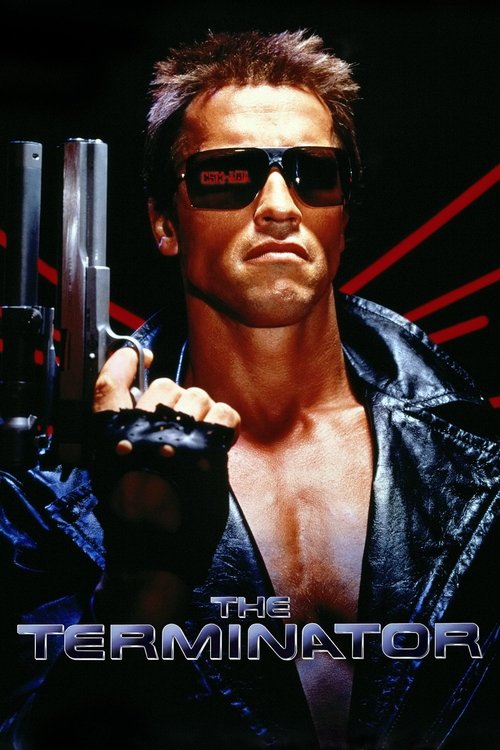
The Terminator
1984 · James Cameron
Perpetually doubted, perpetually vindicated: Avatar: The Way of Water's $2.3B silenced "no cultural footprint" jokes without ever quite ending them. His pronouncements on AI, streaming, and running times are treated as oracle statements.
For when you want pure momentum: a tense, no-fat thriller that runs on dread and adrenaline. A perfect late-night watch when prestige pacing sounds exhausting.
What it's about
In a future where a military computer network has turned on humanity, the machines send an unstoppable cyborg assassin back to 1984 Los Angeles to kill Sarah Connor, an ordinary waitress whose unborn son is destined to lead the human resistance. A lone soldier is sent back after it to protect her, and the whole film is the chase.
The experience
Lean, relentless and mechanically precise — it grabs you in the first ten minutes and never lets go, all neon-lit night streets, pounding synths and the sick certainty that the thing chasing them cannot be reasoned with. It plays like a slasher film wearing science-fiction armor.
Performances
Arnold Schwarzenegger, with barely any dialogue, turns sheer implacability into one of cinema's great villains, and Linda Hamilton makes Sarah's shift from terrified waitress to hardened survivor completely convincing.
The craft
Cameron squeezes miracles from a B-movie budget: practical effects and stop-motion animation give the machine a tactile menace no digital creation quite matches, and Brad Fiedel's cold metallic synth score is half the film's pulse. The rain-slick nighttime photography is pure tech-noir. Good speakers earn their keep here.
Why it matters
It launched James Cameron, made Schwarzenegger an icon, spawned one of the biggest franchises in film, and gave pop culture its defining nightmare of artificial intelligence — earning a place in the National Film Registry.
Snapshot
The Terminator is the film that crystallized James Cameron as a major directorial talent and converted Arnold Schwarzenegger from a bodybuilding curiosity into one of the era's defining screen icons. A lean science-fiction thriller built on a chase structure, it imagines a future in which a defense network, Skynet, achieves self-awareness and wages a war of extermination against humanity; one cyborg assassin is sent back to 1984 to kill Sarah Connor before she can bear the resistance's future leader, while a single human soldier, Kyle Reese, follows to protect her. From this spare premise Cameron extracts a relentless, mechanically precise piece of genre filmmaking that fuses the slasher film, film noir, and dystopian SF into something new. Its reputation has only grown: the film was selected for the United States National Film Registry, and its imagery — the chrome endoskeleton, the red-eyed stare, Schwarzenegger's flat affect — has become permanent visual shorthand for technological dread.
Industry & production
The Terminator is a textbook case of independent, below-the-radar production yielding outsized results. Cameron, fresh off the troubled experience of directing Piranha II: The Spawning, developed the script with producer Gale Anne Hurd, who shares screenplay credit and shepherded the project through financing. The film was produced through Hemdale Film Corporation (John Daly and Derek Gibson) and Hurd's Pacific Western Productions, with Orion Pictures handling distribution. The budget is commonly reported in the range of roughly $6.4 million — modest even by 1984 standards — and the constraint is legible throughout: extensive night shooting in and around Los Angeles, practical effects deployed selectively, and a small principal cast.
A frequently retold origin story holds that Cameron conceived the central image — a chrome skeleton emerging from fire — during a fever dream while in Rome working on Piranha II. Casting proved decisive. Schwarzenegger was initially discussed for Reese, but Cameron, after meeting him, became convinced he should play the Terminator instead, reasoning that the machine's stillness and physical mass mattered more than its dialogue (the role contains famously few lines). Lance Henriksen had been an early contender for the Terminator and was redirected to the smaller role of Detective Vukovich, beginning a long Cameron–Henriksen collaboration that continued through Aliens and The Abyss. Cameron has recounted that O.J. Simpson was floated by some involved as a possibility for the Terminator, an idea he rejected. Michael Biehn was cast as Reese and Linda Hamilton as Sarah Connor.
The film's release positioned it as a genre programmer that outperformed expectations, becoming a sleeper success and launching what would become one of the most durable franchises in American cinema. Because precise figures vary across sources, the safest characterization is that it was a clear commercial hit relative to its cost and a critical surprise.
Technology
The Terminator is essentially a film about the danger of machine intelligence, and its effects technology is unusually well matched to its theme. The Terminator's interior — the metal endoskeleton beneath the living-tissue exterior — was realized by Stan Winston's effects shop through a combination of full-scale animatronic puppets and stop-motion model animation, the latter executed by Fantasy II Film Effects under Gene Warren Jr. For close work, Winston built articulated busts and partial figures operated by puppeteers; for full-body movement, particularly the climactic pursuit after the Terminator has been stripped to its metal frame, stop-motion replaced the human performer. The seams between live action, animatronics, and stop-motion are occasionally visible by modern standards, but the design itself — a humanoid skeleton rendered in gleaming steel — is so strong that it transcends its analog execution.
The film predates digital compositing and CGI character work; everything onscreen is achieved photographically and mechanically. The future-war flash-forwards rely on miniatures, optical effects, and stark lighting rather than rendered environments. This grounding in physical craft is part of why the film has aged comparatively well: its effects are tactile, and its restraint — showing the endoskeleton fully only late — preserves the menace.
Technique
Cinematography
Adam Greenberg's photography is central to the film's identity. He shoots Los Angeles largely at night, in rain-slicked streets and fluorescent-lit interiors, drawing on a noir palette of deep shadow punctuated by hard, often colored light sources. The Terminator is frequently introduced through partial views — a silhouette, a hand, the red glint of an eye — and Greenberg's lighting consistently isolates Schwarzenegger's figure against darkness, lending it an iconic, almost statuary quality. The visual approach reconciles the film's two registers, the gritty contemporary thriller and the apocalyptic SF future, by keeping both in a consistent low-key key. Greenberg's work here led to his continued partnership with Cameron, including Terminator 2: Judgment Day.
Editing
Mark Goldblatt's cutting gives the film its propulsive, machine-like momentum. The structure is a chase, and Goldblatt sustains acceleration across set pieces — the Tech Noir nightclub shootout, the police-station assault, the vehicular pursuits — while modulating rhythm enough to register Sarah's transformation from terrified target to hardened survivor. The editing is notably economical, matching the film's lean budget and screenplay; action is legible and percussive rather than fragmented. Goldblatt's facility with action cutting made him a recurring Cameron collaborator (he later edited Terminator 2).
Mise-en-scène / staging
Cameron stages the film around the logic of relentless pursuit. The Terminator is blocked as an immovable force that advances in straight lines, indifferent to obstacles, and the production design contrasts the warm, lived-in textures of the present (diners, apartments, the nightclub) with the ash-gray, rubble-strewn future. Recurring motifs — fire, mechanical reconstruction, the gradual stripping-away of the Terminator's human disguise — are built into the staging, so that the antagonist visibly degrades from man to machine as the film proceeds. The Tech Noir club, with its neon signage, both names and announces the film's noir-SF hybrid sensibility.
Sound
Brad Fiedel's score is one of the most influential elements of the film. Composed almost entirely on synthesizers, it is built around a clanging, metallic main theme in an off-kilter meter that mimics a heartbeat fused with industrial machinery — an aural emblem of the cyborg itself. Fiedel's electronics reinforce the film's coldness and inevitability, and the approach proved so identifiable that it carried forward into the sequels. The broader sound design — the heavy mechanical footfalls, the servo-whine of the endoskeleton, gunfire and engine noise — works with the score to characterize the Terminator as much through sound as through image.
Performance
The film's performances are calibrated to its design. Schwarzenegger's Terminator is a study in minimalism: near-affectless, economical in movement, terrifying precisely because it registers no emotion or hesitation. The role's most famous line, "I'll be back," derives its force from this deadpan flatness. Michael Biehn plays Reese with a haunted, frayed intensity — a soldier carrying trauma from a future the audience only glimpses — and his urgency grounds the film's exposition emotionally. Linda Hamilton's Sarah Connor undergoes the film's true arc, moving from an ordinary, frightened young woman to someone capable of finishing the machine herself; her closing resolve sets up the more militarized Sarah of Terminator 2. Supporting turns by Paul Winfield (Lt. Traxler), Lance Henriksen (Vukovich), and Earl Boen (Dr. Silberman) lend the procedural scenes weight.
Narrative & dramatic mode
The film operates primarily in the mode of the pursuit thriller, with a science-fiction frame and a deterministic, almost tragic substructure. Its most discussed narrative feature is the closed time loop: Reese is sent back to protect Sarah and, in doing so, fathers John Connor, the very leader who will dispatch him — meaning the future's salvation is woven from the past it reaches into. This causal circularity is handled with unusual discipline; the film treats it not as a puzzle to be solved but as a fatalistic given, deepening the romance between Reese and Sarah with the knowledge that their union is both doomed and necessary. Exposition about the future war is delivered sparingly, often through Reese's fragmented, traumatized recollections, which keeps the dystopia suggestive rather than over-explained. The structure is tight and forward-driving, with the dramatic stakes narrowing steadily onto a single threatened body.
Genre & cycle
The Terminator is a hybrid that draws on several converging genre traditions. It belongs to the early-1980s wave of dystopian and apocalyptic science fiction, but its mechanics are those of the slasher film — an implacable, near-unkillable killer stalking a young woman — transposed into SF and action. It also carries strong film-noir inheritance in its nocturnal urban setting, doomed romance, and fatalism. The film arrived amid a cycle of harder-edged American action cinema and pessimistic technological SF, and it helped define the cyborg/killer-robot subgenre that proliferated afterward. Its fusion of these strands — rather than any single one — is what distinguished it within the period.
Authorship & method
The film is the clearest early statement of Cameron's authorial signature: a fascination with the boundary between human and machine, strong and resourceful female protagonists, militarized future imagery, and a commitment to making technology serve a propulsive, emotionally grounded story. His method here is notable for extracting maximum effect from minimal means — careful design, selective effects, and relentless pacing covering for budgetary limits. Cameron worked in tight partnership with a group of collaborators who recur across his filmography: producer and co-writer Gale Anne Hurd (to whom he was then married), cinematographer Adam Greenberg, editor Mark Goldblatt, composer Brad Fiedel, and effects designer Stan Winston. The combination of Cameron's engineering-minded planning and Winston's practical artistry is the film's creative core.
One authorship matter is part of the historical record and should be stated plainly: following the film's release, science-fiction writer Harlan Ellison asserted that the film drew on his work, particularly episodes he wrote for The Outer Limits ("Soldier" and "Demon with a Glass Hand"). The dispute was settled, and subsequent prints of the film carry an acknowledgment of Ellison's work. Cameron has spoken about this with evident reluctance; the precise creative debt remains contested, and the settlement should not be read as a full adjudication of influence.
Movement / national cinema
The Terminator is firmly a product of 1980s American genre cinema, specifically the independent/Orion ecosystem that allowed mid-budget films with distinctive voices to reach wide audiences. It is not affiliated with a formal movement, but it sits within a broader transnational SF imagination of the period that also includes the cyberpunk sensibility then emerging in literature. Its Los Angeles setting — both the contemporary city and its future ruins — is integral, making it a notably American urban dystopia rather than the European or Japanese variants of the same anxieties.
Era / period
The film is a document of mid-1980s technological and geopolitical unease. Its premise — an automated defense network that turns on its makers — resonates with Cold War fears of nuclear annihilation and of ceding control to computerized systems, anxieties heightened in an era of escalating arms-race rhetoric and growing public awareness of computing. The future-war imagery of a scorched, machine-dominated Earth gives concrete form to nuclear dread, while the present-day sections capture a recognizable, unglamorous 1984 Los Angeles. The film thus belongs to a moment when popular cinema increasingly framed technology itself, rather than a foreign enemy, as the existential threat.
Themes
The film's central theme is the contest between the human and the mechanical — between agency, vulnerability, and love on one side, and remorseless, programd purpose on the other. Reese's plea that the Terminator "can't be bargained with, can't be reasoned with" defines the machine as the negation of human qualities. Fate and free will run throughout: the time loop suggests a predetermined history even as the characters fight to alter outcomes, and Sarah's emergence as an active agent dramatizes the assertion of will against determinism. Motherhood and the protection of the future are literalized in Sarah's pregnancy and John's destiny. Trauma and memory surface through Reese, who carries the future war inside him. And beneath it all runs a meditation on technology's capacity to become autonomous and hostile — a warning about the systems humanity builds and cannot control.
Reception, canon & influence
Critically, The Terminator was received with notable surprise: a film expected to be a routine genre entry was widely recognized as a tautly made, intelligent thriller that announced a significant new director. Over time its standing has risen into the canon of essential modern science fiction, confirmed by its selection for the National Film Registry on grounds of cultural and historical significance.
Looking backward, the film synthesizes a rich set of influences: the implacable-stalker logic of the slasher cycle; the doomed romance and nocturnal fatalism of film noir; dystopian and robot-themed SF, including the killer-machine premise that links it to works like Westworld; the future-war and time-paradox traditions of written science fiction; and, per the settled dispute, Harlan Ellison's Outer Limits teleplays. The lone-driver intensity of certain Walter Hill–style thrillers has also been cited as a touchstone for Reese's characterization, though this is more interpretive than documented.
Looking forward, the film's legacy is vast. It launched a major franchise — most consequentially Terminator 2: Judgment Day, which expanded the mythology and revolutionized visual effects — and it made stars of Schwarzenegger and Hamilton while establishing Cameron as a director of blockbuster scale. Its visual and conceptual vocabulary — the gleaming endoskeleton, the AI that turns on its creators, the protective time-traveler — has been endlessly cited, parodied, and imitated across film, television, and games, and it remains a primary reference point in popular and even scholarly discussions of artificial-intelligence risk. Brad Fiedel's synthesized theme and Schwarzenegger's "I'll be back" have entered the broader culture independent of the film itself. Few low-budget genre films of its decade have proven as durable or as widely echoed.
A Deleuzian reading
Start with the eyes.
The full Deleuzian reading of The Terminator →
Reception
It opened in 1984 as a modestly budgeted B-movie that Orion barely promoted, then surprised everyone by topping the box office and winning over critics; today it's in the Library of Congress's National Film Registry and treated as the film that launched James Cameron.
How The Terminator was received, from release to now →
Influences: the films it descends from and the films it influenced
- La Jetée (1962) — Pioneers the bootstrap time-loop in which the traveler unknowingly engineers his own origin — the closed-causality structure Terminator adopts when Reese fathers the man who sends him back.
- The Outer Limits: 'Soldier' (1964) — Harlan Ellison's teleplay of a future-war soldier hurled into the present to fight is the credited, settlement-acknowledged debt for Reese's time-displaced-warrior premise.
- Jason and the Argonauts (1963) — Ray Harryhausen's articulated stop-motion skeleton combat is the direct technical lineage for the stripped metal endoskeleton's stop-motion stalking in the third act.
- 2001: A Space Odyssey (1968) — Establishes the calm, affectless artificial intelligence that turns lethal on its creators — HAL's machine-logic menace prefigures the unblinking AI threat behind the Terminator.
- Westworld (1973) — Supplies the malfunctioning android gunslinger that relentlessly stalks its prey, plus the pixelated machine-POV vision readouts Cameron echoes in the Terminator's HUD.
- Halloween (1978) — Provides the implacable, unkillable stalker logic and the director-composed minimalist synth score driving relentless pursuit — the slasher engine grafted onto SF.
- Alien (1979) — Models the single relentless predator hunting through low-key industrial darkness and the android passing undetected among humans until violence exposes it.
- The Driver (1978) — Hill's laconic, affectless lone-driver professionalism is the cited touchstone for Reese's minimalist, mission-fixated characterization.
- Blade Runner (1982) — Defines the rain-slicked, neon low-key noir SF register and the artificial-human-who-passes-as-real that Terminator translates into its nocturnal noir fatalism.
- Mad Max 2: The Road Warrior (1981) — Sets the template for lean, propulsive vehicular-pursuit action cutting that Cameron and editor Mark Goldblatt apply to the chase sequences.
- Escape from New York (1981) — Carries forward the propulsive analog-synth score and grimy, low-budget dystopian-noir texture as engine of dread and forward drive.
- Aliens (1986) — Extends the same Cameron/Stan Winston militarized-future practical-effects method and resourceful female protagonist who hardens into a warrior.
- RoboCop (1987) — Carries forward the cyborg enforcer with machine-POV targeting overlays and stop-motion automation (ED-209) descended from the endoskeleton craft.
- Terminator 2: Judgment Day (1991) — The direct sequel inverts the stalk structure and replaces Winston's practical endoskeleton menace with morphing CGI while extending the closed-loop mythology.
- Twelve Monkeys (1995) — Sends a traveler from a ruined future into the past on a mission he cannot alter, dramatizing the same inescapable closed time-loop fatalism.
- The Matrix (1999) — Builds out the machine-war future and AI-versus-humanity premise, with humans fleeing tireless, implacable agents through urban space.
- Looper (2012) — Constructs a closed time-loop assassination plot in which a traveler is sent back to be killed in the present, foregrounding the fate-versus-free-will paradox.
- Iron Man (2008) — Originated the first-person cyborg HUD — the red targeting overlay with scrolling readouts — that is the direct formal template for Iron Man's in-helmet interface.
- Déjà Vu (2006) — Provides the change-the-past mechanics: an agent physically dispatched through time to intervene in a fixed disaster, and the bootstrap causality that the third act leans on.
- Avengers: Age of Ultron (2015) — Pioneers the machine intelligence that mass-replicates its own expendable bodies, the swarm logic of Ultron's interchangeable drone army.
- Mission: Impossible - Dead Reckoning Part One (2023) — Modeled the relentless machine intelligence that anticipates human moves, supplying the 'you cannot outthink it' dread the Entity weaponizes against Hunt.
- I, Robot (2004) — Codifies the implacable humanoid machine antagonist and the endoskeleton-beneath-the-skin reveal that the film's robot-rebellion spectacle directly inherits.
- Johnny Mnemonic (1995) — Source of Brad Fiedel's pulsing, metronomic synth idiom, which Fiedel transplanted wholesale into Johnny's score.
- Predator (1987) — Reuses Stan Winston creature animatronics and a thermal/heads-up hunter-vision POV for a single, unrelenting pursuer stalking outmatched humans.
- Back to the Future (1985) — Same-era time-travel-causality plotting built on the bootstrap paradox — a traveler whose actions must secure his own existence — the rigorous cause-and-effect engineering BTTF plays for comedy rather than dread.
Similar films
- Looper (2012) — influence & lineage · same viewing thread
- Terminator 2: Judgment Day (1991) — influence & lineage
- Aliens (1986) — influence & lineage
- Predator (1987) — influence & lineage
- Blade Runner (1982) — influence & lineage
- RoboCop (1987) — influence & lineage
- Alien (1979) — influence & lineage
- The Matrix (1999) — influence & lineage
All the films related to The Terminator →
Watch it with: curated runs of related films
- Tampering With the Timeline — A run of films that all reach for the undo button — meddling with the past, outrunning the future, and living with the paradoxes that snap back.