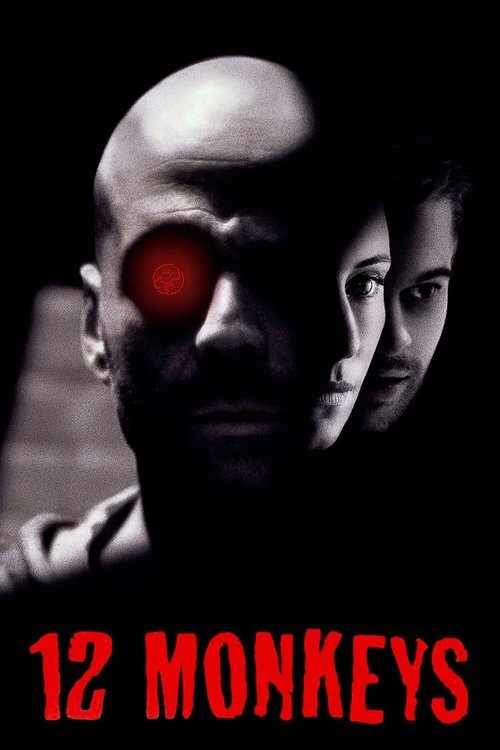
Twelve Monkeys
1995 · Terry Gilliam
When you want a film to chew on for days — a twisty, melancholy puzzle for a late night, not a comfort watch. Reach for it when you're up for being unsettled and rewarded for paying attention.
What it's about
In 2035, a plague has driven the remnants of humanity underground, and convict James Cole is sent back in time to trace the virus to its source. The machine is imprecise: he lands in the wrong year, gets locked in a mental hospital, and meets a psychiatrist who has every reason to believe he's delusional — a possibility the film never lets you rule out either.
The experience
Paranoid, feverish, and disorienting in the best way — you're piecing together the timeline right alongside Cole, never quite sure what's memory, prophecy, or madness. It's a thriller that keeps tightening while quietly breaking your heart.
Performances
Bruce Willis strips away the action-hero armor for something raw and haunted, and Brad Pitt is electric as a twitchy asylum patient — a live-wire turn that earned him an Oscar nomination.
The craft
Terry Gilliam builds both eras out of rusted machinery, off-kilter angles, and decaying grandeur, so the past feels as broken as the future. Adapted from a legendary French short made almost entirely of still photographs, it turns that spare idea into a maze of production design that rewards a big screen.
Why it matters
It proved a studio time-travel movie could be genuinely strange and still be a hit, and its fatalistic loop became a touchstone for the smarter end of science fiction — later spawning a TV series.
Snapshot
Twelve Monkeys is a science-fiction thriller in which James Cole (Bruce Willis), a prisoner in a bleak subterranean future of 2035, is repeatedly sent backwards through time on a mission to identify the origin of a plague that has destroyed most of humanity. The film turns on a question it never fully resolves: is Cole a genuine time traveler, or a delusional man whose prophetic visions are the symptoms of psychosis? That ambiguity anchors a meditation on memory, fate, and institutional power that reaches far beyond its genre conventions. Adapted from Chris Marker's 1962 short film La Jetée — a French essay-film composed almost entirely of still photographs — Twelve Monkeys transforms Marker's haunted, sparse meditation into a labyrinthine and visually extravagant thriller. Critically and commercially successful on release, it has since secured a firm place in late-twentieth-century science-fiction cinema, regularly cited as one of Gilliam's most sustained and coherent achievements.
Industry & production
The project originated with producer Charles Roven, who brought a treatment inspired by La Jetée to Universal Pictures before attaching Gilliam as director. The screenplay was written by David Webb Peoples and Janet Peoples. David Peoples had already demonstrated an unusual facility for science fiction through his co-authorship of Blade Runner (1982, with Hampton Fancher) and had received an Academy Award nomination for Unforgiven (1992), bringing considerable prestige to the attachment. The Peoples' script — rigorous in its predestination logic and disciplined in its management of psychological ambiguity — gave Gilliam a formal scaffold strong enough to support his maximalist visual instincts without being overwhelmed by them.
Bruce Willis was cast against the grain of the action-hero persona he had built through the Die Hard franchise, a choice that proved central to the film's tonal complexity: Cole's bewilderment and vulnerability are convincing in part because Willis's physical authority keeps implying a competence the narrative methodically undermines. Brad Pitt was cast as Jeffrey Goines, the manic scion of a prominent virologist, and reportedly prepared by researching behaviors associated with severe mental illness. His performance earned him a Golden Globe for Best Supporting Actor and an Academy Award nomination in the same category — a pivotal moment in establishing his range beyond romantic-lead roles. Madeleine Stow plays psychiatrist Dr. Kathryn Railly, whose arc from detached clinician to convinced believer structures the film's emotional spine.
Principal photography was concentrated in Philadelphia and Baltimore. The postindustrial ruins and institutional architecture of those cities gave Gilliam and production designer Jeffrey Beecroft the rawer textures of both the future underground sequences and the 1990 psychiatric hospital scenes without requiring extensive purpose-built sets — a decision that grounds the film's fantastical conceits in recognizable material reality.
Technology
Twelve Monkeys sits at a transitional point in cinema technology, before digital visual effects became the standard instrument of science-fiction spectacle. The film's convincing sense of a near-future world is achieved through production design, location selection, and practical effects rather than computer-generated environments; digital compositing is minimal and largely invisible. Gilliam and cinematographer Roger Pratt worked primarily with anamorphic lenses combined with extreme wide-angle and periodically distorting optics — a technique that bends spatial geometry within the frame to suggest a world physically out of joint. The anamorphic format contributes to the film's widescreen compositions, while the lens choices — sometimes approaching fisheye curvature — systematically disrupt the viewer's confidence in perceptual normality. This is a film that builds its science-fictional estrangement through optics rather than post-production, a formal decision aligned with its thematic interest in the unreliability of what is seen.
Technique
Cinematography
Roger Pratt, who had photographed Brazil (1985) for Gilliam, returns here with a visual strategy calibrated to Cole's fractured mental states. The future sequences are rendered in cold, desaturated blues and grays, their compositions crowded and vertiginous, suggesting a world pressed inward. The 1990 sequences in the Baltimore psychiatric hospital are shot with low angles and extreme wide lenses that distort ceilings and walls into expressionist instability, making the institution feel as claustrophobic as the underground future — a visual argument that confinement is not period-specific but structural. When Cole reaches 1996, the palette shifts marginally warmer, but Pratt never allows the past to feel genuinely safe; every frame carries an undertow of threat. The systematic use of point-of-view distortion blurs the line between perception and delusion, refusing the clean objectivity that would anchor Cole — or the viewer — in settled reality.
Editing
Mick Audsley edited the film with a rhythm that honors Gilliam's fragmented conception of time without sacrificing narrative legibility. The temporal jumps are handled without conventional transitional coding: we move abruptly from one era to another, sometimes mid-scene, so that the disorientation Cole experiences is structurally reproduced in the audience. Audsley calibrates pacing carefully between the thriller plot — which demands forward momentum — and the more ruminative passages in which Cole and Railly negotiate the possibility of his delusions. The recurring dream-memory sequences centered on the childhood airport scene are edited in a slightly slowed, twice-seen register that builds towards the film's final revelation without telegraphing it.
Mise-en-scène / staging
Gilliam's staging reflects a persistent emphasis on location and design as expressionistic surfaces rather than neutral containers. The future is built in the decommissioned industrial spaces of underground Philadelphia, with animals reclaiming the ruined surface world above. The psychiatric ward is staged as a panopticon of surveillance and infantilisation; Beecroft fills these spaces with period-accurate institutional furniture while pushing color and spatial geometry toward expressionist distortion. Animal imagery recurs across all three time frames — caged zoo animals, a snail in a prison cell, a horse glimpsed in a Philadelphia skyscraper corridor during what may be a hallucination. These motifs establish a counterpoint between the caged (Cole, Goines, humanity underground) and the free (the natural world repossessing civilization), sustaining thematic resonance without collapsing into allegory.
Sound
The sound design reinforces the film's thematic concern with the unreliability of perception. Cole's time-travel arrivals are accompanied by jarring acoustic dislocations — the noise of displacement rendered as a full-body sonic assault. The film makes prominent use of Astor Piazzolla's tango compositions on the soundtrack, an unexpected tonal choice that introduces a melancholy European fatalism into what might otherwise have been a purely propulsive thriller. Composer Paul Buckmaster contributed original orchestral material, though the Piazzolla pieces constitute the film's most distinctive musical signature. The layering of these two registers — Piazzolla's nostalgic tango lyricism against thriller-driven tension — produces the film's peculiar emotional tone: a grief for a world already lost.
Performance
Willis's performance is the film's structural center and its most undervalued element. Playing a man perpetually uncertain of his own sanity, Willis strips away the ironic self-sufficiency that characterized his earlier stardom; Cole is baffled, frightened, and wholly unable to manage the world he moves through. The performance works in a counterintuitive register: a large, physically capable man rendered helpless by epistemological doubt. Pitt's Jeffrey Goines operates differently — a motormouth dissociation that functions simultaneously as comic relief and genuine menace, grounded in a physicality that never tips into mere caricature. The film's sustained dramatic tension across its middle section depends on the interplay between Stow's Railly — controlled, professional, progressively destabilised — and Willis's Cole — barely controlled, raw, gradually accumulating a terrible certainty — a dynamic Gilliam stages with the patience of a director who trusts his actors to carry weight.
Narrative & dramatic mode
The film's narrative structure is a predestination loop: the plague Cole is sent back to prevent has already occurred; his mission generates the conditions that make his mission necessary; the ending we reach is the one we have already seen. This is not a twist so much as a formally inevitable conclusion, and the film's achievement is to make that inevitability feel tragic rather than merely ingenious. The borrowed structure from La Jetée — the compulsive return to a childhood airport scene that contains the resolution — is deepened by the psychological ambiguity: whether Cole's recollections are memory or symptom remains unstable until the final minutes, and even the resolution fuses rather than separates these possibilities. The dramatic mode is classical dramatic irony compounded by epistemological uncertainty; the viewer never quite knows what kind of story is being told until it is almost over.
Genre & cycle
Twelve Monkeys belongs to the cycle of paranoid science fiction that developed through American cinema in the late 1980s and 1990s, characterized by distrust of institutional power, anxiety about biological and ecological catastrophe, and interest in the instability of perceived reality. Films in this formation include Total Recall (1990), Dark City (1998), and — most significantly in terms of cultural saturation — The Matrix (1999). Twelve Monkeys is distinguished from many of these by its explicit engagement with the European art-film tradition, grounding its science fiction in the existential register of Marker and carrying traces of Kafka's institutional labyrinth and Borgesian temporal paradox. It also participates in a more specific sub-cycle of time-travel films that use predestination mechanics as a vehicle for tragedy rather than adventure: the structural logic connects it to The Terminator (1984) while anticipating later work such as Looper (2012) and Arrival (2016).
Authorship & method
Gilliam arrived at Twelve Monkeys in an unusual position. The Adventures of Baron Munchausen (1988) had been a near-catastrophic production overrun; The Fisher King (1991) represented a partial accommodation of Hollywood convention at some cost to personal vision. Twelve Monkeys achieved a synthesis — a studio picture that nonetheless accommodated Gilliam's maximalist design sensibility, held in harness by a screenplay with the structural discipline to match it. The Peoples' rigorous loop architecture gave Gilliam a formal constraint he could work productively against rather than around.
Pratt's cinematographic collaboration with Gilliam was built on a shared commitment to in-camera visual distortion and the use of production design as the primary carrier of meaning. Audsley's editorial approach brought precision to the temporal architecture that the screenplay demanded. The performances Gilliam drew from Willis and Pitt demonstrate a director who, by the mid-1990s, had developed considerable skill in managing the specific pressures of working with major stars while maintaining a distinctly personal visual intelligence.
Movement / national cinema
Gilliam is constitutively anomalous in the landscape of national cinemas: born in Minnesota, he became a central figure of British comedy through Monty Python before developing a directorial career that is neither straightforwardly British nor American. Twelve Monkeys is an American studio production inflected by a European aesthetic sensibility — specifically the French Left Bank tradition associated with Chris Marker and the German expressionist legacy in psychological distortion. It might be situated within the broader tendency of American films from this period that absorbed and reprocessed the European art cinema of the 1950s–70s without belonging to it. Gilliam's transatlantic position is precisely his utility: Twelve Monkeys is a Hollywood genre film that carries the intellectual freight of European art cinema without becoming an exercise in prestige detachment.
Era / period
Released in December 1995, the film arrived at a moment in which American science fiction was urgently renegotiating its premises. The Cold War framework that had structured much genre SF — with its legible polarities of East/West, human/alien — had dissolved, and anxieties about global ecological collapse, epidemic disease, and civilisational fragility were moving to the center of the cultural imagination. The AIDS epidemic, the 1994–1995 Ebola outbreak in Zaire, and mounting concern about antibiotic resistance gave the film's viral catastrophe scenario a topicality that sharpened its impact without reducing it to mere allegory. The film registers the specific anxiety of a decade caught between the end of one global order and the not-yet-visible shape of what would replace it — a transitional uncertainty that the predestination loop formally encodes: the catastrophe is already baked in; change is structurally impossible.
Themes
The film's central theme is the inscrutability of fate and the inadequacy of individual agency against systemic catastrophe. Cole is sent back not to prevent the disaster — which he gradually understands cannot be prevented — but merely to collect information, a mission that reduces heroism to data gathering and renders conventional genre action futile. This is a deeply pessimistic construction of temporal agency that the film does not soften. Alongside it runs a sustained examination of madness and institutional control: the psychiatric system the film depicts is not a site of healing but of categorization and suppression, and the narrative asks how diagnostic frameworks produce the realities they purport merely to describe. Cole's diagnosis of paranoid schizophrenia is not obviously wrong, and the film refuses to resolve this ambiguity fully even at its close. A third major theme is traumatic memory: the mind's compulsive return to an incomprehensible scene, and the ways in which misremembering functions as self-protection. The film connects its science-fictional conceits to a recognizably psychoanalytic account of mental life, in which what we cannot process we repeat until it destroys us.
Reception, canon & influence
Influences on the film (backward)
La Jetée (1962) is the primary acknowledged source; the Peoples' screenplay credits it, and Gilliam has been consistently open about the adaptation. The film retains the structural core — repeated time travel, a childhood airport scene, the predestination revelation — while translating Marker's still-image meditation into full narrative cinema. Hitchcock's Vertigo (1958) is an explicit intertextual reference, quoted directly when Cole and Railly watch it together in a theater; the parallels between Scottie Ferguson's obsessive reconstruction of a woman who may not exist and Cole's obsessive reconstruction of the airport scene he may have misremembered are clearly intentional and formally load-bearing. Gilliam's own Brazil (1985) shadows the film throughout, in its bureaucratic future, its institutional violence, and its structural interest in the catastrophic limits of heroic intention. Kafka's influence — never cited directly but pervasive in atmosphere — is present in the arbitrariness of Cole's institutional processing and the impossibility of reasoning one's way out.
Critical reception
The film received strong critical notices on release, with particular attention to Pitt's performance and to Gilliam's management of the thriller and art-cinema registers. The dual recognition of commercial accessibility and artistic seriousness was relatively unusual for Gilliam, whose previous films had frequently been praised in spite of rather than because of their popular reception. The combination of box-office success and critical respect represented one of the more straightforwardly positive chapters in a directorial career that had been marked by celebrated difficulty.
Legacy and influence (forward)
Twelve Monkeys has grown steadily in reputation, establishing itself as a touchstone for science fiction that takes epistemological uncertainty seriously. The Syfy television series 12 Monkeys (2015–2018) extended the property into long-form narrative while retaining the core predestination logic. More broadly, the film's approach to time travel as a vehicle for tragedy and political fatalism — rather than adventure or correction — has contributed to a subsequent tradition of ambitious genre films concerned with the same territory. It is regularly cited alongside Brazil as the core of Gilliam's lasting contribution to cinema, and appears frequently on syllabi addressing science fiction, temporal paradox, and the relationship between genre filmmaking and the European art-film tradition from which it has so productively borrowed.
A Deleuzian reading
A boy stands on an airport concourse in hard morning light.
The full Deleuzian reading of Twelve Monkeys →
Reception
A genuine hit in 1995 — Gilliam's biggest box-office success, arriving as his redemption after the Munchausen debacle — and it's only climbed since, now sitting comfortably in the 90s sci-fi canon. Its stock spiked again in 2020, when pandemic-era viewers made it an eerie lockdown rewatch staple.
How Twelve Monkeys was received, from release to now →
Influences: the films it descends from and the films it influenced
- La Jetée (1962) — The entire narrative architecture — predestination loop, airport death-witness reveal, recurring image of a single face as temporal anchor — is directly inherited; Gilliam expands Marker's condensed formal invention into a feature-length labyrinth while preserving its epistemic core.
- Brazil (1985) — Cinematographer Roger Pratt carried the same toolkit forward from this predecessor — anamorphic distorting lenses, low-angle institutional compositions, cold desaturated palette — and the psychosis-ambiguity ending where the protagonist's apparent liberation may be delusion was Gilliam's direct rehearsal for Cole's fate.
- Blade Runner (1982) — David Peoples co-wrote both screenplays; his structural method of grounding existential paranoia in dystopian bureaucratic architecture, and his interest in protagonists who may not be what they believe themselves to be, is the direct craft inheritance linking the two films.
- Vertigo (1958) — The predestination loop as romantic tragedy — a protagonist compelled to re-witness a death at the same location he observed in childhood — is Hitchcock's formal invention Gilliam directly appropriates; the airport sequence's closing revelation mirrors the bell tower's double disclosure of past and present collapsing into one moment.
- The Terminator (1984) — Twelve Monkeys inherits the predestination paradox mechanism — the mission sent back to prevent catastrophe is itself the cause of it — directly from Cameron's genre template, then darkens it from action spectacle into tragedy by stripping any possibility of escape from the loop.
- Repulsion (1965) — Polanski's use of extreme wide-angle lenses to make interior walls curve inward and ceilings press down — externalizing psychological disintegration through architectural distortion — is the direct technical precedent for Roger Pratt's expressionist treatment of the Baltimore psychiatric hospital.
- The Third Man (1949) — Robert Krasker's low-angle wide-lens distortion of postwar urban architecture as a grammar of moral instability — every tilted Vienna sewer a space that feels physically off-true — is the prototype for the institutional expressionism Pratt applies to Gilliam's confinement spaces.
- One Flew Over the Cuckoo's Nest (1975) — The psychiatric institution as the irresolvable site where exceptional perception and clinical psychosis cannot be distinguished from within, combined with research-based method performance establishing behavioral authenticity in mental illness portrayal, sets the template Brad Pitt and the production directly built upon.
- Sans Soleil (1983) — Marker's essay on memory as unreliable image and time as non-linear experience is the philosophical substrate beneath La Jetée itself; Gilliam inherits its insistence that what the camera captures cannot be trusted as witness, which is the epistemic foundation of Cole's unresolvable psychosis-ambiguity.
- The Fisher King (1991) — Gilliam's immediately preceding film established his method of using found urban spaces as expressionist locations for magical realism bleeding into possible delusion, and cast Jeff Bridges against his romantic-lead persona in the same deliberate against-type strategy he would apply to Willis as Cole.
- Donnie Darko (2001) — Kelly inherits the predestination loop structure, the psychosis-ambiguity (genuine temporal vision or schizophrenia?), and the recurring costumed animal figure as ominous supernatural messenger — Frank the rabbit serving the same structural role as Twelve Monkeys' animal motifs — resolving in the same tragic self-sacrifice to close the loop.
- Memento (2000) — Nolan extends the atemporal jump-cut editing strategy into a structural principle — the reversed scene order makes the audience's cognitive disorientation identical to the protagonist's — radicalizing the phenomenological device Mick Audsley used for Cole's temporal displacements into the film's entire organizing logic.
- Primer (2004) — Carruth pushes the predestination paradox to an intentionally insoluble extreme and commits to a practical-effects-only aesthetic that treats time travel as mundane engineering rather than spectacle, radicalizing both the narrative logic and the anti-CGI technology stance Twelve Monkeys established.
- Children of Men (2006) — Cuarón achieves near-future dystopian texture without CGI world-building by shooting real contemporary locations with a cold desaturated palette and practical photography — the same strategy Gilliam and Pratt used in Philadelphia and Baltimore — confirming practical location work as the more cinematically persuasive alternative to digital environment construction.
- Dark City (1998) — Proyas shares Gilliam's production strategy: a cold blue-gray expressionist cityscape built entirely from practical design rather than CGI, and a plot whose engine is psychosis-ambiguity — the protagonist cannot determine whether his memories and perceived identity are real or externally constructed.
- Pi (1998) — Aronofsky deploys extreme wide-angle and near-fisheye lenses as deliberate paranoid visual grammar — a world seen through distorting optics that may be the camera's or the protagonist's diseased perception — extending directly the visual language Gilliam and Pratt developed for Cole's psychotic point of view.
- Outbreak (1995) — Mid-1990s pandemic-dread sibling released the same year, sharing the era's anxiety about an engineered virus escaping containment and overwhelming institutions.
Similar films
- Brazil (1985) — influence & lineage · often watched together
- Donnie Darko (2001) — influence & lineage
- La Jetée (1962) — influence & lineage
- Blade Runner (1982) — influence & lineage · often watched together
- Vertigo (1958) — influence & lineage · often watched together
- One Flew Over the Cuckoo's Nest (1975) — influence & lineage · often watched together
- Dark City (1998) — influence & lineage · often watched together
- Children of Men (2006) — influence & lineage · often watched together
All the films related to Twelve Monkeys →