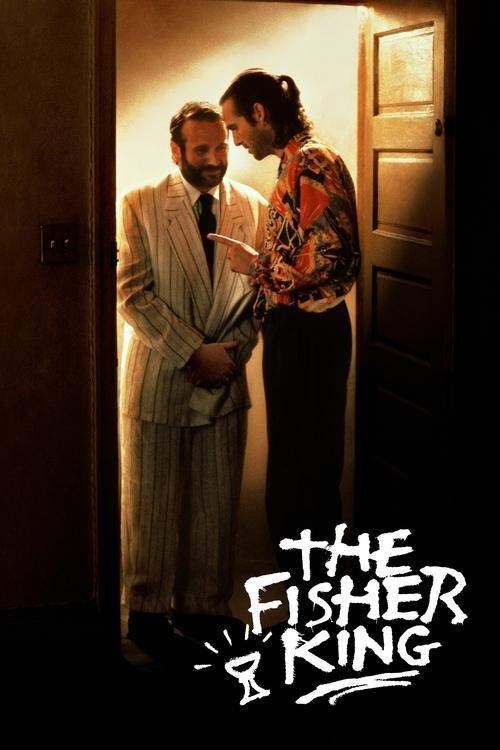
The Fisher King
1991 · Terry Gilliam
For when you need to laugh and cry in the same evening — a big-hearted film about broken people that leaves you more hopeful than it found you. Comfort viewing with real darkness in its veins.
What it's about
A caustic New York radio shock-jock's career and self-regard are destroyed overnight by a tragedy his own cruelty helped set in motion. Three years later, bottomed out, he collides with Parry — a homeless man who believes he's on a knight's quest to recover the Holy Grail from a Fifth Avenue castle — and discovers their fates are tangled together. Helping Parry, including engineering the world's most unlikely first date, becomes his one shot at forgiving himself.
The experience
It swings from raucous comedy to raw grief and back, with bursts of pure movie magic — a crowded train station turning into a waltz, a knight on horseback in Central Park. Funny, wounding, and finally warm; it earns its tears honestly.
Performances
Robin Williams gets to be everything he was — manic, hilarious, and unbearably tender — while Jeff Bridges does the harder, quieter work as a cynic thawing against his will. Mercedes Ruehl is magnificent as the girlfriend who's smarter and braver than the man she loves, and Amanda Plummer makes awkwardness luminous.
The craft
Terry Gilliam pours his visual imagination into real New York locations, tilting the everyday city into fairy tale — canted angles, red knights out of nightmare, a grand terminal transformed by a single romantic idea. Richard LaGravenese's script gives the spectacle a sturdy, humane spine.
Why it matters
It proved Gilliam could bring his fantastical style to an intimate American story, won Mercedes Ruehl an Academy Award, and endures as one of the great New York films about grief and second chances.
Snapshot
The Fisher King is Terry Gilliam's most emotionally direct film and, in his own framing, an anomaly within his career: the first feature he directed from a screenplay he did not originate or co-write. Working from Richard LaGravenese's spec script, Gilliam translated his lifelong fascination with myth, madness, and the redemptive imagination into a contemporary New York register. The film braids two wounded men — Jack Lucas (Jeff Bridges), a caustic radio shock-jock whose on-air cruelty helps trigger a mass shooting, and Parry (Robin Williams), a homeless man whose grief over his murdered wife has fractured into a chivalric delusion that he must recover the Holy Grail. Their reluctant partnership becomes a mutual rescue. Around them, Mercedes Ruehl's Anne and Amanda Plummer's Lydia anchor the film's belief that love is a more plausible miracle than the Grail. The result is a fairy tale set among Manhattan's homeless, a comedy about catastrophe, and one of the most humane works in the Gilliam catalog.
Industry & production
The film arrived at a pivotal, precarious moment in Gilliam's career. After the budgetary and logistical catastrophe of The Adventures of Baron Munchausen (1988) — a production that became a byword for runaway costs and a film widely understood to have damaged his standing with studios — Gilliam needed a project that demonstrated he could deliver a contained, on-budget Hollywood picture. The Fisher King, a TriStar Pictures release produced by Debra Hill and Lynda Obst, was precisely that corrective: a comparatively modest, script-driven, location-shot drama rather than a vast effects spectacle.
The screenplay was Richard LaGravenese's calling-card spec script, and the project came to Gilliam already developed — an unusual position for a director who had written or co-written his prior features. Gilliam has consistently described being drawn to LaGravenese's material precisely because it dramatized themes (the holy fool, the wound that will not heal, the Grail as metaphor) he had circled for years. Casting paired two of the era's most bankable and distinctive stars: Jeff Bridges and Robin Williams, the latter then near the height of his commercial draw. Mercedes Ruehl, primarily a stage and supporting-screen actor, took the role of Anne, and Amanda Plummer played the painfully shy Lydia.
Production was based in New York City, and the film makes extensive, unglamorous use of real Manhattan geography. The shoot's signature set piece — the Grand Central Terminal sequence in which the rush-hour crowd spontaneously waltzes — was an ambitious large-scale staging requiring hundreds of extras choreographed in a working transit hub. Commercially, the film performed respectably and was generally regarded as a success that restored Gilliam's viability with studios; I'll avoid citing a specific gross, as I can't verify exact figures here. Critically and within the awards economy it performed strongly, drawing multiple Academy Award nominations and a win for Ruehl as Best Supporting Actress.
Technology
The Fisher King is a photochemical, location-based production of the early 1990s, predating the digital-effects pivot that would define the decade's later blockbusters. Its fantastical imagery — most famously the Red Knight, a flame-wreathed armored horseman who pursues Parry across the city — was achieved through practical means: physical costume and horse, in-camera staging, and optical/lighting effects rather than computer-generated imagery. This practicality is itself thematically apt; Parry's hallucinations feel handmade and corporeal rather than weightlessly digital.
The film's technological signature lies less in effects than in optics. Gilliam and cinematographer Roger Pratt deployed extreme wide-angle lenses, low and canted camera positions, and deep-focus compositions to warp the everyday into the uncanny — the same distorting lens grammar Gilliam had honed on Brazil. Here the technique is harnessed to a more naturalistic story, so the apparatus becomes a way of rendering subjective states (mania, dread, wonder) within recognizably real spaces. The Grand Central waltz, meanwhile, is a triumph of pre-digital crowd choreography and camera movement rather than of post-production manipulation.
Technique
Cinematography
Roger Pratt, who had shot Brazil, gives the film a visual language that toggles between gritty urban naturalism and heightened fairy-tale lyricism. Pratt and Gilliam favor wide-angle lenses that bend the edges of the frame, exaggerated low angles that monumentalize or menace, and a restless, mobile camera. The palette runs from the cold, institutional surfaces of Jack's world to warmer, more enchanted light in moments of grace. The film's most celebrated image — the entire concourse of Grand Central dissolving into a sweeping waltz as Parry watches Lydia cross the floor — is built from elegant crane and tracking movement that converts documentary space into a ballroom of the mind, a purely subjective transformation realized without a single spoken line of explanation.
Editing
Edited by Lesley Walker, the film modulates between sustained, performance-driven two-handers and bursts of expressionistic rupture. Walker's cutting gives the long dialogue scenes — Jack and Parry, Parry and Lydia, Jack and Anne — room to breathe, trusting the actors. Against that patience, the Red Knight sequences and the opening radio-booth catastrophe are cut with sharper, more disorienting rhythms, so that Parry's terror erupts into an otherwise grounded continuity. The pacing decision to let comedy and devastation sit within the same scene — the tonal whiplash that defines the film — is as much an editorial achievement as a directorial one.
Mise-en-scène / staging
Production designer Mel Bourne grounds the film in a tactile, lived-in New York while reserving pockets of the fantastic. Parry's basement lair beneath a boiler room is a grotto of myth, festooned with Grail iconography, toys, and salvage — a child's enchanted cave built from the city's refuse. The contrast with the sleek emptiness of Jack's post-fall apartment and video store, or the suffocating order of corporate Manhattan, externalizes the film's moral geography: the "mad" man's world is rich and alive, the "sane" world hollow. Gilliam stages crowds and clutter with characteristic density, packing frames with incident, while the Grand Central waltz turns the ultimate transit-of-strangers into a single shared romantic vision.
Sound
George Fenton's score moves between melancholy, whimsy, and grandeur, supporting the film's oscillation between realism and myth. Sound design is crucial to the subjective passages: the Red Knight is announced by an aural assault that overwhelms Parry (and us), collapsing the boundary between the city's ordinary noise and the roar of trauma. The diegetic use of music — culminating, famously, in the crowd's waltz — repeatedly marks the thresholds where the mundane tips into the transcendent. The film also weaves popular song into key emotional beats, using the texture of recorded music as a counterpoint to its darker material.
Performance
Performance is the film's beating heart. Robin Williams channels his manic improvisatory energy into Parry but undergirds it with genuine grief; the comedy is a symptom of trauma, and Williams lets the wound show beneath the riffs — including a famous, vulnerable nighttime scene lying naked in Central Park "cloud-busting." Jeff Bridges plays Jack's arc from glib narcissism through self-loathing to halting decency with unshowy precision, anchoring the fable in recognizable moral weather. Mercedes Ruehl's Anne is the film's reservoir of plainspoken adult love and exasperation, a performance that earned the Academy Award for Best Supporting Actress. Amanda Plummer makes Lydia's clumsiness and fragility almost unbearably tender, and Michael Jeter's brief turn as a homeless cabaret singer is a memorable grace note.
Narrative & dramatic mode
The film operates as a contemporary myth-quest layered over a redemption drama. Its dramatic engine is guilt and its discharge: Jack's careless words help cause a massacre, and the narrative makes his moral debt literal by chaining him to one of its victims-by-proxy, Parry. The structure follows a dual-rescue logic — each man holds the key to the other's healing — so that the "quest" for the Grail doubles as a quest for forgiveness and the capacity to love. LaGravenese's screenplay is notable for refusing to resolve tone: scenes pivot from slapstick to horror to romance without warning, dramatizing the instability of minds in crisis. The film withholds easy realism (is the Grail real? is Parry simply mad?) and instead asks whether belief, even delusional belief, can be curative. Its climax — a literal break-in to retrieve the "Grail," a kitschy trophy in a fortress-like Manhattan townhouse — insists, in true fairy-tale fashion, that the miracle lies in the act of selfless love, not the object.
Genre & cycle
The Fisher King sits at a crossroads of genres: the redemption drama, the romantic comedy, the urban fairy tale, and the buddy film. It belongs loosely to a late-1980s/early-1990s cycle of films reckoning with the social wreckage of the Reagan-Bush boom — yuppie comeuppance narratives and stories foregrounding homelessness and the recession-era city. Within Gilliam's own filmography it forms part of an informal "trilogy of imagination" alongside Time Bandits and Brazil, films organized around the conflict between fantasy and a deadening reality, though here the fantasy is psychological and therapeutic rather than escapist. It also participates in the long tradition of "holy fool" narratives, where a figure dismissed as mad becomes a vessel of spiritual truth.
Authorship & method
The film is a fascinating test of auteurism precisely because Gilliam did not write it. What it demonstrates is that Gilliam's authorship is finally visual and thematic rather than merely literary: handed someone else's words, he produced a film unmistakably his — the warped wide-angle optics, the holy fool, the war between imagination and institutional reality, the conviction that madness may be saner than the world. Key collaborators shape the result decisively. Richard LaGravenese's screenplay supplied the dual-protagonist architecture and the tonal daring; it was the breakthrough that launched his screenwriting career. Cinematographer Roger Pratt, a returning Brazil collaborator, realized the film's distinctive look. Editor Lesley Walker managed its volatile tonal shifts. Composer George Fenton supplied the emotional through-line that holds comedy and tragedy together. Production designer Mel Bourne built the film's contrasting worlds. The collaboration of these figures with two powerhouse lead actors makes The Fisher King a genuinely collective achievement framed by a singular sensibility.
Movement / national cinema
Gilliam is a transatlantic figure — an American expatriate, formed by Mad magazine and underground comics, who became central to the British institution of Monty Python and built his directing career largely within British and European production cultures. The Fisher King is, by contrast, his most thoroughly American film: a U.S. studio production, shot in New York, steeped in the textures of American media (the shock-jock, the self-help guru, the video store) and American social anxiety. It thus occupies an unusual position — a Hollywood film made by a director whose sensibility was shaped outside Hollywood, importing a European-inflected taste for the grotesque and the fantastical into a domestic redemption drama. It does not belong to a national movement so much as to the idiosyncratic, border-crossing authorship Gilliam embodies.
Era / period
The film is a precise artifact of the early 1990s American mood: the hangover after the 1980s, with its visible homelessness crisis, recession, and disillusionment with the decade's acquisitive media culture. Jack Lucas embodies the toxic celebrity of unregulated talk radio — a medium then ascendant — and the film's opening catastrophe reads as a critique of media cruelty and its real-world consequences, prescient about debates that would only intensify. Set against the gleaming, indifferent verticality of Manhattan, the story foregrounds those the boom left behind. The film's faith in interpersonal grace, its skepticism toward institutions (psychiatric and corporate alike), and its fairy-tale framing of urban misery all mark it as a product of its precise cultural moment.
Themes
At its core the film is about the wound that cannot be healed by the sufferer alone — the Fisher King myth from which it takes its name, in which a maimed king's land lies waste until a fool, asking the right question or performing a simple kindness, restores him. Guilt and atonement drive Jack; grief and trauma drive Parry; and the film argues that redemption is reciprocal, achieved only through care for another. Madness and sanity are deliberately destabilized — the film treats Parry's delusion with tenderness and suggests the "normal" world is the truly diseased one. Love is figured as the genuine miracle, more real and more difficult than any Grail. Running beneath all of it is Gilliam's perennial theme: the imagination as both a refuge from and a cure for an intolerable reality, dangerous and redemptive at once.
Reception, canon & influence
The Fisher King was warmly received as a return to form and a demonstration that Gilliam could deliver a disciplined, emotionally accessible film. It garnered multiple Academy Award nominations — including Robin Williams for Best Actor and Richard LaGravenese for Best Original Screenplay, along with recognition in art direction and George Fenton's score — and Mercedes Ruehl won Best Supporting Actress. (I've given the nominations in broad terms; the Ruehl win is the firmest fact in its awards record.)
Looking backward, the film's influences are deep and explicit: the medieval Grail legend and the Fisher King myth as transmitted through Arthurian romance and refracted by Jungian and Joseph Campbell-style readings of myth; the long literary and cinematic tradition of the holy fool; and Gilliam's own prior imagination-versus-reality films. LaGravenese reportedly drew on the disjunction between media spectacle and human consequence that defined the era. Looking forward, the film consolidated Gilliam's reputation enough to enable 12 Monkeys, and it launched LaGravenese as a sought-after screenwriter. Its most enduring legacy is cultural and emotional rather than stylistically imitated: the Grand Central waltz endures as one of cinema's iconic images of love transfiguring the ordinary, and the film remains a touchstone for sympathetic, non-clinical screen portrayals of mental illness, homelessness, and grief — a humane fairy tale that helped define how American film of its moment imagined redemption in a wounded city.
A Deleuzian reading
Parry has spotted Lydia in the rush-hour crush of Grand Central, and the commuters stop being commuters.
The full Deleuzian reading of The Fisher King →
Reception
A genuine hit in 1991 — five Oscar nominations and a Best Supporting Actress win for Mercedes Ruehl — it's since been reframed twice: first by its 2015 Criterion release, then by Robin Williams' death, which turned Parry into one of the roles people reach for when talking about what he could really do.
How The Fisher King was received, from release to now →
Influences: the films it descends from and the films it influenced
- Brazil (1985) — DP Roger Pratt returns to render Gilliam's signature warped wide-angle optics, where bulging lenses make institutional reality grotesque and the dreamer's interior world the only sane refuge.
- Time Bandits (1981) — Establishes Gilliam's in-camera practical-effects method of erupting fully-built fantasy (here the Red Knight) into a banal real world without optical trickery, the same physical-build approach as Fisher King's hallucinations.
- Monty Python and the Holy Grail (1975) — Gilliam's first handling of Grail-quest material and anachronistic medievalism, the mythic armature he relocates from literal Arthuriana into a Manhattan urban-fairy-tale register.
- King of Hearts (1966) — Codifies the holy-fool conceit that the institutionalized madman perceives more truly than the sane world, the moral inversion Parry embodies as a non-clinical rebuke to rational society.
- One Flew Over the Cuckoo's Nest (1975) — Pioneers the sympathetic, non-clinical screen treatment of madness as resistance to an oppressive rational order rather than pathology to be cured.
- City Lights (1931) — The template of a derelict holy-fool redeemed by love in a wounded city, sustaining unguarded sentiment against ironic distance — the emotional grammar of the Grand Central romance.
- Network (1976) — Supplies the disjunction between media spectacle and human consequence that LaGravenese cited: a broadcaster's flippant on-air words detonating real violence, mirrored in Jack's shock-jock guilt.
- Wings of Desire (1987) — Mobile crane-borne camera following a transcendent compassionate presence through a wounded modern city, the divine intervening in mundane urban suffering — the visual rhetoric of the Red Knight pursuit.
- Excalibur (1981) — Directly dramatizes the Fisher King wound-and-healing myth from Arthurian romance, the Grail-quest source text Parry's delusion literalizes.
- The Adventures of Baron Munchausen (1988) — Gilliam's immediately prior imagination-versus-reality film, built on a lunatic fabulist whose conviction physically reshapes the world, the engine he disciplines into Parry's quest.
- Good Morning, Vietnam (1987) — Develops the same manic-energy-into-wounded-pathos register, building a drama on Williams's ability to pivot from improvisational mania to raw vulnerability.
- 12 Monkeys (1995) — The disciplined commercial credibility Fisher King earned enabled it, and it continues the wide-angle-distortion grammar around a destabilized protagonist whose visions may be madness or prophecy.
- The Bridges of Madison County (1995) — LaGravenese's screenwriting breakthrough on Fisher King launched the career that produced this, carrying forward his intimate dual-protagonist architecture of two damaged souls in brief redemptive contact.
- Good Will Hunting (1997) — Extends Robin Williams's Fisher King register of manic grief into the wounded-healer archetype, the bereaved man who redeems another through unlikely intimacy.
- Amélie (2001) — Inherits the urban-fairy-tale mode of transfiguring the ordinary city through whimsical practical-effect fantasy and warm wide-angle compositions, Gilliam's optics turned consolatory.
- Twelve Monkeys (1995) — Gilliam's immediately preceding film established his method of using found urban spaces as expressionist locations for magical realism bleeding into possible delusion, and cast Jeff Bridges against his romantic-lead persona in the same deliberate against-type strategy he would apply to Willis as Cole.
- On the Count of Three (2022) — Yokes mental illness and suicidal despair to a redemptive male-friendship comedy, calibrating whiplash swings between clowning and genuine psychic wound — the tonal-balance problem the film inherits.
- The Intouchables (2011) — A privileged man redeemed by an 'unrespectable' companion from the social margins, blending broad comedy with wound and pathos in the same tonal register Intouchables adopts.
- The Last Viking (2025) — The model for a delusion the film declines to cure: a man's private mythology is treated as a real system with its own quest logic, and the guilty, self-interested character opposite him is assigned a task inside that mythology — restoration of the fantasy, not correction of it, becomes the resolution.
- Bringing Out the Dead (1999) — Shares the subjective aural assault and canted, hallucinatory vision of a wounded city's night, seeking redemption among its damned and homeless through a guilt-haunted rescuer.
- Fearless (1993) — A contemporaneous trauma-and-grief drama using subjective sound and dissociative imagery to portray a survivor untethered from consensus reality, the same humane treatment of post-traumatic withdrawal.
Similar films
- Good Will Hunting (1997) — influence & lineage
- The Adventures of Baron Munchausen (1988) — influence & lineage
- Brazil (1985) — influence & lineage
- City Lights (1931) — influence & lineage
- Wings of Desire (1987) — influence & lineage
- The King of Comedy (1982) — shared sensibility
- The Royal Tenenbaums (2001) — shared sensibility
- If Beale Street Could Talk (2018) — shared sensibility