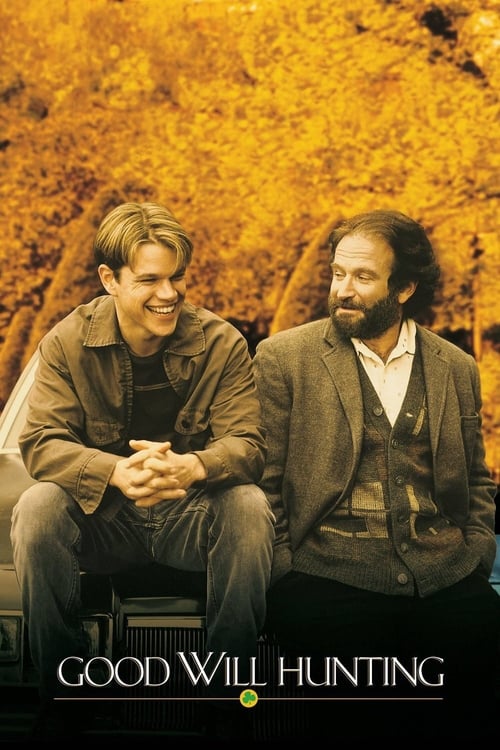
Good Will Hunting
1997 · Gus Van Sant
When you need a good cry that earns it, or a film about becoming who you're supposed to be. A comfort movie in the deepest sense — it's about being seen — and an easy pick to share with someone.
What it's about
Will Hunting mops floors at MIT by night and can solve the math problems the graduate students can't — a working-class South Boston genius who'd rather drink with his friends and pick fights than let anyone see what he is. After one arrest too many, his freedom comes with a condition: sessions with a therapist who's carrying grief of his own. What follows is a tug-of-war between two stubborn men, a first real romance, and the question of what Will owes his talent.
The experience
Warm, talky, and quietly devastating — it builds through conversations rather than events, and a handful of scenes land with the force most films save for their climax. You'll laugh at the bar-room banter and then find yourself blindsided.
Performances
Robin Williams won the Oscar for his therapist — patient, wounded, and completely unshowy — and Matt Damon makes Will's arrogance and terror feel like the same emotion. The park-bench scene between them is one of the most quoted two-hander scenes in modern American drama.
The craft
Damon and Affleck's Oscar-winning screenplay is the engine: profane, funny, structurally classical, with monologues actors have studied ever since. Gus Van Sant shoots Boston with an unfussy tenderness, and Elliott Smith's aching songs on the soundtrack give the film much of its bruised emotional color.
Why it matters
It launched Matt Damon and Ben Affleck from unknowns to A-list overnight — their screenplay Oscar is one of Hollywood's great origin stories — and it remains the modern benchmark for the therapy drama.
Snapshot
Good Will Hunting is the film that fused two seemingly incompatible sensibilities: the bruised, off-Hollywood lyricism of Gus Van Sant and the crowd-pleasing emotional architecture of a star-driven studio drama. Written by and starring Matt Damon and Ben Affleck — then largely unknown Boston actors in their twenties — it tells of a janitor at MIT whose secret mathematical genius is discovered, and whose self-sabotaging armor is slowly worked loose by a grieving therapist played by Robin Williams. Released by Miramax at the end of 1997, it became both a commercial phenomenon and an awards-season fixture, winning Damon and Affleck the Academy Award for Original Screenplay and Williams the Award for Supporting Actor. Its enduring image is two men on a bench by a pond, one telling the other that none of his book-learning means he knows anything about loss. The film's reputation rests on the way it makes therapeutic catharsis feel earned rather than sentimental — and on its launch of a generation of New England screen talent.
Industry & production
The project's origin story is, by now, part of industry folklore, and the verifiable contours are these: Damon and Affleck, childhood friends from Cambridge, Massachusetts, developed the screenplay over a period of years, with Damon having begun an early version as a writing assignment at Harvard. The script circulated in the mid-1990s and was initially set up at Castle Rock Entertainment. The widely reported account holds that Castle Rock, uneasy about two untested writers insisting on starring in their own material, eventually put the project into turnaround, and that Miramax — under Harvey and Bob Weinstein — acquired it. Miramax in the late 1990s was the dominant force in prestige independent and crossover filmmaking, and Good Will Hunting fit its model precisely: a modestly budgeted, performance-driven drama positioned for both arthouse credibility and awards campaigning.
Several directors were attached or considered across the script's development; the eventual choice of Gus Van Sant was significant. Van Sant had come from the American independent scene — Mala Noche, Drugstore Cowboy, My Own Private Idaho — and brought an outsider's tenderness toward marginal and self-destructive young men. Reuniting him with the project was Robin Williams, whose participation as a marquee dramatic lead helped secure financing and gave the film its commercial spine.
Production took place largely in the Boston and Cambridge area in 1997, with some interiors and additional shooting in Toronto standing in for Boston locations — a common cost arrangement of the period. The film opened in limited release in December 1997 to qualify for awards and expanded in early 1998. It became one of the most profitable releases of its season, though precise budget and gross figures should be treated with the caution any single-source number warrants; the broad fact of its outsized commercial success relative to cost is well established.
Technology
Good Will Hunting is a conventionally finished 35mm production of the late-1990s American studio-affiliated drama, and it makes no claim to technological novelty — its innovations are dramatic, not mechanical. It was shot photochemically on film stock and finished by traditional means, predating the digital intermediate workflows that would become standard a few years later. The aesthetic interest of the film lies in restraint: it deliberately avoids the kinetic camerawork and aggressive cutting that were fashionable in mid-'90s American cinema, trusting unhurried compositions and the actors' faces. In this sense its "technology" is the technology of the close-up and the sustained two-shot — old tools used with discipline rather than new ones used for display.
Technique
Cinematography
The cinematography is by Jean-Yves Escoffier, the French-born cameraman known for his work with Leos Carax (Mauvais Sang, Les Amants du Pont-Neuf). Escoffier's reputation was for painterly, expressive light, and in Good Will Hunting that sensibility is channeled into a warm, autumnal naturalism rather than stylization. The Boston of the film is working-class and tactile — bars, construction sites, three-deckers, the unglamorous corridors of MIT — rendered in soft, often low-key interior light. Escoffier favors compositions that hold actors in frame together long enough for the audience to read the negotiation between them, which is essential to a film built almost entirely from conversation. The therapy scenes in particular rely on patient framing that lets performance, not coverage, carry the drama.
Editing
The film was edited by Pietro Scalla. The editing philosophy is self-effacing and classical: it serves clarity of performance and emotional rhythm rather than calling attention to itself. Crucially, the long dialogue scenes — the therapy sessions, the bar confrontation, the bench monologue — are cut to let beats breathe, holding on reactions and resisting the temptation to over-fragment. The film's structure alternates these intimate two-handers with shorter scenes of Will among his friends, and the editing manages the tonal modulation between rough camaraderie and raw confession.
Mise-en-scène / staging
The staging is fundamentally theatrical in the best sense: much of the film's power comes from two people in a room. Van Sant and his collaborators build meaning through location and class texture — the contrast between Will's South Boston world and the rarefied institutional spaces of MIT and Harvard is staged as a spatial argument about belonging. Settings carry thematic weight: the modest therapist's office, the upscale bar where Will humiliates a condescending grad student, the Bunker Hill neighborhoods, the public bench beside the Public Garden pond. The film's most famous scenes are staged with minimal movement, placing the dramatic burden on blocking, eyeline, and the slow erosion of defensive distance between characters.
Sound
The score and song selections are central to the film's emotional identity. The original score is by Danny Elfman, working in a notably restrained, un-Elfman-like register — spare, gentle, melancholic, far from his gothic and comic signatures. The soundtrack is most strongly associated with the songs of Elliott Smith, whose fragile, intimate acoustic recordings (including "Miss Misery," written for the film, and existing tracks such as "Angeles" and "Between the Bars") became inseparable from its texture. Smith's music gives the film a confessional, bruised interiority that mirrors Will's guardedness; the pairing also marked a major moment of mainstream exposure for Smith, then a cult singer-songwriter. The use of song here is diegetically light and emotionally heavy, scoring transitions and solitary moments rather than underlining dialogue.
Performance
Performance is the film's true medium. Matt Damon plays Will as coiled and quick, his verbal aggression a shield over woundedness; the role made him a star and demonstrated a control beyond his years. Robin Williams, cast against his manic comic persona, delivers the performance most often cited as the film's heart — a therapist carrying his own widowed grief, capable of stillness, anger, and warmth. The interplay between Williams's groundedness and Damon's volatility generates the film's central current. Ben Affleck, as Will's loyal best friend Chuckie, anchors the working-class fraternity and delivers the film's quiet thesis about getting out. Stellan Skarsgård, as the mathematics professor Lambeau, embodies ambition's colder face, and Minnie Driver, as the Harvard student Skylar, supplies the romantic line through which Will's fear of abandonment is exposed. The ensemble's chemistry — particularly the improvisational ease among the Boston friends — gives the film its lived-in credibility.
Narrative & dramatic mode
The dramatic mode is therapeutic realism organized around a redemption arc. Structurally the film is a series of duels of language: Will versus the world, then Will versus Sean, the therapist, in a sequence of sessions that function as the spine. Its narrative engine is not plot in the conventional sense — there is little external jeopardy after the early legal threat — but the gradual exposure of an interior wound: childhood abuse, fear of intimacy, and the survivor's strategy of pre-emptive rejection. The screenplay's craft lies in dramatizing psychological change through dialogue without it collapsing into lecture. The repeated motif — "It's not your fault" — and the climactic monologues are calibrated to land as breakthroughs rather than bromides, though the film has been critiqued for the neatness of its catharsis. The romantic subplot and the friendship subplot both restate the central question in different keys: whether a gifted, frightened young man will choose connection over self-protection.
Genre & cycle
The film sits at the intersection of several traditions: the prestige character drama, the "gifted misfit" story, and the therapy or mentor narrative. It belongs to a lineage of films about exceptional working-class intelligence colliding with elite institutions, and to the broader cycle of late-1990s Miramax-era awards dramas built on screenwriting and performance rather than spectacle. It also participates in a then-vital wave of New England–set, regionally specific American films attentive to class and accent. Within the mentor-drama genre, it inverts the usual dynamic: the teacher who matters is not the mathematician who wants to use Will's gift, but the therapist who wants to free him from it.
Authorship & method
Authorship here is genuinely divided, which is part of the film's interest. The screenplay is the authored vision of Damon and Affleck — autobiographically inflected in its Boston specificity and its preoccupation with friendship, loyalty, and class mobility. Gus Van Sant's directorial authorship is more subtle: he brought a sensibility attuned to damaged young men and an unforced naturalism that kept the material from tipping into melodrama, while subordinating his more experimental tendencies to the demands of a mainstream emotional drama. The collaboration of key craftspeople shaped the result decisively: Jean-Yves Escoffier's humane light, Danny Elfman's restrained score, Pietro Scalla's unobtrusive cutting, and — crucially — the curatorial decision to build the film's emotional sound around Elliott Smith. The film is thus a case study in how a star vehicle, a writers' passion project, and an arthouse director's temperament can be reconciled into something coherent.
Movement / national cinema
Good Will Hunting is American cinema of the independent-to-mainstream crossover moment — the period when figures formed in the American independent movement (Van Sant among them) were absorbed into, and reshaped, prestige studio filmmaking through companies like Miramax. It is not avant-garde, but it carries traces of indie sensibility in its regional specificity and its trust in performance. It also belongs, in a national-cinema sense, to a distinctly Bostonian strand of American film — a localized cinema of accent, neighborhood, and class that Damon and Affleck would continue to cultivate and that later filmmakers (and the actors themselves) would extend.
Era / period
The film is a product of the late 1990s, a high-water mark for the mid-budget adult drama in American cinema — a category that has since contracted sharply. It reflects an industry in which a dialogue-driven, star-anchored film could be both a critical prestige object and a major commercial success, supported by the awards-campaign machinery that Miramax had perfected. Its concerns — therapy, masculine emotional inarticulacy, the anxieties of class and meritocracy — are very much of their moment, when discourses of self-actualization and therapeutic culture were ascendant in American life.
Themes
The film's governing theme is the relationship between gift and worth: whether a person's value lies in their talents or in their capacity for connection. Around this cluster several others. There is the theme of self-sabotage as self-protection — Will's intelligence weaponized to keep people at a distance, his survivor's reflex to abandon before being abandoned. There is class and belonging: the question of whether escaping one's origins is loyalty or betrayal, dramatized in Chuckie's blunt blessing that Will owes it to his friends to leave. There is grief and its long aftermath, embodied in Sean's mourning and his insistence that loss is the price of love worth paying. And there is the limit of knowledge — the film's repeated argument that information is not experience, that one can know everything about a subject and nothing about a life. The recurrent line "It's not your fault" crystallizes the film's belief in absolution as the precondition of growth.
Reception, canon & influence
Critical reception in 1997–98 was strong though not unanimous: the film was widely praised for its performances and screenplay and embraced by audiences, while some critics found its emotional resolutions too tidy and its therapeutic uplift too engineered. It was nominated for nine Academy Awards and won two — Original Screenplay for Damon and Affleck, and Supporting Actor for Robin Williams — results that confirmed both its industry standing and the arrival of its young authors.
Looking backward, the film draws on a deep tradition of mentor-and-misfit dramas and of American social-mobility narratives; its therapy-room structure recalls a theatrical heritage of two-hander confession, and Van Sant's own filmography of tender attention to wayward young men is its closest artistic antecedent. Looking forward, its influence is most legible in careers and in template. It launched Damon and Affleck as both stars and credible authors, and it helped consolidate a Boston-centered strand of American film — crime and class dramas rooted in the same neighborhoods and cadences — that the two would return to repeatedly in the following decades. It gave Robin Williams one of his defining dramatic roles, complicating his public image. And it brought Elliott Smith's music to a vast audience, a cultural footnote that became, for many, the film's most lasting emotional residue. The bench monologue and the phrase "It's not your fault" entered the common vocabulary of screen catharsis — endlessly referenced and parodied, the surest sign that a film has lodged in the culture. Its broader legacy is as a benchmark for the earnest, performance-driven therapeutic drama: a film whose sincerity is both the reason for its devotion and the target of its detractors.
A Deleuzian reading
Two men on a bench beside a pond in the Public Garden.
The full Deleuzian reading of Good Will Hunting →
Reception
A hit from day one — nine Oscar nominations, wins for Robin Williams and for two unknown Boston kids' screenplay — and unlike many 90s crowd-pleasers it never really dipped; if anything Williams' death in 2014 deepened its standing from feel-good favorite to something people hold genuinely dear.
How Good Will Hunting was received, from release to now →
Influences: the films it descends from and the films it influenced
- Ordinary People (1980) — Builds its drama from repeated psychiatrist-patient sessions that escalate toward a single guilt-releasing breakthrough — the direct structural model for Will's therapy arc and the 'it's not your fault' catharsis.
- Five Easy Pieces (1970) — Pioneers the gifted protagonist who deliberately conceals his talent among the working class, staging identity through class-spatial contrast in a loose naturalist register.
- On the Waterfront (1954) — Establishes the working-class-vernacular Method performance and the loyalty-versus-self-betterment tension that GWH transposes to South Boston.
- Educating Rita (1983) — A two-hander pairing a rough autodidact with a wounded academic mentor, using class-inflected banter as the vehicle of mutual therapy.
- Dead Poets Society (1989) — Codifies Robin Williams as the unorthodox, privately wounded mentor who unlocks gifted youth — the persona carried directly into Sean Maguire.
- My Own Private Idaho (1991) — Van Sant's tender, naturalist attention to drifting and damaged young men — the authorial sensibility he subordinates here to keep the melodrama unforced.
- Drugstore Cowboy (1989) — Van Sant's unhurried observational handling of wayward outsiders, the restraint that prevents emotionally loaded material from tipping into sentiment.
- The 400 Blows (1959) — The troubled young man shaped by institutions, rendered through patient observational naturalism rather than plotted melodrama.
- Breaking Away (1979) — Stages townie-versus-college class friction through place and the cadences of male friendship, the social-mobility template GWH inherits.
- Rebel Without a Cause (1955) — The gifted-misfit youth steered by a surrogate-parent mentor figure, the foundational mentor-and-troubled-kid dynamic.
- The Fisher King (1991) — Extends Robin Williams's Fisher King register of manic grief into the wounded-healer archetype, the bereaved man who redeems another through unlikely intimacy.
- Awakenings (1990) — Consummates the Robin Williams 'healing-professional' persona strand that Awakenings launched — the gentle, wounded therapeutic authority figure — the role type that carried him to his Academy Award.
- Finding Forrester (2000) — Van Sant's near-remake of his own template — a gifted misfit drawn out by a reclusive older mentor — replicating the same two-hander craft and restraint.
- Antwone Fisher (2002) — Adopts the recurring therapy-room sessions between an angry young man and a psychiatrist that build to an explicit 'it's not your fault' release.
- Gone Baby Gone (2007) — Extends the Boston-neighborhood class-and-loyalty drama in authentic local cadences, the strand the screenwriters consolidated.
- The Town (2010) — Continues the South-Boston working-class crime-and-class register, with characters whose accents, geography, and loyalties descend directly from GWH's milieu.
- Garden State (2004) — Treats a curated melancholic indie-songwriter soundtrack as the film's primary emotional residue, the needle-drop approach GWH modeled with Elliott Smith.
- Dogma (1999) — Launches the Affleck–Damon double act as a screen pairing with lived-in rhythm, the chemistry Smith casts directly as Bartleby and Loki.
- Manchester by the Sea (2016) — A restrained New England grief drama of class texture and buried guilt, produced within the Damon/Affleck Boston strand and built on a withholding-then-release confession.
Similar films
- Manchester by the Sea (2016) — influence & lineage · often watched together
- Dead Poets Society (1989) — influence & lineage · same viewing thread · often watched together
- Gone Baby Gone (2007) — influence & lineage
- Rebel Without a Cause (1955) — influence & lineage · same viewing thread
- The Graduate (1967) — same viewing thread
- The Perks of Being a Wallflower (2012) — same viewing thread
- The 400 Blows (1959) — influence & lineage · often watched together
- My Own Private Idaho (1991) — influence & lineage · often watched together
All the films related to Good Will Hunting →
Watch it with: curated runs of related films
- Restless Youth, Rigid Walls — Watch these as one long walk through the school years — the teachers who crack you open, the friends who pull you off the sidelines, the first loves and the institutions you push against — where a beloved tearjerker and a surreal boarding-school revolt turn out to be cousins.