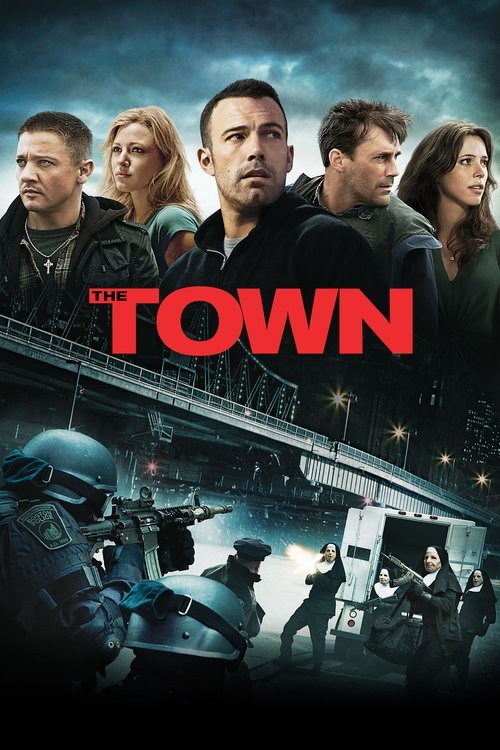
The Town
2010 · Ben Affleck
For when you want a smart, muscular crime thriller on a Friday night — gripping without being grim, comfort-food genre filmmaking with real stakes underneath.
What it's about
Doug MacRay robs banks in Charlestown, a square mile of Boston that has produced generations of armored-car thieves, and he's good enough at it to know he should get out. When a job goes sideways and his crew briefly takes a bank manager hostage, Doug is assigned to keep tabs on her — and instead starts falling for her, while an FBI agent closes in on the whole crew. The neighborhood, his volatile best friend, and his own history all conspire to keep him exactly where he is.
The experience
Tense and propulsive, with heist sequences that hit hard and fast, but the film keeps slowing down to sit with its people — the romance is genuinely tender, which makes the danger around it feel worse. You spend the whole runtime waiting for two worlds to collide.
Performances
Jeremy Renner is the standout as Doug's hair-trigger best friend, all coiled menace and wounded loyalty — a performance that earned wide acclaim. Affleck anchors it with a quieter, conflicted turn, and Rebecca Hall gives the romance real weight.
The craft
Affleck directs with unusual discipline for an actor-turned-filmmaker: the robberies — including a chase through Boston's cramped North End streets — are staged with clean, punishing clarity, and the film uses real Charlestown locations until the neighborhood feels like a character. Big and loud in the action, patient everywhere else; it rewards good speakers.
Why it matters
It cemented Ben Affleck's reinvention as a serious director and became a touchstone for the Boston crime movie, proving a mid-budget adult thriller could still be a hit in 2010.
Snapshot
The Town is Ben Affleck's second feature as director, a tautly engineered heist thriller set entirely within the working-class neighborhoods of Charlestown, Massachusetts. Adapted from Chuck Hogan's 2004 novel Prince of Thieves, the film tracks Doug MacRay (Affleck), a career bank robber caught between the gravity of his criminal community and the possibility of escape offered by a woman his crew briefly took hostage. Equal parts genre exercise and character study, The Town situates itself in a lineage of American crime films—Michael Mann's Heat (1995) most explicitly—while pressing hard on questions of loyalty, place, and the costs of working-class male identity. Commercially successful and critically well-received, it confirmed Affleck's standing as a director of uncommon craft among actors-turned-filmmakers, and Jeremy Renner's performance as Jem Coughlin stands among the most fully realized supporting turns in the crime films of its decade.
Industry & production
Warner Bros. financed and distributed the film on a reported budget in the low-to-mid tens of millions of dollars—modest by studio standards for an action-oriented thriller with significant set-piece ambitions. The production was mounted largely on location in Boston, with Charlestown serving as both setting and character. Affleck, who grew up in the Greater Boston area, brought proprietary familiarity to the geography; the film was shot in actual Charlestown streets, row-house interiors, and working neighborhoods rather than on dressed backlots, a choice that anchored its social realism.
The screenplay was written by Peter Craig and Affleck, with additional contributions from Aaron Stockard—a close adaptation of Hogan's novel that preserved its dual structure of police procedural and doomed romance. Casting was built around Affleck's interest in performers who could carry the physicality of the criminal world while sustaining dramatic weight. Jeremy Renner, fresh off Kathryn Bigelow's The Hurt Locker (2009), was cast as Jem Coughlin, Doug's volatile best friend and the film's most combustible presence. Rebecca Hall, a British actress, played Claire Keesey, the bank manager taken hostage; her casting introduced a useful cultural distance—a legible blankness relative to Charlestown's tribal geography—that the role demanded. Jon Hamm, then at the height of his Mad Men celebrity, played FBI Agent Adam Frawley, the procedural counterweight to the thieves' interior drama. Pete Postlethwaite, in one of his final screen appearances before his death in January 2011, played Fergie Colm, the local crime boss whose authority polices Charlestown's internal code. Blake Lively and Chris Cooper completed the ensemble.
A director's cut, released on home media, ran several minutes longer than the theatrical version and expanded primarily the dramatic and expository material rather than the action sequences—suggesting that Affleck's priorities were characterological rather than spectacular, and that the theatrical cut was shaped by distributor rather than directorial judgment.
Technology
The Town was shot on 35mm film, a choice consistent with the tradition of gritty urban American crime cinema that Affleck and his collaborators were consciously engaging. Practical locations imposed their own technical demands: the narrow streets of Charlestown, the interiors of actual bank branches, and culminating in a major set piece partially staged at Fenway Park, where the production secured access to Boston's iconic ballpark during an off-season period. That sequence—in which the crew disguises itself and assaults the stadium's cash-counting operation—required coordinating substantial stunt and practical effects work within a real and nationally recognizable landmark.
Action sequences throughout the film relied primarily on practical stunt work rather than heavy digital augmentation, consistent with Affleck's stated admiration for the physical, location-grounded aesthetic of 1970s and early 1980s American crime cinema. The opening armored-car robbery, in which the crew systematically destroys evidence with industrial bleach before departing, was shot with a documentary proceduralism that established the film's tonal register from the outset: competence, not glamour, as the governing value.
Technique
Cinematography
Cinematographer Robert Elswit, who won the Academy Award for There Will Be Blood (2007) and whose career encompasses a wide range of Paul Thomas Anderson's work alongside numerous large-scale studio productions, brought an authoritative visual intelligence to The Town. Elswit calibrated the film's two tonal registers: the granular, hand-held immediacy of the robbery sequences, and the longer-lens, compositionally deliberate coverage of the dramatic scenes. Charlestown's brick row-houses, the gray-green estuary of the Charles River, and the institutional interiors of banks and FBI field offices were rendered with a cool, unsentimental palette—blues and grays dominant, warm tones reserved for the handful of genuinely intimate moments between Doug and Claire.
The action sequences were shot with a documentary urgency that owed something to Mann's precedents while maintaining spatial legibility throughout. Elswit avoided the rapid fragmentation that had characterized much mainstream American action cinematography of the period; the geography of each heist remained comprehensible, which allowed the audience to track tactical decision-making rather than simply react to kinetic sensation.
Editing
The editing maintained a careful counterpoint between the patient rhythm of the criminal-procedural material—surveillance, planning, the bureaucratic mechanics of FBI investigation—and the compressed, percussive tempo of the robberies themselves. The structural contrast was classical in conception: the interstitial drama breathes; the heist sequences contract. Scene transitions were handled with a matter-of-fact economy that refused sentimentality at the level of form, even when the narrative was pressing toward emotional resolution.
Mise-en-scène / staging
Affleck's staging reflects his background as a performer working in close proximity to directors of character. Scenes between Doug and Claire were blocked to emphasize the ethical problem at their center—Doug knows who she is; she does not know him—and the spatial arrangement of characters consistently registered this asymmetry of information. The film's most theatrically concentrated scene, in which Frawley confronts Doug in a diner booth, is built almost entirely from blocking and eyeline: Hamm spreads crime-scene photographs across the table as a territorial assertion, and Affleck's Doug neutralizes the provocation with a stillness that the scene earns through everything we have learned about the character's practiced self-concealment.
The robbery crew's use of disguise—bleach suits and hockey masks in the opening sequence, nun habits at Fenway—functions both practically and emblematically, encoding the film's interest in costume as a mechanism of social passage and institutional access. The nun disguise in particular functions as a dark joke about institutional authority and the uniforms through which it is recognized.
Sound
The sound design served the film's generic register with precision: the robbery sequences mixed the industrial percussion of gunfire and vehicle movement against the ambient sonic geography of specific Boston neighborhoods, grounding action in recognizable space. The score tended toward restraint in the dramatic passages—an appropriate decision given that the film's emotional engine ran on performance rather than orchestral underscoring. Source music, including period-appropriate rock, functioned as a cultural marker of the working-class Boston world the film inhabited.
Performance
The performances are the film's most durable achievement. Renner's Jem is the most fully realized character in the film—a man whose loyalty has curdled into a territoriality that operates as a form of structural violence. He is incapable of registering consequence; the film treats this condition not with psychological pathologizing but with something closer to tragic fact. Renner received an Academy Award nomination for Best Supporting Actor, and the recognition was deserved. Rebecca Hall's Claire credibly navigated the transition from traumatized witness to romantic subject without the role collapsing into utility or into the simpler contours of a genre love interest. Jon Hamm's Frawley was a notably cold antagonist—the film declined to humanize him beyond his professional competence, which gave the FBI procedural strand a useful ruthlessness that prevented the law enforcement narrative from becoming a secondary sympathy engine. Affleck's performance as Doug was the most contested element of the film's critical reception; the prevailing view was that he acquitted himself without achieving the distinction of Renner or Hall—a competent star turn rather than a revelatory one, perhaps the unavoidable consequence of directing oneself.
Narrative & dramatic mode
The Town operates in a dual register—heist thriller and doomed romance—without resolving the tension between them into a clean synthesis. The romance is the mechanism of Doug's potential escape from Charlestown's closed world, but the film is careful to render that escape as morally compromised: Doug's interest in Claire originates in surveillance that is itself a form of violation, a fact the film does not elide. The heist thriller strand provides forward momentum through the procedural logic of planning and execution; the FBI investigation provides a tightening vice. The film's ending resolves the genre's requirements while leaving the romantic strand deliberately open: Doug survives and escapes, but the escape is a form of exile.
The thriller architecture is linear and relatively conventional, which is part of the film's design—Affleck was working within genre rather than against it, and the pleasure the film offers is largely the pleasure of watching a craftsman execute within classical constraints rather than the pleasure of formal surprise.
Genre & cycle
The Town belongs to a 2000s–2010s cycle of prestige American crime films that combined the structural ambitions of the heist genre with the character-depth expectations of the literary adaptation. This cycle—which included No Country for Old Men (2007), Michael Clayton (2007), Prisoners (2013), and Heat as its foundational text—developed in dialogue with the long tradition of French polar and American crime cinema while reaching for theatrical and novelistic density. Within this cycle, The Town occupies a specific niche: the Boston crime film, a subgenre that became commercially visible with Affleck's own Good Will Hunting (1997, as writer) and was consolidated by Clint Eastwood's Mystic River (2003) and Dennis Lehane adaptations generally before Affleck returned to it as director with Gone Baby Gone (2007). Charlestown's documented historical association with professional bank robbery—a sociological reality the film's opening text card explicitly invokes—gave the setting a documentary authority that distinguished it from the generic urban crime backdrop of less place-specific films.
The influence of Heat on The Town was broadly acknowledged by Affleck and noted by critics. The dual-protagonist structure of law enforcement and criminal operating in parallel, the insistence on professional precision as a value in itself, and the use of Boston's specific urban geography as more than backdrop—all mark Mann's film as the most significant precursor. Deeper in the lineage, William Friedkin's Thief (1981) and the gritty proceduralism of 1970s crime cinema informed the aesthetic of lived-in working-class criminality. The question of Doug's potential redemption through a woman from outside his world echoes the romantic strand of Thief's Frank, and to some extent the moral geography of Sidney Lumet's Prince of the City (1981).
Authorship & method
Affleck had established his credentials as a director with Gone Baby Gone (2007), which surprised critics accustomed to discounting actors-turned-filmmakers; The Town consolidated that reputation by demonstrating the first film was not anomalous. Affleck's directorial method, as he described it in promotional materials and interviews, emphasized location authenticity, extended rehearsal with actors, and a conscious study of the classical American crime films he was working within and against. His relationship to the genre was explicitly that of a devoted student rather than a revisionist.
Robert Elswit as cinematographer brought the film a formal authority that a less distinguished collaborator might not have secured. The screenplay's co-authorship—Affleck, Craig, and Stockard—distributed the adaptation work in ways consistent with Affleck's stronger interest in character than in plotting: the film's dramatic scenes have a sharpness that the genre mechanics occasionally lack. The production's coherence—visual, tonal, and performative—suggests a director with clear authority over his collaborators and a well-formed sense of what the film needed to be.
Movement / national cinema
The Town is firmly an American studio genre film, positioned within the mainstream of Warner Bros.' crime output rather than at the margins of independent cinema. Its formal conservatism—classical shot-reverse-shot construction, linear narrative, genre-legible structure—places it in continuity with Hollywood tradition rather than in dialogue with international or experimental cinemas. The Boston specificity represents a form of regional American cinema that the Hollywood mainstream rarely accommodated with such topographic precision; the film's investment in Charlestown as a sociological entity, rather than a picturesquely generic American city, is one of its most distinctive qualities and the one most obviously traceable to Affleck's biographical relationship to the place.
Era / period
The Town was released in September 2010, in the immediate aftermath of the 2008 financial crisis and its ongoing recessionary consequences. The Charlestown bank-robbery world the film depicts—working-class men systematically looting financial institutions, armored cars, and stadium cash operations—carried an ironic charge in this context that the film did not explicitly exploit but that attentive critics registered. More broadly, The Town belongs to a period of American crime cinema in which the genre reasserted its seriousness after a period of ironic pastiche; the films of this moment—Mann's Public Enemies (2009), No Country for Old Men, and The Town itself—shared a sobriety about the genre's possibilities that distinguished them from the Tarantino-influenced crime films of the preceding decade.
Themes
The film's central preoccupation is the relationship between place and identity in a working-class world where loyalty is enforced by proximity rather than chosen. Charlestown in The Town is not merely a setting but a system—a closed ecology in which everyone knows everyone's business, criminal vocation is inherited rather than elected, and departure is treated as betrayal. Doug's desire to leave registers as simultaneously aspirational and transgressive within this system, and the film takes seriously the costs of such departure: escape requires the abandonment of every relationship that constitutes the self, including the friendship with Jem that has been the most formative bond of Doug's adult life.
The romantic plot complicates the escape theme by raising the question of whether Claire's appeal is genuine or merely instrumental—whether Doug actually loves her or has cast her as the vehicle of his projected self-transformation. The film's ambiguity on this point is one of its most interesting sustained qualities, and Affleck resists resolving it cleanly in either direction.
Class and institutional power run throughout: the FBI's professional and educational advantages over the thieves they pursue are registered without sentimentality, and Hamm's Frawley is precisely the credentialed, institutionally backed representative of an order that Charlestown's working-class world has been systematically excluded from. The film does not sentimentalize the thieves' position—it refuses to aestheticize poverty as romance—but it maps the structural conditions that reproduce criminal vocation across generations with some care.
Reception, canon & influence
The Town was warmly received by critics upon its September 2010 release, with consensus centered on Renner's performance and Affleck's continued development as a director. The film was a commercial success, grossing substantially more than its production budget in domestic and international release—a performance that validated the mid-budget adult crime film as commercially viable at a moment when the format was under sustained studio pressure from franchise tentpole economics.
Backward influences are more legible than forward ones: Mann's Heat is the film's declared ancestor; William Friedkin's Thief, Sidney Lumet's procedural crime work, and the broader tradition of 1970s American realist cinema constitute the deeper lineage. The film's relationship to French polar cinema—Melville's Le Samouraï (1967) and Le Cercle Rouge (1970) in particular, whose cold professionalism and existential cost-accounting informed Mann and through Mann inflected The Town—is indirect but traceable.
Forward, the film's influence on subsequent American crime cinema has been diffuse rather than concentrated. It reinforced the Boston crime subgenre's commercial credibility, contributed to Jeremy Renner's establishment as a supporting actor of the first rank, and cleared the path for Affleck's Argo (2012), which would win the Academy Award for Best Picture. The demonstration that an actor-director could work coherently within classical genre—without the ironic distance that had characterized much auteur genre work of the period—was perhaps its most significant contribution to the directorial conversation.
Within the contemporary crime canon, The Town occupies a secure if mid-tier position: a highly accomplished genre exercise that does not transcend its form in the way that Heat or No Country for Old Men did, but that demonstrates what rigorous craft, strong performance, and thorough location commitment can achieve within classical thriller constraints. Its strengths are the strengths of execution rather than conception, which may be why it is more often cited as a model of craft than as an influence on vision.
A Deleuzian reading
First they bleach it.
The full Deleuzian reading of The Town →
Reception
A well-reviewed hit in 2010 that confirmed Gone Baby Gone was no fluke, it's since settled into something warmer: the crown jewel of the late-2000s Boston crime wave and a certified comfort-rewatch thriller people quietly rank over Argo.
How The Town was received, from release to now →
Influences: the films it descends from and the films it influenced
- Heat (1995) — Robert Elswit shot both films; the long-lens telephoto compression of urban space in Heat's Los Angeles bank-robbery sequence is the direct visual template for The Town's Fenway armored-car heist, including the moral-equivalence architecture between professional thief and law enforcement pursuer that structures both films' dual-protagonist grammar.
- Thief (1981) — Mann's diner scene—the professional criminal explaining his aspirational worldview across a table to a woman—is the structural template for The Town's ice cream parlor scene; Affleck lifts the device of intimate confession as character exposition and the existential 'wants out' arc intact.
- The Friends of Eddie Coyle (1973) — Yates shot the original Boston working-class Irish-American crime procedural on Charlestown and South Boston locations, establishing the milieu—loyalty as liability, neighborhoods as inescapable fate, 35mm naturalism grounding criminal life in social texture—that The Town inherits wholesale.
- Le Cercle Rouge (1970) — Melville's extended silent heist sequence established the grammar of robbery as pure craft demonstration—spatial choreography replacing dialogue, editing as functional rather than expressive—which filtered through Mann's Heat into The Town's vault execution.
- Le Samouraï (1967) — Melville's code-of-honor professional criminal counterpointed by unwanted romantic entanglement is the dual-register narrative design—cold competence vs. intimate vulnerability—that Affleck inherits through Mann as the structural framework for the Coughlin/Claire relationship.
- The French Connection (1971) — Friedkin's handheld location cinematography—camera as physical body within the action, registering kinesthetic momentum through operator movement—is the direct ancestor of The Town's foot-chase sequences, establishing urban pursuit as bodily experience rather than composed spectacle.
- Dog Day Afternoon (1975) — Lumet's 35mm New York location photography treats the bank robbery as a social event embedded in neighborhood ecology, establishing the procedural template—real locations as deterministic social pressure rather than neutral backdrop—that The Town applies to its Charlestown milieu.
- The Hurt Locker (2008) — Renner's physical performance grammar—contained explosive energy, the character fully present only under extreme pressure—carries directly from Sergeant James to Jem Coughlin; Bigelow's industrial-percussion sound architecture for improvised tension sequences is the formal model for The Town's action audio design.
- Gone Baby Gone (2007) — Affleck's directorial debut formalized the location-immersive Boston crime method he deepened in The Town: casting neighborhood residents as environmental texture, treating Dorchester geography as social determinant, building dramatic scenes through extended actor rehearsal within non-studio real locations.
- The Dark Knight (2008) — Affleck directly borrows TDK's bank-robbery staging precision—professional criminals moving with tactical spatial legibility, the camera placed to show spatial relationships rather than cut for impact—applying the Mann/Nolan procedural action template to a Boston crime film.
- Inside Man (2006) — Extends Inside Man's uniformed/masked heist crew as procedural genre grammar: Affleck's hockey-mask robbers make identification structurally impossible for the same narrative reasons Lee's boiler-suit crew does, and his procedural cross-cutting between the FBI apparatus and the criminal operation inherits Lee's dual-track editing structure directly.
- Good Will Hunting (1997) — Continues the South-Boston working-class crime-and-class register, with characters whose accents, geography, and loyalties descend directly from GWH's milieu.
- Argo (2012) — Affleck transferred The Town's procedural authenticity model to the political thriller: classical genre construction without ironic distance, compression-counterpoint editing for the airport climax, and a method of extended research shaping staging decisions rather than simply informing production design.
- The Place Beyond the Pines (2012) — Cianfrance and cinematographer Sean Bobbitt adopt The Town's handheld/telephoto counterpoint and the bank robbery as masculine catastrophe gateway, extending the prestige crime grammar into triptych structure that tracks the consequences of criminal action across two generations.
- Hell or High Water (2016) — Mackenzie applies The Town's grammar—working-class place-as-social-determinism, desaturated location photography of economically depleted American space, compression editing in heist sequences—to West Texas, demonstrating the portability of the prestige crime cycle's formal vocabulary across regions.
- Den of Thieves (2018) — Gudegast explicitly re-stages The Town's dual-protagonist law enforcement/criminal symmetry for Los Angeles, with long-lens surveillance cinematography and industrial-percussion action sound design functioning as formal quotations from The Town's (and Heat's) Elswit-derived visual grammar.
- The Rip (2026) — Affleck's directorial grammar makes crew loyalty, not the score, the real subject and the robbery merely the instrument that tests it; The Rip borrows that frame and inverts it by placing Affleck on the failing side of the same question.
- Michael Clayton (2007) — Elswit shot both films in consecutive years; his signature moves here—cool desaturated color temperature, surveillance telephoto framing that maintains institutional distance from subjects trapped in systemic machinery—are the visual grammar The Town inherits directly, making the two films consecutive chapters in Elswit's prestige-crime visual development.
- Mystic River (2003) — Eastwood's Boston crime drama established the prestige-cinema emotional register for working-class male loyalty as tragedy—Tom Stern's desaturated low-key palette, the neighborhood as inescapable determinant of fate—that The Town inherits as its dramatic mode before tipping it toward genre resolution rather than Shakespearean catastrophe.
- No Country for Old Men (2007) — The Coens' spatial information asymmetry in threat choreography—geometric precision about who knows whose position, editing that withholds relational geography to build dread rather than clarify it—is the formal model for The Town's motel and garage confrontation staging.
Similar films
- Gone Baby Gone (2007) — influence & lineage · same viewing thread
- Heat (1995) — influence & lineage · often watched together
- Argo (2012) — influence & lineage
- Hell or High Water (2016) — influence & lineage
- Dog Day Afternoon (1975) — influence & lineage
- Mystic River (2003) — influence & lineage
- The Departed (2006) — same viewing thread · often watched together
- The French Connection (1971) — influence & lineage · same viewing thread
All the films related to The Town →
Watch it with: curated runs of related films
- Undercover and Underworld — A run of cops, criminals, and the moles planted between them — watch these back-to-back for how loyalty curdles into betrayal across one corrupt city after another, from the Boston docks to Hong Kong to Marseille-by-way-of-New-York.