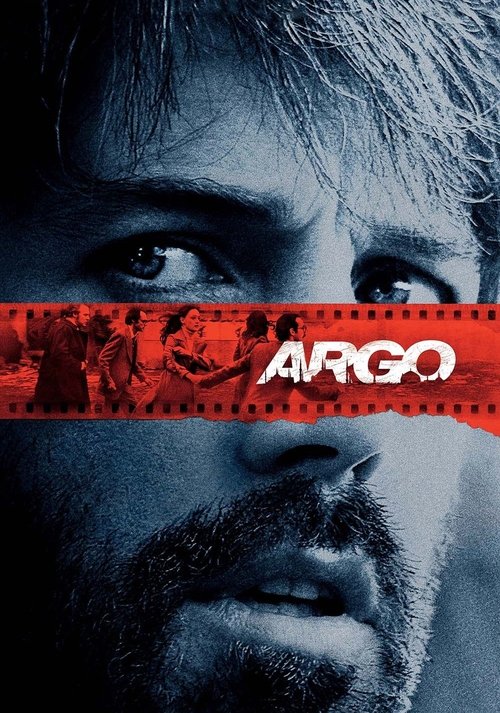
Argo
2012 · Ben Affleck
For when you want a grown-up thriller that grips without grimness — smart enough to respect you, entertaining enough for a Friday night. Firmly on the comfort side of tense.
What it's about
Tehran, 1979: as revolution boils over and the US embassy falls, six Americans slip out and hide in the Canadian ambassador's residence. A CIA exfiltration specialist hatches the least-bad option anyone can think of — pose the six as a Canadian film crew scouting locations for a fake sci-fi movie called Argo, and walk them out through the airport in plain sight.
The experience
A slow-tightening vise of a thriller with an unexpectedly funny middle — the Hollywood scenes are a riot — before the last stretch cranks the suspense until you realize you've stopped breathing. Brisk, confident, and hugely satisfying.
Performances
Alan Arkin and John Goodman are a joy as the Hollywood veterans lending the fake production its showbiz armor, trading world-weary one-liners that give the film its wit; Ben Affleck plays the CIA man with deliberate, watchful restraint.
The craft
Affleck directs with a real feel for the paranoid political thrillers of the 1970s — grainy period texture, teeming crowd scenes, archival footage woven in — while Rodrigo Prieto's camera makes 1980 look lived-in rather than dressed-up. The airport finale is a masterclass in cross-cut suspense.
Why it matters
It swept to the Best Picture Oscar, cemented Affleck's second act as a serious director, and reopened a long-running argument about how much truth a 'true story' thriller owes its history.
Snapshot
Ben Affleck's third feature as director is a political rescue thriller based on the declassified 1980 CIA operation known as the "Canadian Caper." CIA exfiltration specialist Tony Mendez devised a cover story — a fake Hollywood science-fiction production called Argo — to extract six American State Department employees who had escaped the seizure of the U.S. embassy in Tehran and taken refuge in the residence of Canadian Ambassador Ken Taylor. Working from Chris Terrio's screenplay and shot by Rodrigo Prieto with deliberate period fidelity, Argo fuses the paranoid aesthetic of 1970s New Hollywood political thrillers with a classical three-act suspense architecture. It won three Academy Awards at the 85th ceremony, including Best Picture and Best Adapted Screenplay, and reignited sustained critical conversation about docudrama craft, historical responsibility, and the place of the political thriller in contemporary Hollywood.
Industry & production
Argo was produced by GK Films and Smokehouse Pictures (Affleck and producing partner Grant Heslov) in association with Warner Bros., which distributed the film. The project originated with Joshuah Bearman's 2007 Wired article "How the CIA Used a Fake Sci-Fi Flick to Rescue Americans from Tehran," which brought the long-classified operation to wide public attention after its partial declassification in the 1990s. Terrio's script also drew on Tony Mendez's memoir The Master of Disguise (1999). George Clooney, a Smokehouse partner, served as a producing presence alongside Affleck and Heslov, and the Clooney connection helped shepherd the project through Warner's development process.
Production took place in and around Los Angeles (standing in for CIA Langley, Hollywood, and Washington interiors), with significant location work in Istanbul, Turkey, standing in for Tehran — a practical necessity, as access to Iran was impossible. The production design by Sharon Seymour was meticulous in its reconstruction of late-1970s surfaces: the CIA corridors, the Warner Bros. backlot offices used by the fictional Argo production, and the Canadian ambassador's residence were dressed with period-accurate detail. Costume designer Mark Bridges, who had worked with Paul Thomas Anderson, dressed the cast in the polyester and earth tones of the Carter era with equal precision.
The budget was in the range of forty to fifty million dollars — modest by contemporary tent-pole standards, in keeping with Affleck's preference for mid-range adult genre filmmaking. The film performed substantially above expectations at the domestic box office, and its awards campaign transformed it from a well-reviewed late-summer release (it opened in October 2012) into a Best Picture frontrunner. The DGA Award to Affleck followed by his conspicuous omission from the Academy's Best Director lineup generated considerable industry controversy and arguably intensified the film's awards momentum.
Technology
Rodrigo Prieto and Affleck committed early to a photographic strategy that would close the visual distance between the film and its historical moment. Prieto shot on Super 35mm using a combination of spherical and anamorphic vintage glass — including period-correct lenses of the kind in active use during 1979–1980 — to reproduce the slightly soft, organically grained look of late New Hollywood cinematography without resorting to digital approximation. The choice to shoot on film rather than digitally was fundamental to the aesthetic project. Tehran sequences were given additional textural differentiation: handheld work, tighter focal lengths, and a cooler color grade evoking the newsreel and network footage of the hostage crisis that constituted the visual vocabulary most audiences carried into the theater.
The film's opening sequence — a storyboard-illustrated history of twentieth-century Iran, voiced over by Victor Garber as Ambassador Taylor — deploys a graphic novel idiom reminiscent of Persepolis (Satrapi/Paronnaud, 2007) before cutting to re-created archival footage of the embassy siege. This transition from illustrated history to hyper-real recreation establishes the film's epistemological contract: it will play as documentary-inflected truth even as it dramatizes and compresses.
Editing was handled by William Goldenberg, working on Avid but serving a classically constructed script that drew its suspense from parallel action and deadline mechanics rather than digital spectacle.
Technique
Cinematography
Prieto's visual strategy separates the film's three primary spatial worlds. Washington and Langley are rendered in warm but bureaucratically flat interiors, shallow depth reducing officials to functionaries in beige corridors. Hollywood is oversaturated, almost garish — the Sunset Strip and studio backlots shot in the punchy primary palette of the entertainment industry's self-image. Tehran is the most kinetically shot environment: tight focal lengths, elevated grain, zooms that recall the news photography of the era. The zoom lens — largely abandoned by prestige American filmmaking after the mid-1980s — is used diagnostically throughout Tehran sequences, evoking surveillance and the instability of observation. When Mendez and the six escapees move through Mehrabad Airport in the climax, Prieto shifts to a slightly wider, flatter register that makes the oppressive bureaucratic spaces feel both claustrophobic and weirdly banal.
Editing
Goldenberg's editing is the film's primary dramatic engine. The climactic airport sequence cross-cuts across five simultaneous lines of action — the escapees at check-in, Mendez managing the group, CIA officials in Washington scrambling to reinstate the canceled operation, Iranian revolutionary guards verifying the Argo cover story, and the aircraft taxiing toward the runway — in a manner that is formally indebted to D.W. Griffith's last-minute rescue construction and, more proximately, to Alan Pakula's parallel editing in All the President's Men (1976). The sequence has been widely criticized for dramatizing a departure that was, by all available historical accounts, comparatively undramatic; nevertheless, as a piece of editorial craftsmanship, its control of tempo and threshold is exemplary. The film was edited to a lean one hundred twenty minutes with very little fat, a discipline that keeps the audience in a sustained state of low-grade dread.
Mise-en-scène / staging
Affleck's staging reflects his background as an actor: scenes are blocked for performance rather than visual rhetoric. The film favors medium shots and over-the-shoulder coverage that keeps faces legible under stress. The Canadian ambassador's residence functions as an interior pressure cooker — the geography of the house is established efficiently so that the audience feels the constraint of the six Americans' confinement. The Hollywood sequences introduce deliberate tonal levity through the staging of producer Lester Siegel (Alan Arkin) and make-up artist John Chambers (John Goodman), whose broad office-comedy register provides structural release before the film's tightening third act. Affleck is careful to return each comedic beat to dread: the industry jokes land, then dissolve into the awareness of what they're serving.
Sound
Alexandre Desplat's score operates primarily in the film's margins, filling transitions and underscoring the ticking-clock mechanics without overwhelming the dialogue-driven center. Desplat uses sparse percussion and low strings, keeping the soundscape taut rather than melodically declarative. The film's more effective aural strategy is the deployment of period source music — Van Morrison's "Sultans of Swing"-era rock and the sonic texture of late-1970s AM radio — to temporally anchor the Washington and Hollywood sequences. The Tehran sequences are more sparsely scored, relying on ambient crowd noise, the sound of loudspeakers broadcasting revolutionary rhetoric, and the mechanical sounds of the airport.
Performance
Affleck's performance as Tony Mendez is the film's most discussed and contested artistic choice. Playing the lead himself — as he had done in The Town — he gives Mendez a studied understatement, a man of minimal emotional display operating under maximum pressure. Critics divided on whether this constituted effective stoicism or a fundamental flatness. The film's emotional warmth resides largely in the ensemble: Cranston as CIA superior Jack O'Donnell brings bureaucratic exasperation and genuine affection; Arkin and Goodman form a vaudeville double act that runs on comic timing; the six Americans are carefully differentiated by Scoot McNairy, Clea DuVall, Rory Cochrane, Tate Donovan, Kerry Bishé, and Christopher Denham, each given a specific register of fear to carry.
Narrative & dramatic mode
Argo is structured as a classical suspense thriller in the Hitchcockian sense: the audience possesses more information than the characters, and the pleasure is in watching endangered people navigate a situation the viewer has been prepared to understand as lethal. The film's opening history lesson is unusual precisely because it loads the audience with political context that the characters — trapped in the ambassador's residence — can only partially understand. The narrative proceeds in a trifurcated construction: establish the crisis, build the cover (the Hollywood act), execute the exfiltration. The second act's industry comedy is a deliberate generic splice — screwball mechanics inserted into a paranoid thriller — and the tonal management is sufficiently controlled that the transition back to suspense does not fracture the film's credibility.
The script's central dramatic irony is structural: a fiction (a fake film) must be made real enough to deceive, and the film's self-referential premise — Hollywood artifice as life-saving instrument — is handled with enough wit that it avoids collapsing into ironic paralysis.
Genre & cycle
Argo belongs to the American political thriller, a genre whose dominant cycle runs from roughly 1969 (Z released in the U.S.) through the late 1970s: The Parallax View (Pakula, 1974), Three Days of the Condor (Pollack, 1975), All the President's Men (Pakula, 1976), Marathon Man (Schlesinger, 1976). Affleck and Terrio consciously invoke this cycle not merely thematically but formally — the grain, the zoom lenses, the institutional mise-en-scène are direct citations. Argo arrives during a concurrent wave of post-9/11 American films revisiting covert operations and state violence: Zero Dark Thirty (Bigelow, 2012) and Lincoln (Spielberg, 2012) were its awards-season contemporaries, and all three engaged with how the American state deploys force or deception in its own interest. The docudrama sub-genre is also relevant: Argo sits alongside Paul Greengrass's United 93 (2006) and Captain Phillips (2013) as a film that applies visceral suspense mechanics to documented historical events.
Authorship & method
Affleck's directorial career through 2012 — Gone Baby Gone (2007), The Town (2010), Argo — describes a consistent method: genre filmmaking grounded in specific milieu, research-intensive production design, ensemble performance work, and a preference for location-derived texture over studio stylization. Each film took a genre form (mystery procedural, heist thriller, political thriller) and relocated it into a rigorously authenticated environment. Affleck is not an auteur in the French sense — his films do not accumulate a distinctive visual signature independent of their material — but he is a consistent craftsman whose intelligence is largely organizational and performative.
Rodrigo Prieto, Affleck's cinematographer for Argo, brings a career spanning Iñárritu's early trilogy and later Paul Thomas Anderson collaborations; his ability to calibrate period-authentic texture without nostalgia was essential to the project. William Goldenberg, the editor, brought prior experience with Seabiscuit and The Insider — films that similarly required sustained narrative pressure over long running times. Chris Terrio, before Argo a director of short films, wrote a screenplay of considerable structural economy; his subsequent career — Batman v Superman (2016) and Justice League (2017) — does not reflect the quality of the Argo script, though the Argo work remains his most fully realized writing.
Movement / national cinema
Argo is firmly within Hollywood mainstream production — studio-backed, commercially oriented, broadly accessible — but its relationship to American national cinema is complicated by its subject matter. The film dramatizes an American covert operation while simultaneously constructing an Iranian political and historical context that is unusually sympathetic by Hollywood standards. The opening animated history of twentieth-century Iran — acknowledging the CIA's role in the 1953 coup against Mossadegh — is rare for mainstream American filmmaking. At the same time, the film was criticized in Canada and the United Kingdom for significantly diminishing the role of Canadian Ambassador Ken Taylor, the British Embassy, and the New Zealand Embassy, all of whom provided critical assistance in the real operation. Former President Jimmy Carter publicly noted that the film understated the Canadian contribution. This tension between acknowledgment and nationalist framing is characteristic of the American prestige docudrama.
Era / period
The film was made and released during the Obama administration, a moment of renewed American public interest in Middle Eastern politics following a decade of post-9/11 conflict. The Iran hostage crisis remained a politically charged reference point in American discourse around Iranian nuclear negotiations. Argo's 2012 release positioned the story as an implicit argument about American competence, moral complexity, and the occasional necessity of deception in statecraft — a reading available without being insisted upon. The Carter-era setting also allowed the film to invoke a recognizable mode of American institutional anxiety, pre-Reagan, that registers as sympathetic in contrast to the more ideologically polarized present.
Themes
The film's central thematic proposition is the weaponization of unreality: fiction — specifically Hollywood genre fiction — as instrument of survival. This is articulated both literally (the fake film saves the hostages) and formally (the film you are watching is itself an artifact of the same industry). The tension between documentary truth and constructed narrative is present throughout, most explicitly in the gap between the film's climax and the historical record. Argo also engages with institutional trust — the CIA's cumbersome authorization structures, the moment when Mendez acts unilaterally to reinstate the operation, the question of what individuals owe to bureaucratic process under moral pressure. Beneath these, the film carries a sustained meditation on risk calibrated against complacency: the six Americans' varying degrees of willingness to attempt the exfiltration maps a spectrum from paralysis to courage that structures the ensemble's emotional arc.
Reception, canon & influence
Critical reception. Argo received strong reviews on release, with particular praise for its tonal management, ensemble performance, and the airport sequence's formal craft. It holds a high approval rating on Rotten Tomatoes and was named among the year's best films by numerous critical organizations. Dissenting voices — notably A.O. Scott at The New York Times, who admired the craft while questioning the historical sleight of hand — raised concerns about the film's manipulation of documented events for suspense purposes and its nationalism by omission. These criticisms deepened after Canadian and British responses to the film's release.
Influences on the film (backward). The primary precursors are Costa-Gavras's political thrillers (Z, 1969; State of Siege, 1972; Missing, 1982) and the Pakula paranoia cycle. Affleck has cited All the President's Men as a foundational reference, and the shared emphasis on institutional procedure as both obstacle and instrument is clear. Sidney Lumet's Dog Day Afternoon (1975) and Network (1976) inform the film's period texture and its awareness of media-spectacle as political force. The docudrama tradition running from Peter Watkins through Paul Greengrass shaped the grammar of authenticated re-creation.
Legacy and forward influence. Argo's Best Picture win was culturally significant as a validation of mid-budget, dialogue-driven genre filmmaking at a moment when the awards conversation was increasingly dominated by prestige literary adaptations and art cinema. Whether the film directly spawned successors is difficult to isolate — the concurrent wave of historical political thrillers (Zero Dark Thirty, The Report, Official Secrets) draws from overlapping sources. Affleck's career as director stalled subsequently, making Argo his commercial and critical peak. The film's most durable contribution may be methodological: it demonstrated that period-authentic cinematography achieved through practical means — actual film stock, vintage glass, location-specific color design — remained a viable and legible strategy for mainstream audiences, and that the New Hollywood political thriller's formal vocabulary retained its power when applied to genuinely documentary material.
A Deleuzian reading
Start with the table read.
The full Deleuzian reading of Argo →
Reception
A critical and awards juggernaut in 2012 — Best Picture, near-universal praise — Argo has since become shorthand for the 'fine but forgettable' Oscar winner, routinely ranked near the bottom in Best Picture retrospectives and invoked whenever people argue the Academy plays it safe.
How Argo was received, from release to now →
Influences: the films it descends from and the films it influenced
- Z (1969) — Established the political-thriller template of rapid cross-cutting between procedural investigation and political spectacle, and the deployment of a factual subtitle ('This film is a fiction. Any resemblance…') as simultaneous authentication device and ironic indictment — Argo inherits both the editing rhythm and the disclaimer gambit.
- All the President's Men (1976) — Affleck's explicit foundational template: institutional procedure — phone calls, paper trails, bureaucratic obstruction — as the primary dramatic action, and a competent ensemble navigating institutional opacity as the thriller engine, without a single conventional action beat.
- The Day of the Jackal (1973) — The foundational model for deadline-mechanics suspense within a procedural docudrama frame: parallel timelines converging on a historically known endpoint, generating tension not from outcome uncertainty but from procedural precision and the audience's privileged omniscience.
- The Conversation (1974) — Established zoom-lens surveillance as the primary cinematographic grammar of political paranoia; Rodrigo Prieto's roving, detached zoom work throughout Argo descends from this visual language of observation-as-threat.
- Three Days of the Condor (1975) — The Pakula-adjacent formula of a competent professional isolated within a hostile institutional system, deploying procedural intelligence rather than physical force as the primary suspense mechanism against an unnamed state adversary.
- Dog Day Afternoon (1975) — The ensemble of eccentric supporting players providing vaudeville counterweight to a stoic lead under deadline pressure, shot in high-grain period-specific color temperature — the tonal and textural template Affleck and Prieto replicated for the Hollywood studio sequences.
- Missing (1982) — The political thriller as docudrama indictment: period-authentic reconstruction of an American government's complicity in a foreign crisis, using parallel timelines and an institutional paper trail to simultaneously build suspense and make a historical argument — Argo's structure and its nationalist omission problem in miniature.
- United 93 (2006) — Demonstrated that docudrama authentication through procedural real-time pressure and non-professional casting could sustain maximum formal tension even when the historical outcome is universally known — the methodological proof Affleck extended to the airport sequence.
- The Town (2010) — Affleck transferred The Town's procedural authenticity model to the political thriller: classical genre construction without ironic distance, compression-counterpoint editing for the airport climax, and a method of extended research shaping staging decisions rather than simply informing production design.
- Charlie Wilson's War (2007) — Affleck dramatizes a declassified CIA covert operation as a brisk, star-powered caper with comic relief offsetting geopolitical danger—the same 'entertaining true-spy-op' tonal recipe.
- Bridge of Spies (2015) — Explicit formal descendant in the Cold War political-procedural: parallel cross-cutting between two institutional timelines converging on a deadline, period-authentic Super 35 cinematography, stoic lead navigating bureaucratic obstruction through procedural competence alone.
- Spotlight (2015) — Inherits Argo's ensemble-of-competent-professionals grammar: performance-driven blocking without directorial stylization, institutional obstruction as the primary dramatic obstacle, and the investigation itself — the accumulation of documents and interviews — as the thriller action.
- The Report (2019) — Direct formal descendant: the political-procedural as pure dialogue and bureaucratic stonewalling, austere cinematography in fluorescent institutional settings, a lone civil servant pressing forward against classified obstruction — Argo's structural grammar stripped of its period-adventure packaging.
- Official Secrets (2019) — Applies Argo's deadline-mechanics parallel cross-cutting to a British intelligence whistleblower case, using convergent procedural timelines and the legal documentation trail as suspense architecture — the same formal strategy in a transatlantic docudrama register.
- Escape from Mogadishu (2021) — Provides the structural template for the diplomatic-escape thriller in which bureaucratic protocol detail — paperwork, clearance procedures, checkpoint negotiations — functions as the primary suspense mechanism rather than as procedural background.
- Munich (2005) — Political-operational thriller built on countdown mechanics and parallel cross-cutting between mission timelines, using Super 35 period-authentic texture and docudrama legitimacy to authorize a morally ambiguous covert narrative — the structural template Argo compressed and accelerated.
- Zodiac (2007) — Procedural thriller using archival obsession, location-derived period-specific color, and Super 35 film grain to build suspense through accumulation of documentary detail rather than action set-pieces — the same strategy that sustains Argo's first two acts.
- Tinker Tailor Soldier Spy (2011) — Concurrent sibling in Super 35mm film with a muted tripartite institutional palette (greens, grays, tobacco), stoic lead navigating betrayal through cognitive procedure rather than action — the period spy-thriller as a purely deductive suspense machine, released one year before Argo.
- Zero Dark Thirty (2012) — Concurrent sibling deploying the same docudrama grammar of procedural accumulation and period-authentic reconstruction; both films were simultaneously interrogated for whether their documentary framing constituted endorsement of the nationalist narrative they authenticated.
- Operation Mincemeat (2022) — An intelligence procedural where a manufactured fiction is itself the operational weapon, assembled as a caper and edited for cross-cut suspense around the deception's plausibility.
- To Be or Not to Be (1942) — Builds its rescue on a fake film production as espionage cover, reprising performance-as-survival and the masquerade-must-hold suspense of the troupe posing as Nazi officers.
Similar films
- Zero Dark Thirty (2012) — influence & lineage
- Missing (1982) — influence & lineage
- United 93 (2006) — influence & lineage
- Bridge of Spies (2015) — influence & lineage
- It Was Just an Accident (2025) — often watched together
- Gravity (2013) — often watched together
- The Martian (2015) — often watched together
- 13 Hours: The Secret Soldiers of Benghazi (2016) — shared sensibility