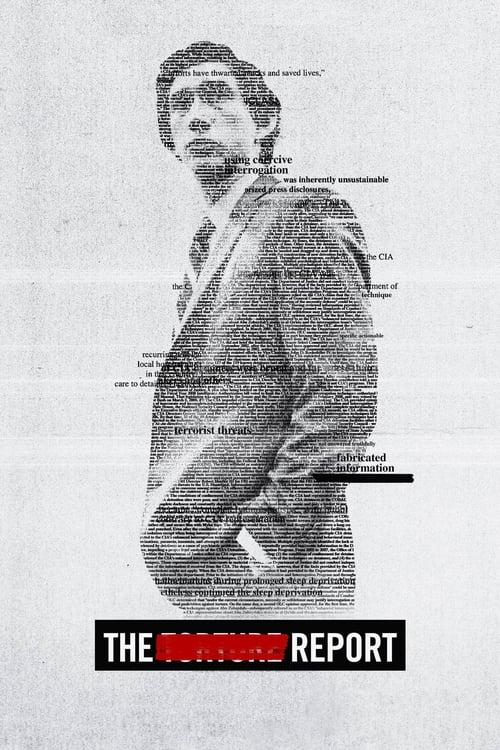
The Report
2019 · Scott Z. Burns
For when you want to be engaged and a little angry — a serious, talky evening for fans of journalism and whistleblower stories. Challenge over comfort, but gripping if you're in the mood to pay attention.
What it's about
The true story of Daniel Jones, a Senate staffer assigned to investigate the CIA's post-9/11 detention and interrogation program. What starts as document review becomes a years-long war of attrition: assembling proof that the program amounted to torture and didn't work, then fighting the agency and the political machinery trying to keep the findings buried.
The experience
Tense in a dry, gathering way — the thrills come from arguments, redactions, and the slow grind of one stubborn person against an institution. It's sobering and quietly infuriating, the kind of film that makes you want to read the actual document afterward.
Performances
Adam Driver plays Jones with a coiled, monkish intensity that makes paperwork feel like combat, and Annette Bening gives a sharp, unshowy turn as Senator Dianne Feinstein weighing principle against politics.
The craft
Writer-director Scott Z. Burns strips the procedural down to essentials: fluorescent basement offices, hearing rooms, and dialogue that turns bureaucratic maneuvering into drama. Its discipline is the point — it trusts the record to be shocking enough without embellishment.
Why it matters
Part of the late-2010s reckoning with the War on Terror on screen, it stands as the definitive dramatization of the Senate torture report and an argument for oversight as heroism.
Snapshot
The Report dramatizes the years-long effort by Senate staffer Daniel J. Jones to investigate the CIA's post-9/11 Detention and Interrogation Program — the "enhanced interrogation techniques" that, the resulting Senate Intelligence Committee study concluded, constituted torture and produced little actionable intelligence. Written and directed by Scott Z. Burns, the film stars Adam Driver as Jones and Annette Bening as Senator Dianne Feinstein, who as chair of the committee authorized and ultimately defended the investigation. The film is a procedural in the most literal sense: it follows the assembly of a document, the bureaucratic and legal warfare over its declassification, and the moral stakes of forcing an institution to read its own record back to itself. Premiering at the Sundance Film Festival in January 2019 and acquired there by Amazon Studios, it received a limited theatrical release in November 2019 before streaming on Prime Video. It belongs to the lineage of the American political-investigation drama — All the President's Men, Spotlight, The Insider — and is among the most rhetorically uncompromising of that cycle.
Industry & production
The Report sits at the intersection of mid-budget prestige cinema and the streaming economy that was, by 2019, reshaping where such films could live. It was produced under the banners of Topic Studios (the production arm associated with First Look Media) and VICE Studios, with Steven Soderbergh among the producers — a significant fact given Burns's long screenwriting partnership with Soderbergh. The film was made independently and brought to Sundance without a distributor attached, the classic festival-premiere financing model. Amazon Studios' acquisition there, reported at the time as one of the larger deals of the festival, exemplified the moment when streamers were aggressively buying adult-oriented, issue-driven dramas that traditional studios had largely abandoned.
That distribution path shaped the film's public life. A brief awards-qualifying theatrical run preceded streaming release, meaning The Report reached most of its audience domestically. Reliable theatrical box-office figures are negligible and not a meaningful index of its reach; I will not invent them. The production's budget was modest by studio standards, consistent with a dialogue-driven drama shot largely in interiors — offices, hearing rooms, secure facilities — rather than on location at scale.
Technology
The film was shot digitally, the default for a contemporary interior-heavy drama of this scale, allowing cinematographer Eigil Bryld to work in the low-light, fluorescent-lit, windowless environments the story demands without the lighting overhead of celluloid. The aesthetic is deliberately undramatic in its technology: this is not a film that announces its tools. Its most pointed technological motif is internal to the story — the redaction, the classified PDF, the air-gapped CIA facility where Jones's team works, the literal struggle over what can be printed and released. The film treats the document itself, and the apparatus of classification, as its central piece of "technology," and stages the editing and declassification of text as a thriller mechanism. Period reconstruction of the 2002–2014 span relies on practical set dressing — government-issue computers, surveillance imagery, news footage — rather than visual-effects spectacle.
Technique
Cinematography
Eigil Bryld — a cinematographer whose credits include In Bruges and the early seasons of Netflix's House of Cards — gives The Report a cool, desaturated, institutional palette. The dominant register is the gray-green of fluorescent-lit federal interiors: the cramped basement room where Jones and his small staff work, the corridors of the Hart Senate Office Building, the controlled neutrality of hearing chambers. The camera favors steady, composed framing over handheld agitation, suiting a story about patient accumulation rather than action. The sharpest visual contrast is reserved for the interrogation flashbacks — depictions of waterboarding, stress positions, sleep deprivation at the black sites — which Burns and Bryld render in a harsher, more clinical light, refusing both eroticized brutality and false catharsis. These inserts are deliberately stripped of suspense scoring or heroics; their flatness is the point.
Editing
The film's editing carries an unusually heavy structural burden, because the narrative spans more than a decade and braids three timelines: the immediate post-9/11 origins of the program, the long middle years of Jones's investigation, and the climactic fight over declassification. Cutting between Jones reading and the events he is reading about, the film uses montage to dramatize research itself — the act of correlating cables, memos, and testimony into a coherent indictment. The rhythm is procedural and cumulative rather than propulsive; tension is built through the steady disclosure of fact. I am not able to confirm the editor's name with certainty from the established record, so I will not attribute it; the technique, however, is plainly central to how the film converts archival labor into drama.
Mise-en-scène / staging
Burns stages the film as a study in confinement. Jones spends years in a basement room with no windows, surrounded by stacks of documents and locked behind security doors — a visual thesis about the closed loop of secrecy. Against this, the more open, mahogany-and-marble spaces of senatorial power read as worlds Jones can only petition, never inhabit. Staging repeatedly isolates Jones within frames dense with paper and screens, the individual dwarfed by the volume of the record he is trying to master. Dialogue scenes are blocked for confrontation across desks and tables — the geometry of bureaucratic power — and the film's restraint with movement keeps attention on language and argument.
Sound
The sound design is spare and pointedly unsensational. David Wingo's score — Wingo being a composer associated with the films of David Gordon Green and Jeff Nichols, including Take Shelter and Midnight Special — works in restrained, tense tones rather than swelling cues, declining to underscore the torture sequences with emotional manipulation. Much of the film's "sound" is talk: testimony, argument, the legalistic back-and-forth of officials parsing what words like "torture" and "effective" are permitted to mean. Silence and the absence of music in the black-site scenes throw the depicted brutality into colder relief.
Performance
Adam Driver anchors the film with a performance built on contained intensity — Jones as a man whose obsessiveness curdles into righteous exhaustion. Driver plays him with minimal sentimentality: clipped, dogged, occasionally explosive when confronted with obstruction, but never softened into an easy hero. Annette Bening's Dianne Feinstein is a study in institutional caution and eventual resolve, embodying the political calculation that surrounds Jones's moral absolutism. The deep supporting ensemble — including Jon Hamm, Maura Tierney, Ted Levine, Tim Blake Nelson, Corey Stoll, Michael C. Hall, and Matthew Rhys — fills out the bureaucratic and intelligence apparatus with actors who give weight to short scenes. Tim Blake Nelson's turn as a medical officer disturbed by what he witnessed is among the performances most often singled out for grounding the abstraction of policy in individual conscience.
Narrative & dramatic mode
The dramatic mode is the investigative procedural pushed toward the docudrama end of its spectrum. The film is structured around a problem of knowledge: what happened, who authorized it, whether it "worked," and whether the public will ever be allowed to know. Its forward motion is supplied not by physical jeopardy but by the threat of suppression — the possibility that years of work will be buried, that the CIA's improper search of Senate computers will derail the investigators rather than the investigated. Burns writes in a dense, information-rich register, trusting the audience to follow acronyms, legal distinctions, and chains of authorization. The result is a film that dramatizes reading and argument, with the reveal of fact standing in for the reveal of plot. Its climaxes are textual and political — a vote, a declassification, a speech on the Senate floor — rather than confrontational in the conventional thriller sense.
Genre & cycle
The Report belongs squarely to the American political-conscience drama, the cycle of films about institutional whistleblowing and investigative truth-telling that runs from All the President's Men (1976) and The Insider (1999) through Spotlight (2015) and The Post (2017). Within that cycle it is notable for its austerity: where Spotlight and The Post offer the warmth of teamwork and the romance of the press, The Report is colder, more solitary, and more explicitly an indictment. It also participates in the post-9/11 reckoning cinema — the body of films grappling with torture, surveillance, and the war on terror that includes Zero Dark Thirty (2012). The Report can be read as a direct rebuttal to Zero Dark Thirty's ambiguous suggestion that "enhanced interrogation" contributed to finding Osama bin Laden; Burns's film insists, in line with the Senate study, that it did not.
Authorship & method
Scott Z. Burns came to The Report primarily as a screenwriter, and the film is best understood through that authorship. His credits include The Bourne Ultimatum and a sustained collaboration with Steven Soderbergh — The Informant!, Contagion, Side Effects, and later The Laundromat — films marked by systemic thinking, institutional skepticism, and an interest in how complex apparatuses (finance, public health, espionage) actually function. The Report was only his second feature as director, following the 2006 HBO film Pu-239 (also released as The Half Life of Timofey Berezin). His method here is fundamentally that of the researcher-dramatist: the screenplay is steeped in the actual findings of the 6,700-page Senate study and its released executive summary, and Burns reportedly drew on extensive reporting to reconstruct the investigation. His directorial choices subordinate style to argument — a clarity-first approach that reflects a writer's confidence in language over spectacle.
Among key collaborators, cinematographer Eigil Bryld supplies the institutional visual grammar described above, and composer David Wingo provides the restrained score. Soderbergh's presence as a producer reinforces the film's lineage in the kind of intelligent, procedurally curious filmmaking the two men had built together over a decade. The title sequence's gesture of partially redacting the word "Torture" — the film was developed under the title The Torture Report — is itself an authorial statement, dramatizing in the credits the very act of suppression the film is about.
Movement / national cinema
The film is firmly within American independent and specialty cinema, made outside the major studios and routed to audiences through a streamer. It reflects the late-2010s migration of the "serious adult drama" — the prestige issue film — from theatrical studio production into the streaming sphere, a structural shift in American filmmaking as consequential to this kind of movie as any aesthetic movement. It is not part of a formal stylistic movement; its affiliations are thematic and industrial rather than school-based.
Era / period
The Report is both a film of 2019 and a film about the period 2001–2014. Its release came in a moment of intense argument over governmental accountability, secrecy, and the long shadow of the war on terror, and it self-consciously revisits the Bush-era decisions and the Obama-era reluctance to fully reckon with them. The film is pointed about the bipartisan character of institutional self-protection: it shows a Republican administration authorizing the program and a Democratic administration hesitant to expose it. As an artifact of the late 2010s, it speaks to a wider cultural appetite for nonfiction-grounded dramatizations of recent history and for narratives about lone investigators confronting powerful systems.
Themes
The film's governing theme is the conflict between truth and institutional self-preservation — the question of whether a democracy can bear to document its own wrongdoing. Closely linked is the theme of moral injury and complicity: the program implicates not only its architects but the agency, the oversight bodies, and the public that looked away. The film interrogates the language of euphemism, showing how phrases like "enhanced interrogation techniques" are engineered to make torture sayable, and it dramatizes the bureaucratic weaponization of classification as a tool of concealment. Running beneath these is a portrait of obsessive, self-sacrificing public service — Jones's near-monastic dedication — and the personal cost of being the keeper of an unbearable record. Finally, the film advances an argument about efficacy: it insists, against a comforting national myth, that torture was not merely immoral but useless, severing any utilitarian justification.
Reception, canon & influence
Critical reception was generally favorable, with particular and consistent praise for Adam Driver's lead performance and for the film's intelligence and moral seriousness. The most common critical reservation was that the film's density and didactic, information-forward construction made it admirable rather than emotionally enveloping — that its commitment to the record sometimes outran its drama. I will avoid citing specific aggregate scores or award outcomes I cannot verify, but the consensus placed it as a respected, substantive entry in the political-drama field rather than a major awards-season force, a position partly attributable to its streaming-led release pattern.
Looking backward, the film's influences are clear: the investigative procedurals of the 1970s, especially All the President's Men, supply its template of patient document-driven heroism; The Insider and Spotlight provide the modern grammar of the institutional whistleblower film; and Zero Dark Thirty serves as a direct antagonist text whose claims The Report was in part made to refute. Its grounding in the actual Senate study and surrounding journalism places it in the docudrama tradition that prizes fidelity to the record.
Looking forward, The Report's legacy is best understood as part of the streaming era's validation of the talky, fact-based prestige drama — proof that a rigorous, uncommercial political film could find a home and an audience outside theaters. Within the broader culture, it stands as one of cinema's most explicit dramatic statements on the CIA torture program, a work that fixed the Senate study's conclusions in narrative form for a general audience. Its influence is likely to be measured less in stylistic imitation than in its function as a reference point: a film that argued, with documentary conviction, that the historical record of state wrongdoing deserves to be dramatized precisely because powerful institutions would prefer it stay redacted.
A Deleuzian reading
Picture the room first.
The full Deleuzian reading of The Report →
Reception
A hot Sundance 2019 buy — Amazon paid $14M — with real awards buzz, it then got a token two-week theatrical run before being quietly shunted onto Prime. It's since become Exhibit A in the 'great grown-up dramas that streaming buried' conversation, and a favorite 'actually underrated' pick from Adam Driver's monster 2019.
How The Report was received, from release to now →
Influences: the films it descends from and the films it influenced
- All the President's Men (1976) — Supplies the document-driven procedural grammar — two-shots hunched over files, phone-call legwork, cross-referenced records — that makes the act of reading and verifying the archive the film's central suspense engine.
- The Parallax View (1974) — Gordon Willis's compositions that dwarf the lone investigator inside monolithic institutional architecture model the bureaucratic-geometry framing Burns uses for Senate corridors and hearing rooms.
- The Insider (1999) — Establishes the modern whistleblower grammar of claustrophobic interiors and the procedural toll of testimony, where the dramatic stakes are institutional suppression versus disclosure rather than action.
- Spotlight (2015) — The de-glamorized ensemble procedural built from undramatic document-sifting, restrained contained performances, and a deliberate refusal of stylistic flourish in service of fidelity to the record.
- Zero Dark Thirty (2012) — The direct antagonist text: The Report restages the same clinical enhanced-interrogation imagery as desaturated flashback specifically to rebut its implied argument that torture produced actionable intelligence.
- Z (1969) — The foundational political-investigation procedural template that reconstructs an official inquiry as a taut thriller, assembling institutional culpability through fragmented flashback testimony.
- The Post (2017) — Dramatizes classified-document disclosure as dialogue-driven prestige procedural, staging the suspense around what may be published rather than physical jeopardy.
- Good Night, and Good Luck. (2005) — Burns's film is the most direct formal descendant: a document-driven government investigation procedural with retrospective framing through a witness's testimony, post-9/11 political allegory, and the identical institutional-ambiguity dramaturgy—courage under political pressure inside a bureaucratic space—that structures Clooney's film.
- Argo (2012) — Direct formal descendant: the political-procedural as pure dialogue and bureaucratic stonewalling, austere cinematography in fluorescent institutional settings, a lone civil servant pressing forward against classified obstruction — Argo's structural grammar stripped of its period-adventure packaging.
- Kill the Messenger (2014) — A restrained institutional procedural pitting a lone investigator against CIA cover-up, sustaining the procedural-to-frustration arc and the agency-accountability subject directly.
- The Mauritanian (2021) — Extends the identical post-9/11 torture reckoning, intercutting clinical detention-flashbacks with a legal-documentary effort to pry the redacted record open for a general audience.
- The Trial of the Chicago 7 (2020) — Belongs to the streaming-era validation of the talky, fact-forward prestige political drama, fixing a contested historical record in dramatic narrative for a mass audience.
- Contagion (2011) — Burns's own screenwriting method here — dramatizing how a complex bureaucratic apparatus actually functions — paired with Soderbergh's cool, systems-level procedural detachment that recurs as producer on The Report.
- The Informant! (2009) — The Burns–Soderbergh collaboration's signature institutional skepticism and forensic interest in the internal mechanics of agency and corporate malfeasance.
- Michael Clayton (2007) — Shares the desaturated corporate-thriller palette and the figure of the conscientious operator navigating an apparatus whose first instinct is self-preservation over truth.
- Dark Waters (2019) — Built on the same desaturated institutional palette and the grinding, box-by-box document attrition of a single investigator wearing down a powerful entity over years.
- Official Secrets (2019) — A whistleblower-procedural of the same vintage organized around the personal cost of leaking against the Iraq-war intelligence apparatus and its language of classification.
- Vice (2018) — Shares the post-9/11 reckoning on the Cheney-era security state and the theme of euphemism-and-classification — how policy crimes are renamed into administrative procedure.
- Standard Operating Procedure (2008) — The nonfiction counterpart that anatomizes the torture program's bureaucratic euphemism and chain-of-classification, sharing the clinical, evidence-forward construction Burns dramatizes.
- Crisis (2021) — A Soderbergh-collaborator's austere institutional procedural — desaturated office spaces and a restrained score dramatizing systemic capture through documents and testimony.
- Thirteen Days (2000) — Descendant procedural of governmental self-examination, building feature-length tension from documents, briefings, and the institutional argument over what may be acted upon.
- Moneyball (2011) — Institutional procedural built almost entirely from files and bureaucratic obstruction, with a desaturated palette and a pointedly withheld, joyless triumph.
Similar films
- Zero Dark Thirty (2012) — influence & lineage · same viewing thread
- Official Secrets (2019) — influence & lineage · same viewing thread
- The Insider (1999) — influence & lineage
- The Post (2017) — influence & lineage
- Spotlight (2015) — influence & lineage
- All the President's Men (1976) — influence & lineage
- The Trial of the Chicago 7 (2020) — influence & lineage
- Body of Lies (2008) — same viewing thread · often watched together
All the films related to The Report →
Watch it with: curated runs of related films
- Inside the Security State — A run of modern espionage and national-security thrillers — globe-trotting spycraft, submarine brinkmanship, and the paper trail behind the black sites — where operatives and investigators race secretive institutions and catastrophic clocks.