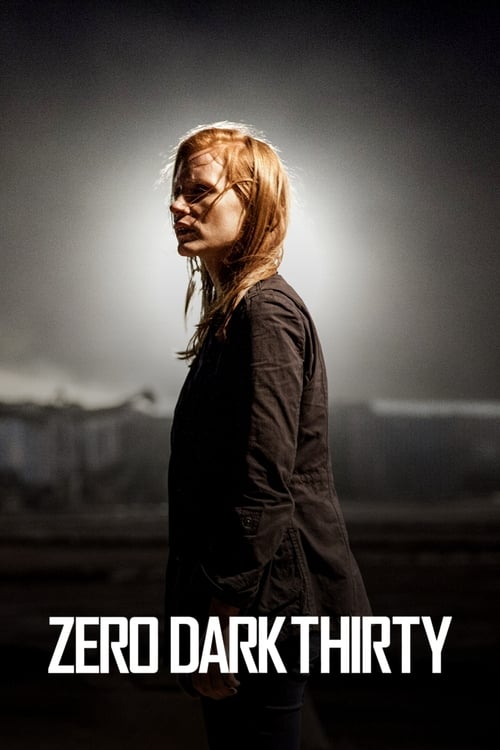
Zero Dark Thirty
2012 · Kathryn Bigelow
For when you want a serious, absorbing thriller that treats you like an adult and gives you something to argue about afterward. This is challenge viewing, not comfort — it asks what the hunt cost, and doesn't answer for you.
What it's about
After the September 2001 attacks, a young CIA analyst joins the agency's Pakistan station and gradually makes the hunt for Osama bin Laden her entire life. The search stretches across a decade of dead ends, detainee interrogations, bureaucratic resistance, and attacks that keep landing closer to home, all built around one fragile lead she refuses to let go. It follows the intelligence work itself — the meetings, the surveillance, the arguments over what the evidence actually proves.
The experience
Cold, gripping, and deliberately unheroic — it plays like a case file that slowly tightens around you, with long stretches of procedure punctured by sudden violence. The final act is some of the most sustained tension in modern film, and it leaves you unsettled rather than triumphant.
Performances
Jessica Chastain carries the film as Maya, playing obsession as something quiet and corrosive — a decade of certainty hardening in her face. It's a performance built from stillness and flashes of fury, and it made her a major star.
The craft
Kathryn Bigelow directs with documentary-like restraint, and Mark Boal's screenplay is structured as an intelligence dossier rather than a hero's journey — dates, sites, names, consequences. The nighttime raid sequence, shot largely in near-darkness and eerie quiet, is a masterclass in staging and sound design that genuinely rewards a dark room and good speakers.
Why it matters
One of the defining political films of the post-9/11 era, it ignited a real congressional and critical firestorm over its depiction of torture — a rare case of a thriller becoming a national argument. It cemented Bigelow's standing as the premier American director of institutional warfare.
Snapshot
A procedural chronicle of the CIA's decade-long pursuit of Osama bin Laden, Zero Dark Thirty is one of the defining political films of the post-9/11 era and one of the most contested. Structured as an intelligence case-file rather than a heroic narrative, the film follows Maya (Jessica Chastain), a composite figure drawn from actual CIA analysts, from the early years of enhanced interrogation through the May 2011 Abbottabad raid. Bigelow and screenwriter Mark Boal constructed it as a deliberate act of institutional portraiture: unheroic, exhausting, morally unresolved. Its depiction of torture set off a congressional firestorm; its elliptical final image — a lone woman in an empty military transport, weeping without explanation — generated sustained critical debate about what political cinema is permitted to feel.
Industry & production
Zero Dark Thirty grew directly out of the professional and creative partnership Bigelow and Boal forged on The Hurt Locker (2008). Boal, a journalist who had embedded with Army explosive ordnance disposal units in Iraq, developed the reporting instinct that would structure both films: accumulate testimony, render institutional process, resist resolution. Their first conception of a bin Laden film was set at Tora Bora in 2001, focusing on the failed early opportunity to capture him — a story of institutional failure rather than success. The May 2011 operation that killed bin Laden restructured everything; Boal revised the project substantially to encompass the full decade.
Annapurna Pictures, the production company founded by Megan Ellison, co-financed the film alongside Columbia Pictures, which handled distribution. Ellison's backing became synonymous in this period with prestige projects that major studios would not fully fund at comparable levels of creative autonomy — Zero Dark Thirty benefited from that arrangement in its willingness to carry a 157-minute runtime, a protagonist who never fires a weapon, and an ending that offers no catharsis. The film shot across multiple countries, including Jordan (for much of the detention site and operational footage) and India (for sequences representing Pakistan), with production design working to recreate the compound and the look of CIA black sites. Principal photography extended through 2011 and into early 2012.
The question of government access became a controversy in its own right. Boal conducted extensive research with CIA personnel, and the Senate Intelligence Committee and the office of the Inspector General opened inquiries into whether classified information had been improperly provided to the filmmakers. Acting CIA Director Michael Morell issued a public statement in December 2012 distancing the agency from the film's suggestion that enhanced interrogation yielded the crucial intelligence chain, calling it "not a realistic portrayal." This was the unusual spectacle of a film's factual premises being publicly disputed by the institution it depicted, while that film was still in release.
Technology
Greig Fraser, the Australian cinematographer who shot the film, employed a largely practical and observational lighting grammar — an approach suited to the film's rhetorical claim of documentary proximity. For the Abbottabad raid sequence, the production shot with high-ISO capability to replicate genuine night-operation conditions, using the image noise as an expressive rather than corrective factor. The raid's opening passage employs night-vision rendering — monochromatic green, limited depth, the compound reduced to thermal outlines — before transitioning to conventional photography as the SEALs breach the compound. This shift functions as a formal seam, marking the moment the operation crosses from surveillance abstraction to irreversible physical action.
Fraser and Bigelow avoided the aggressive handheld style that had become shorthand for combat verisimilitude in post-Saving Private Ryan cinema; the camera is often handheld but controlled, attentive, positioned as an observer within scenes rather than a surrogate combatant. This restraint is itself a kind of argument: the film refuses the kinetic pleasure of action filmmaking even when depicting a military assault.
Technique
Cinematography
Fraser's palette is deliberately subdued — desaturated interiors, high-contrast overhead light in detention sequences, fluorescent institutional spaces in Langley. The black sites are rendered without expressionist distortion; their horror is in their ordinariness, a point the film makes formally. The film's geography is tracked through title cards and time stamps that recall Boal's journalistic method, but Fraser's framing holds steady within each locale rather than cutting for momentum. The Islamabad streetscapes carry real visual density, the camera moving through crowds in a way that generates genuine spatial uncertainty. The raid sequence builds toward it as a photographic event: the destruction of the stealth helicopter near the compound wall, the dust cloud, the bodies.
Editing
William Goldenberg and Dylan Tichenor edited the film, winning the Academy Award for Best Film Editing. Their achievement is largely one of architecture rather than rhythm: the film spans a decade of institutional time, and the editing must compress that time while preserving the accumulative texture of casework. Scenes are cut for information rather than impact; witnesses speak at length; briefings run past the point of comfort. The pacing is slow by the standards of the thriller genre and fast by the standards of a chronicle — a deliberate calibration. The Abbottabad raid occupies roughly forty minutes of screen time, an extraordinary investment in a sequence whose outcome no audience member could be uncertain of, justified by the sustained formal patience the film has earned.
Mise-en-scène / staging
Bigelow stages the early interrogation sequences with careful spatial geometry: the detained subject and the interrogator occupy clearly bounded positions, but the staging avoids the expressionist lighting and claustrophobic enclosure that would aestheticize the scenes as horror. Normalcy is the rhetorical instrument. Later, when Maya works through the intelligence chain at her desk or at whiteboards, the staging rhymes her obsession with the institutional structures around her — she is both product of the apparatus and increasingly alien to it. The film's staging of bureaucratic confrontation is among its strongest work: Mark Strong's rebuke of the Islamabad station in the Langley conference room, Maya's escalating memos to her superiors, the countdown she marks in red on a glass window. These scenes are held with an almost theatrical restraint that throws the performances into relief.
Sound
The film opens on black over audio recordings from the September 11 attacks — voices of people dying, dispatchers receiving calls, no images. It is one of the most austere and affecting openings in recent American cinema: a refusal to represent, an insistence on witness. Alexandre Desplat's score is sparse throughout, functioning more as texture than theme — low drones, minimal melodic development, an avoidance of the propulsive string writing that conventionally drives the genre. The Abbottabad raid is carried largely on ambient and practical sound: rotors, explosions, radio traffic, the percussive detail of breach and entry. The decision to deny that sequence a conventional score is significant; music would have introduced emotional instruction, and the film refuses to instruct.
Performance
Jessica Chastain's performance is the structural core. Maya is not a vehicle for interiority in the conventional sense — we learn almost nothing of her history, her relationships outside the operation, her inner life except as it registers in fatigue, rage, and finally the film's extraordinary closing ambiguity. Chastain plays her as someone who has made herself into a function, and the film watches that process with curiosity rather than judgment. Jason Clarke's Dan is the film's most psychologically complex supporting figure: casual, technically precise in his methods, apparently unbothered, and then, abruptly, gone — transferred to a Washington desk, the implication being that the human cost of such work is eventually institutional removal. The ensemble includes Jennifer Ehle, Kyle Chandler, and Mark Strong, all working within the film's register of professional blankness occasionally cracking.
Narrative & dramatic mode
The film operates in a mode best described as procedural witnessing. Its narrative engine is not suspense in the conventional sense — bin Laden's death is known before the film begins — but accumulation: the building of a case, the testing of hypotheses, the grinding of institutional machinery. This is closer to the procedural novel tradition (le Carré, Deighton) than to the action film. The dramatic mode is deliberately alienated from heroism: Maya never participates in the violence she orchestrates, her victory is formally represented as a body bag and an unreadable question, and the film ends not on triumph but on the image of a woman alone, unmoored, without a next objective.
The film's most argued structural choice is its presentation of the intelligence chain: the interrogation of Ammar in the opening act yields, through a circuitous and disputed route, the nom de guerre of bin Laden's courier, which eventually enables the Abbottabad identification. Whether this chain is historically accurate was the center of the political controversy. As dramatic construction, it is tightly built; as moral argument, its implications were vigorously contested.
Genre & cycle
Zero Dark Thirty belongs to a cycle of post-9/11 procedural films that emerged across the 2000s and early 2010s: Syriana (Gaghan, 2005), United 93 (Greengrass, 2006), In the Valley of Elah (Haggis, 2007), Rendition (Hood, 2007), The Hurt Locker (Bigelow, 2008), Green Zone (Greengrass, 2010). These films constitute a loose genre cycle unified by subject matter (the War on Terror and its institutional machinery), a shared formal vocabulary (documentary-adjacent realism, procedural structure, avoidance of conventional heroism), and a broadly skeptical or ambivalent political stance toward the operations they depict. Zero Dark Thirty is the most formally ambitious and politically contested of the cycle, partly because its subject — bin Laden's death — was more recent, more publicly known, and more nationally loaded than earlier subjects in the cycle.
Its deeper generic antecedents are the 1970s political thriller: All the President's Men (Pakula, 1976), The Parallax View (Pakula, 1974), Three Days of the Condor (Pollack, 1975). These films shared the conviction that institutional process was itself dramatic material, that the bureaucracy was a protagonist.
Authorship & method
Kathryn Bigelow's authorship is characterized by a sustained formal interest in male-coded institutional spaces — military, police, criminal — examined through the lens of physical and psychological pressure. Near Dark (1987), Point Break (1991), Strange Days (1995), K-19: The Widowmaker (2002), The Hurt Locker, and Zero Dark Thirty all share this structural preoccupation. What distinguishes the later work is an increasing austerity: the kinetic pleasure of Point Break has been progressively stripped away in favor of procedural weight.
Mark Boal's contribution as writer is inseparable from the film's texture. His journalism-trained method — embedding, accumulating testimony, resisting narrativization — functions as the film's epistemological model. The screenplay's deliberate refusal of conventional biopic or thriller structure (no origin story, no private life, minimal psychology) is Boal's characteristic mode applied at full pressure. Greig Fraser, who would go on to shoot Dune (Villeneuve, 2021) and win an Oscar for No Time to Die — later for Dune: Part Two — established with this film a visual language of practical-light observation that influenced subsequent cinematographic approaches to intelligence and military subjects. Desplat's score is among his most restrained, demonstrating his range beyond his more ornate work.
Movement / national cinema
Zero Dark Thirty sits within a tradition of American political cinema that runs from the 1970s through the present and that tends to emerge in periods of national crisis or institutional breakdown: post-Watergate, post-Vietnam, and, in this case, post-9/11. It is not a national cinema film in the auteur-movement sense; it is firmly a product of Hollywood's prestige-independent tier. But it participates in the broader current of American cinema's periodic attempts to process national trauma through formal realism — a tradition that includes The Best Years of Our Lives (Wyler, 1946), Coming Home (Ashby, 1978), and Platoon (Stone, 1986). The international location shooting and the film's gaze on American intelligence operations from a position of uncomfortable proximity also place it in conversation with the European political thriller tradition, particularly Costa-Gavras (Z, 1969; State of Siege, 1972) and Pontecorvo's The Battle of Algiers (1966), which is perhaps the most direct formal antecedent for the film's interrogation sequences and its treatment of counterinsurgency procedure.
Era / period
The film is doubly a period piece: it depicts events from 2001 to 2011, and it was made in the period of their immediate aftermath, when those events remained politically and emotionally unresolved. This double temporality gives it an unusual position in cinema history — it is both a record of how those events were depicted in 2012 and a document of the unresolved national argument about the War on Terror at the moment of its apparent military culmination. The era it belongs to — post-9/11 prestige American cinema — is also one defined by the rise of production companies like Annapurna and Plan B that could finance serious political work outside the full studio apparatus.
Themes
The film's central thematic axis is the relationship between institutional obsession and individual identity. Maya exists only as her case; when the case concludes, she has nowhere to go — the pilot's question in the final scene, "Where do you want to go?", hangs unanswered. This is simultaneously a portrait of dedication and a portrait of what dedication costs when the institution consuming it has no interest in the individual's survival beyond utility.
The film engages the moral status of torture without resolving it, which is both its most contested feature and arguably its most honest one. By presenting the intelligence chain as passing through the detention sequences without endorsing or condemning them in the conventional dramatic register, the film refuses the audience the comfort of moral instruction. Whether this refusal is itself a moral position — an implicit normalization — or a principled act of documentary restraint was the question around which the political controversy organized itself.
The themes of feminine authority in masculine institutions, of bureaucratic obstruction as antagonist, and of the gap between operational reality and official narrative are all developed with characteristic Bigelow restraint: shown rather than argued, accumulated rather than stated.
Reception, canon & influence
Zero Dark Thirty received widespread critical acclaim on release, landing on numerous year-end best-film lists and entering the awards season as a frontrunner. It received five Academy Award nominations: Best Picture, Best Actress (Chastain), Best Original Screenplay (Boal), Best Film Editing (Goldenberg and Tichenor, who won), and Best Sound Editing. Bigelow's notable absence from the Best Director nominees was widely interpreted as a response to the torture controversy — a reading Bigelow herself disputed.
The political controversy was substantial and had direct effects on the awards campaign. Senators Dianne Feinstein, Carl Levin, and John McCain wrote publicly to Sony Pictures objecting to the film's implication that coercive interrogation produced actionable intelligence, arguing this was historically false and morally damaging. Glenn Greenwald and other critics argued the film functioned as propaganda regardless of authorial intent. defenders, including the critic Manohla Dargis, argued that the film was far more morally complex than its detractors acknowledged, and that Maya's final tears — grief, exhaustion, horror, hollowness — constituted a definitive authorial judgment that the operation had cost something irretrievable.
The film's backward influences include The Battle of Algiers (as noted) most explicitly, as well as the Pakula political thrillers, Errol Morris's documentary Standard Operating Procedure (2008) on Abu Ghraib, and — perhaps most directly — Paul Greengrass's United 93 (2006), which established the model of procedural docudrama that Bigelow and Boal deepened. The Hurt Locker is the immediate formal antecedent in their own body of work.
Its forward influence is visible in the procedural intelligence thriller as a prestige genre in both film and television: the first season of Homeland, which aired concurrently in 2011–12, shares personnel, method, and subject matter; Sicario (Villeneuve, 2015), shot by Fraser, carries forward both the cinematographic language and the moral ambivalence about institutional violence; Bridge of Spies (Spielberg, 2015) is partially in dialogue with it. The post-9/11 procedural cycle that Zero Dark Thirty crowns has not produced a direct successor of comparable ambition, which may testify to how thoroughly the film occupied its own territory.
It remains, a decade-plus after release, a genuinely unresolved film — which is both its limitation and its distinction. It does not tell audiences what to think about what they have seen. The final image of Maya alone in the transport holds: she has done what she set out to do, and the film will not say whether that was worth it.
A Deleuzian reading
The last thing the film gives you is a face with nowhere to put itself.
The full Deleuzian reading of Zero Dark Thirty →
Reception
It swept early critics' prizes and looked like the 2012 Oscar frontrunner until the torture controversy — including a letter from three US Senators — derailed its campaign and cost Bigelow a directing nomination; a decade on, it's widely reappraised as one of the 2010s' major American films, with the discourse now part of its legend.
How Zero Dark Thirty was received, from release to now →
Influences: the films it descends from and the films it influenced
- The Battle of Algiers (1966) — Pontecorvo's pseudo-documentary staging of systematic state interrogation as institutional routine — procedure observed without editorial music or moral framing — is the direct template for Zero Dark Thirty's black-site sequences.
- All the President's Men (1976) — Pakula formalized the bureaucratic procedural as prestige dramatic architecture: institutional function replacing private psychology as narrative engine, and research accumulation as the film's primary form of suspense — the grammar Zero Dark Thirty inherits wholesale.
- Three Days of the Condor (1975) — Pollack established the CIA as opaque institutional architecture where moral complicity is embedded in operational procedure rather than individual villainy — a structural inheritance Bigelow retains while stripping away genre resolution.
- Munich (2005) — Spielberg's formal investigation of state-sanctioned targeted killing as a decade-spanning operation that morally erodes its executors — the procedural anatomy of assassination as both mission and wound — is the direct structural template Zero Dark Thirty extends to its female institutional protagonist.
- United 93 (2006) — Greengrass established the procedural docudrama grammar for post-9/11 historical events — real-time operational compression, non-actor casting in functional roles, deliberate refusal of conventional dramatic resolution — the model Bigelow and Boal inherited and deepened.
- Standard Operating Procedure (2008) — Morris's documentary treatment of Abu Ghraib as evidence of systematic institutional behavior rather than individual aberration — observed with an evidentiary, non-commentating gaze — established the ethical and visual framework for Zero Dark Thirty's black-site sequences.
- The Hurt Locker (2008) — The same Bigelow-Boal collaboration developed here — practical-light embed cinematography, scoreless ambient-sound sequences, journalism-derived refusal to psychologize protagonists — was transferred wholesale and scaled architecturally across Zero Dark Thirty's decade-spanning structure.
- The Dark Knight (2008) — Bigelow extends TDK's post-9/11 surveillance-ethics and extralegal institutional power into documentary procedural form; Greig Fraser's source-plausible cinematography applies the unglamorous unglamorous available-light palette to interrogation and raid sequences in the same moral register as TDK's Joker scenes.
- Black Hawk Down (2001) — The Abbottabad raid sequence — multi-camera handheld in near-total darkness, tier-one operators clearing rooms, no score, diegetic radio and weapon sounds dominant — is a direct craft extension of BHD's operator-film aesthetic retooled for the surveillance and drone era.
- The Hunt for Red October (1990) — Bigelow extends Red October's procedural epistemology — intelligence gathering rendered as cinematic suspense through the patient assembly of incomplete information toward a single actionable conclusion — from Cold War submarine thriller into post-9/11 counterterrorism, the same formal template in a new historical register.
- The Bourne Ultimatum (2007) — Bigelow and Greig Fraser adopt Bourne's procedural-institutional narrative architecture — bureaucratic chains of command as dramatic structure, intelligence tradecraft as scene grammar — and its desaturated surveillance-inflected visual register to authenticate CIA operational space as morally contaminated rather than heroic.
- Enemy of the State (1998) — Bigelow's procedural integration of drone feeds, surveillance video, and degraded imagery alongside principal photography extends Enemy of the State's image-quality epistemology—the visual hierarchy distinguishing institutional vantage from human-scale embodied vision—now applied to documented rather than speculative intelligence operations.
- Sicario (2015) — Cinematographer Greig Fraser carried Zero Dark Thirty's practical-light observational language and high-ISO night cinematography directly into Sicario, which also reproduces the female-protagonist-as-institutional-witness structure and Bigelow's formal refusal to adjudicate sanctioned violence on the audience's behalf.
- Eye in the Sky (2015) — Inherits Zero Dark Thirty's formal innovation of staging the bureaucratic decision-chain of targeted killing as dramatic architecture — extending the operational sequence from field to command tier, scoring collateral-damage calculus with the same moral withholding and procedural granularity.
- Detroit (2017) — Bigelow transfers Zero Dark Thirty's practical-light observational grammar and procedural staging of state coercion to domestic institutional violence — the same formal vocabulary of immersive observation without adjudication applied at the Algiers Motel, with the black-site technique mapped onto American civil unrest.
- The Report (2019) — Burns reconstructs the Senate investigation into CIA interrogation with Boal's evidentiary-accumulation procedural grammar while directly rebutting Zero Dark Thirty's causal framing of enhanced interrogation's efficacy, making it both formal heir and adversarial companion piece to the same institutional subject matter.
- American Sniper (2014) — Establishes the post-9/11 procedural model in which a protagonist's lethal operational competence is rendered in granular tactical detail without the film's score or editorial grammar ever supplying a moral verdict — American Sniper adopts this structural withholding as its central formal strategy.
- 13 Hours: The Secret Soldiers of Benghazi (2016) — Positioned the docudramatic procedural — operational detail foregrounded, political causation bracketed — as the dominant mode for War on Terror narratives; 13 Hours inherits the cycle's desaturated palette and moral-circumspect framing.
- First Man (2018) — Institutional procedural staging the classified operational workspace with period-specific bureaucratic texture and a suppressive central performance that withholds legible emotional affect across the full mission timeline, foregrounding professional process over psychological confession.
- Thirteen Lives (2022) — Procedural multi-strand structure organized around a specific operation with de-heroicized performance throughout and an ambient low-register score that treats dramatic intensity as a function of accumulating information rather than orchestrated sentiment.
- A House of Dynamite (2025) — The most immediate direct ancestor: Boal's research-intensive dramatization of institutional procedure, Ackroyd's ambient-practical lighting in interrogation and command spaces, and the structural refusal of moral resolution — the mission achieves its objective but the epistemic and ethical questions the operation raised are left formally open.
- Warfare (2025) — Bigelow's forensic reconstruction of actual classified special-operations events from assembled testimony — treating accuracy of operational procedure as the film's primary ethical obligation — and the sustained critical debate its political abstention generated about whether experiential fidelity is itself a moral position directly prefigures the formal strategy and reception controversy of Warfare.
- Sicario: Day of the Soldado (2018) — Supplies the war-on-terror black-ops procedural: cross-cut between analysts in a control room and operators on the ground, with morally-vacated professionalism replacing heroics.
- Dune (2021) — Cinematographer Greig Fraser developed his naturalistic available-light realism and infrared/low-light night photography here—directly the technique behind Dune's Sardaukar night raid.
- Tinker Tailor Soldier Spy (2011) — Alfredson's densely procedural intelligence reconstruction — bureaucratic institutional architecture staged as moral labyrinth, information accumulation as dramatic form, spy-genre pleasure systematically stripped — is a formal parallel to Zero Dark Thirty in a colder European register, both films stripping the intelligence thriller down to its procedural skeleton.
- Argo (2012) — Released the same year, Affleck adopts CIA operational procedure as prestige historical reconstruction — institutional function over character interiority, documentary-inflected period staging, tension derived from bureaucratic process rather than physical action — a formal sibling in the same post-9/11 intelligence cycle.
- Captain Phillips (2013) — Greengrass applies his docudrama grammar — handheld immersion, real-time compression, scoreless tactical climax with non-actors in operational roles — to a Navy SEAL extraction that formally mirrors Zero Dark Thirty's Abbottabad raid, completing a procedural dialogue between the two filmmakers.
- Spotlight (2015) — McCarthy applies Boal's journalism-as-method procedural architecture — investigative accumulation replacing psychological characterization, sources and documents as narrative grammar — to institutional accountability, sharing Zero Dark Thirty's scoreless momentum and the epistemological model of witnessing without editorializing.
- Fury (2014) — Ackroyd's source-light-only, action-height cinematography in the Abbottabad raid — tight framing, no coverage wider than the action requires, camera at eye-level of the operators — codifies the documentary-proximity grammar that Fury employs for its night combat and tank interior sequences.
- Anthropoid (2016) — Bigelow and Mark Boal's procedural-accuracy grammar — subordinating dramatic structure to operational sequence, letting the mission's own logic generate tension without conventional plot mechanics — and Greig Fraser's desaturated handheld visual language together constitute the most direct stylistic sibling to Ellis's approach throughout the Anthropoid operation.
- Escape from Mogadishu (2021) — Shares EfM's procedural architecture of prolonged institutional deliberation paid off by concentrated physical action, merging the grammar of the intelligence-bureaucracy film with a kinetic climax in which institutional planning dissolves into body-level improvisation.
- Clear and Present Danger (1994) — Descendant that pushes the analyst-procedural to its limit — an intelligence officer's dossier-building and bureaucratic persistence given the same staging seriousness as the climactic raid.
- Killing Them Softly (2012) — Released the same year, it showcases Greig Fraser's textured low-key naturalism that Killing Them Softly helped launch, establishing the desaturated, available-light look that defined his subsequent decade.
- A Most Wanted Man (2014) — The defining post-9/11 surveillance procedural — slow-burn accumulation of intelligence, naturalistic ambience, and an unglamorous Muslim-world counterterror apparatus that ends without triumph.
- Lone Survivor (2013) — The fact-based, procedural reconstruction of a SEAL operation — methodical, research-driven realism rather than conventional heroics — running parallel to Berg's memoir-based approach.
- Thirteen Days (2000) — Descendant 'deliberation thriller' that inherits the procedural account of an intelligence crisis — analysts presenting competing readings to decision-makers, suspense located in the argument over certainty.
Similar films
- The Report (2019) — influence & lineage · same viewing thread
- The Hurt Locker (2008) — influence & lineage
- Argo (2012) — influence & lineage
- Munich (2005) — influence & lineage
- United 93 (2006) — influence & lineage
- Captain Phillips (2013) — influence & lineage
- Sicario (2015) — influence & lineage
- Three Days of the Condor (1975) — influence & lineage · same viewing thread
All the films related to Zero Dark Thirty →
Watch it with: curated runs of related films
- Inside the Security State — A run of modern espionage and national-security thrillers — globe-trotting spycraft, submarine brinkmanship, and the paper trail behind the black sites — where operatives and investigators race secretive institutions and catastrophic clocks.