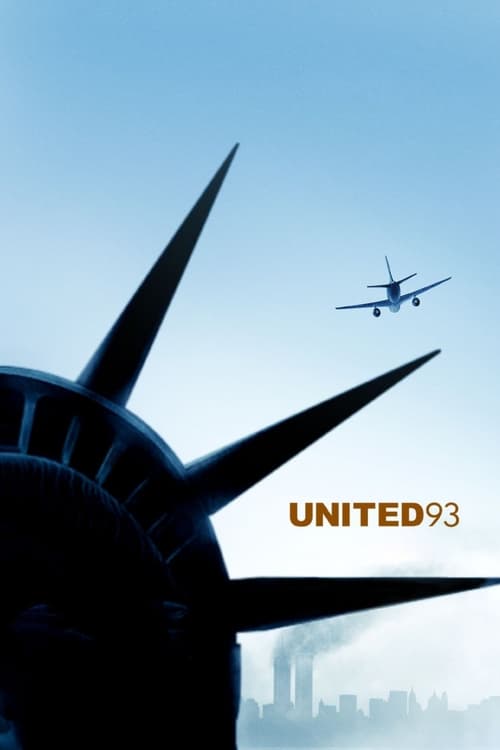
United 93
2006 · Paul Greengrass
For when you want to be gripped and gutted by something true — this is demanding, serious viewing, not escapism, and you'll want a moment to yourself afterward. Reach for it when you're ready to sit with it.
What it's about
The morning of September 11, 2001, reconstructed almost minute by minute: passengers boarding United Flight 93 amid ordinary airport tedium, air-traffic controllers and military officers slowly realizing the day's hijackings are a coordinated attack no procedure was written for, and then the passengers themselves — learning by phone what's happening — deciding to act. It stays inside the confusion as people lived it, with no hindsight and no speeches.
The experience
Almost unbearably tense even though you know exactly how it ends — the real-time structure and documentary shooting create a dread that builds without a single cheap beat. It's respectful without being soft, and it leaves you shaken and quiet.
Performances
The cast is deliberately unknown faces, and many aviation and military personnel play themselves — including the FAA's actual national operations manager, Ben Sliney, re-living the worst day of his career — which gives the control-room scenes a verisimilitude no star casting could.
The craft
Greengrass shoots handheld with overlapping, largely improvised dialogue, cutting between cabin and control rooms with an editor's precision that turns procedure into mounting horror. The score stays almost invisible; the tension comes from radio chatter, silence, and the clock. It plays like found history.
Why it matters
Released less than five years after the attacks, it proved 9/11 could be dramatized with rigor and restraint rather than sentiment, earned Greengrass an Oscar nomination for directing, and became the benchmark for the real-time docudrama.
Snapshot
United 93 is Paul Greengrass's near-real-time reconstruction of the events of September 11, 2001, told largely from inside the fourth hijacked aircraft — United Airlines Flight 93, which crashed in a field near Shanksville, Pennsylvania, after its passengers and crew revolted against the four hijackers steering it toward Washington, D.C. The film begins in the ordinary tedium of an air-travel morning and proceeds, with almost unbearable forward pressure, through the dawning recognition — first in the air-traffic and military control rooms, then aboard the plane — that the day's hijackings are not a containable emergency but a coordinated attack of a kind no procedure anticipated. Greengrass interleaves the cabin with the ground: the FAA's Herndon Command Center, regional air-traffic facilities, and the Northeast Air Defense Sector (NEADS), where controllers and officers scramble to understand and respond to an unfolding catastrophe they are structurally unequipped to grasp in time. The film withholds the conventional consolations of the disaster genre — no backstories, no heroes singled out by star casting, no swelling uplift — and instead renders the morning as a chaos of partial information and institutional paralysis, culminating in the passengers' decision to act. It stands as one of the first major narrative films to confront 9/11 directly, and as perhaps the defining example of a documentary-realist aesthetic applied to recent historical trauma: an act of dramatized witness that stakes its entire claim on restraint, procedure, and the refusal to mythologize.
Industry & production
United 93 was produced by Universal Pictures, with Greengrass's regular collaborator Tim Bevan and Eric Fellner of Working Title Films among the producers, along with Lloyd Levin and Kathleen Kennedy. It arrived as a project of extraordinary sensitivity: the first studio film to dramatize the events of September 11 at feature length, released in April 2006, less than five years after the attacks. The central production decision — and the one that gave the film its moral standing — was Greengrass's choice to ground the script in the documented record: the 9/11 Commission Report, air-traffic and military transcripts, the cockpit voice recorder, and, crucially, the phone calls passengers and crew made to family members in the plane's final hour. Greengrass and the production sought the cooperation of the victims' families, consulting them extensively and securing the participation of many, a process widely reported as essential to the film's legitimacy and to its reception as respectful rather than exploitative.
The casting strategy reinforced the documentary aim. Greengrass deliberately avoided stars, populating the passenger cabin with lesser-known and unknown actors so that no famous face would pull the audience out of the reconstruction. Most strikingly, a number of the ground-control roles were played by the real participants portraying themselves — most prominently Ben Sliney, the FAA's national operations manager, who was working his first day in that job on September 11, 2001, and who appears in the film as himself, issuing the unprecedented order to ground all civil aviation over the United States. Several military and aviation personnel likewise reprised their own roles, blurring the line between dramatization and document.
The film opened in late April 2006 to strong critical acclaim and a charged public conversation about whether it was "too soon." Its commercial performance was modest — a sober, harrowing film with no stars and a known, devastating ending is not built for blockbuster returns — and I won't cite specific box-office figures I can't verify. Its significance rests on its craft, its timing, and its standing as a landmark in cinema's reckoning with the attacks.
Technology
United 93 was shot on 35mm film using lightweight, highly mobile camera setups suited to Greengrass's handheld, improvisational method, rather than on any conspicuously novel equipment. The relevant technical achievement is one of staging and capture: the cabin and control-room scenes were filmed in conditions designed to maximize spontaneity and to let the camera find action rather than pre-block it. The aircraft interior was a constructed set mounted to permit the jolting, claustrophobic camerawork the film depends on, and the cockpit and cabin were lit and rigged for long, continuous, multi-camera takes. The control-room sequences at the FAA and NEADS were reconstructed with operational fidelity, the screens and procedures recreated so that real participants could perform plausibly within them. Where the period demanded it, the limited exterior and aerial imagery was handled with restraint; the film conspicuously avoids spectacle, and the destruction of the World Trade Center is registered obliquely, through the reactions of people watching distant television feeds, rather than through visual-effects recreation. The precise balance of practical and digital work in the few exterior shots is something a reader should confirm against production sources rather than take from this summary.
Technique
Cinematography
The photography is by Barry Ackroyd, the British cinematographer long associated with Ken Loach's social realism and later with Kathryn Bigelow's The Hurt Locker (2008). Ackroyd shoots United 93 in the verité register that became Greengrass's signature: handheld, restless, often operating in available or naturalistic light, the camera behaving like an embedded observer rather than an omniscient narrator. Framing is reactive — catching faces a half-beat late, drifting between speakers, losing and re-finding the action — so that the image itself seems to be discovering events as they happen. In the control rooms the camera hunts among banks of monitors and crowds of bodies; in the cabin it presses in close on hands, faces, and the cramped geometry of the seats. The effect is to strip the imagery of composed beauty and impose instead a texture of immediacy and contingency, as though the footage were recovered rather than authored. This is cinematography as reportage, its authority derived precisely from its refusal of polish.
Editing
The film was edited by Clare Douglas, Christopher Rouse, and Richard Pearson, and its editing is inseparable from its meaning. The cutting builds the film's relentless, accelerating sense of real time and parallel action — crosscutting among the plane, the FAA centers, and the military command so that the audience holds more knowledge than any single participant, and feels the catastrophic lag between what is happening and what the responders can comprehend. The rhythm is propulsive without being slick; cuts are motivated by the search for information and the spread of alarm rather than by conventional dramatic beats. As the film converges on the cabin uprising, the editing tightens into a frenzy of fragments — bodies, blows, the cockpit door — that conveys the violence of the revolt without choreographing it into action-movie legibility. The editing won wide admiration; Christopher Rouse would continue as a key Greengrass collaborator, including on the Bourne films, and the propulsive style here is foundational to that partnership.
Mise-en-scène / staging
Greengrass's staging is built on controlled improvisation within rigorously researched environments. The two principal spaces — the airliner cabin and the control rooms — are rendered as total, functioning worlds in which the actors (and real participants) were encouraged to behave moment to moment rather than hit marks. In the control rooms, the staging captures the procedural texture of institutions under stress: overlapping chatter, miscommunication, the helplessness of watching radar tracks vanish. In the cabin, the staging tracks the slow social process by which a random group of strangers gathers information, weighs it, and resolves to act — the film's drama is in this collective dawning, not in individual heroics. Greengrass deliberately keeps the hijackers human-scaled and frightened rather than cartoonishly villainous, staging their prayers, nerves, and violence with the same observational coolness applied to the passengers. The result is a mise-en-scène of distributed attention, in which meaning emerges from the accumulation of small, plausible behaviors across a crowded frame.
Sound
The score is by John Powell, a frequent Greengrass collaborator, and it is used with notable discipline. For most of the film Powell's music is withheld or kept to a low, tense undercurrent, allowing the soundscape of radio chatter, engine noise, intercom announcements, and overlapping voices to carry the realism. As the film moves toward its conclusion, the score swells into something closer to requiem — a mounting, anguished intensity that accompanies the final revolt and the plane's descent, releasing the emotion the film has otherwise rigorously suppressed. The sound design is central to the experience: the aural clutter of the control rooms, the muffled terror of the cabin, the fragments of phone calls, and the mechanical sounds of the aircraft build an environment of overwhelming, disorienting immediacy. The interplay of restrained naturalism and a final, devastating musical release is one of the film's most calculated and affecting strategies.
Performance
The performances are pitched toward anonymity and authenticity rather than star turns. The passenger ensemble — including actors such as Christian Clemenson, Cheyenne Jackson, David Alan Basche, and others cast for plausibility rather than recognition — works as a genuine collective, no single figure permitted to become the conventional protagonist. The most discussed performances are those of the real participants playing themselves, above all Ben Sliney, whose unactorly authority lends the ground sequences their documentary weight. The actors playing the four hijackers perform fear and zealotry without caricature, their nervousness and ritual rendered with unsettling restraint. The overall performance style is improvisational and reactive, prizing the unguarded gesture and the half-finished line over polished delivery, so that the cabin and control rooms feel inhabited rather than staged. The achievement is ensemble realism: a film of faces and behaviors rather than characters and arcs.
Narrative & dramatic mode
United 93's dramatic mode is documentary realism applied to a known, foreordained tragedy — a structure of dread rather than suspense, since the audience arrives knowing exactly how the morning ends. Greengrass converts that foreknowledge into the film's engine: the drama lies not in whether but in the agonizing gap between event and comprehension, and in the moral process by which the passengers move from disbelief to resolve. The narrative is organized as accelerating real-time parallel action, distributing its point of view across the plane and the institutions on the ground rather than centering a single hero. It withholds nearly every convention of the disaster film — there are no introductory character vignettes, no romantic subplots, no last-minute rescue. Instead it offers procedure, contingency, and collective decision under extremity. The mode is one of restrained, almost forensic reconstruction that nonetheless builds to overwhelming emotional force; its discipline is precisely what licenses its catharsis. It is a tragedy whose suspense has been replaced by the unbearable weight of inevitability.
Genre & cycle
The film sits at the intersection of the historical-reconstruction drama, the disaster film, and the docudrama, while subverting the expectations of each. It belongs to a long tradition of dramatized true events but pushes toward the documentary pole more aggressively than most studio films dare, employing real participants and transcript-based dialogue. Within Greengrass's own body of work it forms a clear cycle with Bloody Sunday (2002), his verité reconstruction of the 1972 killings in Derry, and later Captain Phillips (2013) and 22 July (2018) — a recurring project of staging real-world political violence and institutional crisis in real time. More broadly, United 93 stands at the head of the first wave of post-9/11 American films willing to depict the attacks directly; it was released the same year as Oliver Stone's very different World Trade Center (2006), and the two together mark the moment Hollywood began to dramatize the event. It is also a key text in the early-21st-century cycle of War on Terror cinema, the strand concerned with the day that inaugurated the era rather than the wars that followed.
Authorship & method
The film is unmistakably the work of Paul Greengrass, and it crystallizes his authorial method. Trained in British television journalism and documentary, Greengrass built a style on the dramatization of real political events through verité technique — handheld camera, improvisation within researched environments, ensemble realism, and the refusal of conventional heroics. Bloody Sunday was the template; United 93 is its most rigorous application, and the Bourne films (The Bourne Supremacy, The Bourne Ultimatum) carried the same kinetic, you-are-there aesthetic into commercial action cinema, making Greengrass one of the most influential stylists of his generation. His authorship is defined by a documentary ethics as much as a visual style: a conviction that recent atrocity must be approached through fidelity to the record and respect for the people involved, not through spectacle or sentiment.
The key collaborators are integral to the method. Cinematographer Barry Ackroyd, formed in Loachian social realism, supplies the searching, handheld image that gives the film its reportorial authority. Editors Clare Douglas, Christopher Rouse, and Richard Pearson construct the real-time, crosscut architecture that is the film's dramatic spine — Rouse in particular becoming a defining Greengrass collaborator thereafter. Composer John Powell provides the disciplined, finally devastating score. And Greengrass himself, as sole credited screenwriter, performed the research-driven writing that built the film from transcripts, the 9/11 Commission Report, and the families' testimony. The authorship is a director's vision realized through a tight ensemble of craftspeople schooled in the same realist values.
Movement / national cinema
United 93 is a transatlantic production — an American subject realized by a British director and largely British key creatives (Greengrass, Ackroyd, Working Title) within the Hollywood studio system via Universal. Its proper aesthetic lineage is British social realism and documentary, the tradition running from the Free Cinema movement and Ken Loach through the dramatized-reconstruction strand of British television, transplanted onto an American national trauma. It is not the product of a named movement so much as the most fully realized example of Greengrass's personal documentary-fiction practice. Its standing as an American film about the foundational American event of the century, made through a distinctly British realist sensibility, is part of what gives it its peculiar authority — an outsider's discipline brought to bear on a subject American cinema approached with great trepidation.
Era / period
The film is doubly inscribed by its moment. It depicts September 11, 2001, with archival precision, and it was released in April 2006, into a United States still inside the wars and the political climate the attacks produced. The dominant public discourse around its release was the question of whether it was "too soon" — whether dramatizing the attacks within five years was premature or even exploitative — a debate the film's restraint and its collaboration with victims' families were designed to answer. The mid-2000s were a period in which American culture was beginning, cautiously, to process 9/11 through narrative art, and United 93 both reflected and shaped that turn. It registers its era's preoccupation with the failures of institutions and intelligence on the day, with the gap between catastrophe and official response, and with the meaning of the passengers' revolt as a contested emblem of citizen agency in the face of terror.
Themes
The film's central theme is ordinary people confronting extraordinary catastrophe — the transformation of a random group of passengers into a body capable of collective, sacrificial action, rendered as a social process rather than an act of individual heroism. Bound to this is institutional failure and the limits of procedure: the control-room sequences dramatize how systems built for known emergencies disintegrate before an unprecedented one, and how the responders' competence and goodwill are no match for the speed and novelty of the attack. The film is preoccupied with information, comprehension, and lag — the agonizing distance between what is happening and what anyone can understand in time. Real time and inevitability operate as both structure and theme, the foreknown ending lending every ordinary gesture the weight of last things. There is the theme of collective action and democratic agency — the passengers' vote-like deliberation and revolt, often read as a parable of citizens acting where the state could not. And running beneath it, the refusal of myth: the film's insistence on rendering even the hijackers as frightened humans and the passengers as ordinary people is itself an ethical argument against the heroizing and demonizing narratives that quickly accreted around the day.
Reception, canon & influence
Critical reception was strong and, by the standards of so charged a subject, remarkably united. The film drew wide praise for its restraint, its refusal of exploitation, its documentary integrity, and the cumulative power of its method; many critics named it among the best films of its year and judged that it had navigated an almost impossible task with rare tact. Greengrass's direction was singled out, and the film earned an Academy Award nomination for Best Director among other recognitions. The "too soon" debate accompanied but did not overwhelm its reception, and the consensus that emerged — that the film honored rather than exploited its subject — has largely held. I'd note that the precise contours of its 2006 reviews are best verified against contemporary sources rather than taken solely from this summary.
Backward — influences on the film: The foundational sources are documentary and testimonial: the 9/11 Commission Report, air-traffic and military transcripts, the cockpit voice recorder, and the families' accounts of the phone calls. Cinematically, the film descends from British social realism — Ken Loach's verité practice transmitted through Barry Ackroyd — and most directly from Greengrass's own Bloody Sunday (2002), which established the real-time, transcript-driven reconstruction method that United 93 perfects. The broader tradition of the docudrama and the dramatized true-event film stands behind it.
Forward — its legacy: United 93 set a benchmark for how cinema might approach recent atrocity with discipline and respect, and it cemented Greengrass's verité method as one of the most imitated styles of the era — its handheld immediacy, absorbed into the Bourne films, reshaped the visual grammar of mainstream action and thriller cinema. It anchored Greengrass's continuing project of real-time political reconstruction in Captain Phillips (2013) and 22 July (2018). As one of the first and most respected narrative treatments of 9/11, it became a reference point for every subsequent attempt to dramatize the attacks and the War on Terror, and a touchstone in debates about the ethics of representing real trauma on screen. Its lasting achievement is to have demonstrated that the most devastating account of a known catastrophe could be built not from spectacle but from restraint, procedure, and the patient reconstruction of how ordinary people met an unthinkable hour.
A Deleuzian reading
Start with the radar.
The full Deleuzian reading of United 93 →
Reception
Released just four and a half years after 9/11 to cries of 'too soon' — a Manhattan theater famously pulled the trailer after audience complaints — it's now widely regarded as the definitive film about that day and one of the best-reviewed films of the 2000s, earning Greengrass a Best Director Oscar nomination.
How United 93 was received, from release to now →
Influences: the films it descends from and the films it influenced
- Bloody Sunday (2002) — Greengrass's own immediate template — the transcript-driven, real-time reconstruction built from handheld coverage and parallel crosscutting between authorities and victims that United 93 perfects.
- The Battle of Algiers (1966) — Newsreel-grain photography, telephoto crowd-shooting and casting of non-professionals to stage a known atrocity as if captured by reportage rather than dramatized — the docudrama grammar of verisimilitude Greengrass inherits.
- Culloden (1964) — Pioneered treating a historical event as live front-line TV reportage — handheld cameras pushed into the action with vox-pop immediacy — the 'you-are-there' actuality device United 93 adopts.
- The War Game (1965) — Built unbearable dread from clinical procedure and documentary detachment rather than melodrama, modeling the 'dread-not-suspense' affect of an outcome the audience already knows.
- Z (1969) — Fused political-thriller momentum with procedural reconstruction and rapid investigative crosscutting, establishing the kinetic docudrama of real events Greengrass extends.
- Kes (1969) — The Loachian social-realist method — improvisation within researched environments, available light, performances kept unactorly — transmitted to United 93 directly through cinematographer Barry Ackroyd.
- Medium Cool (1969) — Dissolved the line between staged fiction and documentary actuality with reportorial handheld shooting, anticipating United 93's blend of dramatization and non-actors playing themselves.
- The French Connection (1971) — Friedkin's documentary-trained, grab-shot handheld realism and refusal of glamour gave the American thriller its reportorial roughness, a direct precursor to the verité action grammar.
- The Bourne Supremacy (2004) — Carries the same shaky-cam immediacy, fast impressionistic cutting (Christopher Rouse) and you-are-there geography into commercial action — the channel through which United 93's style reshaped mainstream cinema.
- Apollo 13 (1995) — Extends Apollo 13's procedural real-event reconstruction formula by radicalizing the handheld grammar and compressing the cross-cutting between the aircraft and FAA/military institutional response into near-real-time, stripping the score entirely; where Howard uses craft to build controlled tension, Greengrass pushes the same structural logic toward documentary rupture.
- Dog Day Afternoon (1975) — Greengrass's reconstruction of a real event using handheld available-light cameras, democratic ensemble casting with no recognizable stars, and compressed real-time duration is the most direct formal descendant of Dog Day Afternoon's quasi-documentary siege grammar applied to a contemporary historical subject.
- The Bourne Identity (2002) — Greengrass transferred Bourne's discovery-mode cinematography and spatially-motivated fast cutting to documentary reconstruction, demonstrating the methodology could achieve tragic weight outside genre action—the confined-geography choreography of the cabin interior is formally continuous with Bourne's stairwell fight.
- Green Zone (2010) — Applies the handheld, transcript-and-research docudrama method to the Iraq War, continuing Greengrass's project of real-time political reconstruction shot by Ackroyd.
- Captain Phillips (2013) — Reprises the real-time, procedural reconstruction of a single ordeal with restrained scoring and a delayed, devastating emotional release — the exact 'requiem-release' structure of United 93.
- 22 July (2018) — Returns to dramatizing recent atrocity through fidelity to the record and refusal of spectacle, the documentary-ethics application of the United 93 method to the Utøya massacre.
- The Hurt Locker (2008) — Barry Ackroyd shoots it in the same searching, multi-camera handheld verité, building procedural dread around bomb-disposal routine rather than plotted suspense.
- Zero Dark Thirty (2012) — Adopts the restrained-procedural register and refusal of catharsis — institutional process over heroics, withheld score — to dramatize a charged recent event with documentary sobriety.
- Patriots Day (2016) — Reconstructs the Boston Marathon bombing in near real time with handheld coverage and command-center crosscutting, an explicit application of Greengrass's procedural-reconstruction template.
- The Voice of Hind Rajab (2025) — Cross-cuts among air-traffic and military control rooms in documentary-grade real time with restrained ensemble non-stars—the coordinated-dispatch montage and reconstruction-from-record method Hind Rajab borrows for its Red Crescent operators.
- Argo (2012) — Demonstrated that docudrama authentication through procedural real-time pressure and non-professional casting could sustain maximum formal tension even when the historical outcome is universally known — the methodological proof Affleck extended to the airport sequence.
- 13 Hours: The Secret Soldiers of Benghazi (2016) — Established real-time siege structure and acoustic confusion — overlapping radio traffic, disorienting ambient sound — as legitimate docudramatic devices; the aircraft cabin as cramped tactical space prefigures the Annex compound.
- The Big Short (2015) — Barry Ackroyd, Big Short's cinematographer, carried his Greengrass collaboration directly into the film — the handheld documentary vérité style, anti-glamour digital image quality, and urgent handheld framing that Ackroyd developed across United 93 and Green Zone constitute the visual grammar he transposed to McKay's subject.
- First Man (2018) — Handheld proximity locked inside a confined institutional vehicle generates documentary immediacy in a story the audience already knows ends in death — the exact tension between formal closeness and predetermined outcome that Chazelle replicates in the test-flight and launch sequences.
- Official Secrets (2019) — Greengrass's handheld observational-restraint digital cinematography — maintaining documentary proximity to institutional interiors without aesthetic aggression — establishes the grammar of credibility-through-restraint that Official Secrets inherits for its GCHQ open-plan offices, newsroom interiors, and legal chambers.
- The Bourne Ultimatum (2007) — Extends the verité-action method with real-time parallel surveillance crosscutting between command rooms and field, the institutional-coordination architecture lifted straight from United 93's control-center editing.
- World Trade Center (2006) — The contemporaneous narrative 9/11 treatment defined by contrast — its star-driven, scored, redemptive approach throws United 93's non-actor, anti-spectacle restraint into relief as the era's competing model.
- Munich (2005) — Greengrass's integration of archival broadcast footage with 16mm verité reconstruction — including deliberate editorial roughness at the join between news material and dramatized action — extends Munich's archival-integration strategy into the 9/11 event itself, treating historical footage as morally charged material that resists seamless absorption into narrative cinema rather than as authenticating texture.
- The Last King of Scotland (2006) — The year's other major documentary-grammar political drama uses handheld camera as an ethical instrument for reconstructed atrocity, builds tension through duration management rather than musical scoring, and deploys elliptical cutting to convey violence without aestheticizing it—arriving at the same formal ethics as LKOS by an independent route.
- Children of Men (2006) — Barry Ackroyd applies the same Dogme-adjacent handheld, available-light, no-conventional-coverage grammar to the September 11 hijacking, refusing the emotional distance that classical coverage would produce; both films deploy documentary immediacy as a political argument that the event depicted exceeds the conventions of genre fiction.
- A House of Dynamite (2025) — Greengrass's documentary-density handheld method for rendering institutional crisis in real time: ensemble performance calibrated to professional procedure rather than emotional legibility, ambient-institutional sound design that foregrounds the acoustic texture of command spaces, and real-time compression that denies interpretive distance.
- The Baader Meinhof Complex (2008) — You-are-there handheld reenactment of a terror event at near-real-time, privileging immersive verisimilitude over commentary — the purest expression of reconstruction-over-distance.
- Eye in the Sky (2015) — Runs a real-time, multi-location procedural that cross-cuts civilian and military command centers tracking a crisis through screens, performed by an ensemble-as-system with no individual hero.
- 25th Hour (2002) — The opposite pole of post-9/11 craft: literal, real-time, documentary-handheld reenactment of the attack, against which 25th Hour's oblique metabolization through atmosphere and intimate story defines itself.
- Four Days in September (1997) — Renders a real-time hijacking confinement through handheld documentary naturalism and multi-perspective intercutting, the same compressed, you-are-there parallel construction Barreto uses across the four days.
- The Queen (2006) — A contemporaneous docudrama reconstructing a recent documented event with near-real-time procedural realism and a refusal of editorializing — the restraint-as-respect strategy applied to catastrophe.
- Quo Vadis, Aida? (2021) — Real-time procedural construction and documentary restraint that build dread toward a foreknown catastrophe — the same near-run pacing that drives Aida.
Similar films
- Captain Phillips (2013) — influence & lineage
- The Hurt Locker (2008) — influence & lineage
- Bloody Sunday (2002) — influence & lineage
- Zero Dark Thirty (2012) — influence & lineage
- The Bourne Ultimatum (2007) — influence & lineage
- Green Zone (2010) — influence & lineage
- The Bourne Supremacy (2004) — influence & lineage
- September 5 (2024) — shared sensibility
All the films related to United 93 →