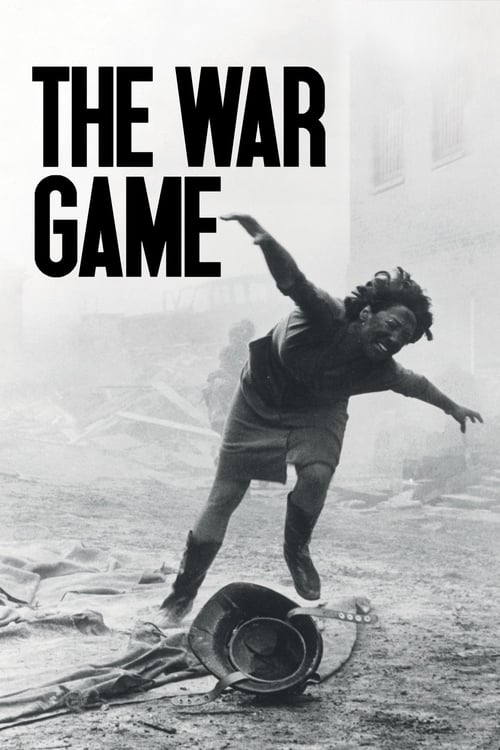
The War Game
1966 · Peter Watkins
For when you want to be confronted, not entertained — the film you watch when you're ready to understand something the culture preferred to look away from. Bring your full attention; it earns it in under an hour.
What it's about
A 47-minute docudrama that imagines, with clinical precision, a Soviet nuclear strike on Kent and the days that follow: evacuation, firestorm, the collapse of medicine and civil order, radiation sickness, and a society coming apart. Commissioned by the BBC and then banned by it as 'too horrifying for the medium of broadcasting,' it reached cinemas instead — and British television not until 1985.
The experience
One of the most genuinely frightening films ever made, and it never raises its voice — the calm newsreel narration over unbearable images is exactly what makes it land. It's short, but it stays with you for years.
The craft
Watkins invents the future-tense documentary: handheld cameras, non-actors, vox-pop interviews, and official statistics deployed to make a hypothetical feel like found footage of something that already happened. Its grainy black-and-white immediacy is the whole argument — fiction wearing the authority of news.
Why it matters
It won the Academy Award for Best Documentary despite depicting events that never occurred, became a cornerstone of the anti-nuclear movement, and its suppression by the BBC remains a landmark case in the politics of broadcasting.
Snapshot
The War Game is a 47-minute pseudo-documentary that imagines a Soviet thermonuclear strike on the county of Kent and the days that follow: the panicked evacuation, the flash and firestorm, the collapse of medical and civil order, and the slow attrition of radiation sickness, looting, summary executions and psychological ruin. Commissioned by the BBC and directed by Peter Watkins in 1965, it was then refused broadcast by the Corporation, which declared the film "too horrifying for the medium of broadcasting." Released instead into cinemas in 1966, it won the Academy Award for Best Documentary Feature and hardened into one of the most influential anti-nuclear works ever made — yet it went unseen on British television until 1985. Its lasting importance is double: as a moral intervention into Cold War civil-defence complacency, and as the film that most rigorously fused documentary grammar with speculative fiction, inventing a template later called drama-documentary or, more pointedly, the docudrama of the not-yet-happened.
Industry & production
The War Game was made inside the BBC, not against it — a crucial fact often flattened by the "banned film" legend. Watkins had just delivered Culloden (1964), a reconstruction of the 1746 battle shot as if a modern TV news crew had been embedded with the Jacobite army, and the BBC had greenlit a second, more ambitious project. Watkins turned to the nuclear question, undertaking an extended research period drawing on the documented effects of the atomic bombings of Hiroshima and Nagasaki and of the conventional firebombings of Hamburg and Dresden, together with Home Office and civil-defence literature. The production was small, mounted on location in Kent using local, non-professional residents rather than actors.
Once the film was finished, the BBC declined to transmit it. The public rationale was the horror of the content; the private and political dimensions have been debated ever since. Watkins himself long maintained that the decision was not purely editorial and that outside pressure — from government and civil-defence interests uneasy about a film that portrayed Britain's preparations as hopeless — played a part. Documentary evidence about exactly who intervened and how remains contested, and honest scholarship treats the "did the government ban it?" question as unresolved rather than settled. What is not in dispute is that the BBC, having financed the film, permitted it a theatrical life. The British Film Institute distributed it to cinemas, and it was in that arena that it accrued its reputation and awards. Watkins, embittered, left the BBC, beginning a lifelong career as an itinerant, institutionally homeless filmmaker — a biographical fact inseparable from the film's meaning. The twenty-year broadcast embargo ended only in 1985, when the BBC finally aired it around the fortieth anniversary of Hiroshima.
Technology
The film's power is bound up with the lightweight monochrome technology of mid-1960s location filmmaking. Working in black-and-white on portable equipment, Watkins and his crew could shoot handheld, in cramped interiors and open streets, with the mobility and grain that audiences of the period read as the signature of authentic news and actuality footage. The absence of color is not a limitation exploited so much as a rhetorical choice: it aligns the imagined future with the archival past — with the newsreel record of the Second World War and of Hiroshima — so that the fiction inherits the evidentiary weight of documentary stock. Sound was likewise built from modest means: sync and post-synced voice, sparse effects, and an authoritative spoken commentary. The result looks and sounds like something recorded rather than staged, which is precisely the illusion the technology was marshalled to produce.
Technique
Cinematography
The cinematography, by Peter Bartlett, is the engine of the film's realism. The camera behaves like a reporter's: it is jostled, it searches, it is caught off guard by events, it zooms and refocuses in the manner of a crew improvising under duress. Faces are shot in tight, unflattering close-up; the handheld frame lurches during the firestorm and the scenes of civil breakdown. Crucially, the imagery is composed to be legible as footage rather than as cinema — under-lit, grabbed, sometimes nearly abstract in the smoke and glare. This "found" quality is a constructed effect, and its consistency across the running time is what allows the speculative content to pass as reportage.
Editing
The editing, by Michael Bradsell, organizes the film as an argument rather than a story. It intercuts three registers: the enacted scenes of attack and aftermath; direct-address interviews and vox-pop with ordinary "witnesses"; and the sober narration accompanied by on-screen text. The cutting repeatedly juxtaposes official reassurance with visceral consequence, and layers statistics and citations over images so that each atrocity arrives pre-annotated with its documentary source. The rhythm builds from bureaucratic calm through the escalation to the detonation, then fragments into the disordered, episodic aftermath — a structural mimicry of social collapse itself.
Mise-en-scène / staging
Staged in real Kent streets, homes and civic spaces, the mise-en-scène refuses spectacle. There are no model cities or elaborate optical effects; the nuclear flash is rendered through overexposure and the reactions of bodies, and the firestorm through wind, smoke, debris and human panic. The staging concentrates on the domestic and the procedural: families being billeted, buckets and improvised firefighting, rows of the dying in requisitioned buildings, police and soldiers administering a shattered order. This ordinariness is the point — Watkins stages catastrophe at the scale of the parish, the household, the bucket of sand, so that the abstraction of "megadeath" is made local and unbearable.
Sound
The soundtrack is austere and weaponized. A measured, professional narration — pitched in the neutral, authoritative cadence of a newsreader — delivers escalating horrors in the same even tone used for weather or cricket, and that contrast is itself an argument. Interviewees speak haltingly to camera; official statements are read aloud and set against the images they fail to match. Music is used sparingly and often ironically. The film also deploys unsettling silences and the sudden roar of the firestorm. Where quotations from clergy, strategists and officials appear on the soundtrack, they are drawn from the public record as part of Watkins's indictment; the precise wording of individual citations is best consulted in the film itself rather than paraphrased from memory.
Performance
The non-professional cast do not "act" in any conventional sense; they are directed toward states rather than characterizations — shock, disorientation, exhaustion, blank trauma. The children's dazed faces in the closing passages, and the vacant testimony of survivors, register as documentary affect precisely because the performers are not polished. This deliberate amateurism, a Watkins hallmark, dissolves the boundary between actor and witness and is fundamental to the film's claim on authenticity.
Narrative & dramatic mode
The War Game operates in a hybrid mode Watkins effectively pioneered: the future-conditional documentary. Its scenario is fiction — a Cold War crisis escalating to a Soviet nuclear strike that detonates, off-target, over Kent — but every element is presented in the grammar of factual reportage: on-the-spot interviews, authoritative narration, cited statistics, captions. There is no protagonist and no plot in the dramatic sense; the "characters" are functionaries, victims and vox-pop respondents. The dramatic engine is instead the widening gap between official language (evacuation plans, fallout guidance, reassurances) and depicted reality. The film addresses the viewer directly and forensically, alternating enactment with interrogation — even pausing to ask ordinary Britons what they know about strontium-90 or a carbon-14, exposing public ignorance as part of the catastrophe.
Genre & cycle
Formally the film sits at the crossroads of documentary, science fiction and the war film, and it belongs to no tidy genre — which is why it needed a new label. It is an anti-nuclear "warning film," kin to the Cold War cycle of atomic-anxiety cinema, but distinguished from Hollywood's nuclear thrillers by its refusal of narrative catharsis or heroism. More usefully, it is the founding text of the British drama-documentary tradition, and specifically of the nuclear-holocaust docudrama that would recur through the 1980s. It is also, in its research-heavy, indicting stance, a work of the essay-film and the campaigning documentary lineage.
Authorship & method
This is auteur filmmaking of an unusually total kind. Peter Watkins wrote, directed and shaped the film's research, and its method — the anachronistic embedding of a modern news crew inside a reconstructed or projected event, the use of non-actors, the direct address, the collision of official and human registers — is recognizably his across Culloden, The War Game, Punishment Park (1971) and the epic La Commune (Paris, 1871) (2000). Watkins's later theoretical writing on what he called the "Monoform" — the standardized, rapid, closed grammar of mass audiovisual media — grows directly out of the experience of making and losing this film to the broadcasting apparatus.
His key collaborators materially realized that vision. Cinematographer Peter Bartlett supplied the grabbed, newsreel handheld imagery; editor Michael Bradsell built the film's interrogative montage of enactment, testimony and citation. The film has no conventional composer in the manner of a scored feature; its soundtrack is assembled from spare, often ironic musical fragments and sound rather than an original symphonic score. Watkins is credited as writer as well as director, the research and commentary being extensions of his authorship. Where the historical record on individual crew contributions is thin, it should be read as thin rather than embellished; the dominant and well-documented signature is Watkins's own.
Movement / national cinema
The War Game is a British film in dialogue with the social-realist and documentary energies of its moment — the legacy of the Griersonian public-service documentary, the Free Cinema movement's turn to ordinary lives, and the "kitchen-sink" realism then reshaping British screens. But Watkins pushed that realism into confrontation with the state that funded it. The film is thus a landmark of British public-service broadcasting's contradictions: produced by the very institution whose caution it exposed, and suppressed by it. It stands as a defining moment in the national story of the BBC's relationship to political controversy, and in the emergence of an oppositional, campaigning strand within British factual filmmaking.
Era / period
The film is saturated in the specific anxieties of the mid-1960s: the shadow of the 1962 Cuban Missile Crisis, an active Campaign for Nuclear Disarmament, escalating superpower brinkmanship, and a British civil-defence program widely suspected of being a reassuring fiction. Its imagined trigger draws on the geopolitical flashpoints of the era. Made two decades after Hiroshima, it belongs to the first generation of works able to look back on the atomic bombings as history while looking forward to their possible repetition on home soil. The twenty-year gap between its making and its eventual 1985 broadcast means the film also became a document of two eras — conceived amid 1960s Cold War tension, finally aired amid the renewed nuclear fears of the early-1980s Euromissile crisis, to which it spoke with uncanny freshness.
Themes
Its central theme is the unrepresentability and unsurvivability of nuclear war, and the moral bankruptcy of pretending otherwise. The film indicts official euphemism and civil-defence propaganda, arguing that "preparation" is a lie that leaves populations ignorant and undefended. It dwells on the collapse of the social contract under catastrophe: the shooting of looters, mercy killings, the breakdown of medicine and law, the psychological destruction of children. It interrogates complicity — of the public in its own ignorance, of the churches and strategists who rationalize the bomb, and of a media that will not show what it cannot bear. Above all it advances an ethics of confrontation: the conviction that citizens have a right, even a duty, to see the consequences of the policies enacted in their name — the very right the film's suppression denied them.
Reception, canon & influence
Denied the airwaves, The War Game achieved its stature in cinemas and on the festival and awards circuit, culminating in the Academy Award for Best Documentary Feature — a striking honor for a work of enacted fiction, and testament to how completely it read as documentary. Critically it was received as harrowing and important, and it became a touchstone for the anti-nuclear movement, screened in activist and educational contexts for decades. Its canonization was sealed by its long invisibility: the twenty-year broadcast ban made it a byword for state and institutional squeamishness before difficult truth, and its eventual 1985 transmission was itself a media event.
Looking backward, the film draws on identifiable sources: the documented human effects of Hiroshima, Nagasaki and the Second World War firebombings; the newsreel and actuality traditions of British documentary; and, most directly, Watkins's own Culloden, whose embedded-news-crew method it transposes from past to future. Looking forward, its influence is enormous and specific. It established the drama-documentary as a serious form and set the template for the nuclear-holocaust film, feeding directly into the 1980s cycle — most obviously the British television film Threads (1984) and the American The Day After (1983), both of which inherit its clinical, aftermath-centred realism. Its method — non-actors, direct address, faux-reportage applied to speculative or reconstructed events — echoes through later docudrama, mockumentary and the found-footage sensibility. And Watkins's fate at the BBC became a permanent reference point in debates over broadcasting, censorship and the responsibilities of public media. Few 47-minute films have cast so long a shadow.
A Deleuzian reading
A bucket of sand in a hallway in Kent.
The full Deleuzian reading of The War Game →
Reception
Commissioned by the BBC, then banned by the BBC before it ever aired — deemed 'too horrifying for the medium of broadcasting' in 1965 — it wasn't shown on British TV until 1985, twenty years later. In the meantime it went from suppressed broadcast to cinema release, Oscar winner, and cornerstone of nuclear-dread cinema.
How The War Game was received, from release to now →
How to watch The War Game: what to notice on a first viewing
- Watch the camera flinch, search, and lose focus. The camera behaves like a reporter caught off guard: it jostles, searches, zooms, and refocuses as though the crew were improvising under duress during a real event. You are made to feel a camera struggling to keep up, not a shot composed in advance.
- Listen to the narrator's calm, newsreader voice throughout. A measured, professional narration delivers escalating horror in the exact even tone normally used for weather or cricket scores, and it never once rises to match what it describes. The flatness of the voice against the horror of the image is itself doing the arguing.
- Watch ordinary households prepare with almost nothing. There are no model cities or special effects. The staging stays at household scale, a bucket of sand by the stairs, families being billeted, ordinary objects standing in for a catastrophe too large to picture. The film makes an abstraction like megadeath local enough to actually look at.
- Watch faces directed toward shock, not toward acting. The non-professional cast are directed toward states, shock, disorientation, exhaustion, rather than characterizations, dissolving the line between someone performing and someone simply enduring. An untrained face that does not resolve into a performance is what makes this feel like a document.
The whole guide to watching The War Game, with the keys for a rewatch →
Influences: the films it descends from and the films it influenced
- Culloden (1964) — Watkins's immediate prototype: an anachronistic modern TV news crew embedded in a reconstructed 18th-century battle, with vox-pop interviews and direct-address commentary — The War Game transposes this exact embedded-reportage method from the historical past to the speculative future.
- Fires Were Started (1943) — Real London firemen re-enacting Blitz firefighting as non-professional 'cast' — the actuality-reenactment hybrid, where documented events are restaged with the people who lived them, that Watkins pushes into projected catastrophe.
- Listen to Britain (1942) — Associative sound montage that collides official and everyday registers without narration — the ironic juxtaposition of institutional and human sound that Watkins weaponizes through his deadpan newsreader commentary.
- The Battle of San Pietro (1945) — Combat 'actuality' partly staged and passed off as frontline reportage, with unflinching casualty imagery — the war-documentary claim to captured truth that Watkins borrows and exposes as constructible.
- Night Mail (1936) — The GPO/British documentary movement's dramatized process-reportage of a public institution using ordinary workers — the actuality-newsreel tradition and lightweight-location aesthetic Watkins inherits and subverts.
- Punishment Park (1971) — Non-actors improvising inside a speculative near-future America filmed by an embedded, audible TV crew whose questions provoke the subjects — the interrogative-reportage method carried forward.
- The Day After (1983) — Network-TV nuclear film built on clinical, aftermath-centred realism — radiation sickness, blast physics and civil-defence collapse rendered as procedural detail rather than spectacle, the register War Game established.
- Testament (1983) — Parish-scale nuclear aftermath told through one suburban family's slow radiation deaths — Watkins's domestic, undramatic, statistics-of-the-ordinary approach applied to a single household.
- Special Bulletin (1983) — A nuclear crisis staged entirely as a simulated live news broadcast, inheriting Watkins's faux-reportage frame and the 'mistaken for real' anxiety that framed his own suppression.
- Threads (1984) — The most direct heir: a single English city (Sheffield) as parish-scale catastrophe, on-screen captions and statistics annotating the atrocity, and a cold docudrama aftermath extending years past the blast — Watkins's template made explicit.
- When the Wind Blows (1986) — An ordinary couple dutifully following government civil-defence pamphlet advice as they die of radiation — a direct dramatization of the media-complicity-and-suppression theme Watkins indicted in the official reassurance apparatus.
- Ghostwatch (1992) — A scripted drama presented as a live BBC outside broadcast, so convincingly 'real' that it triggered public panic and institutional censure — inheriting both Watkins's faux-broadcast realism and his collision with the broadcasting authority.
- La Commune (Paris, 1871) (2000) — Watkins's own late masterwork: anachronistic TV-news crews reporting live from the 1871 revolution, non-actors breaking frame to critique the coverage — the fullest realization of his Monoform theory born from The War Game's fate.
- Death of a President (2006) — A future-conditional faux-documentary that narrates a not-yet-happened event as retrospective news, complete with fabricated archival footage and talking-head testimony — Watkins's speculative-reportage form applied to the near future.
- United 93 (2006) — Built unbearable dread from clinical procedure and documentary detachment rather than melodrama, modeling the 'dread-not-suspense' affect of an outcome the audience already knows.
- Bloody Sunday (2002) — Extends Watkins's faux-reportage method to imagined catastrophe, sculpting horror through cut, handheld immediacy and withheld omniscience rather than score — modeling docudrama as a vehicle for political reckoning.
- Zelig (1983) — Applies live newsreel and TV-reportage camera language to events that could never have been filmed, the faux-newsreel realism Zelig counterfeits for the 1920s–30s.
- The Battle of Algiers (1966) — Grainy pseudo-newsreel reconstruction of recent history with non-professional cast, shot and processed to read as captured actuality — the same 'this footage exists' illusion arrived at independently the same year.
- Privilege (1967) — Faux-documentary set in a near-future Britain, extending Watkins's future-conditional reportage into a full-length satire of media manufacture of consent.
- David Holzman's Diary (1967) — A wholly fictional first-person 'documentary' that turns the grammar of vérité — handheld camera, direct address, non-actor authenticity — into a self-aware fiction, the mockumentary logic Watkins helped legitimize.
- Dr. Strangelove or: How I Learned to Stop Worrying and Love the Bomb (1964) — Watkins applied hand-held direct-cinema aesthetics and television news reportage conventions to a staged nuclear attack on Britain — pushing Strangelove's quasi-documentary visual register (used for Burpelson) to its limit, using the same documentary form Kubrick deployed for comedy as an instrument of horror.
Similar films
- Punishment Park (1971) — influence & lineage · often watched together
- When the Wind Blows (1986) — influence & lineage
- Testament (1983) — influence & lineage
- A Night to Remember (1958) — same viewing thread
- Dead Man's Letters (1986) — often watched together
- Threads (1985) — shared sensibility
- The Sacrifice (1986) — shared sensibility
- Fail Safe (1964) — shared sensibility
All the films related to The War Game →
Watch it with: curated runs of related films
- The Machinery of Catastrophe — A run of hour-by-hour reconstructions and unblinking documentaries that watch disaster as procedure — ice warnings, intercepted cables, evacuation drills, ward routines — and refuse to sentimentalize what the systems grind out.