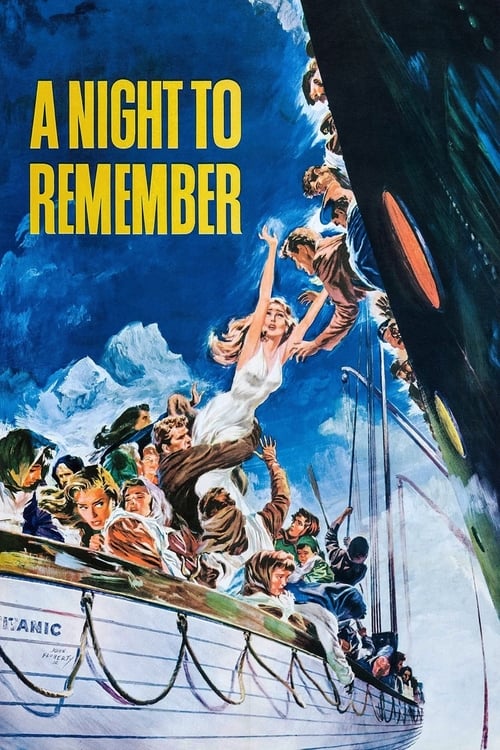
A Night to Remember
1958 · Roy Ward Baker
For a night when you want a serious, absorbing true story rather than escapism — the kind of film that leaves you quiet at the end and sends you to the history books.
What it's about
The sinking of the Titanic in April 1912, told hour by hour as it happened — the ice warnings ignored, the collision, and the long night in which everyone aboard discovers there aren't enough lifeboats. Rather than inventing a romance, it follows a broad cross-section of the real ship: officers, stokers, wireless operators, first-class swells and steerage families, anchored loosely on Second Officer Charles Lightoller.
The experience
Cool-headed and devastating precisely because it refuses to melodramatize — the dread accumulates procedurally, order by order, mistake by mistake. By the final hour the calm British restraint becomes almost unbearable, and the class injustice of who lives and who doesn't lands without a word of editorializing.
Performances
Kenneth More anchors the ensemble as Lightoller, giving the crisis a spine of practical decency — a professional doing his job as the job becomes impossible.
The craft
Adapted by Eric Ambler from Walter Lord's meticulously researched bestseller, it plays like a semi-documentary: crisp black-and-white photography, matter-of-fact staging, and a script devoted to how systems and hierarchies actually failed that night. The model work and flooding sequences were state of the art for 1958 and still carry real weight.
Why it matters
For decades the definitive and most historically scrupulous Titanic film, it set the template every later screen version of the disaster — including the famous ones — measured itself against.
Snapshot
A Night to Remember is the British cinema's definitive account of the 1912 sinking of the RMS Titanic — a semi-documentary disaster drama that treats catastrophe less as spectacle than as a moral and procedural reckoning. Produced by the Rank Organisation at Pinewood Studios and adapted by Eric Ambler from Walter Lord's meticulously researched 1955 bestseller, it substitutes fabricated romance for reconstruction, tracing the disaster through a dispersed ensemble anchored loosely on Second Officer Charles Lightoller (Kenneth More). Its ambition was fidelity: to render, hour by hour, how a ship believed unsinkable was lost, and how the human systems aboard her — deference, courtesy, class, denial — failed and occasionally rose. For decades it stood as the most historically scrupulous of Titanic films, and its influence on later treatments of the disaster, James Cameron's included, is direct and acknowledged.
Industry & production
The film emerged from the Rank Organisation at a moment when the British studio system, though contracting under the pressure of television, could still marshal large resources for a prestige production. It was produced by William MacQuitty, an Ulsterman who as a small boy in Belfast had reportedly witnessed the Titanic's 1911 launch — a biographical connection often cited as the emotional engine behind the project's insistence on accuracy. MacQuitty secured the rights to Walter Lord's book, which had been a considerable publishing success and had itself been built from correspondence and interviews with survivors.
The production was mounted at Pinewood Studios and was, by the standards of British filmmaking in the late 1950s, expensive and logistically demanding — frequently described as among the costliest British films of its era, though precise budget figures cited in secondary sources vary and should be treated cautiously. The scale went chiefly into physical reconstruction: large ship sets, a substantial scale model of the vessel, and extensive night shooting to stage the sinking. Rank's willingness to underwrite this reflected both the built-in prestige of the subject and confidence in Kenneth More, then one of Britain's most bankable stars following successes such as Reach for the Sky.
The picture's commercial performance is less cleanly documented than its critical standing; it was well received but its exact returns are not something I can state with confidence, and I will not invent figures. What is clear is that it was positioned and understood as a major, serious undertaking rather than a programmer.
Technology
A Night to Remember was shot in black-and-white and in the standard Academy-shaped frame rather than in the widescreen and color that Hollywood was then deploying to differentiate cinema from television. This was an aesthetic as much as an economic choice: monochrome lent the film the grain of newsreel and period photography, aligning the image with the documentary record of 1912 and with the surviving still imagery of the ship. The absence of color and 'scope width kept the film from tipping into the lush, romantic register that widescreen Technicolor might have imposed on the material.
The genuine technological achievement lay in the special effects and model work executed at Pinewood. The sinking demanded miniatures of the ship intercut with full-scale set pieces, water tanks, and controlled flooding of sets, all matched to the black-and-white photography closely enough to sustain the film's realist contract with the audience. Sources commonly note that a large model of the ship was used and that exterior water sequences involved location work as well as studio tanks; the finer particulars of the effects rigs are not uniformly documented, and I flag that the technical literature here is thinner than the film's reputation might suggest.
Technique
Cinematography
The photography is credited to Geoffrey Unsworth, a cinematographer of the first rank who would later shoot 2001: A Space Odyssey and Cabaret. His black-and-white work here is disciplined and unshowy, favoring a clear, quasi-documentary legibility over expressive stylization. The lighting must carry an enormous burden — the disaster unfolds at night, on and around a darkened ship — and Unsworth stages the descent into chaos so that space, orientation, and the relentless list of the deck remain readable even as panic mounts. The restraint is deliberate: the camera testifies rather than editorializes.
Editing
Editing (credited to Sidney Hayers) is fundamental to the film's method, because the narrative has no single protagonist to follow but rather a mosaic of crew, first-class passengers, steerage families, and the ships nearby. The film crosscuts among these strata to build a composite portrait of the disaster and to dramatize simultaneity — the coexistence, in the same hour, of ballroom decorum and third-class terror, of the Carpathia racing toward the wreck and the Californian sitting inert on the horizon. The cutting also modulates tempo, moving from the almost leisurely accumulation of warnings and small ironies in the first act to the accelerating fragmentation of the sinking.
Mise-en-scène / staging
The staging is the film's signature achievement. Alex Vetchinsky's production design reconstructs the Titanic's spaces with attention to their social meaning — the grand staircase and first-class interiors set against the cramped steerage quarters — so that the ship's architecture becomes an argument about class. As the vessel founders, the physical staging of the tilting decks, the loading of lifeboats, and the choreography of crowds converts abstract statistics into embodied event. The film repeatedly stages small, telling human tableaux: the band playing on, an elderly couple choosing to remain together, crewmen holding order at the boats. These vignettes, drawn from Lord's reportage, do the film's ethical work.
Sound
Sound design serves the realist project — the groan of the ship, the escalating noise of the crowd, the eventual dreadful quiet of people in the water — though the detailed sound-production record is not richly documented. William Alwyn's score is used with notable restraint; the film largely resists a swelling emotional accompaniment during the sinking itself, letting diegetic sound and silence carry the horror. The most famous musical element is diegetic: the ship's band, whose continued playing became one of the disaster's enduring legends.
Performance
Performance is pitched toward understatement and ensemble rather than star turns. Kenneth More gives Lightoller a steady, capable decency that functions as the audience's point of stability, but the film pointedly refuses to let any one figure dominate. The large supporting cast plays in a restrained, naturalistic British idiom that suits the semi-documentary tone; heroism and cowardice alike are rendered without melodramatic underscoring, which is precisely what gives the film its sober authority.
Narrative & dramatic mode
The film's dramatic mode is reconstructive and choral. It largely eschews invented private drama — there is no fictional love story of the kind Cameron would later center — in favor of a procedural, near-real-time account of how the disaster developed and was managed. This is docudrama in an almost sociological key: the "characters" are frequently real historical figures, and the tension derives not from whether the ship will sink (the audience knows) but from the mounting accumulation of missed chances, institutional complacency, and individual choices under extremity. The dramatic irony is structural — every reassurance about unsinkability, every ignored ice warning, lands with the weight of hindsight.
Genre & cycle
A Night to Remember sits at the intersection of the disaster film and the British realist tradition. It predates the cycle of 1970s Hollywood all-star disaster spectacles (The Poseidon Adventure, The Towering Inferno) and differs from them fundamentally: where those films manufacture jeopardy and survival melodrama, this one is bound to a historical record and to a documentary ethic. It also belongs to a smaller lineage of Titanic films specifically — following the 1943 German Titanic and Fox's 1953 Hollywood Titanic, and preceding Cameron's 1997 epic — and within that lineage it is the entry most committed to fidelity over invention.
Authorship & method
Roy Ward Baker directs with a self-effacing precision well suited to the material. A craftsman who moved fluently across genres (he would later work extensively in horror for Hammer and Amicus), Baker here subordinates directorial personality to the reconstructive task, orchestrating a vast ensemble and complex effects without letting the seams show. The film is in a real sense a producer's and a source-author's film as much as a director's: MacQuitty's guiding passion for accuracy and Walter Lord's research define its DNA.
Eric Ambler's screenplay is central to the achievement. A celebrated novelist of intelligent thrillers, Ambler translated Lord's kaleidoscopic reportage into a workable dramatic structure, preserving the multiplicity of viewpoints while giving the film narrative momentum. Geoffrey Unsworth's cinematography, Alex Vetchinsky's production design, and William Alwyn's score complete a team of first-rank British craftsmen. The method throughout was research-driven: the production is widely reported to have consulted survivors and drawn on Lord's documentation, and the film's authority rests on that scholarly foundation.
Movement / national cinema
The film is a product of the mainstream British studio system at Pinewood under Rank — not of any avant-garde or auteurist movement, but of a robust national industry capable of prestige spectacle. It arrived on the cusp of the British New Wave; it is not a "kitchen sink" film, yet its unglamorous realism and its unmistakable class consciousness resonate with the period's broader cultural reappraisal of British social hierarchy. Its Britishness is also thematic: the disaster is presented partly as a story about English institutions, manners, and the codes — both admirable and fatal — of a stratified Edwardian order.
Era / period
Made in 1958, the film looks back nearly half a century to 1912, and that double temporality matters. Postwar Britain, still processing the dismantling of empire and the erosion of the old class settlement, could regard the Titanic as a parable of Edwardian hubris — the confidence of an age that believed in progress, technology, and the permanence of its own order. The film's period reconstruction is thus also a form of national self-examination, staged at a moment when the certainties it depicts had already been swept away by two world wars.
Themes
The governing themes are hubris and class. The ship is a floating microcosm of Edwardian society, and the disaster exposes its stratifications with cold clarity: first-class passengers reach the boats while steerage passengers are, in the film's telling, held below and left to their fate. The film indicts complacency — the faith in unsinkability, the ignored ice warnings, the insufficiency of lifeboats — as a systemic and moral failure rather than mere bad luck. Against this it sets the theme of conduct under extremity: duty, courtesy, cowardice, and sacrifice, examined without sentimental resolution. The nearby Californian, which failed to respond, becomes the film's emblem of culpable inaction. Underlying all of it is a meditation on certainty and its collapse — the human need to believe in the invulnerable, and the cost of that belief.
Reception, canon & influence
A Night to Remember was warmly and seriously received on release and its critical standing has only grown; it is now widely regarded as a classic of British cinema and, for many decades, was considered the most historically accurate dramatization of the Titanic disaster. Its reputation rests precisely on its refusal of the melodramatic conventions its subject invites.
Its influences flow backward through the documentary and realist currents of British filmmaking and, most directly, through Walter Lord's book — itself an act of survivor-testimony scholarship — which supplied the film's structure, its ethic, and many of its indelible specific incidents. Ambler's adaptation and MacQuitty's research-driven production translated that literary source into cinematic reconstruction.
Forward, its legacy is substantial and well attested. It established the template for the Titanic story as a multi-strand, class-conscious ensemble tragedy, and it set a standard for period and technical accuracy against which subsequent treatments were measured. James Cameron has repeatedly acknowledged the film's importance to his own 1997 Titanic, and certain incidents and images — the band playing on, the couple who remain in their cabin, the loading of the boats — recur across later versions in forms this film helped canonize. Where Cameron added a fictional romance and color spectacle, he built atop a reconstructive scaffolding that A Night to Remember had authoritatively laid down. Its enduring status is that of the definitive sober account: the Titanic film that trusted the historical record to be dramatic enough on its own.
A Deleuzian reading
Out on the black water, another ship sits still.
The full Deleuzian reading of A Night to Remember →
Reception
Acclaimed on release in 1958 as the definitive Titanic docudrama — it even took the Golden Globe for best English-language foreign film — yet it underperformed at the box office relative to its cost; today it's a Criterion-canonised classic whose stock only rose after 1997 gave everyone a comparison point.
How A Night to Remember was received, from release to now →
How to watch A Night to Remember: what to notice on a first viewing
- Watch how often the film cuts between different decks and classes. The editing crosscuts among crew, first-class passengers, steerage families, and nearby ships to build one composite portrait rather than following a single hero. No one character carries the story, so the disaster reads as a whole society's failure, not one person's tragedy.
- Notice the grand staircase compared to the steerage quarters. The production design gives first-class and steerage entirely different architectures, so the ship's layout itself argues about class before the accident happens. The geography quietly tells you who will have the shortest walk to a lifeboat.
- Listen for how little music plays during the sinking. Alwyn's score holds back, and diegetic sound, including the ship's band continuing to play, carries most of the horror instead. The restraint keeps the disaster feeling like reportage instead of manufactured tragedy.
- Watch how clearly you can read the tilt of the deck. Unsworth's black-and-white photography keeps space and orientation legible even as the ship lists further and panic spreads. The camera testifies to what happened rather than dramatizing it for effect.
- Watch how evenly the film treats panic and composure. The large ensemble plays in a restrained, naturalistic register, so no single figure's courage or cowardice is underlined for you. It leaves you to notice who rises and who doesn't, rather than being told.
The whole guide to watching A Night to Remember, with the keys for a rewatch →
Influences: the films it descends from and the films it influenced
- Intolerance (1916) — Codified the accelerating parallel montage of separate story-strands converging on a single catastrophe — the crosscutting-toward-doom grammar Baker uses to intercut boiler rooms, bridge, and boat deck.
- Grand Hotel (1932) — Established the enclosed-setting ensemble that cuts between social strata sharing one structure, the multi-strand cross-section architecture ANTR transposes from hotel corridors to the ship's decks and classes.
- In Which We Serve (1942) — Used a single vessel as a microcosm of the British class hierarchy, an understated ensemble of ratings-to-officers facing maritime disaster with stiff-upper-lip restraint rather than melodrama.
- Fires Were Started (1943) — The GPO/Crown docudrama method — restrained, procedural reconstruction of a real ordeal performed by non-melodramatic 'ordinary men' — supplies ANTR's realist ethic and refusal of star heroics.
- San Demetrio, London (1943) — Ealing's dramatization of a collective maritime ordeal with no romantic lead and a democratic spread of viewpoints models ANTR's viewpoint-multiplicity and anonymous-crew emphasis.
- The Cruel Sea (1953) — Black-and-white documentary-realist naval filmmaking with a restrained score and matter-of-fact staging of death at sea directly precedes Unsworth-era ANTR's sober reconstructive register.
- Sink the Bismarck! (1960) — Extends ANTR's black-and-white, research-driven procedural naval reconstruction — cross-cut command rooms and understated ensemble performance in place of individual heroics.
- Airport (1970) — Industrialized the multi-strand disaster-ensemble crosscut ANTR pioneered, intercutting a cross-section of passengers and crew whose fates converge on one catastrophe.
- The Poseidon Adventure (1972) — Inverts ANTR's sinking-liner architecture literally, staging human tableaux against class-marked ship spaces (ballroom, engine room) as a flooding vertical set.
- The Towering Inferno (1974) — Uses class-stratified architecture as the disaster stage and cross-cut ensemble jeopardy, the hubris-of-engineering parable structure ANTR set for the modern disaster cycle.
- Apollo 13 (1995) — Research-driven procedural reconstruction that trusts the documented record to be dramatic on its own, restraining score and star-personality in favor of technical-process accuracy — ANTR's method in the space age.
- Titanic (1997) — Explicitly built its reconstructive scaffolding on ANTR, re-staging incidents ANTR canonized — the band playing on, the couple who stay in their cabin, the sequential loading and lowering of the boats — beneath an added fictional romance.
- United 93 (2006) — Near-real-time, research-verified docudrama with unknown-actor ensemble and no romantic subplot, extending ANTR's disciplined refusal of melodrama in dramatizing a fatal real event.
- Deepwater Horizon (2016) — Grounds a maritime/rig catastrophe in the reconstructed engineering record and procedural cause-and-effect, the technically-accurate-disaster ethic ANTR established as the genre's standard.
- Dunkirk (2017) — Crosscuts multiple near-wordless strands whose simultaneity converges on a single ordeal, sustaining tension through understated ensemble and restrained scoring rather than individuated melodrama — ANTR's editing logic at feature scale.
- 2012 (2009) — The methodical tilting-and-flooding choreography of a great vessel going under, cross-cut between decks and classes, is the staging grammar 2012 reuses for both the limousine-outrunning-fissures and the capsizing-ark sequences.
- Tora! Tora! Tora! (1970) — Advances a documented catastrophe with procedural fidelity and no central hero, cross-cutting between bridge, engine room, and passenger decks—the disaster-as-reconstruction grammar Tora applies to a military event.
- Titanic (1953) — The immediately prior Titanic film built on invented family melodrama; ANTR is its deliberate counter-model, keeping the class-tiered ship-in-peril structure while stripping the fictional love-plot the historical record didn't need.
Similar films
- Apollo 13 (1995) — influence & lineage · often watched together
- Titanic (1997) — influence & lineage
- Dunkirk (2017) — influence & lineage
- Tora! Tora! Tora! (1970) — same viewing thread · often watched together
- The War Game (1966) — same viewing thread
- Darkest Hour (2017) — often watched together
- Lifeboat (1944) — shared sensibility
- The Long Voyage Home (1940) — shared sensibility
All the films related to A Night to Remember →
Watch it with: curated runs of related films
- The Machinery of Catastrophe — A run of hour-by-hour reconstructions and unblinking documentaries that watch disaster as procedure — ice warnings, intercepted cables, evacuation drills, ward routines — and refuse to sentimentalize what the systems grind out.