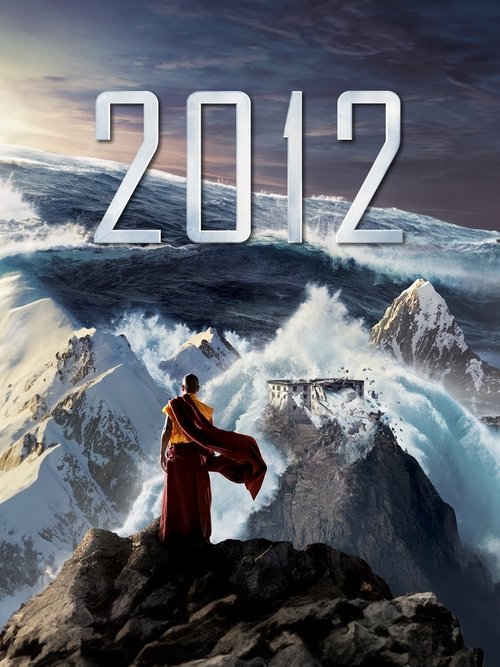
2012
2009 · Roland Emmerich
For popcorn-and-couch night when you want maximum destruction and zero homework — grab friends, suspend disbelief, and enjoy the ride. Pure comfort-food spectacle.
What it's about
The Earth's core is heating up, the crust is coming loose, and governments are secretly building arks to save a chosen few. As civilization starts to crumble — earthquakes, floods, cities sliding into the sea — a divorced novelist-turned-limo-driver races across the collapsing planet to get his family to safety, while a young scientist fights the politics of who gets a seat.
The experience
Two and a half hours of gleeful, over-the-top spectacle — narrow escapes stacked on narrower escapes, with the planet as the villain. It's ridiculous and knows it; the fun is surrendering to the sheer scale.
The craft
This is disaster-movie maximalism from the genre's reigning showman: entire cities buckle, split, and sink in effects sequences that were a landmark of digital destruction. It's built for a huge screen and a loud sound system — subtlety was never the assignment.
Why it matters
The peak of the 2000s apocalypse craze, it rode the pop-culture frenzy around the Mayan-calendar 2012 prophecy to a massive global box office and set the bar for CGI catastrophe.
Snapshot
2012 is the apotheosis of Roland Emmerich's career-long project of staging the end of the world as mass entertainment — a roughly two-and-a-half-hour symphony of planetary destruction in which the Earth's crust slips, California slides into the Pacific, and a flotilla of clandestine "arks" carries a remnant of humanity over a global flood. Built around the pop-eschatological notion that the Maya Long Count calendar predicted a cataclysm in December 2012, the film yokes that millenarian premise to the most conventional of disaster-movie spines: a divorced everyman, novelist-turned-limo-driver Jackson Curtis (John Cusack), races to reunite and rescue his family while a parallel track follows scientist Adrian Helmsley (Chiwetel Ejiofor) and the political class deciding who lives and who dies. Released by Columbia/Sony in November 2009, it was a substantial commercial success — grossing more than $700 million worldwide and ranking among the year's biggest hits — even as critics treated it as the genre's reductio ad absurdum. Its lasting significance is less narrative than technological and cultural: it pushed digital fluid and destruction simulation to a new scale, and it functions as a time capsule of pre-recession-hangover apocalypse anxiety.
Industry & production
2012 was a tentpole production for Columbia Pictures, mounted on a budget widely reported in the neighborhood of $200 million, with additional financing and risk spread through Emmerich's customary international and partner arrangements. It was developed and produced through Emmerich's own production apparatus — Centropolis Entertainment — with Emmerich and his longtime collaborator Harald Kloser writing the screenplay and Kloser, Mark Gordon, and Larry Franco among the producers. Principal photography took place largely in Vancouver, British Columbia, then a favored hub for large-scale effects production owing to tax incentives and stage capacity; the production used both physical sets and extensive green-screen environments that would be completed in post.
The film arrived at a particular industrial moment. Emmerich was coming off the comparatively modest 10,000 BC (2008), and 2012 represented a return to the contemporary-set, global-spectacle disaster mode that had made Independence Day (1996) and The Day After Tomorrow (2004) hugely profitable. Sony's marketing leaned hard on the "2012 phenomenon," including a now-notorious viral campaign fronted by a fictitious "Institute for Human Continuity" website soliciting applications to survive the apocalypse — a stunt that drew criticism from scientists and educators who feared it stoked genuine public anxiety. The film's release was timed for the November frame, positioning it as a holiday-season global event picture rather than a summer release, a slot Emmerich's brand could anchor on the strength of spectacle alone.
Technology
Technologically, 2012 is the film's most genuinely consequential dimension. Its destruction sequences required simulating water, debris, and collapsing terrain at a scale that strained the tools of the period, and the production distributed work across several major houses — including Sony Pictures Imageworks, Double Negative, Digital Domain, Uncharted Territory (Emmerich's in-house effects entity), and Scanline VFX, among others. Scanline's proprietary fluid-simulation system, Flowline, was central to the climactic deluge — the mega-tsunamis, the flooding of the Himalayan ark site, and the vast volumes of churning water — and 2012 became one of the signature showcases for large-scale CG fluid dynamics in mainstream cinema, work for which Scanline's technology was subsequently recognized within the visual-effects industry.
Beyond water, the film's set pieces depended on rigid-body and procedural destruction simulation: the disintegration of Los Angeles as the ground heaves and freeways buckle, the collapse of St. Peter's Basilica, and the airborne escape sequences in which aircraft thread between toppling skyscrapers. These required tight integration of simulated environments with live-action plates and digital doubles. The film thus sits at a hinge point in effects history — late enough that fully digital large-scale fluid and destruction simulation was feasible, but early enough that 2012 served as a proof-of-concept whose techniques would propagate through the disaster and superhero spectacle that followed.
Technique
Cinematography
Director of photography Dean Semler, ASC, ACS — an Academy Award winner for Dances with Wolves (1990) and a veteran of large-scale action — shot 2012 in a clean, high-key, wide-format spectacle idiom. The photography is functional in service of the effects: compositions are built to accommodate the extension of practical foregrounds into vast digital environments, with camera moves (sweeping aerials, plunging crane and helicopter-style perspectives) designed to convey scale and velocity through collapsing cityscapes. Semler's lighting favors legibility over atmosphere — the catastrophe is meant to be seen with maximum clarity — and the palette tends toward cool grays and ash tones in the destruction sequences, warming for the family-drama interludes. The visual grammar is that of the contemporary tentpole: the human-scale action is staged so that the eye can always read the geography of an impossibly large event.
Editing
Cut by David Brenner and Peter S. Elliot, the film employs the cross-cutting architecture that is the disaster genre's structural signature: it braids the Curtis family's ground-level flight with the scientists-and-statesmen B-plot, accelerating the intercutting as the global timeline tightens. The escape set pieces — the limousine outrunning the collapse of Los Angeles, the plane lifting off as the runway disintegrates — are edited for sustained kinetic momentum, with the destruction beats timed to near-miss rhythms. The film's considerable length (it runs roughly two and a half hours) is a structural feature of Emmerich's late disaster mode, accommodating multiple national vignettes and an extended third act at the arks rather than a single climactic catastrophe.
Mise-en-scène / staging
The staging operates on two registers that 2012 deliberately holds in tension: the intimate (cramped car interiors, the family unit pressed together in flight) and the planetary (continents fracturing, oceans overrunning mountains). Emmerich's hallmark is the iconographic destruction of recognizable monuments and symbols — here the collapse of St. Peter's Basilica onto a crowd of the faithful, the Christ the Redeemer statue of Rio crumbling, the White House obliterated by an aircraft carrier borne on a tsunami wave. These images are staged as legible spectacle-icons, each a self-contained postcard of apocalypse. The production design moves the survivors toward the "arks" — enormous vessels built in secret in the Himalayas — whose cavernous engineering interiors give the final act a confined, mechanical setting after the open-world devastation that precedes it.
Sound
The sound design is built around the low-frequency physicality of catastrophe — the deep rumble of the heaving crust, the roar and crash of water, the splintering of structures — deployed for visceral subwoofer impact in the theatrical mix. Harald Kloser and Thomas Wanker's orchestral score underlines both the awe of destruction and the sentiment of the family-survival narrative, in the broad, emotive symphonic idiom typical of the genre. As is conventional in Emmerich's work, sound serves to make digitally created destruction feel weighty and present rather than to unsettle through restraint.
Performance
The performances are calibrated to the genre's demands rather than to psychological nuance. John Cusack anchors the film as the harried, resourceful everyman-father, a role that asks for sympathetic competence under duress. Chiwetel Ejiofor lends the scientist Adrian Helmsley an earnest moral gravity that gives the film what conscience it has, while Danny Glover plays the U.S. President as a figure of dignified sacrifice. Oliver Platt supplies the pragmatic-villain register as the chief of staff who rations survival, and Thandie Newton, Amanda Peet, Thomas McCarthy, and Woody Harrelson — the last as a conspiracy-minded radio prophet — fill out the ensemble. The acting is broad by design; the actors function as recognizable human coordinates within an overwhelmingly effects-driven frame.
Narrative & dramatic mode
2012 runs on the disaster film's classical melodramatic engine: catastrophe as the crucible that restores a fractured family and tests the moral character of institutions. Its dramatic mode is sentimental-apocalyptic — the destruction of the world is paradoxically the occasion for emotional reconciliation, as the estranged Curtis parents are drawn back together by the imperative of saving their children. Around this domestic spine the film arranges its public ethical drama: the question of who deserves rescue, the lottery and the secrecy by which elites and the wealthy secure berths on the arks, and the eleventh-hour gesture of opening the gates to the excluded. The narrative is frankly schematic — survival is rewarded for the virtuous and resourceful — but it gestures, however broadly, at a critique of triage capitalism and the commodification of survival.
Genre & cycle
The film is a late, maximalist entry in the disaster cycle that runs from the 1970s Irwin Allen productions (The Poseidon Adventure, The Towering Inferno) through the CGI-enabled revival of the 1990s. Within that lineage 2012 is most directly the culmination of Emmerich's own sub-cycle: Independence Day (alien apocalypse), The Day After Tomorrow (climate apocalypse), and now 2012 (geological/cosmic apocalypse). It pushes the genre's defining logic — the systematic destruction of global landmarks intercut with a family's survival — to a near-parodic extreme of scale, such that many critics read it as the disaster film consuming itself. It also belongs to a brief late-2000s vogue for "2012"-themed end-times media keyed to the Maya-calendar pop phenomenon, of which Emmerich's film was by far the largest and most visible.
Authorship & method
2012 is unmistakably an Emmerich film, the work of a director who built a singular career on the spectacle of monumental destruction and the German émigré's outsider fascination with American iconography. His method is the reverse-engineering of narrative from set piece: the destruction sequences are the film's reason for being, and the human story is the connective tissue that carries an audience between them. He co-wrote the screenplay with Harald Kloser, his frequent musical and writing collaborator, who also co-composed the score with Thomas Wanker — an unusual concentration of creative control in which the same hands shape both script and music. Cinematographer Dean Semler brought blockbuster-scale craft and Academy pedigree to the photography; editors David Brenner (a recurrent Emmerich collaborator) and Peter S. Elliot structured the cross-cut catastrophe. The visual-effects supervision — the true authorial center of a film like this — was distributed across Emmerich's own Uncharted Territory and the major houses noted above, with Scanline's fluid work the standout technical achievement. The authorship of 2012, in other words, is genuinely divided between a director-showman and an effects-engineering enterprise.
Movement / national cinema
2012 is a product of Hollywood's globalized blockbuster system rather than of any national movement, but it is worth noting Emmerich's biography as a German director — trained in Munich — who imported a European outsider's appetite for spectacle into the American studio machine. The film is also a paradigmatic artifact of the runaway-production economy of the era, made substantially in Canada for an American studio with a globally distributed effects pipeline. In its commercial design it is consciously transnational: the casting, the worldwide sweep of its destruction, and the relocation of salvation to the Himalayas (with China as the builder of the arks) all reflect a calculated appeal to the international markets that, by 2009, increasingly drove the economics of the tentpole picture.
Era / period
The film is firmly of its late-2000s moment. It emerged amid genuine pop-cultural traffic in the 2012 Maya-calendar prophecy, which lent its apocalypse a topical hook unavailable to earlier disaster films. It also arrives just after the 2008 financial crisis, and its preoccupations — secret elite survival schemes, the buying of safety, a public excluded from rescue — read in retrospect as refracted anxieties of a moment when faith in institutions and in the fairness of who gets saved was under strain. Technologically it belongs to the period in which fully digital large-scale simulation had matured enough to render planetary destruction convincingly, marking a threshold the genre had been approaching since the mid-1990s.
Themes
At its surface the film is about catastrophe and survival, but its more pointed theme is the ethics of triage — who is chosen, by what authority, and at what price. The arks, sold to the rich and reserved for the powerful, dramatize a class politics of apocalypse, and the film's moral climax hinges on whether the excluded will be admitted. Running beneath this is the genre's perennial theme of the family as the irreducible unit of meaning, restored through disaster. There is also a thread of science-versus-power — the scientist who warns and the politicians who manage — and, in the figure of Harrelson's doomed prophet, a wry treatment of conspiracy and the will to believe. The Maya framing lends a veneer of mysticism, though the film grounds its mechanism in pseudo-scientific terms (solar neutrinos, a heating core) rather than the genuinely supernatural.
Reception, canon & influence
Critically, 2012 was received as spectacle divorced from substance: reviewers widely acknowledged the technical bravura of its destruction while dismissing its characterization, length, and narrative as formulaic, and a number treated it as the disaster genre pushed to self-parody. Commercially, however, it was a major hit — grossing more than $700 million worldwide and standing among the most successful films of its year — confirming the durability of Emmerich's brand even as critics tired of it.
Looking backward, the film draws on a deep genre inheritance: the 1970s all-star disaster cycle of Irwin Allen, the biblical-flood and ark archetype, the monument-destruction iconography Emmerich himself had codified in Independence Day, and the climate-catastrophe template of his own The Day After Tomorrow. Its pseudo-scientific apparatus and end-times mood also tap a long lineage of millenarian cinema.
Looking forward, its most concrete legacy is technical: 2012 was a landmark demonstration of large-scale CG fluid and destruction simulation, and Scanline's Flowline technology, showcased here, went on to underpin water and destruction work across subsequent blockbuster and superhero cinema. In genre terms, 2012 is frequently cited as the high-water mark — and, for many, the exhaustion point — of the maximalist global-destruction disaster film; it is hard to escalate further than the literal drowning of the world, and the cycle largely retreated afterward toward more contained or franchise-integrated catastrophe. As a cultural document, it remains the definitive screen monument to the 2012 phenomenon, a spectacle that outlived the prophecy it dramatized.
A Deleuzian reading
Watch the limousine.
The full Deleuzian reading of 2012 →
Reception
Critics shrugged in 2009 — empty spectacle, peak CGI excess — but it made nearly $800M worldwide anyway, and it's since settled into affectionate status as the maximalist endpoint of the 2000s disaster-movie cycle: the one people rewatch when they want Emmerich at full throttle.
How 2012 was received, from release to now →
Influences: the films it descends from and the films it influenced
- The Poseidon Adventure (1972) — Irwin Allen's all-star ensemble-in-peril template, where a cross-section of stock human types is funneled through one collapsing physical environment, supplies the survival-architecture 2012 borrows for its airborne and ark escapes.
- The Towering Inferno (1974) — Establishes the disaster-cycle structure of escalating, discretely engineered destruction set pieces strung along a thin melodramatic throughline — Emmerich's reverse-engineering of narrative from spectacle inherits this scaffolding directly.
- Earthquake (1974) — Pioneered Sensurround's theater-shaking low-frequency rumble to make seismic collapse a felt bodily event, anticipating 2012's reliance on sub-bass impact to sell crumbling-city geology.
- When Worlds Collide (1951) — Codifies the secular-ark plot — an elite few selected to flee planetary doom by engineered vessel while triage ethics torment the chosen — the exact narrative spine 2012 modernizes into its Himalayan arks.
- A Night to Remember (1958) — The methodical tilting-and-flooding choreography of a great vessel going under, cross-cut between decks and classes, is the staging grammar 2012 reuses for both the limousine-outrunning-fissures and the capsizing-ark sequences.
- Independence Day (1996) — Emmerich's own codification of landmark-destruction iconography — recognizable monuments obliterated in wide master shots as the spectacle's money image — is the authorial signature 2012 escalates to whole-continent scale.
- The Day After Tomorrow (2004) — Emmerich's prior climate-apocalypse film established his pseudo-scientific catastrophe apparatus plus the estranged-father-races-to-reunite-with-family melodrama that 2012 reruns almost beat for beat.
- Deep Impact (1998) — Pairs global extinction-event with intimate sentimental melodrama and an explicit triage lottery over who survives, modeling the 'intimate-versus-planetary' tonal braid and ethics-of-triage that drive 2012's ark politics.
- Titanic (1997) — Cameron's fusion of CG water simulation, digital doubles tumbling down a foundering hull, and a small love story scaled against mass death set the blockbuster benchmark 2012 chases with its fluid-sim drowning of the world.
- The Avengers (2012) — Scanline VFX's Flowline procedural-destruction pipeline, showcased on 2012, directly underpins the Manhattan-leveling third act here, carrying the same large-scale CG fluid-and-debris simulation into superhero cinema.
- Man of Steel (2013) — Inherits 2012's procedural city-collapse and digital-double crowd work — much of it via the same effects houses — to stage the Metropolis devastation as sustained, physics-driven mass destruction.
- San Andreas (2015) — A near-direct technical heir: Scanline-driven CG fluid and tectonic destruction simulation applied to collapsing California, reprising 2012's wide-format aerial spectacle and family-reunion melodrama almost as homage.
- Geostorm (2017) — Devlin, Emmerich's longtime producing partner, extends the climate-catastrophe-as-global-montage formula — synchronized multi-city destruction beats cross-cut across the planet — straight out of the Emmerich disaster playbook.
- Moonfall (2022) — Emmerich's own later return to maximalist planetary catastrophe, again building narrative backward from procedural destruction set pieces and an everyman-saves-family throughline, explicitly continuing 2012's exhausted-spectacle lineage.
- The Wandering Earth (2019) — Adapts 2012's secular-ark, save-the-species engineering epic for Chinese blockbuster cinema, deploying comparable large-scale CG destruction-and-fluid simulation and intimate-versus-planetary staging at globalized scale.
- Armageddon (1998) — Shares the late-'90s end-times template of accelerating parallel cross-cutting, blue-collar everyman heroics, and a sacrificial-rescue climax scored for maximum sentiment — the Bruckheimer mode 2012 runs in the disaster register.
- War of the Worlds (2005) — Spielberg's ground-level, single-family POV on civilizational collapse — staging planetary cataclysm through one parent shepherding children — is the intimate-anchor strategy 2012 adopts to humanize otherwise abstract destruction.
Similar films
- Independence Day (1996) — influence & lineage
- War of the Worlds (2005) — influence & lineage
- The Avengers (2012) — influence & lineage
- Pacific Rim (2013) — shared sensibility
- Don't Look Up (2021) — shared sensibility
- Cloverfield (2008) — shared sensibility
- Godzilla: King of the Monsters (2019) — shared sensibility
- Apocalypto (2006) — shared sensibility