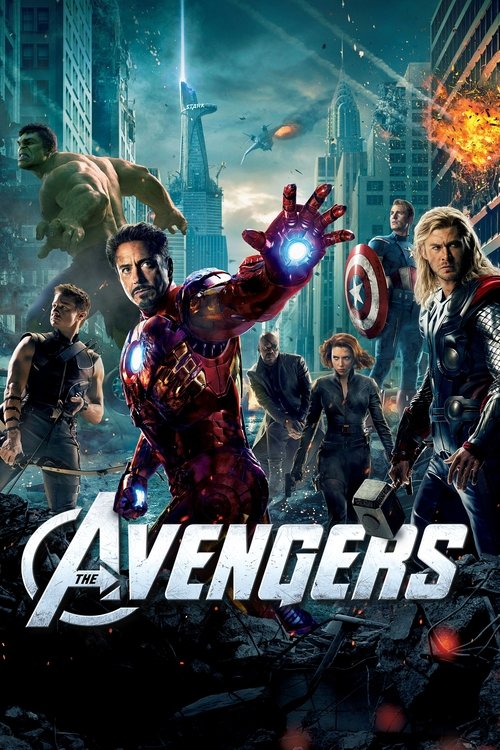
The Avengers
2012 · Joss Whedon
For when you want a guaranteed good time — pizza-and-friends viewing, a pick-me-up after a rough week, or the film to convert someone who thinks they don't like superhero movies. Zero homework required to enjoy it, comfort all the way.
What it's about
When a vengeful god-figure arrives with an alien army and designs on Earth, the head of the spy agency S.H.I.E.L.D. gathers the planet's scattered heroes — a billionaire in an armored suit, a super-soldier out of his time, a thunder god, a scientist with a monster inside him, and two master assassins — into one room. The problem isn't the invasion; it's getting these egos to work as a team before New York pays the price.
The experience
Pure crowd-pleasing momentum — banter-heavy, bright, and building to a sustained city-wide battle that still delivers a grin. The fun is less the spectacle than the friction: watching larger-than-life characters needle, clash, and finally click.
Performances
Robert Downey Jr.'s fast-talking Tony Stark sets the film's comic pulse, and Mark Ruffalo's rumpled, wary Bruce Banner quietly steals it — his transformation gets the biggest cheer in the movie.
The craft
Joss Whedon's script is an ensemble juggling act: six heroes, each with a voice, each with a moment, stitched together with quotable banter and one famous unbroken shot that circles through the entire team mid-battle. Big, clean, legible action that rewards the largest screen available.
Why it matters
The moment the interconnected film universe was proven to work — it validated years of setup across five previous movies and reshaped how Hollywood builds franchises for the next decade.
Snapshot
The Avengers is the film in which the modern superhero franchise discovered its definitive industrial form. Conceived as the convergence point of five preceding Marvel Studios features — Iron Man (2008), The Incredible Hulk (2008), Iron Man 2 (2010), Thor (2011), and Captain America: The First Avenger (2011) — it gathered four separately franchised heroes plus a supporting ensemble into a single narrative, validating a serial-storytelling model that Hollywood had not previously attempted at this scale. Joss Whedon, brought in to write and direct, supplied the connective tissue: an ensemble comedy of friction and reluctant cooperation grafted onto an alien-invasion spectacle. The film was an enormous commercial success and became, for a time, one of the highest-grossing films ever released. Its real significance, though, is structural. The Avengers proved that the "shared universe" was not merely a marketing conceit but a reproducible blueprint, and it reorganized the priorities of studio filmmaking around interlocking, multi-film continuity for the decade that followed.
Industry & production
The film was produced by Marvel Studios and distributed by Walt Disney Studios Motion Pictures, Disney having acquired Marvel Entertainment in 2009 while distribution of some earlier titles had run through Paramount. It represented the culmination of a strategy that Marvel Studios president Kevin Feige and his collaborators had been building since Iron Man: post-credit teasers, recurring characters, and Samuel L. Jackson's Nick Fury appearing across films had been seeding the prospect of a team-up for four years. The gamble was considerable. No studio had previously asked audiences to follow continuity across distinct franchises as a precondition for a payoff film, and the contractual and scheduling logistics of assembling Robert Downey Jr., Chris Evans, Chris Hemsworth, Mark Ruffalo, Scarlett Johansson, and Jeremy Renner — several of them stars of their own pictures — were formidable. Ruffalo replaced Edward Norton as Bruce Banner, a recasting Marvel framed in terms of the collaborative ensemble it wanted to build.
Joss Whedon was an unconventional choice to helm a production of this magnitude. His feature directing experience was limited largely to Serenity (2005), the film continuation of his canceled television series Firefly; his reputation rested on television (Buffy the Vampire Slayer, Angel) and on a facility with large ensembles and quippy dialogue. Marvel hired him both to direct and to rework the screenplay, and the resulting credit structure — Whedon credited with screenplay, with story credited to Whedon and Zak Penn — reflects a substantial rewrite. The production was a tentpole operation with the attendant apparatus of pre-visualization, second units, and extensive effects vendor coordination, but Whedon's authorial contribution was concentrated in the script's management of character and tone, the dimension the franchise most needed to make a crowded roster cohere.
Technology
The Avengers was photographed largely on 35mm film by Seamus McGarvey, a choice that ran somewhat against the grain of a blockbuster industry then migrating rapidly to digital capture. The decision lent the live-action photography a particular density and grain quite distinct from the cleaner digital look that would come to dominate the genre. The film was post-converted to 3D rather than shot natively — a common and frequently criticized practice of the period, in which stereoscopic depth is generated in post-production rather than captured by dual cameras. The 3D conversion was a commercial rather than aesthetic imperative, aligned with the early-2010s exhibition push for premium-format ticketing.
The film's heaviest technological investment lay in visual effects, particularly the Hulk. Earlier screen versions of the character had struggled to reconcile a fully digital creature with the human actor beneath; The Avengers used performance-capture techniques to map Mark Ruffalo's facial performance onto the digital Hulk, giving the creature a legibility and expressiveness its predecessors lacked. The climactic Battle of New York — an extended sequence of citywide alien invasion — required large-scale digital environment work, crowd simulation, and the integration of multiple heroes' distinct effects signatures (repulsor energy, Asgardian lightning, the Hulk's mass) into continuous action. The work was distributed across several major effects houses, with Industrial Light & Magic among the principal vendors.
Technique
Cinematography
Seamus McGarvey, an Irish cinematographer whose prior work included Atonement (2007), brought a relatively classical sensibility to the photography. His framing favors clarity and comprehensibility over the destabilized, rapidly cut handheld style that had become common in action cinema after the Bourne films. In the dialogue and ensemble scenes — particularly the lengthy mid-film sequences aboard the S.H.I.E.L.D. helicarrier — the camera is composed to keep multiple characters legible within the frame, a practical necessity given how many principals must share scenes. The much-discussed climactic battle includes a roving "oner"-style sweep that travels between the heroes across the Manhattan battlefield, stitching their individual actions into a single continuous geography. This shot functions as the film's thesis made visual: the team operating as a coordinated whole, the camera tracing the connective logic the entire enterprise was built to deliver. McGarvey's lighting is generally high-key and readable, prioritizing the audience's orientation in complex action over expressive shadow.
Editing
The film was edited by Jeffrey Ford and Lisa Lassek. The editorial challenge was structural balance: introducing, or re-introducing, a half-dozen protagonists, granting each sufficient presence, and converting an act of pure exposition — assembling the team — into momentum. The editing's most consistent achievement is in the ensemble friction scenes, where comic timing and the rhythm of overlapping personalities are managed with a precision closer to ensemble comedy than to action convention. In the climactic battle, the cutting alternates between the continuous-geography passages and conventional crosscutting among simultaneous fronts, maintaining spatial coherence across a sequence that could easily have dissolved into incoherent spectacle. The decision to keep action geography legible — to let the viewer always know where each hero stands relative to the others — is as much an editorial as a directorial one, and it distinguishes the film from the more chaotically assembled blockbusters around it.
Mise-en-scène / staging
Whedon's staging instincts are theatrical and ensemble-driven, honed across years of television. Much of the film's middle is constructed as a chamber piece: heroes confined together in the helicarrier's laboratories and corridors, antagonisms staged through blocking and proximity. The recurring strategy is to put incompatible personalities in a shared space and let the staging dramatize their refusal to cohere — Tony Stark and Steve Rogers circling each other, Banner held at the edge of the frame as a barely contained threat. The production design renders S.H.I.E.L.D. as a sleek techno-bureaucratic apparatus, against which the gods and monsters of the roster register as anomalies. The climactic Manhattan setting grounds the cosmic threat in recognizable urban space, a deliberate choice that gives the alien invasion human scale and stakes.
Sound
Alan Silvestri composed the score. A veteran of large-scale studio scoring (the Back to the Future films, Forrest Gump), Silvestri supplied a brassy, declarative main theme intended to function as the unifying musical identity the assembled team had lacked — each prior film having carried its own composer and signature. The Avengers theme is built on a rising, fanfare-like motif designed for heroic assembly, and its deployment is keyed to the moments of team consolidation. The sound design carries the heavy lifting of differentiating the heroes' powers aurally — the metallic register of Iron Man's repulsors, the thunderous low end of the Hulk and of Thor's hammer — and of sustaining the dense, layered soundscape of the final battle without losing dialogue intelligibility.
Performance
The film's performances are calibrated to ensemble interplay rather than individual showcase. Robert Downey Jr.'s Tony Stark functions as the engine of the film's comic register, his improvisatory, deflecting wit setting the tonal baseline. Chris Evans plays Steve Rogers as earnest counterweight, the friction between the two men carrying much of the film's thematic argument about individualism and collective duty. Mark Ruffalo's Bruce Banner is the film's quiet center — a performance of contained dread and rueful intelligence that made the Hulk, for the first time on screen, a fully sympathetic figure. Scarlett Johansson's Natasha Romanoff is given an interrogation-scene introduction that establishes competence through misdirection. Tom Hiddleston's Loki, carried over from Thor, supplies a theatrical, wounded antagonist whose grievance is personal rather than abstract, giving the spectacle an emotional antagonist to organize around. The performances cohere because Whedon writes to each actor's established register and stages their incompatibilities as the drama itself.
Narrative & dramatic mode
The film's dramatic mode is the assembly narrative — the team-formation story familiar from the war film and the heist film, here scaled to franchise. Its first two acts are devoted to gathering, and crucially to failure: the team cannot cooperate, their egos and traumas set them against one another, and the antagonist Loki's scheme depends precisely on this internal fracture. The death of a unifying secondary character functions as the catalytic loss that converts a collection of individuals into a team — a classic structural device, the sacrifice that supplies common purpose. The third act is pure convergence: the assembled Avengers defending New York against an alien incursion, the spectacle serving as the literal enactment of cooperation achieved. The dramatic engine is therefore not the external threat, which is relatively schematic, but the internal one: whether these incompatible figures can become a unit. Whedon's screenplay treats the spectacle as the resolution of a character problem rather than as an end in itself.
Genre & cycle
The Avengers is a superhero film, an alien-invasion science-fiction film, and an ensemble action-adventure simultaneously, and its importance lies partly in fusing these strands into a template. It belongs to the post-Iron Man cycle of Marvel Studios productions, but it occupies a singular position within that cycle as its first convergence event — the film that retroactively defined the preceding entries as chapters of a larger whole. It draws on the team-superhero tradition long established in comics (the Justice League, the X-Men, the Avengers themselves) but had few cinematic precedents for translating that team structure to the screen at this scale. Its closest generic ancestors are the all-star ensemble adventure and the men-on-a-mission war film; its closest contemporary kin are the other tentpole spectacles of the early 2010s. The film effectively founded a sub-cycle — the "team-up event film" — that would recur across the franchise and be widely imitated.
Authorship & method
Authorship in The Avengers is genuinely divided between a corporate and an individual author. The film is, at the level of overall design and continuity, the work of Marvel Studios and Kevin Feige's producing apparatus, which determined the characters, the continuity obligations, the post-credit hooks, and the franchise architecture into which the film had to fit. Whedon's authorship operates within those constraints and is most legible in the dialogue and the management of ensemble dynamics — the comic timing, the verbal sparring, the privileging of character friction, all signatures recognizable from his television work. The collaboration with cinematographer Seamus McGarvey produced the film's commitment to legibility; the partnership with composer Alan Silvestri produced its unifying theme; the editorial work of Jeffrey Ford and Lisa Lassek realized the balance among protagonists. This is filmmaking as managed collaboration under franchise discipline, and The Avengers is an unusually clear case study in how a strong individual sensibility can be productive precisely by working within, rather than against, a corporate authorial structure.
Movement / national cinema
The film is a product of the American studio system at its most consolidated — Hollywood franchise filmmaking under the Disney-Marvel umbrella — and it belongs less to any aesthetic movement than to an industrial one. If it has a "movement," it is the shared-universe model of serialized blockbuster production that it did more than any other film to establish. Its national-cinema identity is American in the specific sense of global Hollywood: a film made for worldwide simultaneous release, increasingly dependent on international box office, its iconography (New York under attack, a federalized peacekeeping agency, an assembly of national-and-cosmic icons) legible to a transnational audience. The production drew talent internationally — an Irish cinematographer, an Australian and a British actor among its leads — in the manner characteristic of contemporary Hollywood's globalized labor.
Era / period
The Avengers arrived in 2012, at a moment when Hollywood's economic model was reorganizing around pre-sold intellectual property, franchise continuity, and global theatrical release. It crystallized that reorganization. Released a little over a decade after the post-2000 superhero boom began (with X-Men in 2000 and Spider-Man in 2002), it marked the genre's transition from a sequence of standalone adaptations to an integrated serial enterprise. The film's New York invasion, with its imagery of an alien assault on Manhattan, inevitably carries a post-9/11 charge that recurs throughout the genre in this period — the spectacle of the wounded American city defended by exceptional figures. Its faith in coordinated institutional and heroic response, and its essentially optimistic resolution, mark it as belonging to a relatively confident moment in the franchise's evolution, before the darker, more fractious turns of its later phases.
Themes
Beneath the spectacle, the film's persistent theme is the negotiation between individualism and collective obligation — the conversion of a set of self-sufficient, ego-driven exceptional individuals into a cooperating body. Tony Stark's arc, articulated in his confrontations with Steve Rogers, is the explicit treatment of this: the man who insists he does not "play well with others" learning the self-sacrifice that membership requires. The film is preoccupied with the problem of containing power — the Hulk as the literalization of force that cannot be controlled, only channeled, and Banner's eventual reconciliation with his own monstrousness as the film's quiet emotional resolution. Loki's antagonism dramatizes a thematics of grievance and the desire for submission, his argument that humanity craves subjugation set against the team's improvised, contentious freedom. Running under all of this is a meta-theme proper to the film's industrial situation: the value of assembly itself, the proposition that disparate parts are worth more combined — a thematic statement that doubles as the franchise's commercial thesis.
Reception, canon & influence
The Avengers was both a critical and commercial success on release, widely praised for accomplishing the difficult balancing act its premise demanded — giving each hero satisfying presence while delivering large-scale spectacle and sustaining a consistent comic tone. Critics singled out Whedon's handling of the ensemble and the dialogue, and the film was generally regarded as having exceeded the considerable risk of its concept. It became one of the highest-grossing films of its time and stood for years as a benchmark of franchise success. Its critical reputation rests more on its industrial and formal accomplishment than on claims to art-cinema significance; it is canonical as a pivot point in film history rather than as an object of auteurist veneration.
The film's backward debts run through the team-adventure and ensemble traditions and, most directly, through the four years of preceding Marvel films whose characters, tone, and continuity it inherited and synthesized. Whedon's own prior work — the ensemble construction and tonal management of Buffy, Firefly, and Serenity — is the clearest authorial antecedent. The men-on-a-mission war film and the all-star disaster and adventure ensembles of earlier Hollywood supply the structural template of incompatible specialists forced into cooperation.
Its forward influence is among the most consequential of any film of its decade, though the influence is industrial as much as aesthetic. The Avengers proved the shared-universe model viable and immensely profitable, and the subsequent decade saw nearly every major studio attempt to construct equivalent interlocking franchises from their own intellectual property, with widely varying success. Within Marvel's own output it established the template for the recurring team-up event film, a structure the franchise would repeat and escalate. More broadly, it reoriented studio development priorities around continuity, serialization, and the post-credit hook, changing the basic unit of blockbuster planning from the individual film to the multi-film arc. Whatever one's judgment of that legacy, The Avengers is the film in which it became the dominant logic of mainstream American cinema.
A Deleuzian reading
Remember the shot.
The full Deleuzian reading of The Avengers →
Reception
In 2012 it felt like a miracle — the impossible crossover that actually worked, greeted as a new peak for the blockbuster. Now it reads as the innocent high-water mark of the MCU before superhero fatigue set in, its breezy charm complicated by Joss Whedon's subsequent fall from grace.
How The Avengers was received, from release to now →
Influences: the films it descends from and the films it influenced
- Iron Man (2008) — Established the MCU's improvisational, overlapping comic delivery (Downey ad-libbing through exposition) and the post-credits continuity stinger, both of which Whedon inherits as the connective tissue and tonal baseline for the team-up.
- Seven Samurai (1954) — Originated the recruit-the-specialists assembly structure — each fighter introduced by a distinct, demonstrated skill before the unit converges on a single climactic defensive siege, the exact spine of Avengers' three acts.
- The Dirty Dozen (1967) — The men-on-a-mission template of insubordinate, mutually hostile specialists welded into a unit, using personality clash and disciplinary friction as the narrative engine of the assembly act.
- The Guns of Navarone (1961) — The all-star commando ensemble in which each marquee actor embodies one indispensable technical competency, and screen time is rationed to keep every specialist's expertise load-bearing to the mission.
- Serenity (2005) — Whedon's own found-family ensemble method — chamber-blocking a crew of equals around a table and driving scenes through rapid, status-jockeying verbal sparring — ported wholesale to the Helicarrier bridge.
- Superman: The Movie (1978) — Set the template of earnest, high-key superhero spectacle anchored by a declarative brass fanfare (Williams), the scoring lineage Silvestri's unifying Avengers theme directly extends.
- Star Wars (1977) — Williams' leitmotif-driven declarative fanfare and the serialized multi-film saga model that made the studio's planning unit the arc rather than the single picture.
- The Lord of the Rings: The Two Towers (2002) — Serkis/Weta on-set performance capture of Gollum pioneered the actor-driven CG creature, the technique behind Ruffalo's facial-capture Hulk replacing the old composited-stunt approach.
- Avatar (2009) — Coupled performance capture with the stereoscopic-3D event-film economics that Avengers chases through its (notoriously rushed) post-conversion to 3D.
- Children of Men (2006) — Choreographed the sustained continuous-take action sequence as spatial storytelling, the precedent for Avengers' climactic circular oner that pivots through all six heroes to assert ensemble spatial coherence.
- Ocean's Eleven (2001) — The assemble-the-specialists comedy of star wattage, sustaining breezy ensemble interplay and comic timing across a large cast without losing legibility of who does what.
- The Towering Inferno (1974) — The all-star disaster ensemble's craft of juggling multiple top-billed leads with parceled screen time and converging crisis, a scheduling-and-balance problem Whedon inherits at superhero scale.
- Avengers: Age of Ultron (2015) — Whedon directly repeats and escalates his own formula — opening with a team already assembled, then re-fracturing it through character friction before reassembly.
- Avengers: Infinity War (2018) — Escalates the team-up event film into cross-franchise convergence, treating the multi-film arc as the basic unit and cross-cutting parallel ensembles Avengers first proved manageable.
- Justice League (2017) — DC's direct attempt to replicate the assemble-the-team event film — recruiting montage, banter-driven ensemble, capstone battle — with Whedon himself brought in for tonal reshoots.
- The Mummy (2017) — Universal's 'Dark Universe' attempt to manufacture a shared-universe franchise spine — pre-loading continuity hooks and crossover setups before standalone success — in explicit imitation of the model Avengers validated.
- Avengers: Endgame (2019) — Established the rotating 'assembly tableau' hero shot and the protocol for cutting an oversized ensemble into legible spatial beats during a single converging battle — the grammar Endgame's finale scales up.
- Vikram (2022) — The connected-universe blueprint of a late-film antagonist tease functioning as a franchise hook — the device Vikram imports via the closing Rolex/Suriya reveal to seed a shared cinematic world.
- Guardians of the Galaxy (2014) — Extends the ensemble-comic-timing and bickering-misfit interplay within the MCU, adding needle-drop scoring but keeping Whedon's verbal-friction-as-bonding mechanism.
Similar films
- Avengers: Infinity War (2018) — influence & lineage · same viewing thread
- Avengers: Age of Ultron (2015) — influence & lineage
- Iron Man (2008) — influence & lineage
- Guardians of the Galaxy (2014) — influence & lineage
- The Dark Knight Rises (2012) — same viewing thread
- The Dark Knight (2008) — same viewing thread
- Man of Steel (2013) — same viewing thread
- Avengers: Endgame (2019) — shared sensibility
All the films related to The Avengers →
Watch it with: curated runs of related films
- The Superhero Movie Grows Up — Watch these as one arc — Raimi's warmth into Nolan's gravity into Logan's elegy and The Batman's rain-soaked noir — the two decades the comic-book film reached for real weight.