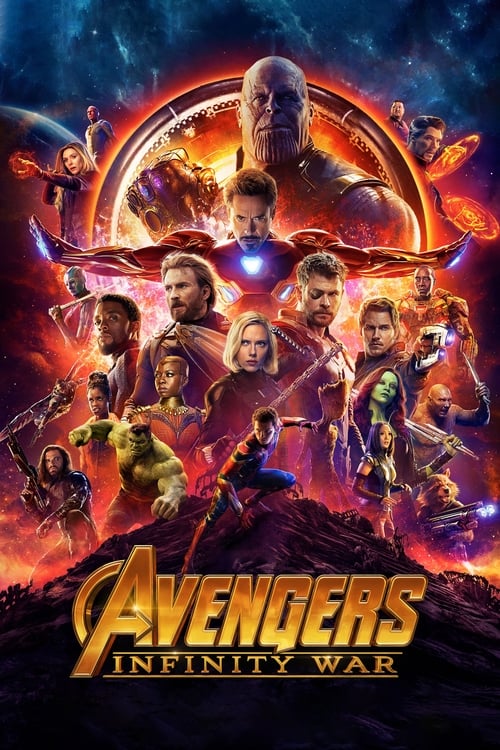
Avengers: Infinity War
2018 · Joe Russo
For a big, all-in event night — when you want spectacle with actual stakes and you're okay being left rattled rather than reassured. Not the comfort-food entry in this franchise; it's the one that hits.
What it's about
Thanos, a cosmic warlord with a horrifying plan for balancing the universe, sets out to collect six Infinity Stones — artifacts that together would give him power over reality itself. Every hero the Marvel movies have introduced across a decade scrambles to stop him, split into ragtag teams scattered from New York to deep space. It's a chase, a war, and a countdown all at once, and for the first time the story belongs as much to the villain as to the heroes trying to head him off.
The experience
Relentless and surprisingly heavy for a film with this many jokes — it moves at a sprint across a half-dozen storylines, but a sense of genuine dread builds underneath the banter. By the end it does something blockbusters almost never do to their audience, and it earns the stunned silence it became famous for.
Performances
Josh Brolin's motion-capture Thanos is the reason the movie works: a fully expressive, almost mournful performance that makes a genocidal tyrant feel like the tragic lead of his own story.
The craft
The screenwriting feat is keeping nineteen films' worth of characters legible and emotionally distinct while crosscutting between planets, and the Russo brothers pull it off with the timing of the ensemble comedy they cut their teeth on. The scale demands the biggest screen and loudest speakers you can find — the effects work on Thanos alone, a digital character who carries close-ups, was a landmark.
Why it matters
Its ending broke the superhero genre's most sacred promise to its audience and became a genuine mass moviegoing memory — people remember where they saw it. It stands as the boldest structural gamble ever taken by a franchise at this scale.
The boldest structural gamble in franchise filmmaking: after a decade of serialized world-building, the Russo brothers hand the protagonist's arc to the villain. Thanos, rendered by Josh Brolin through performance capture of startling expressiveness, pursues his genocidal calculus with the gravity of a tragic hero, while the assembled Avengers — scattered across planets and plotlines — scramble to stop him. The film crosscuts among a half-dozen ensembles with a fleetness learned from the Russos' television comedy roots, keeping nineteen films' worth of characters legible and emotionally distinct. What made it a genuine cultural event was the ending, which broke the superhero genre's most sacred covenant with its audience and sent viewers out of theaters in stunned silence — a mass moviegoing memory of the kind the streaming era has made rare. Whatever one's stance on the Marvel machine, Infinity War represents its high-water mark of ambition: the moment a corporate mega-franchise briefly behaved like a serialized nineteenth-century novel, willing to close a chapter on catastrophe. It became, at the time, only the fourth film ever to gross two billion dollars.
A Deleuzian reading
Two fingers touch.
The full Deleuzian reading of Avengers: Infinity War →
Reception
In 2018 it was a genuine culture-stopping event — record-shattering opening, audiences gasping in unison at that ending, the fastest film ever to $2 billion at the time. Now it's remembered as peak MCU, the high-water mark fans point to with increasing nostalgia as the franchise's post-Endgame era divided them.
How Avengers: Infinity War was received, from release to now →
Influences: the films it descends from and the films it influenced
- Intolerance (1916) — Established large-scale parallel crosscutting between wholly separate storylines accelerating toward a converging climax — the editorial grammar Infinity War uses to intercut Titan, Wakanda, and Knowhere.
- The Godfather Part II (1974) — Perfected sustained crosscutting between two independent timelines whose moral weight comments on each other, the same intercut-for-meaning editing that binds Thanos's arc to the heroes' failures.
- Nashville (1975) — Pioneered the multi-protagonist ensemble weave with no single lead and overlapping fates, the structural model for juggling twenty-plus principals without a center.
- Magnolia (1999) — Advanced the interlocking hyperlink ensemble where dispersed characters share a single emotional pulse and converge on a collective climax.
- The Empire Strikes Back (1980) — Codified the downbeat middle-chapter of a serialized saga that ends on defeat and cliffhanger rather than resolution — the tonal and structural blueprint for the dusting.
- The Lord of the Rings: The Return of the King (2003) — Modeled crosscutting a scattered fellowship across multiple battlefronts into simultaneous converging climaxes at blockbuster scale.
- The Lord of the Rings: The Two Towers (2002) — Andy Serkis's Gollum proved a fully CG character driven by an actor's on-set performance capture could carry dramatic scenes — the direct lineage to Brolin's Thanos.
- Dawn of the Planet of the Apes (2014) — Wētā's facial capture gave a computer-generated antagonist (Caesar/Koba) real pathos and interiority, the emotive-villain pipeline Thanos inherits.
- Avatar (2009) — Cameron's facial performance-capture and virtual-camera pipeline made photoreal emotive CG leads viable, the technological groundwork for a mocap villain-protagonist.
- The Avengers (2012) — Invented the modern crossover-ensemble template — assembling separately-franchised heroes and balancing their screen time and clashing egos in one film.
- Captain America: Civil War (2016) — The Russos' own airport melee established their method of choreographing a dozen powers in one legible ensemble battle and staging clashing-agenda drama across a large cast.
- The Dark Knight (2008) — Built its climax on crosscutting between escalating parallel threats orchestrated by a villain whose plan drives the narrative, foregrounding the antagonist's design over the heroes'.
- Avengers: Endgame (2019) — Directly completes the two-part serialized arc, resolving the crosscut ensemble and downbeat cliffhanger that Infinity War left deliberately unresolved.
- Spider-Man: No Way Home (2021) — Extends the franchise-crossover event film by stacking legacy characters from prior series into a single continuity for a mass-moviegoing payoff.
- Joker (2019) — Takes the comic-book villain-as-protagonist further, building an entire feature around the antagonist's subjective justification, escalating Thanos's villain-POV framing.
- Godzilla vs. Kong (2021) — Applies the shared-universe crossover-event structure to a rival IP stable, colliding separately-established franchise titans as a single ticketed spectacle.
- Zack Snyder's Justice League (2021) — A competing studio's ensemble-assembly film crosscutting individually-introduced heroes against a genocidal cosmic villain seeking convergent artifacts (the Mother Boxes to Infinity Stones).
Similar films
- The Avengers (2012) — influence & lineage · same viewing thread
- The Dark Knight (2008) — influence & lineage · same viewing thread
- Avengers: Endgame (2019) — influence & lineage
- Spider-Man: No Way Home (2021) — influence & lineage
- Avengers: Age of Ultron (2015) — shared sensibility
- Black Panther (2018) — shared sensibility
- Guardians of the Galaxy Vol. 2 (2017) — shared sensibility
- Iron Man 2 (2010) — shared sensibility
All the films related to Avengers: Infinity War →
Watch it with: curated runs of related films
- The Superhero Movie Grows Up — Watch these as one arc — Raimi's warmth into Nolan's gravity into Logan's elegy and The Batman's rain-soaked noir — the two decades the comic-book film reached for real weight.