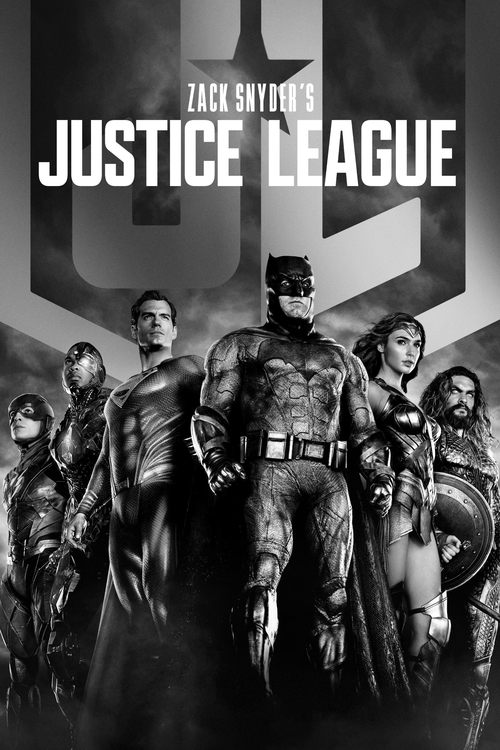
Zack Snyder's Justice League
2021 · Zack Snyder
Less a director than a fandom phenomenon: the #ReleaseTheSnyderCut campaign's success changed studio-fan power dynamics forever, and Rebel Moon's critical drubbing versus loyalist defense is a permanent internet fault line. Naming him takes a side.
For a full-commitment event night — clear the evening, dim the lights, and settle in for superhero storytelling at its most grandiose. Comfort viewing if you love the genre; an endurance test if you don't.
What it's about
With Superman gone, Bruce Wayne and Diana Prince race to assemble a team of scattered metahumans — a sea king, a speedster, a half-machine young man — before an ancient conqueror arrives to claim three artifacts that would remake the Earth. This is the four-hour director's version of the story, restored years after a very different theatrical cut, giving each hero a full arc before the battle begins.
The experience
Operatic, somber, and unhurried — closer to a miniseries than a popcorn movie, all slow motion, mythic framing, and thunderous score. It's a lot of film, but the length lets characters breathe, and the fans who campaigned for it got exactly the maximalist epic they wanted.
Performances
Ray Fisher's Cyborg benefits most from the restoration — his story becomes the emotional spine of the film, a grieving son learning what he's become.
The craft
Snyder presents it in a boxy, almost square frame built for sheer monumentality, with painterly slow-motion set pieces and a brooding new score. The whole four hours was reworked in post — new effects, new scenes, a chapter structure — and it demands the biggest screen and loudest speakers you have.
Why it matters
The most famous director's cut ever made — a studio spending real money to restore a filmmaker's version after an unprecedented fan campaign — and a case study in how streaming changed what's possible for a released film.
Snapshot
Zack Snyder's Justice League is a four-hour superhero epic released directly to HBO Max in March 2021, and it occupies an almost singular position in film history: a major studio's restoration of a director's intended version of a film that had already been released, three and a half years earlier, in a substantially different form. The 2017 theatrical Justice League had been completed by Joss Whedon after Snyder departed during post-production following the death of his daughter, Autumn. That release was a commercial disappointment and was widely disowned by Snyder's admirers. What followed was the multi-year "#ReleaseTheSnyderCut" fan campaign, an unusually visible and organized lobbying effort that eventually persuaded Warner Bros. to fund the completion of Snyder's edit. The result is not a fan-myth made flesh so much as a genuine alternate authorship: longer, darker, structured in chapters, scored anew, and stripped of the lighter comic register Whedon had imposed. As a cultural object it is inseparable from the conditions of its making; as a film it is a maximalist statement of Snyder's mythic-operatic sensibility applied to DC Comics' premier superhero team.
Industry & production
The production history is the film's defining fact. Snyder shot principal photography on Justice League in 2016 across UK and Iceland locations. After his exit in 2017, Warner Bros. brought in Whedon — fresh from Marvel's Avengers films — to oversee reshoots and re-editing, with a studio mandate reported to include a sub-two-hour runtime. The 2017 release ran roughly two hours and underperformed relative to the studio's hopes for the nascent DC Extended Universe.
The Snyder Cut was greenlit in 2020 amid the launch of HBO Max, WarnerMedia's streaming service, which needed marquee exclusive content. Warner reportedly committed a substantial sum — figures around $70 million were widely cited in trade reporting — to finish visual effects, complete unfinished sequences, record a new score, and add limited new photography during the COVID-19 pandemic. Because most of the cast's original performances existed on film, the "reshoots" were comparatively contained, focused on connective material (notably scenes involving Jared Leto's Joker that had never appeared in any prior version). The release strategy was itself novel: a tentpole-scale work bypassing theaters entirely for a streaming premiere on March 18, 2021, a decision shaped both by the pandemic's closure of cinemas and by the film's unconventional length and origins.
Technology
The film is a showcase of contemporary digital effects pipelines, with character work — the redesigned Steppenwolf in his fractal, reactive armor, and the fuller realization of Darkseid and Apokolips — built and re-rendered specifically for this version. Because the project assembled material shot in 2016 with effects completed in 2020–21, it is in part an exercise in retroactive VFX finishing: shots that had been incomplete or differently conceived for the theatrical cut were taken to completion under Snyder's supervision.
The most discussed technical choice is the 1.33:1 (4:3) aspect ratio, presented in a near-square frame. Snyder framed the film with IMAX exhibition in mind — the taller frame approximates IMAX's full-height image — and elected to preserve it even for home-screen streaming, an unusual decision that draws attention to vertical composition and to the framing of single figures. The film was also released in a monochrome "Justice Is Gray" version, underscoring Snyder's treatment of color as an expressive variable rather than a default.
Technique
Cinematography
Cinematographer Fabian Wagner, who also shot Snyder's Justice League photography in 2016, gives the film a desaturated, high-contrast palette consistent with the visual world Snyder and Larry Fong had established in Man of Steel and Batman v Superman. The 1.33:1 frame is exploited for monumentality: figures are isolated and stacked vertically, skies and architecture loom, and the square aspect lends a quasi-religious, altarpiece quality to hero compositions. Snyder's long-standing fondness for backlight, atmospheric haze, and silhouetting recurs throughout, and the imagery leans toward the painterly tableau rather than the kinetic handheld.
Editing
Where the 2017 cut was compressed, the Snyder Cut is expansive, running just over four hours and divided into named chapters plus an epilogue. Editing is credited to David Brenner and Dody Dorn. The chaptered structure slows the storytelling deliberately, giving each metahuman an extended introduction — most substantially Ray Fisher's Cyborg, whose arc was heavily trimmed in 2017 and is restored here as an emotional center. Snyder's signature editorial rhythms — abrupt speed-ramping, slow motion deployed for emphasis at moments of physical extremity — recur, particularly in The Flash's set pieces.
Mise-en-scène / staging
Staging tends toward the iconographic: heroes posed against landscape and sky, action arranged as a sequence of legible, frieze-like beats rather than continuous chaos. The production design extends the DCEU's brutalist-mythic vocabulary, from the Kryptonian and Apokoliptian machinery to the Amazonian and Atlantean settings. Snyder repeatedly composes for the held image — the tableau over the cut — and the longer runtime affords more of these contemplative arrangements than a conventional blockbuster would permit.
Sound
The new score by Tom Holkenborg (Junkie XL) replaces Danny Elfman's theatrical music wholesale and is one of the cut's most consequential changes. Holkenborg, who had collaborated with Hans Zimmer on Batman v Superman, supplies a dense, percussive, choral-inflected score with distinct leitmotifs for individual characters, including a keening female vocal associated with the Amazons. The sound design favors weight and impact, in keeping with the film's emphasis on scale and physical force.
Performance
The principal cast — Ben Affleck (Batman), Henry Cavill (Superman), Gal Gadot (Wonder Woman), Jason Momoa (Aquaman), Ezra Miller (The Flash), and Ray Fisher (Cyborg) — perform in the more somber register Snyder favors, the comedic beats and lighter banter of the Whedon version largely absent. Fisher's Cyborg, Victor Stone, is the performance most transformed by the restoration: given a full grief-and-identity arc, he becomes the film's dramatic fulcrum. Cavill's Superman appears in a black suit for much of his return, a costume choice long associated with the comics' "death and return" storyline.
Narrative & dramatic mode
The film's dramatic mode is mythic and elegiac rather than quippy. The plot — Bruce Wayne assembling a team to confront Steppenwolf's hunt for the three Mother Boxes, with Darkseid as the looming master threat — is essentially that of the 2017 release, but the telling is operatic, organized as a series of origin movements building to a collective stand. Snyder treats the superhero team-up as resurrection myth: Superman's death hangs over the action, his return is staged as a literal raising, and the narrative repeatedly frames its heroes as figures of sacrifice and faith. The much-discussed epilogue, including a "Knightmare" dystopian vision and the appearance of Leto's Joker, gestures toward sequels Snyder would never make, giving the film an unresolved, prophecy-laden quality.
Genre & cycle
Zack Snyder's Justice League belongs to the 2010s superhero team-up cycle, the same commercial form perfected by Marvel's Avengers, but it positions itself as the deliberate antithesis of that house style. Where the dominant cycle prizes lightness, interlocking continuity, and brisk runtimes, Snyder's film is long, grave, and tonally severe — closer in spirit to mythic fantasy epic than to the wisecracking ensemble adventure. It is the culminating statement of the "SnyderVerse," the director-driven strand of the DCEU running from Man of Steel (2013) through Batman v Superman (2016), a strand defined by its self-conscious gravity and its treatment of comic-book characters as modern gods.
Authorship & method
This is, more than almost any blockbuster of its era, an auteur object — its existence is an argument about authorship itself. Zack Snyder's method is visual-first and mythological: he builds from iconic images, treats narrative as a vehicle for tableau and theme, and draws openly on comics' splash-page grammar, religious iconography, and operatic emotion. His key collaborators here extend relationships across his DC work: cinematographer Fabian Wagner; composer Tom Holkenborg, whose wall-to-wall new score reorients the film's emotional architecture; and editors David Brenner and Dody Dorn, who realize the chaptered long-form structure. The screenplay credit traces to Chris Terrio, with story by Terrio and Snyder; the restoration restores Terrio's and Snyder's connective tissue that the theatrical version had pared away. Snyder's wife, Deborah Snyder, and his producing partners were central to shepherding the project. The film is also inseparable from a collective authorship the industry rarely acknowledges: the fan campaign whose pressure made the funding possible.
Movement / national cinema
The film is a product of the American studio-blockbuster system, financed and distributed by Warner Bros. and conceived within the franchise logic of the shared cinematic universe. It does not belong to a national-cinema movement in the art-historical sense, but it can be read against a particular Hollywood-industrial moment: the streaming-era pivot, in which platforms (here HBO Max) became willing to fund and host content that the theatrical market would not naturally support. In that sense it is an artifact of the platform economy as much as of any aesthetic movement.
Era / period
Released in March 2021, the film is a pandemic-era work in multiple senses: completed under COVID-19 restrictions, released to a streaming service while many theaters remained closed, and emblematic of the accelerated theatrical-to-streaming realignment of 2020–21. It also closes a chapter in DC's screen history — after its release, Warner's strategy moved decisively away from Snyder's vision, making the film a kind of terminus for the director-driven DCEU even as it was its fullest expression.
Themes
Snyder's preoccupations are present in concentrated form. Sacrifice and resurrection structure the whole: Superman's death and return are treated as a quasi-religious event, and the heroes are repeatedly framed as redeemers. Grief is the film's emotional undercurrent — most explicitly in Cyborg's loss of his mother and estrangement from his father, but inevitably colored, for many viewers, by the personal tragedy that removed Snyder from the original production. Faith, hope, and the question of whether humanity is worth saving recur, as they do across Snyder's DC films. The "unite the seven" / fellowship motif gives the film a mythic-quest shape, and its closing visions introduce a fatalistic strain — prophecy, ruin, and the fragility of victory — that the film leaves pointedly unresolved.
Reception, canon & influence
Influences on the film (backward): The most immediate source is the DC Comics canon itself — the New Gods mythology created by Jack Kirby (Darkseid, Apokolips, the Mother Boxes, the boom-tube cosmology) and the comics' "Death and Return of Superman" arc that licenses the black suit and resurrection plot. Aesthetically the film extends Snyder's own prior work, both his DC films and the comics-panel fidelity of 300 and Watchmen, with their splash-page compositions and speed-ramped action. Its mythic-operatic ambitions reach back toward the epic and the religious image more than toward the lighter strain of the modern team-up movie.
Critical reception: Critics broadly agreed that the Snyder Cut was a more coherent, better-realized film than the 2017 theatrical version, with restored character arcs — Cyborg's especially — and a unified tone, while many also found its four-hour length indulgent and its gravity unrelenting. Reception was thus genuinely mixed-to-favorable rather than uniform, and assessments often turned on one's tolerance for Snyder's maximalism. I should be candid that precise audience and financial metrics are not straightforwardly available: as a streaming exclusive, the film had no conventional box-office gross, and Warner did not release detailed viewership figures, so claims about its "performance" rest on limited public data.
Legacy (forward): The film's most durable influence may be industrial rather than aesthetic. The success of the #ReleaseTheSnyderCut campaign in compelling a studio to fund and release a director's alternate version became a reference point — and a cautionary tale — in debates about fan power, "director's cut" culture, and the leverage of online communities over corporate decision-making. It intensified discussion of toxic fandom as well, given controversies that surrounded the campaign and the production's labor disputes, including Ray Fisher's public allegations about the 2017 reshoot process. Aesthetically, the film stands as the definitive monument of the "SnyderVerse," a touchstone for that vision's devotees even as Warner's subsequent strategy moved away from it. Whether it inspires future films directly is uncertain; its clearer legacy is as a landmark case in how movies get made, unmade, and remade in the streaming age.
A Deleuzian reading
Stop the film almost anywhere and you have a poster.
The full Deleuzian reading of Zack Snyder's Justice League →
Reception
In 2017, Justice League limped out as a Frankenstein flop after Snyder's exit and Joss Whedon's reshoots; four years of #ReleaseTheSnyderCut later, HBO Max actually released the four-hour version — and even many skeptics admitted it was a real, coherent movie rather than a fan mirage.
How Zack Snyder's Justice League was received, from release to now →
Influences: the films it descends from and the films it influenced
- 300 (2006) — Snyder's own template for speed-ramping (whip from slow-motion to real-time mid-blow) over a desaturated, high-contrast palette that renders every frame as a Frank Miller splash panel.
- Watchmen (2009) — Establishes Snyder's splash-page grammar of slow-motion iconographic tableaux composed for maximum graphic-novel fidelity, the same panel-to-screen logic structuring JL's hero-reveal compositions.
- Sin City (2005) — Pioneers the literal comics-panel transcription — extreme high-contrast, near-monochrome silhouetting and backlight — that licenses Snyder's anti-naturalistic, ink-and-shadow superhero image.
- Man of Steel (2013) — Originates the SnyderVerse desaturated teal-amber palette and the Superman-as-Christ-figure staging (cruciform poses, sacrificial framing) that JL's resurrection arc directly continues.
- Batman v Superman: Dawn of Justice (2016) — Direct narrative-craft predecessor: plants the Death-of-Superman beat and the prophetic Knightmare dream-tableau, vertical monumental framing of figures dwarfed against architecture that JL pays off.
- The Matrix (1999) — Codifies the bullet-time/variable-speed action grammar — ramping into frozen mid-air beats to fetishize a body in motion — that Snyder inherits and applies to Flash's perceptual-time sequences.
- Excalibur (1981) — Models the backlit, mist-and-armor mythic-operatic image where knights become religious icons, the same fusion of medieval pageantry and sacred light Snyder uses for the Amazon/Atlantean tableaux.
- The Passion of the Christ (2004) — Supplies the slow-motion theology of suffering and resurrection rendered as devotional image, the sacrifice-and-faith iconography Snyder maps onto Superman's death and return.
- Triumph of the Will (1935) — Source of the low-angle vertical monumentality and mass iconographic tableau — backlit figures shot as monuments against sky — that Snyder repurposes for heroic deification framing.
- Metropolis (1927) — Foundational vertical-monumental architecture and the figure overwhelmed by towering scale, the compositional scale-logic underpinning Apokolips and Snyder's cathedral-like staging.
- Kingdom of Heaven (2005) — The end point of the alternate-cut culture Kingdom of Heaven's 194-minute roadshow presentation legitimized — long-form assembly with overture-style chaptering marketed as the authorial version, though produced by campaign and reshoot rather than recovered from the cutting room.
- Superman (1978) — The Donner Cut's direct structural heir — a director's version of a taken-away film reassembled under fan pressure and released as an alternate authorial text, establishing restoration-by-campaign as a distribution form rather than an archival one.
- Army of the Dead (2021) — Snyder extends his own speed-ramped, backlit-silhouette action grammar and shallow-focus monumental framing into the heist genre the same year, the technique traveling intact.
- Rebel Moon (2023) — The fullest descendant of JL's method: chaptered long-form structure, relentless speed-ramping, backlight-silhouette tableaux and resurrection/sacrifice mythos rebuilt as original space-opera.
- Mad Max: Fury Road (2015) — Showcases collaborator Tom Holkenborg's (Junkie XL) percussive, wall-to-wall leitmotif scoring method that Snyder hired to rebuild JL's entire emotional architecture.
- Eternals (2021) — Parallel attempt to translate Jack Kirby's cosmic New-Gods mythology into monumental, statuesque tableaux — gods posed against landscape — sharing JL's Kirby-derived iconographic staging.
- Dune (2021) — Contemporaneous craft-sibling in desaturated, vertical-monumental sci-fi epic image-making, dwarfing figures against brutalist scale with a low, droning leitmotif score.
- Avengers: Endgame (2019) — Sibling superhero team-up built on the same resurrection-and-reassembly narrative engine and culminating iconographic hero-line-up tableau, though pitched toward levity rather than Snyder's operatic gravity.
- Avengers: Infinity War (2018) — A competing studio's ensemble-assembly film crosscutting individually-introduced heroes against a genocidal cosmic villain seeking convergent artifacts (the Mother Boxes to Infinity Stones).
Similar films
- Man of Steel (2013) — influence & lineage
- Avengers: Endgame (2019) — influence & lineage
- Superman (2025) — shared sensibility
- The Lego Batman Movie (2017) — shared sensibility
- Batman: The Dark Knight Returns, Part 2 (2013) — shared sensibility
- 300 (2007) — shared sensibility
- Masters of the Universe (2026) — shared sensibility
- Batman: The Dark Knight Returns, Part 1 (2012) — shared sensibility
All the films related to Zack Snyder's Justice League →