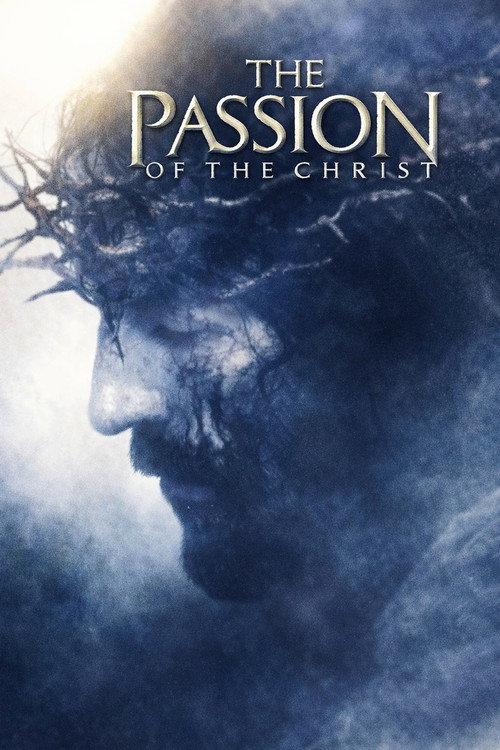
The Passion of the Christ
2004 · Mel Gibson
Not a casual pick: reach for it when you want a serious, demanding experience — as an act of faith, during Easter season, or to understand a genuine cultural phenomenon. This is challenge viewing, full stop, and not for the squeamish.
What it's about
The last twelve hours of Jesus of Nazareth's life, from his arrest at night in the garden of Gethsemane through interrogation, scourging, and crucifixion. Mel Gibson stages it hour by hour, with all dialogue in reconstructed Aramaic, Latin, and Hebrew, aiming for the immediacy of witnessed event rather than pageant.
The experience
Punishing by design — the violence is sustained, graphic, and meant to be endured rather than watched; many viewers describe it as an ordeal that is also, for them, a devotional act. It is solemn, relentless, and physically hard to sit through.
Performances
Jim Caviezel undergoes one of the most physically committed performances in modern film, conveying nearly everything through a battered body and eyes, largely without intelligible dialogue.
The craft
The ancient-language dialogue, painterly candlelit imagery, and unflinching makeup effects create a startling sense of historical immersion. Gibson's staging draws on centuries of religious painting, and the film's refusal to cut away from suffering is itself the central formal choice — one you should know about going in.
Why it matters
Financed independently and marketed through churches, it became a cultural event and one of the highest-grossing R-rated films ever, proving a massive audience existed outside Hollywood's usual channels — while igniting fierce controversy over its portrayal of the events. It remains the benchmark modern Biblical film.
Snapshot
The Passion of the Christ is Mel Gibson's unflinching, hour-by-hour dramatization of the final twelve hours of Jesus of Nazareth's life, from the arrest in Gethsemane through the scourging, the way of the cross, and the crucifixion. It is remembered for three radical choices: dialogue performed entirely in reconstructed Aramaic, Latin, and Hebrew with subtitles; a sustained, almost documentary intensity of physical suffering that earned it an R rating and made "endurance" a category of viewing; and a mode of distribution and reception that ran outside the ordinary industrial channels of Hollywood. Financed independently by Gibson and marketed heavily through churches, it became a cultural event as much as a film — the highest-grossing religious feature and, for over a decade, the highest-grossing R-rated film in the American market. It is also among the most bitterly contested films of its era, at the center of a public argument over whether its portrait of Jesus's Jewish accusers revived old antisemitic tropes. Any honest account of the film must hold its formal seriousness and its controversy together.
Industry & production
The film's production history is inseparable from its meaning. Gibson, then one of the most bankable stars and an established director (an Oscar winner for Braveheart), developed the project as a personal act of faith and could not, or would not, secure conventional studio backing for a subtitled, extremely violent Passion narrative. He financed it himself through his company Icon Productions, on a modest budget by star-vehicle standards (widely reported at roughly $30 million; I flag that figure as an industry estimate rather than a certified accounting). When the major studios passed, distribution went to Newmarket Films, the independent that had handled Memento — a telling sign of how far outside the mainstream the project sat.
Principal photography took place in Italy, using the ancient cave-dwellings of Matera in Basilicata — long a stand-in for biblical Judea — and the sound stages of Cinecittà in Rome. The shoot was famously punishing: Jim Caviezel, playing Jesus, was reportedly injured during the scourging sequences, suffered exposure and hypothermia on the cross set, and was struck by lightning during filming, an incident that became part of the movie's lore.
The release strategy was itself an innovation. Icon and Newmarket bypassed the usual critical gatekeepers and courted pastors, congregations, and religious organizations directly, arranging advance screenings and block ticket purchases. Timed to open on Ash Wednesday 2004, the film turned churchgoing communities into a distribution network. The result was a commercial phenomenon disproportionate to its budget and genre, and a demonstration — closely studied afterward — that a faith audience could be reached and mobilized outside the standard marketing playbook.
Technology
The Passion is a photochemical, largely analog production in an era when digital tools were becoming routine, and its look reflects a deliberate embrace of celluloid texture and practical craft. It was shot on 35mm film by Caleb Deschanel, who favored film's rendering of shadow and skin. The picture leans on in-camera and practical lighting, prosthetic and makeup effects for the wounds and scourging, and slow-motion for its moments of heightened suffering, rather than on a digital-effects spectacle. Where digital work appears, it is largely invisible, in the service of the painterly image rather than as a display. A notable technological footnote is the film's afterlife in re-edited form: Gibson later released The Passion Recut, a version with several minutes of the most graphic violence trimmed, an attempt to widen access to audiences deterred by the original's brutality.
Technique
Cinematography
Caleb Deschanel's photography is the film's most admired formal achievement and earned him an Academy Award nomination. The visual grammar is explicitly indebted to Baroque painting — the tenebrism of Caravaggio above all, with its bodies emerging from deep darkness into raking, sculptural light. Gethsemane is bathed in cold, bluish night; the scourging plays out in a bleached, shadowless courtyard; Golgotha builds toward a desaturated, storm-darkened climax. Deschanel and Gibson use color temperature and light quality to move the film through emotional registers, and the camera oscillates between reverent stillness — compositions arranged like altarpieces — and a jolting, handheld immediacy during the violence. Slow motion is deployed sparingly and pointedly, stretching moments of impact and grief into something closer to liturgical contemplation.
Editing
Cut by John Wright, the film's structure is fundamentally linear — a forward march toward the cross — but it is punctuated by flashbacks that supply the only relief from the present-tense agony: Jesus as a carpenter, the Last Supper, the Sermon on the Mount, moments with his mother. These interpolations do editorial work, framing the suffering as sacrifice rather than mere ordeal and giving the audience the theological context the stripped-down narrative otherwise withholds. The cutting during the scourging is deliberately extended past the point of comfort, using duration itself as an expressive device; the film wants the viewer to feel the length of the suffering, not to be spared it.
Mise-en-scène / staging
The staging aspires to the condition of religious painting brought to life. Costumes, textures, and the weathered stone of Matera create a tactile, grimy antiquity far from the clean pageantry of the old Hollywood biblical epic. Gibson stages key tableaux — the Pietà-like cradling of the dead Christ, the falls on the Via Dolorosa — as living quotations of the visual tradition of Western Christian art. One of the boldest staging choices is the recurring figure of Satan, an androgynous, hooded presence (played by Rosalinda Celentano) who drifts through the crowds as a silent tempter and observer, a non-scriptural interpolation that gives the film a mythic, almost horror-inflected dimension.
Sound
Because the dialogue is in dead and ancient languages, sound carries an unusual burden. The film asks the audience to follow emotion through vocal texture, cadence, and cry rather than through legible speech, which lends the soundtrack an incantatory quality. The sound design foregrounds the visceral — the whistle and crack of the flagrum, the pounding of nails, ambient wind and crowd — building a nearly bodily assault to match the imagery. John Debney's score, discussed below, weaves through this design as its emotional connective tissue.
Performance
Jim Caviezel's Jesus is a performance built almost entirely on physical endurance and the eyes, given the language barrier and the character's near-total passivity through the ordeal; expression must survive prosthetics and blood. Maia Morgenstern, as Mary, provides the film's emotional anchor, her grief functioning as the audience's point of identification and access. Monica Bellucci appears as Mary Magdalene, and the supporting cast — largely European actors performing in unfamiliar tongues — sustains a register of grave seriousness. The performances are pitched toward the iconic rather than the psychological, in keeping with the film's devotional aims.
Narrative & dramatic mode
The film's dramaturgy is radical in its narrowness. Rather than a life of Christ, it dramatizes only the Passion — roughly the last twelve hours — compressing the story to its terminal ordeal. This concentration removes the conventional arc of teaching, miracles, and rising conflict; the outcome is known, the theology assumed. What remains is a dramatic mode closer to Stations of the Cross than to classical narrative: a devotional progression through fixed episodes of suffering, designed for contemplation and emotional-spiritual participation rather than suspense. The flashbacks are the only concession to exposition, and they function less as plot than as gloss. The effect is deliberately liturgical, positioning the viewer as witness and mourner.
Genre & cycle
The Passion belongs to the long tradition of the Hollywood biblical epic — the lineage of The King of Kings, The Greatest Story Ever Told, and King of Kings — but it inverts that tradition's conventions. Where the mid-century epic offered lavish spectacle, reverent distance, and a luminous, untouchable Christ, Gibson delivers claustrophobic intensity, graphic corporeality, and an aesthetic of horror and endurance. It converses pointedly with the more artful, revisionist Jesus films that preceded it — Pier Paolo Pasolini's austere The Gospel According to St. Matthew and Martin Scorsese's controversial The Last Temptation of Christ — while rejecting their interpretive liberties in favor of a claim to devotional literalism. Commercially, it effectively inaugurated (or vastly amplified) the modern faith-based film cycle as a distinct market segment.
Authorship & method
This is emphatically an auteur's film, and Gibson's authorship runs from financing to final cut. His method fused a traditionalist Catholic devotional sensibility with the visceral, body-centered filmmaking already visible in Braveheart — a fascination with martyrdom, physical suffering, and redemptive violence. The screenplay, credited to Gibson and Benedict Fitzgerald, draws on the four Gospels but also, by wide account, on the nineteenth-century mystical visions of the Augustinian nun Anne Catherine Emmerich (The Dolorous Passion of Our Lord Jesus Christ), which supplied several non-canonical details and much of the film's emphasis. The decision to shoot in Aramaic, Latin, and Hebrew — Gibson initially hoped to release with no subtitles at all — reflects a purist ambition for immersion and authenticity.
His key collaborators were essential to realizing that vision. Cinematographer Caleb Deschanel translated Gibson's painterly instincts into image and earned an Oscar nomination. Composer John Debney produced a score blending orchestral, choral, and Middle Eastern and ethnic vocal elements — solemn, keening, and enveloping — that carries much of the film's emotional argument and was itself Oscar-nominated. Editor John Wright shaped the film's punishing rhythm and its flashback architecture. Co-writer Benedict Fitzgerald partnered on the adaptation. The film received three Academy Award nominations — cinematography, original score, and makeup.
Movement / national cinema
The film resists tidy placement within a national cinema. It is an American production by an American star-director, made through an independent American company, yet shot in Italy with a largely international cast in ancient languages, drawing its visual DNA from European religious painting and its narrative sensibility from a transnational Catholic devotional tradition. If it belongs to any "movement," it is less a stylistic school than a phenomenon: the emergence of a self-conscious faith-based filmmaking sector operating parallel to, and partly in reaction against, mainstream secular Hollywood. Its use of Matera and Cinecittà also ties it to the long history of international productions using Italy as biblical antiquity.
Era / period
The film arrived in early 2004, in a post-9/11 American climate marked by heightened religiosity, culture-war intensity, and sharp public argument over faith in public life. Its success was read at the time as evidence of an underserved and mobilizable religious audience, and it landed amid a broader Hollywood interest in event filmmaking and franchise spectacle to which it stood as a stark, unglamorous counterexample. Technologically it sits at the tail end of the fully photochemical era, just before digital capture became dominant. Its independent financing and church-based marketing anticipated later shifts toward niche-targeted, community-driven distribution.
Themes
The film's central theme is redemptive suffering — the conviction that Christ's physical agony is salvific, that the wounds themselves carry meaning. Gibson dwells on the body in extremity to a degree unprecedented in mainstream Jesus films, insisting on the cost of sacrifice as a felt, corporeal reality rather than a symbol. Adjacent to this run themes of maternal grief (Mary as co-sufferer and witness), the presence of evil as an active, personified force (the androgynous Satan), and the contrast between physical brutality and spiritual triumph. The film also engages, unavoidably and controversially, the theme of guilt and responsibility for the crucifixion — the question of who is shown to condemn Christ, and how, which became the flashpoint of its reception.
Reception, canon & influence
Critical reception was deeply polarized. Admirers praised the film's formal seriousness, Deschanel's imagery, and its raw devotional power; detractors found its relentless violence gratuitous, even sadistic, and questioned whether spectacle had overwhelmed spirit. The most serious charge was antisemitism: critics, scholars, and Jewish organizations argued that the film's portrayal of the Jewish high priests and crowd as the drivers of Jesus's death revived the "Christ-killer" tradition that Christian churches had spent the postwar decades repudiating. The controversy focused in part on the line from Matthew 27:25 ("His blood be on us and on our children"); by widely reported accounts, Gibson retained the line in the spoken Aramaic while removing it from the subtitles. Gibson and defenders rejected the antisemitism charge, and the debate was inflected by scrutiny of his own background and, later, by his personal conduct. This argument is now inseparable from the film's place in history.
Its influences run backward to the four Gospels, to Emmerich's mystical writings, to the Stations of the Cross devotion, and visually to the Western tradition of Passion painting, Caravaggio foremost. Its legacy runs forward in several directions. Commercially, it demonstrated the scale and reachability of the faith audience and helped catalyze the modern faith-based film industry — the wave of church-marketed features and biblically themed projects (such as Son of God and Risen) that followed in its wake. It made the ancient-language, subtitled historical film briefly viable at scale. And it durably reshaped popular imagery of the Passion toward graphic realism. Gibson has long spoken of a sequel centered on the Resurrection; as of this writing that project remains in development rather than realized, and I note it as an announced intention rather than an accomplished fact. More than twenty years on, The Passion of the Christ stands as a genuine anomaly of its era — a devotional artwork, a commercial disruption, and a lasting controversy, all at once.
A Deleuzian reading
A courtyard at midmorning, bleached white, and no shadows anywhere in it.
The full Deleuzian reading of The Passion of the Christ →
Reception
In 2004 it was a full-blown cultural event — protests, op-eds, church groups buying out entire theaters — and it shocked Hollywood by grossing over $600M on Gibson's own money. Two decades on it's still radioactive: a devotional Easter staple for some, while much of film culture views it through the lens of the controversies and Gibson's later scandals.
How The Passion of the Christ was received, from release to now →
How to watch The Passion of the Christ: what to notice on a first viewing
- Notice how light falls from one side, leaving darkness. Deschanel builds most scenes in Caravaggio-style tenebrism, bodies emerging from black, until the scourging courtyard is lit flat and shadowless from every side. The one place the darkness disappears is the one place you are meant to look longest.
- Listen for cries and cadence, not legible words. Dialogue plays entirely in reconstructed Aramaic, Latin, and Hebrew, so emotion travels through voice and cry rather than vocabulary. You feel the emotion in the sound before subtitles tell you what was said.
- Notice the brief scenes of Jesus as carpenter or teacher. These flashbacks interrupt the forward march toward the cross, supplying the context the stripped-down present-tense narrative otherwise withholds. They reframe the suffering you are watching as sacrifice, not just as an ordeal.
- Track how often the camera returns to Mary's face. Maia Morgenstern's grief anchors nearly every major sequence; she cannot act on what she sees, only witness it. Mary is what the reading calls the seer, someone who can only watch and endure, not intervene.
- Look at scenes staged like paintings, bodies posed in light. Gibson stages the Pietà-like cradling of the dead Christ and the falls on the Via Dolorosa as living quotations of Christian religious art. These posed, held moments borrow the authority of painting to make suffering feel sacred rather than random.
The whole guide to watching The Passion of the Christ, with the keys for a rewatch →
Influences: the films it descends from and the films it influenced
- The Passion of Joan of Arc (1928) — Renders martyrdom almost entirely through relentless close-ups of an anguished face and Falconetti's punishing physical-endurance performance, the devotional-intensity template Gibson revives for iconic bodily suffering.
- The Gospel According to St. Matthew (1964) — Staged the Passion on the raw stone of Matera with non-professional casting and documentary austerity — the exact location and immersion precedent Gibson extends (he too shot at Matera).
- The Last Temptation of Christ (1988) — Establishes a corporeal, physically vulnerable Christ whose agony is felt in the flesh and an interior flashback architecture cutting the Passion against memory that Gibson's editing directly adopts.
- Andrei Rublev (1966) — Composes long-take living tableaux of faith and bodily endurance like devotional painting, the extended-duration contemplation of suffering Deschanel and Wright echo.
- Diary of a Country Priest (1951) — Structures redemptive suffering as a stations-like via dolorosa tracking a Christ-figure's bodily decline, an austere Catholic model for the film's liturgical-stations narrative.
- Barabbas (1961) — Pushed the biblical epic toward graphic, physically realistic crucifixion and Roman brutality (even filming the darkness during a real eclipse), the flesh-and-blood realism Passion consummates.
- Ben-Hur (1959) — Codified the reverent, largely off-screen roadshow-scale Passion staging that Gibson inherits in ambition and deliberately overturns through unflinching graphic explicitness.
- Caravaggio (1986) — Dramatizes Caravaggio's tenebrist chiaroscuro as single-source-lit living tableaux, the painterly lighting method Deschanel adapts for the film's caravaggesque tenebrism.
- Braveheart (1995) — Gibson's own template of slow-motion martyrdom, public torture-execution as climax, and redemptive violence, carried whole into the scourging and crucifixion.
- Apocalypto (2006) — Extends Passion's fully subtitled ancient-language immersion into Yucatec Maya and reprises the body-endurance-through-torment gauntlet as its central structural engine.
- The Nativity Story (2006) — The immediate studio attempt to reproduce Passion's reverent naturalistic realism and faith-audience reach within the biblical epic.
- Son of God (2014) — A church-marketed Gospel feature built directly on the faith-audience distribution model Passion proved commercially viable at scale.
- Risen (2016) — A Resurrection-centered companion applying Passion's grounded, tactile first-century realism to the aftermath Gibson himself long promised to film.
- Hacksaw Ridge (2016) — Transposes Passion's martyrdom-endurance to war, again framing a Christ-figure who absorbs graphic bodily violence as redemptive witness in Gibson's slow-motion idiom.
- Mary Magdalene (2018) — A naturalistic, ancient-world-textured Passion retelling that reacts against Gibson's violence while inheriting his realist, location-grounded idiom.
- The Chosen (2017) — Serialized, crowd-funded Gospel drama that scaled the devoted faith-audience market Passion first revealed as commercially self-sustaining.
- Zack Snyder's Justice League (2021) — Supplies the slow-motion theology of suffering and resurrection rendered as devotional image, the sacrifice-and-faith iconography Snyder maps onto Superman's death and return.
- The Chronicles of Narnia: The Lion, the Witch and the Wardrobe (2005) — Proved a mobilizable faith audience and church-marketing apparatus that Disney and Walden courted directly to sell the stone-table sacrifice's Christian allegory.
- Silence (2016) — Makes sustained depiction of bodily martyrdom and faith under torture its central devotional argument, extending the endurance-as-theology logic Passion shares with Scorsese's earlier Christ film.
- Martyrs (2008) — Stages martyrology as durational, practical-effects flagellation framed as suffering-as-witness, the same religious-passion scaffolding Martyrs adopts for its finale.
- The Message (1976) — Pursues the same devotional-authenticity strategy of shooting sacred history in original liturgical languages (Aramaic/Latin) with recitation-driven sound, treating linguistic and theological fidelity as a structural precondition as Akkad did.
Similar films
- Apocalypto (2006) — influence & lineage · often watched together
- Andrei Rublev (1966) — influence & lineage · often watched together
- The Last Temptation of Christ (1988) — influence & lineage
- Braveheart (1995) — influence & lineage
- Silence (2016) — influence & lineage
- Hacksaw Ridge (2016) — influence & lineage
- Ben-Hur (1959) — influence & lineage
- Hard to Be a God (2014) — same viewing thread
All the films related to The Passion of the Christ →
Watch it with: curated runs of related films
- Bodies at the End of the World — A run of visionary, punishing films where flesh is scarred, melted, mechanized or sacrificed while the world tips into its last days — watch these back to back when you want cinema at its most extreme and transcendent.