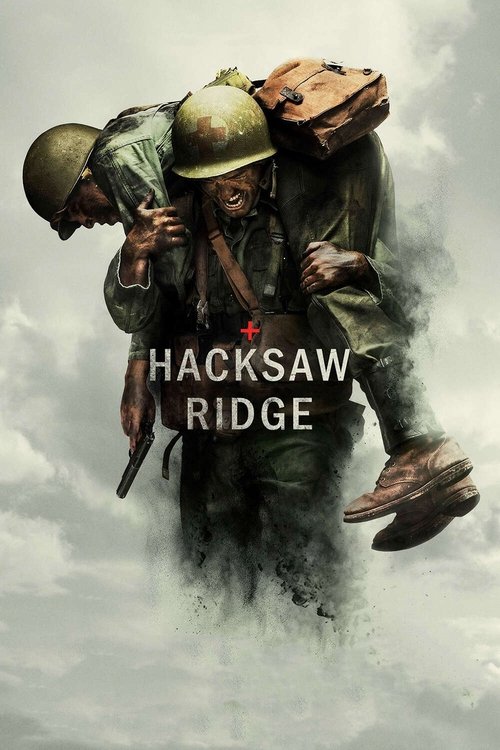
Hacksaw Ridge
2016 · Mel Gibson
For when you want a true story that restores some faith in people — and you have the stomach for graphic, unsparing war violence. Uplifting destination, brutal road.
What it's about
Desmond Doss, a devout young man from rural Virginia, enlists in World War II determined to serve as a medic without ever touching a rifle — a conviction that makes him a pariah in boot camp before it makes him extraordinary. The film follows his courtship and stubborn faith at home, then plunges into the Battle of Okinawa, where an unarmed man walks into one of the war's worst killing grounds.
The experience
Two films in one: a tender, old-fashioned first hour, then combat of overwhelming ferocity. It's inspiring and harrowing in equal measure — expect to flinch, and expect a lump in your throat.
Performances
Andrew Garfield makes Doss's gentleness feel like steel rather than naivety — an Oscar-nominated turn that keeps a saintly figure human — and Hugo Weaving is wrenching as his haunted veteran father.
The craft
Gibson stages the Okinawa sequences with visceral, ground-level intensity — mud, fire, and chaos rendered with largely practical grit — and the film's editing and sound work were Oscar-winning. On a big screen with good sound, the battle scenes are overwhelming by design.
Why it matters
It marked Mel Gibson's return as a director after a decade in the wilderness, earned six Academy Award nominations, and revived the earnest combat epic for a new audience.
Snapshot
Mel Gibson's return to the director's chair after a decade of professional exile produced one of the most morally unusual war films of the twenty-first century: a sincere, full-throated tribute to a man who refused to pick up a weapon. Based on the documented life of Desmond T. Doss — a Seventh-day Adventist from Lynchburg, Virginia who served as an unarmed combat medic during the Battle of Okinawa and became the first conscientious objector to receive the Medal of Honor — Hacksaw Ridge operates on a structural and tonal contradiction it never tries to resolve. The film is simultaneously a pacifist's portrait and a gore-saturated combat picture; a Protestant hymn to personal conviction delivered by a director whose artistic sensibility is soaked in Catholic martyrology. That tension is not a flaw so much as the film's defining condition.
Industry & production
The project had a long gestation. The real Doss, who died in 2006, had been interviewed for a 2004 documentary, The Conscientious Objector, produced by Terry Benedict, and the dramatic rights were pursued by multiple parties before the property reached Bill Mechanic and David Permut, who shepherded it to screen. Robert Schenkkan — a Pulitzer Prize–winning playwright — wrote an early draft; Andrew Knight, an Australian screenwriter, was brought on to revise and tighten the script, resulting in the shared screenplay credit. Gibson attached himself as director after reading Schenkkan and Knight's work, reportedly drawn to Doss's unbreakable sense of personal covenant in conditions designed to break it.
Financing came from a mixture of American and Australian sources, with Summit Entertainment (Lionsgate) handling North American distribution. Production relocated almost entirely to Australia, a practical and fiscal decision that also placed Gibson close to the local industry infrastructure he had used throughout his career. The film was shot primarily in New South Wales — the Hunter Valley region and various properties around Sydney standing in for rural Virginia, with Fox Studios Australia providing the backlot and production facilities for the extensive battle sequences. The Okinawa escarpment itself, the film's central topographical fact, was a constructed practical set extended and augmented with digital work.
The budget, by Hollywood standards for a major war film, was notably modest — reported in the range of forty million dollars — a figure that placed significant pressure on the production design and visual-effects teams. The film's worldwide theatrical gross significantly exceeded that investment, and its six Academy Award nominations, including Best Picture and Best Director for Gibson, confirmed the commercial gamble as a critical and industrial rehabilitation story running parallel to the human story onscreen.
Technology
Gibson and cinematographer Simon Duggan shot on the ARRI Alexa, the dominant digital acquisition platform of the mid-2010s. The choice allowed the kind of high dynamic range and latitude in the shadow detail that the extreme contrast of the battle sequences demanded — fire, smoke, and mud in deep darkness, interspersed with blinding daylight. The film avoids the desaturated, blue-gray palette that had become a visual cliché of post-Saving Private Ryan war cinema; Duggan's approach retains warmth in the Virginia sequences and allows the Okinawa images a sickly but not purely monochromatic palette that emphasizes the organic grotesquerie of the battlefield.
The practical effects work under the supervision of the production design department was extensive. The ridge escarpment set was built to allow vertical movement — soldiers climbing ropes, bodies falling — in ways that would have been impossible or prohibitively expensive as entirely digital constructions. Visual effects supervised by Sebastien Moreau integrated digital extensions, crowd simulation, and enhancement of practical gore elements. The combination is largely seamless, and the film belongs to a tradition of augmented-practical rather than fully synthetic war filmmaking.
Technique
Cinematography
Duggan's visual strategy divides cleanly along the film's narrative fault line. The Virginia sequences are bathed in the golden-hour light of American pastoral cinema: rolling fields, a white church, a father's weathered face. The frames breathe. When Doss first sees Dorothy Schutte through a window at a medical clinic, the shot possesses a genuine Hollywood softness, an image borrowed from the studio romance. This visual grammar is deliberate because its shattering must be earned. Once the film crosses to Okinawa, the camera becomes unstable, handheld, pressed into the action. The escarpment sequences are shot with an almost suffocating closeness to bodies — the viewer cannot abstract violence into choreography because the lens will not grant the distance.
Editing
John Gilbert's editing won the Academy Award, a recognition that acknowledges genuine craft difficulty. The film's first act is classical and measured; its second operates at two distinct registers: frenzied parallel cutting during combat, and long, sustained takes when Doss is alone in the dark, lowering wounded soldiers over the cliff's edge. Gilbert's particular achievement is managing the transition between these modes without making the quieter passages feel like conventional respite from action. The rhythm of the rescues — rope, prayer, next man — becomes a kind of liturgical repetition that editing enforces rather than merely depicts.
Mise-en-scène / staging
Gibson's staging instincts are fundamentally theatrical and muscular. He has spoken in interviews about his admiration for the unironic staging of spectacle, and the battle sequences reflect a director who thinks in terms of spatial geography rather than montage-as-reality. The escarpment is a literal threshold — the film repeatedly stages figures at its edge, bodies falling, ropes stretching between earth and void. The staging of Doss's lone-night rescue owes something to hagiographic visual tradition: a solitary figure moving through carnage in a state of almost preternatural calm, filmed to suggest election rather than mere individual courage.
Sound
The sound design, supervised by Robert Mackenzie and Kevin O'Connell (the latter winning the Academy Award for Sound Mixing), is perhaps the film's most consistently sophisticated technical element. Gibson and the sound team work against the expectation of numbing loudness: the battles are oppressively loud, yes, but the specific choice of sounds — the wet percussion of close-range wounds, the low register of artillery detonating beneath the ridgeline — is calibrated for horror rather than spectacle. The relative silence of Doss's solitary nighttime passages is absolute; the contrast does more narrative work than any dialogue.
Performance
Andrew Garfield's performance as Doss is the film's emotional center and its most discussed element. The casting against type was significant — Garfield, best known at that point for The Social Security Network (2010) and the Amazing Spider-Man franchise, brought a quality of guileless sincerity to the role that a conventionally rugged war-film lead could not have managed. His Doss is not without intelligence, but his moral vocabulary is simple, bedrock, unteachable — a man who has decided one thing and will not undecide it regardless of what the institution or the battlefield demands. Garfield received a Best Actor nomination. Hugo Weaving as Tom Doss, a scarred WWI veteran with a violent alcoholism that is both cause and context for his son's pacifism, brings the film's most textured supporting work. Vince Vaughn as Sergeant Howell operates in a register closer to classical Hollywood drill-sergeant archetype, and Vaughn handles it with self-aware precision, knowing what kind of movie he is in during the training sequences and what kind he has entered by the end.
Narrative & dramatic mode
Hacksaw Ridge is formally a diptych. The first half — roughly seventy minutes — is a domestic and institutional bildungsroman: Doss's Virginia upbringing, his father's trauma, the inciting incident of near-fraternal violence that crystallizes his refusal to touch weapons, the courtship, the enlistment, the brutal campaign of harassment and legal pressure conducted against him during training. This is the film Gibson needed to make to earn the second half. The mode is earnest genre classicism: romance, coming-of-age, institutional-resistance narrative.
The second half is a war film of unusual ferocity. The shift is not gradual; it arrives with the deliberateness of a chapter break. Gibson's commitment to representing the Battle of Okinawa as industrialized slaughter — bodies in mud, fire, rats, the dead used as cover by the living — positions the film as a legitimate heir to the post-Vietnam tradition of physically unsparing combat cinema. The dramatic irony sustaining the entire second half is that the film's most violent sequences center on its most committed pacifist. Doss's refusal to carry a weapon is not tested in a safe environment; it is tested in hell, and the film's argument is that his actions in that hell were more courageous for the unarmed condition in which he performed them.
Genre & cycle
The film arrives in the company of a early-twenty-first century cycle of prestige American war films that attempted to reclaim WWII as a site of uncomplicated heroism following a decade of ambivalent Iraq-and-Afghanistan combat pictures. Films like Fury (2014) and Unbroken (2014) mark the edges of this cycle; Hacksaw Ridge is its most morally specific entry because its hero's heroism is predicated on an explicit rejection of the genre's conventional premise — that a soldier's virtue is expressed through combat effectiveness. The film also connects to the biographical-religious epic, a subgenre with roots in the classical Hollywood studio era that Gibson's career has consistently revisited.
Authorship & method
Gibson is one of the cinema's most unambiguous auteurs in the sense that his films — as director — are legible as a continuous project even across wildly different subjects. Braveheart (1995), The Passion of the Christ (2004), Apocalypto (2006), and Hacksaw Ridge share a structure: a protagonist defined by a singular conviction faces institutional power, undergoes extreme physical suffering that the film depicts without mitigation, and emerges transformed or transfigured. The suffering is not incidental; it is the point. Gibson's Catholic sensibility — rooted in a traditionalist formation that is more medieval than contemporary — organizes these films around a theology of redemptive pain that is both their most distinctive and most contested quality.
Robert Schenkkan and Andrew Knight's screenplay is notable for what it does not do: it does not psychologize Doss's faith away or treat it as repression or neurosis. The script respects the covenant as a covenant. This was reportedly a condition Gibson placed on the project.
Simon Duggan's cinematography collaboration gave Gibson a visual partner who understood the dual demands of the material. Rupert Gregson-Williams composed the score, which operates in the mode of orthodox orchestral war-film scoring — full strings, military percussion — without obvious formal innovation, but with calibrated restraint at the film's most important emotional moments. John Gilbert's editing collaboration extended across the full post-production period and was central to the film's final shape.
Movement / national cinema
Hacksaw Ridge is an American film in subject and distribution, but it is in practice a co-production that reflects a specific strand of Australian-Hollywood collaboration that has characterized much of Gibson's career since Braveheart. The Australian crew, cast members (Weaving, Worthington, Palmer, Griffiths), and production infrastructure are not incidental. Australia's robust government film incentives and the technical excellence of its below-the-line talent have made it a consistent location for large-scale American productions requiring practical flexibility, and Gibson — who spent formative professional years in the Australian industry — has returned to this infrastructure repeatedly. The film is not meaningfully a work of Australian national cinema in terms of cultural concern, but it demonstrates the continuing industrial symbiosis between Hollywood and Sydney-based production.
Era / period
The film is set during WWII, specifically 1940–1945, with the climactic sequences depicting the Battle of Okinawa (April–June 1945). The period is rendered with considerable attention to material culture — uniforms, equipment, the specifics of the Hacksaw Ridge escarpment (officially Maeda Escarpment) and its tactical significance in the broader Okinawa campaign. The film was released in 2016, during a moment of renewed American public interest in mid-century national mythology, a nostalgia that carried distinct political valence in the year of the presidential election.
Themes
The film's central thematic concern is the relation between personal covenant and institutional demand. Doss's story poses the question starkly: what does a democracy do with a citizen who takes its founding claims about individual conscience more seriously than the institution can accommodate? The military's treatment of Doss during training — the legal threats, the violence, the coordinated harassment by fellow soldiers — is depicted as a kind of democratic failure that his eventual recognition corrects but does not erase.
Faith as a form of practical knowledge is a related preoccupation. The film does not present Doss's religious conviction as irrational sentiment; it presents it as a technology of survival, a cognitive and moral system that allows him to function in conditions designed to shatter cognition and morality. The juxtaposition with his father Tom — a man whose faith in violence was produced by WWI and who cannot transmit anything but wreckage to his family — is the film's psychological substrate.
Fatherhood, inheritance, and the possibility of breaking a cycle of transmitted trauma run beneath the combat narrative. Doss enlists partly to escape his father's darkness, but the war finds him in a darkness more total. That he returns from it intact, by the film's measure, is presented as something close to miracle.
Reception, canon & influence
Critical reception at the Venice Film Festival, where Hacksaw Ridge premiered in competition, was warm, and the film maintained a strong reception through its theatrical release. Consensus praise centered on Gibson's kinetic mastery of the combat sequences, Garfield's performance, and the sincerity of the film's engagement with its subject's faith. Dissenting views — and they existed — focused on the sentimentality of the first half, the relative conventionality of the courtship sequences, and an unease with the juxtaposition of pious pacifist subject and maximalist combat spectacle that some critics read as incoherent and others read as the film's animating tension.
Influences on the film: The most direct antecedent is Saving Private Ryan (1998), whose opening Omaha Beach sequence established a grammar of physically immediate, temporally disordered combat cinematography that Hacksaw Ridge extends and in some ways intensifies. Terrence Malick's The Thin Red Line (1998), released the same year, offered an alternative model — contemplative, interior, philosophically digressive — that Gibson's film absorbs more selectively, primarily in its treatment of Doss's inner life. Gibson's own Braveheart and Apocalypto are the most relevant self-citations, establishing his commitment to visceral physical suffering as a vehicle for transcendence. The classical Hollywood tradition of the combat biography — particularly pictures like Sergeant York (1941), Howard Hawks's account of another religiously motivated WWI soldier, Alvin York — provides the film's structural template, even as Gibson inflects it with post-Vietnam unsparing physicality.
Legacy: Hacksaw Ridge contributed to the reinstatement of Gibson as a working Hollywood director with commercial and awards credibility, though his subsequent career trajectory has remained complicated by factors outside the film itself. The film is frequently cited in discussions of faith-based and religiously sincere Hollywood cinema, occupying an unusual position between mainstream prestige production and the explicitly evangelical market that films like God's Not Dead (2014) were cultivating simultaneously — more aesthetically ambitious and industrially mainstream than the latter category, but more doctrinally explicit than comparable prestige war films. Garfield's performance influenced subsequent casting considerations for roles requiring credible naivety in extreme conditions. The film has entered syllabi in courses on war cinema and on the representation of religion in American film, typically taught in conjunction with Sergeant York and The Thin Red Line as triangulating points in an ongoing debate about what a war film's relationship to violence and to conviction is permitted to be.
A Deleuzian reading
A rope pulls taut over the lip of a cliff in the dark.
The full Deleuzian reading of Hacksaw Ridge →
Reception
Landed in 2016 as the 'Hollywood forgives Mel Gibson' story — a Venice standing ovation, six Oscar nominations, and his first Best Director nod since Braveheart. A decade on it's settled in as a modern war-movie staple, though every rewatch reopens the art-vs-artist question.
How Hacksaw Ridge was received, from release to now →
Influences: the films it descends from and the films it influenced
- Sergeant York (1941) — Hawks's diptych structure — moral-formation first half, combat-heroism second — established the biographical template for narrating a devout soldier whose religious covenant precedes and governs his conduct under fire, the exact architecture Hacksaw Ridge inherits.
- Come and See (1985) — Klimov's use of aural horror — concussive distortion and post-blast tinnitus rendered subjectively on the soundtrack — established the grammar of sound-as-psychological-horror in combat cinema that Hacksaw Ridge's sound designers deploy to prioritize dread over visual spectacle.
- Platoon (1986) — Stone and Robert Richardson encoded moral testimony in the physical instability of grunt-level handheld cinematography, establishing the ethical stance of US prestige war cinema — camera as witness rather than orchestrator — that Simon Duggan's work at Hacksaw Ridge extends.
- Full Metal Jacket (1987) — Kubrick's two-part structure — institutional formation under authoritarian pressure followed by the disorienting chromatic hell of combat — establishes the palette-registered diptych that Hacksaw Ridge inherits: a coherently lit civilian world giving way to a visually destabilized war theater.
- Glory (1989) — Zwick pioneered the prestige war biographical hagiographic climax — slow-motion sacrifice tableau with choral score — encoding the soldier's death as spiritual transcendence within mainstream Hollywood production grammar that Gibson adopts directly for Doss's ordeal sequences.
- Braveheart (1995) — Gibson's own prior template for parallel-cutting between intimate close-up suffering — specific wounded bodies, the protagonist's face — and wide epic landscape spectacle within a single battle sequence directly prefigures the combat editing grammar of Hacksaw Ridge.
- Saving Private Ryan (1998) — Janusz Kaminski's bleached, desaturated palette and shutter-speed-manipulated handheld chaos at Omaha Beach — rendering combat as a physical event the camera cannot fully stabilize — is the direct cinematographic grammar Simon Duggan extends and intensifies at Hacksaw Ridge.
- The Thin Red Line (1998) — Malick and John Toll established silence, ambient natural sound, and interior voiceover as the register for a soldier's spiritual experience of war — a model Gibson selectively absorbs for Doss's contemplative passages, the film's interior life suspended against carnage.
- We Were Soldiers (2002) — Wallace — who scripted Braveheart for Gibson — deploys the same parallel-cut home/battlefield structure and hagiographic framing of a morally certain soldier-hero, creating the immediate prestige-biographical template Hacksaw Ridge inhabits in both structure and devotional register.
- The Passion of the Christ (2004) — Gibson developed here the technique of hagiographic martyrdom tableaux — extreme wound close-ups, slow-motion suffering, liturgical editing rhythm accumulating across repeated torment — that becomes the formal language for staging Doss's near-death sequences as theological spectacle.
- Apocalypto (2006) — Gibson's immediately prior film perfected sustained handheld physical-ordeal cinema — the body pushed to its limit as the vehicle for spiritual transcendence — establishing the authorial method Hacksaw Ridge applies to a WWII biographical subject without formal interruption.
- Fury (2014) — Ayer and cinematographer Roman Vasyanov deployed a desaturated, high-contrast WWII combat palette with cramped handheld immersion in the same production cycle, working an identical cinematographic register to Duggan's — both films competing to reinstate gritty-immersive war cinema as awards-viable prestige product.
- Dunkirk (2017) — Nolan and Hans Zimmer systematized Gibson's sound-as-horror priority — building an entire prestige war film around aural dread (Shepard-tone score, ambient terror) displacing visual spectacle as the primary experiential register — extending the sonic approach Hacksaw Ridge proved commercially viable at scale.
- 1917 (2019) — Mendes and Roger Deakins built the liminal threshold — traversing no-man's-land as a sustained, irresolvable ordeal structured around continuous spatial exposure — into a complete feature architecture, a staging logic Hacksaw Ridge's Escarpment sequences had reinvigorated as prestige-cinema viable.
- The Outpost (2020) — Stages a single fortified-position battle as a sustained, fidelity-driven set piece honoring a documented real soldier's valor, the same commemorative fact-based combat mode.
Similar films
- The Thin Red Line (1998) — influence & lineage
- The Passion of the Christ (2004) — influence & lineage
- Braveheart (1995) — influence & lineage
- American Sniper (2014) — influence & lineage
- Saving Private Ryan (1998) — influence & lineage
- Platoon (1986) — influence & lineage
- 1917 (2019) — influence & lineage
- We Were Soldiers (2002) — influence & lineage
All the films related to Hacksaw Ridge →
Watch it with: curated runs of related films
- The Testing of Faith — Watch these together when you want cinema that puts belief on the rack — devout men pushed to the brink of renouncing everything while their bodies are broken and their souls interrogated.