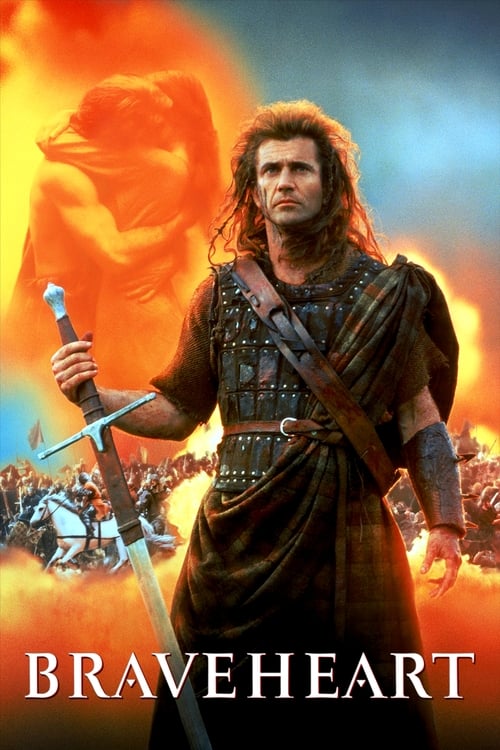
Braveheart
1995 · Mel Gibson
For when you want a big old-fashioned epic to lose an evening to — sweeping landscapes, doomed love, speeches and battle cries. Comfort food for the heart, though the violence is genuinely brutal.
What it's about
Thirteenth-century Scotland, under the boot of an English king. When soldiers murder his new bride, commoner William Wallace takes bloody revenge — and his village's revolt swells into a full national uprising, with Wallace leading farmers and clansmen against armored English armies while nobles scheme on both sides. It's a love story, a revenge story and a war epic rolled into three sweeping hours.
The experience
Rousing and unashamedly emotional — tender in its romance, savage in its battles, and built to make your blood rise. It swings for the fences at every turn and mostly connects; expect to come out wanting to charge a hillside.
Performances
Mel Gibson throws his whole body into Wallace, charisma and fury in equal measure, and Patrick McGoohan makes the English king a study in reptilian cruelty.
The craft
The medieval battles — thousands of extras, mud, steel and terrifying cavalry charges — set a standard that war films chased for years. John Toll's cinematography bathes the Highlands in mist and iron-gray light, and James Horner's score, with its keening pipes, does as much crying as the audience. Made for the biggest screen you can find.
Why it matters
It swept five Academy Awards including Best Picture, established Gibson as a major director, and its battle staging shaped a generation of historical epics — while in Scotland its legend has outrun the history books.
Snapshot
Mel Gibson's second directorial feature is a three-hour epic tracing the rise and execution of Scottish rebel William Wallace, from the murder of his wife through the guerrilla campaigns of the 1290s to the Battle of Falkirk and his death in 1305. Shot across Scotland and Ireland with tens of thousands of extras, scored by James Horner with Uilleann pipes threading through a full orchestra, and lensed by John Toll in muted greens and iron grays, the film operates as romantic tragedy, nationalist fable, and blood-soaked action spectacle simultaneously. Its five Academy Awards — including Best Picture and Best Director — confirmed it as a major industrial event; its afterlife in politics, tourism, and subsequent epic cinema has proved more durable than its critical standing.
Industry & production
Randall Wallace's screenplay originated from his encounter with a statue of William Wallace in Edinburgh and his subsequent reading of Blind Harry's fifteenth-century Scots epic poem The Wallace. The script circulated Hollywood before landing at Icon Productions and Paramount, with Gibson attaching himself as both star and director. The budget is reported in the range of seventy to seventy-five million dollars, a substantial commitment for a period war film at a moment when the genre had been largely dormant since the 1960s cycle of roadshow epics.
Principal photography divided between Scotland — notably Glen Nevis in the Scottish Highlands, Fort William, and Loch Ness areas — and Ireland, where the Wicklow Mountains and Trim Castle in County Meath doubled extensively for Scottish terrain. The decision to shoot in Ireland was pragmatic: larger stretches of undeveloped countryside were available, and the production drew on the Irish Defence Forces to supply several thousand soldiers as extras for the major battle sequences, a casting arrangement that had become an informal tradition for large-scale productions in the country. The Scottish unit provided landscape authenticity, particularly for quieter pastoral scenes, while the Irish unit absorbed the logistical demands of coordinated mass combat.
Alan Ladd Jr. and Bruce Davey produced alongside Gibson. Ladd's involvement carried a kind of institutional memory: he had championed Star Wars at Fox in 1977 and had a history of backing films the wider industry considered risky propositions.
Technology
The film was shot on 35mm using anamorphic lenses, a format chosen deliberately for its capacity to render wide horizontal landscape — the cinemascope ratio allowing Gibson and Toll to embed figures in an immensity of sky and heath. Practical effects dominated the battle sequences; CGI played a supplementary rather than generative role, augmenting crowd sizes in select shots but not replacing the physical mass of performers. This grounds the film aesthetically in an older filmmaking tradition even as it arrived in the mid-1990s digital transition.
The production built or adapted several large-scale practical sets, including earthwork fortifications and stockade structures for the Battle of Stirling sequence. Post-production was handled conventionally for the period, with no significant digital color grading — the film's tonal palette was established on set through lighting and filtration rather than in the DI suite.
Technique
Cinematography
John Toll had won the Academy Award for Best Cinematography the previous year for Legends of the Fall (1994), making his back-to-back Oscar wins on Braveheart an unusual distinction in the craft's recent history. His approach to the Scottish and Irish exteriors avoided postcard idealization: the sky is frequently overcast, the light flat or diffuse, the greens undersaturated. This choice lends the landscape a harsh, indifferent quality appropriate to the material's violence.
For the battle sequences, Toll and Gibson adopted a handheld aesthetic that contrasted sharply with the stable compositions of the quieter scenes — the camera pushed into the bodies, losing spatial orientation in the melee, creating an immersive chaos that anticipates the more systematic deployment of such techniques in Saving Private Ryan (1998) and Gladiator (2000). The rack-focus foreground-to-background compositions in the highland establishing shots establish visual depth that makes the armies seem continuous with the landscape itself.
Editing
Steven Rosenblum's editing won the Academy Award and remains, along with Toll's photography, the film's most formally accomplished dimension. The intercutting of the Battle of Stirling — coordinating the wide strategic shots with close-quarters brutality without losing spatial coherence — required a specific temporal intelligence about when to hold and when to cut. The film's nearly three-hour runtime is managed through Rosenblum's pacing, which uses the pastoral and romantic interludes as genuine breathing space rather than mere connective tissue.
The climactic execution sequence is edited at a notably slower rhythm than the surrounding material, using the formal deceleration to shift register from action spectacle to martyrdom tableau.
Mise-en-scène / staging
Gibson's staging of the battle sequences draws on a long tradition of large-format combat cinema — the influence of Anthony Mann's El Cid (1961) and the Kurosawa of Kagemusha (1980) is visible in the approach to massed formations and the attempt to render medieval warfare as both organized and catastrophically disordered. The notable historical liberty taken at Stirling — omitting the bridge that gave the historical Battle of Stirling Bridge its tactical significance and its name — was apparently a staging decision: the bridge's presence would have constrained the dynamic movement the sequence required.
The use of woad body-paint, the bare-chested Highland charge, and the lifted kilts belong to a mythologized visual vocabulary of Celtic warrior culture. Costume designer Charles Knode's tartans are anachronistic — clan tartan as a codified system developed centuries after Wallace's lifetime — a fact that became a repeated target of historical criticism but also a conscious choice to render the Scots visually legible to a global audience.
Sound
James Horner's score is the film's most culturally pervasive contribution. His palette centered on Uilleann pipes — performed by Eric Rigler — layered against full orchestra, with Irish tin whistle and low brass providing melodic counterpoint to martial percussion. The main theme, used in both romantic and elegiac contexts, became one of the most recognizable film scores of the decade and established a template for Celtic-inflected epic scoring that subsequent productions would emulate extensively. Horner's use of the pipes as signifier of national longing was not without precedent — similar gestures appear in earlier British and Irish film scoring — but the scale and commercial reach of Braveheart disseminated the convention widely.
Dialogue sound was recorded on location where practical and augmented in post; the ambient sound design of the battle sequences prioritized physical impact — the clatter of pikes, the wet percussion of close combat — over abstracted acoustic spectacle.
Performance
Gibson plays Wallace with deliberate restraint in the opening acts, building the character's charisma on long silences and contained grief before unleashing the rhetorical register of the battlefield speeches. The performance is calibrated to a tradition of epic hero-acting in which interior life is signified through stillness rather than displayed — a technique closer to the Gary Cooper or Henry Fonda mode than to the psychologically introverted acting the New Hollywood had normalized.
Patrick McGoohan's Edward I — nicknamed Longshanks — is played as a cold, administrative evil, dispensing with the scenery-chewing villainy the role might have invited. Angus Macfadyen's Robert the Bruce carries the film's most complex arc: his betrayal at Falkirk is presented as structural tragedy, guilt as the engine of future action. Brendan Gleeson as Hamish provides physical and comedic counterweight, a function the epic film conventionally assigns to a loyal second. Sophie Marceau's Princess Isabelle operates in a narrative that is historically implausible — the historical Isabella of France was a child in France during Wallace's lifetime — but her scenes are given the film's most intimate staging.
Narrative & dramatic mode
The film operates as a classical revenge tragedy that expands into national myth. The structural engine is personal — the murder of Murron — and the political uprising is presented as Wallace's grief projected outward onto collective resistance. This subordination of historical causation to emotional causation is one of the film's defining ideological gestures: Scottish nationalism is rendered as a consequence of love and loss rather than of material or political grievance.
The narrative template is the hero-martyr arc familiar from hagiography and, more proximately, from the Western: the exceptional individual who galvanizes a community, is betrayed by institutional forces, and whose death transforms into founding myth. The closing invocation — Robert the Bruce charging at Bannockburn calling Wallace's name — frames the historical record as the vindication of the individual sacrifice, a closure the historical timeline supports loosely but which the film presents as direct causal fulfillment.
Genre & cycle
Braveheart belongs to the revival of the historical epic that characterized the mid-to-late 1990s and early 2000s. The genre had been largely dormant since the financial failures of roadshow productions in the late 1960s — Cleopatra (1963) and The Fall of the Roman Empire (1964) serving as cautionary precedents. Michael Mann's The Last of the Mohicans (1992) had demonstrated that a physically visceral, romantically charged historical action film could find a contemporary audience. Rob Roy, released the same year as Braveheart and sharing its Scottish period setting and its theme of honor against institutional corruption, was immediately positioned in critical discourse as the more historically grounded and formally restrained alternative; Braveheart's commercial dominance settled the comparison in Gibson's favor at the box office, if not always critically.
The film's success accelerated the cycle. Ridley Scott's Gladiator (2000) is the most direct inheritor: its hero's structure, its approach to mass battle staging, and its employment of James Horner's regular orchestral idiom (replaced by Hans Zimmer and Lisa Gerrard) all bear the imprint of Gibson's film. The historical epic cycle that ran through Troy (2004), Kingdom of Heaven (2005), and 300 (2006) is broadly traceable to Braveheart's commercial proof-of-concept.
Authorship & method
Gibson had made his directorial debut with The Man Without a Face (1993), a modest character study that gave little indication of his ambitions at epic scale. His preparation for Braveheart reportedly included intensive study of historical battle films; the Kurosawa epics are the most frequently cited points of reference in production accounts, though direct documentation of Gibson's specific influences in interviews available to the scholarly record is limited.
The collaboration with Toll defined the film's visual identity. Gibson's stated preference was for a look that avoided the golden-hued romanticism common to period spectacle — he wanted the landscape to feel inhabited and austere rather than idealized, an intention Toll's understated photography realized consistently.
Randall Wallace's screenplay foregrounds the oral and bardic dimensions of the Wallace legend, opening with a child's-eye framing narration that announces the story as myth consciously retold. The script's relationship to Blind Harry's The Wallace is one of loose inspiration rather than adaptation; the historical record of the actual William Wallace is sparse enough — few documents survive — that significant invention was unavoidable regardless of fidelity intentions.
James Horner had already established a practice of scoring epic-scale films with ethnic instrumentation layered against Hollywood orchestra — his work on Legends of the Fall immediately preceded Braveheart — and his collaboration with Gibson extended this method into its most commercially successful expression.
Movement / national cinema
Braveheart is an American studio production engaging with Scottish historical identity from the outside, a dynamic that has shaped its critical reception in Scotland and the United Kingdom. The film's representation of English characters — almost uniformly venal, effeminate, or brutal — drew consistent objection from British critics and historians; Gibson has acknowledged the anti-English register without substantially qualifying it.
The film's political resonance in Scotland was immediate and documented. Released two years before the 1997 devolution referendum that established the Scottish Parliament, it was widely invoked in that political context, with anecdotal accounts of voters citing the film as an emotional catalyst. Whether the connection was causal or correlative is contested, but Scottish National Party figures have acknowledged the film's role in the cultural atmosphere of the period. The convergence of a Hollywood epic with a live national political question was unusual enough to attract scholarly attention in the fields of cinema and nationalism.
Era / period
The film arrives in the middle decade of post-Cold War American cinema, a moment when the epic genre's reassertion coincided with questions about American international identity following the Soviet collapse. The 1990s historical epics often displaced contemporary anxieties about power, sovereignty, and violence into pre-modern settings; Braveheart's rhetoric of freedom against empire carried resonances that were not purely medieval. The film's production values — its scale, its investment in physical spectacle at a moment when digital filmmaking was beginning to propose alternatives — align it with a final wave of practically-constituted epic cinema before CGI fundamentally changed the economics and aesthetics of the form.
Themes
The film's organizing antithesis is freedom against tyranny, rendered at every scale: personal (Wallace's autonomy, his refusal to yield), communal (the Scottish clans' resistance), and political (national sovereignty). This antithesis is complicated — the film is careful to register — by the question of aristocratic self-interest: the Scottish nobles' repeated betrayal of Wallace traces the limits of collective freedom when individual land and title are at stake.
The romantic theme interweaves love and nation, presenting Wallace's original motivation as private and his political transformation as a secondary consequence. This structure invites the reading of public history as private psychology writ large. The film also engages, through Robert the Bruce's arc, with the tension between pragmatic accommodation and principled resistance — a question it ultimately resolves in favor of martyrdom as political catalyst, the dead hero more efficacious than the living one.
Masculinity and its performance — particularly the warrior code of honor, the differentiation of virile Scots from effeminized English court culture — runs through the film's characterization in ways that attracted both popular enthusiasm and critical scrutiny. The film's gender dynamics are constrained by the hero-myth structure; female characters function largely as catalysts for male action.
Reception, canon & influence
Backward: influences on the film. The most direct formal precedents are the large-scale Hollywood historical epics of the late 1950s and 1960s: Spartacus (Stanley Kubrick, 1960) provides the basic template of the rebel slave-warrior who becomes a symbol of collective liberation and dies in martyrdom; El Cid (Anthony Mann, 1961) contributes the model of staging massed medieval combat in widescreen landscape. David Lean's epic methodology — the use of landscape as moral indicator, the slow construction of heroic mythology — is a broader atmospheric precedent. Kurosawa's late period epics, particularly Kagemusha (1980) and Ran (1985), provide specific models for battle-sequence staging. The Last of the Mohicans (Michael Mann, 1992) established the immediate commercial and aesthetic template for the romantic historical action film at this budget level.
Critical reception. Initial reviews were divided. The film's advocates praised its sweep, its visceral battle sequences, and Gibson's directorial confidence at scale. Its detractors, including a substantial constituency of British critics and professional historians, attacked its historical inaccuracies — the anachronistic tartans and kilts, the impossible romance with Isabella, the absent bridge at Stirling, the compressed timeline — and what many read as an uncritical embrace of ethnic nationalism. American critical consensus at the time of release was moderately positive; the Academy's judgment — five Oscars including the two top prizes — represented a stronger institutional endorsement than most critical accounts would have warranted. Subsequent critical reassessment has generally been harsher: the film appears less frequently in serious critical retrospectives than its commercial prominence might suggest, and its reputation has been affected by changing assessments of Mel Gibson as a public figure.
Forward: the film's legacy. The most concrete influence is on the subsequent revival of the historical epic. Ridley Scott's Gladiator (2000) draws directly on Braveheart's structural grammar — the hero wronged by empire, the intimate personal loss driving political resistance, the martyrdom that validates the cause — as well as its approach to large-scale practical battle staging. The film is widely credited with demonstrating that the genre was commercially viable at blockbuster scale, which unlocked studio investment for the cycle of early-2000s historical epics. James Horner's score influenced the sonic language of the epic genre for over a decade; the use of Uilleann pipes and Celtic melodic material as shorthand for national longing became a convention in subsequent period scores.
In the wider culture, the film's rhetoric — and particularly the battlefield speeches, with their invocations of freedom — entered general circulation as quotable popular idiom, appearing in political speeches, advertising, and internet culture in contexts entirely detached from Scottish history. Its role in Scottish cultural politics of the late 1990s constitutes a relatively unusual case of a Hollywood fiction film with documented influence on a live democratic process. Whether that influence was generative or reductive of actual historical understanding is a question the scholarly literature has engaged without resolving.
A Deleuzian reading
A blue-streaked face fills the frame and roars at a militia about to break.
The full Deleuzian reading of Braveheart →
Reception
It swept the 1996 Oscars (five wins including Best Picture), then spent the next decades getting knocked down a peg — now it's a regular in 'least deserving Best Picture winner' conversations, even as its battle scenes and score keep defenders loyal.
How Braveheart was received, from release to now →
Influences: the films it descends from and the films it influenced
- Kagemusha (1980) — Gibson's massed-formation battle staging — infantry blocks rendered as geometric patterns against open terrain before dissolving into close-quarters chaos — directly adapts Kurosawa's method of intercutting strategic overview with individual human scale within the same sequence, a technique Gibson explicitly cited during production.
- El Cid (1961) — Mann's template of staging large practical cavalry engagements across open terrain — wide establishing shots of formation maneuver cutting to the physical impact of the charge — established the organizational-clarity-before-chaos grammar that Gibson's Battle of Stirling directly inherits.
- Spartacus (1960) — Kubrick's structural template of the freedom-fighter hero whose execution becomes the founding act of collective liberation — martyrdom transformed into sustaining political myth — provided the narrative architecture Braveheart reproduces in a Scottish nationalist register.
- Lawrence of Arabia (1962) — Lean and Young's anamorphic CinemaScope grammar — the solitary protagonist dwarfed within immense terrain, the wide horizontal ratio making landscape a force rather than backdrop — established the visual vocabulary John Toll adapted for the Scottish Highlands.
- The Last of the Mohicans (1992) — Mann and Spinotti's technique of thrusting the handheld camera into the body of combat — losing spatial orientation in the melee while tracking individual combatants through the chaos — provided the immediate formal precursor that Toll and Gibson amplified in Braveheart's battle sequences.
- Legends of the Fall (1994) — Cinematographer John Toll developed his specific vocabulary here — muted naturalistic palette suppressing saturation to iron-gray tones, rack-focus compositions anchoring figures within landscape depth — winning his first Oscar; that same visual grammar transferred directly into Braveheart one year later.
- Henry V (1989) — Branagh's staging of the pre-battle oration as a rhetorical set-piece — the outnumbered hero's speech transforming a dispirited army into a symbolic community — established the theatrical register Gibson's Stirling battle speeches inherit, including the formal shift from intimate address to collective charge.
- Gallipoli (1981) — Weir established the structural template of the nationalist military martyrdom film in which men condemned by political betrayal sacrifice themselves for a collective identity, including the formal deceleration of the fatal charge into slow-motion tableau that Braveheart's execution sequence directly adapts.
- The Mission (1986) — Morricone's integration of indigenous instruments — pan pipes functioning as leitmotif within a full classical orchestral score — for a martyrdom narrative in a colonial setting provided the sonic template for James Horner's use of Uilleann pipes as recurring thematic material throughout Braveheart.
- Glory (1989) — Weds massed-infantry linear-battle geometry to personal martyrdom and elegiac voiceover, the intimate-hero-in-historical-slaughter formula Glory templated.
- Waterloo (1970) — Revives pre-modern massed-infantry collision with overhead shots of formations closing on open ground, explicitly modeling battlefield legibility on Bondarchuk's aerial choreography of ranks.
- Michael Collins (1996) — Jordan transfers Braveheart's martyrdom-as-founding-myth structure — the executed nationalist hero whose death catalyzes the political cause he embodied — directly into Irish independence, sharing the political execution climax rendered as martyrdom tableau rather than action sequence.
- Saving Private Ryan (1998) — Kamiński's Omaha Beach cinematography — handheld camera thrust into the assault, desaturated near-monochrome palette, deliberate spatial disorientation — develops the immersive battle-chaos aesthetic Toll pioneered in Braveheart's Stirling sequence into a systematic formal program for WWII combat.
- Gladiator (2000) — Scott adopted Braveheart's specific combination of handheld battle-immersion, desaturated warm-to-gray palette, and hero-martyr arc terminating in a death that guarantees political change, while introducing digital DI color grading where Braveheart had achieved the same palette through practical filtration on set.
- The Patriot (2000) — Gibson reprises the Braveheart archetype — stoic settler-warrior radicalized by family murder into nationalist guerrilla leadership — with Caleb Deschanel's cinematography reproducing the muted naturalistic palette and mass-formation battle staging in an American Revolutionary War setting.
- The Last Samurai (2003) — Zwick reproduces Braveheart's central formal proposition — a climactic massed-formation charge of an outnumbered force against industrialized firepower, staged with practical extras and anamorphic widescreen compositions — as the culmination of a warrior-martyr narrative structurally identical to Wallace's arc.
- Apocalypto (2006) — Gibson transported his Braveheart craft vocabulary — handheld immersive action photography, desaturated naturalistic palette, dominantly practical effects — into a Mesoamerican setting, radicalizing the formal experiment by eliminating dialogue exposition entirely in favor of pure kinetic and visual storytelling.
- We Were Soldiers (2002) — Wallace's own screenplay for Braveheart established the elegiac historical battle chronicle template — a commanding officer's controlled grief anchoring mass-battle sequences in anamorphic widescreen with practical pyrotechnics at scale — carried wholesale from Stirling Bridge to Ia Drang.
- Hacksaw Ridge (2016) — Gibson's own prior template for parallel-cutting between intimate close-up suffering — specific wounded bodies, the protagonist's face — and wide epic landscape spectacle within a single battle sequence directly prefigures the combat editing grammar of Hacksaw Ridge.
- The Last Duel (2021) — The revisionist medieval epic whose formal grammar The Last Duel explicitly critiques: Gibson's golden-hour romanticization and swelling score secure male-protagonist identification through emotional manipulation that Wolski's desaturated palette and diegetic-over-score sound preference systematically deflate and argue against.
- How to Train Your Dragon (2010) — John Powell's Celtic-inflected idiom — soaring orchestral swells threaded with pennywhistle and bodhrán against Nordic-Gaelic settings — descends from James Horner's Braveheart scoring palette.
- RRR (2022) — The template of the freedom-fighter melodrama where personal loss ignites anti-imperial rebellion, complete with martyrdom-as-climax that RRR structures its finale around.
- The Passion of the Christ (2004) — Gibson's own template of slow-motion martyrdom, public torture-execution as climax, and redemptive violence, carried whole into the scourging and crucifixion.
- Rob Roy (1995) — Released the same year, this sibling film shares the Scottish Highland warrior-hero setting and naturalistic muted palette but deploys intimate domestic tragedy rather than nationalist epic spectacle, using close-quarters sword-combat choreography as psychological revelation rather than battlefield immersion.
- Queen Margot (1994) — Contemporaneous historical epic built on fragmentary hand-to-hand battle cutting and visceral, meaty sound design to make mass killing felt rather than admired.
Similar films
- The Last of the Mohicans (1992) — influence & lineage · same viewing thread
- Gallipoli (1981) — influence & lineage · same viewing thread
- Henry V (1989) — influence & lineage
- Gladiator (2000) — influence & lineage
- The Revenant (2015) — same viewing thread
- We Were Soldiers (2002) — same viewing thread
- Saving Private Ryan (1998) — influence & lineage · often watched together
- Lawrence of Arabia (1962) — influence & lineage · often watched together
All the films related to Braveheart →
Watch it with: curated runs of related films
- Against Overwhelming Force — A run for when you want scale and physical punishment — men set against armies, tanks, and the frozen wild, holding a line that by rights should have broken them.