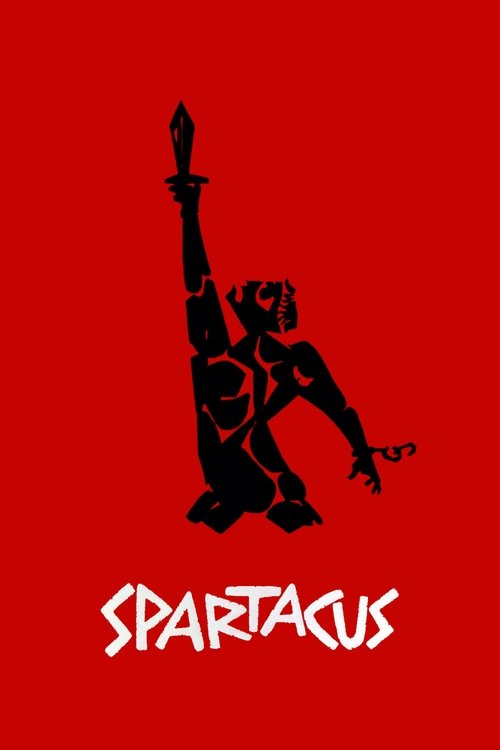
Spartacus
1960 · Stanley Kubrick
For when you want to give an evening over to something monumental — a long, old-fashioned epic that leaves you stirred rather than merely entertained. Ideal for a rainy Sunday with three hours to spare.
What it's about
A Thracian slave, sold to a gladiator school and trained to kill for other men's entertainment, turns on his owners and ignites a rebellion that sweeps across ancient Italy. As escaped slaves flood into his ranks by the thousands, Spartacus finds himself leading not an army but a people — while in Rome, ambitious senators maneuver to use the crisis to seize power for themselves.
The experience
A grand, full-blooded epic that alternates intimate scenes of love and dignity with battle sequences of staggering scale. It's rousing and sincere in a way big films rarely risk anymore, and its final stretch lands with real emotional weight.
Performances
Kirk Douglas plays Spartacus with clenched, physical conviction — the role of his career — while Peter Ustinov steals every scene as the oily, self-preserving owner of the gladiator school, and Laurence Olivier and Charles Laughton spar deliciously as rival Roman politicians.
The craft
Shot in glorious widescreen with battle scenes marshaling thousands of extras across real landscapes, it's one of the most visually imposing of the great Hollywood epics, with a surging, inventive score to match. The screenplay gives the spectacle a spine of genuine political anger — this is a film about freedom made by people who meant it.
Why it matters
By openly crediting blacklisted screenwriter Dalton Trumbo, it helped break the Hollywood blacklist — a political act as consequential as anything on screen — and it stands as the conscience-driven peak of the sword-and-sandal era.
Snapshot
A monument of the Hollywood roadshow era and one of the most politically charged mainstream films produced by a major American studio in the twentieth century, Spartacus (1960) retells the story of the Thracian slave who led Rome's third and final servile war (73–71 BCE) to its doomed but defiant conclusion. Produced by and starring Kirk Douglas through his Bryna Productions company and distributed by Universal Pictures, the film is an anomaly in Stanley Kubrick's career: the one major work he directed but did not originate, and the one he later acknowledged as a project over which he did not exercise the creative sovereignty that defines his other films. Yet Spartacus remains a landmark — formally ambitious, politically subversive, and historically significant for its role in dismantling the Hollywood blacklist. It is simultaneously a Kirk Douglas vehicle, a Dalton Trumbo political statement, and an inadvertent Kubrick experiment in industrial constraint.
Industry & production
The film's origins lie with Douglas, who purchased the rights to Howard Fast's 1951 novel of the same name — a book Fast had written while imprisoned for contempt of Congress during the Red Scare. Douglas hired the blacklisted screenwriter Dalton Trumbo under his own name at a moment when the blacklist was still nominally enforced; Trumbo had been working pseudonymously for years. Giving Trumbo a full screen credit was a deliberate act of defiance, and when the film opened, President-elect John F. Kennedy's decision to cross American Legion picket lines to attend a screening in Washington helped signal that the blacklist's enforceability had finally collapsed. The credit break is considered one of the catalysts for the formal end of that era of Hollywood political suppression.
Anthony Mann began principal photography but was dismissed by Douglas after roughly a week — the reasons remain somewhat contested, though friction over creative direction is the established account. Kubrick, who had collaborated with Douglas on Paths of Glory (1957), was brought in as replacement. The production was therefore structured around Douglas's vision before Kubrick arrived, and key casting, script, and design decisions were largely settled. The ensemble was exceptional: Laurence Olivier as the patrician villain Crassus, Charles Laughton as the scheming senator Gracchus, Peter Ustinov as the wily slave trader Batiatus, Jean Simmons as Varinia, and Tony Curtis as the Roman slave Antoninus.
The scale of production was extraordinary. Crowd and battle sequences were filmed in Spain using thousands of Spanish military personnel as extras, a common production strategy for the era's epics that allowed access to large numbers of disciplined extras at manageable cost. Studio work was completed at Universal, where large interior sets — the gladiatorial school at Capua, Roman interiors — were constructed. The budget was substantial, placing the film at the top tier of Hollywood productions of the period.
Technology
Spartacus was photographed in Super Technirama 70, a large-format anamorphic process that projected at 70mm and offered an image of exceptional sharpness and width. The format was part of the industry's response to television competition — roadshow epics needed an experiential scale that home screens could not approximate. The film's theatrical presentation typically included an overture, intermission, and exit music, structured as an event rather than a mere screening. Stereophonic sound, then still a prestige signifier, accompanied the wide-gauge release print. The widescreen ratio demanded compositional strategies that privileged horizontal arrangements, crowd formations, and landscape — the Spanish battle terrain was chosen partly because its topography read well at that extreme width.
Technique
Cinematography
Russell Metty, the film's director of photography, won the Academy Award for Best Cinematography for his work here, though the win was not without controversy: Kubrick reportedly took significant personal control over camera placement and composition during production, and accounts differ on the precise division of labor. Whatever the collaborative arrangement, the film's visual language is sophisticated. Metty's lighting in the intimate scenes — particularly the scenes within the gladiatorial school — makes use of low-key, raking light that emphasizes flesh and shadow, drawing on a classical chiaroscuro tradition that sits in tension with the spectacle mode demanded by the wider action sequences. The Spanish battle footage, shot under open Castilian sky, has a flatter, more documentary brightness that contrasts with the more theatrical interiors.
The camera is notably restrained during scenes of emotional intensity. Kubrick's characteristic geometric precision begins to surface in certain compositions — symmetrical framings of Roman interiors, overhead shots that reduce soldiers to pattern — even within a studio system that typically resisted such abstraction.
Editing
Robert Lawrence edited the film to its roadshow length, navigating between the intimate drama of the slave quarters and the panoramic spectacle of battle and march. The intercutting between Crassus's political maneuvers in Rome and Spartacus's campaign in the field gives the film a structure that alternates between intimate psychological study and broad historical canvas — a rhythm that the epic form had established with Ben-Hur (1959) and that Spartacus inherits and modulates.
The 1991 restoration, supervised by Robert A. Harris and James C. Katz with Universal's cooperation, reinstated approximately six minutes of footage cut from the original release, most significantly the "oysters and snails" scene between Olivier and Curtis. This scene, which had been removed by censors for its overt implication of bisexuality, was restored with Anthony Hopkins dubbing Olivier's dialogue (Olivier having died in 1989) and Curtis re-recording his own lines. The restored cut is now the standard version in circulation.
Mise-en-scène / staging
The film's most celebrated staging is the climactic "I am Spartacus" sequence, in which a mass of captured slaves, asked to identify their leader, each rises to claim his identity — an act of collective solidarity that dooms them all to crucifixion but preserves Spartacus's anonymity. The staging is formally simple: repetitive, cumulative, building through rhythm rather than visual complexity. Its power is entirely structural and ideological, and it became one of cinema's most imitated gestures of collective defiance.
The gladiatorial combat sequences were choreographed with an eye toward plausibility rather than theatrical flourish — particularly the fight between Spartacus and the Ethiopian gladiator Draba (Woody Strode), which is brief, brutal, and resolved in a way that refuses the arena's demand for spectacle. Draba's choice not to kill Spartacus, and instead to attack the Roman spectators, is a compressed moral drama that the staging renders with economy and force.
Sound
Alex North's score is one of the major achievements of Hollywood orchestral composition from this period. North worked with a large orchestra and drew on ancient-world musical archetypes — modal scales, brass fanfares, percussion patterns — without attempting literal archaeological reconstruction. The main theme is martial and mournful simultaneously, a quality that serves the film's tragic arc. North would go on to score Cleopatra (1963) and later Under the Volcano (1984), but the Spartacus score is widely considered his most fully realized work.
Performance
The film benefits from the deliberate contrast between its two performance registers. Douglas, trained in the American method tradition, plays Spartacus with an internal intensity and physical directness that grounds the film in psychological realism. Olivier, operating from a classical British theatrical tradition, plays Crassus with elaborate surface control — every gesture calculated, desire expressed obliquely through manner and implication. The tension between these two modes is thematically apt: the slave and the aristocrat are separated not just by class and power but by entirely different relationships to self-presentation. Ustinov's Batiatus, meanwhile, is a comic creation of considerable sophistication — self-serving, eloquent, and possessed of a survivor's moral flexibility that Ustinov renders with evident pleasure. His performance won the Academy Award for Best Supporting Actor.
Narrative & dramatic mode
Spartacus is structured as a political tragedy in the classical sense: a leader of exceptional gifts brought down not by personal flaw alone but by the accumulated weight of structural forces — the Roman army, Roman politics, the economic logic of slavery itself. Trumbo's screenplay preserves Fast's essentially Marxist framework: the rebellion is not a story of individual heroism but of collective action, and its failure is systemic rather than contingent. This ideological substrate distinguishes the film from the more spiritually inflected epics of the period — Ben-Hur's redemption narrative, The Ten Commandments' providential theology. Spartacus offers no divine rescue. Its ending — Spartacus crucified, his wife and infant son escaping to freedom — is a qualified defeat, tragic in the formal sense.
The romantic subplot with Varinia (Simmons) is handled with more tenderness than the epic form typically allows, and the scenes between Douglas and Simmons carry a genuine emotional weight that coexists uneasily with the film's more rhetorical political passages.
Genre & cycle
The film belongs to the late-1950s and early-1960s Hollywood roadshow epic — a cycle initiated in part by the blockbuster success of The Ten Commandments (1956) and Ben-Hur (1959) and sustained through films including El Cid (1961), Lawrence of Arabia (1962), and Cleopatra (1963). These films were distinguished by their running times (typically over three hours), their wide-gauge photography, their elaborate period production design, and their marketing as theatrical events. The cycle was partly a studio response to television competition and partly a continuation of the older Hollywood tradition of biblical and historical spectacle.
Spartacus also belongs to a specific sub-genre — the Roman slave epic — that had a parallel and slightly earlier life in Italian cinema. The Italian peplum or "sword-and-sandal" films of the late 1950s, many featuring Hercules or gladiatorial combat, had established an international market for this material. Spartacus operates at a higher budget and artistic ambition than the peplum cycle but occupies overlapping cultural space.
Authorship & method
The authorship question surrounding Spartacus is genuinely complex and has generated substantial critical discussion. Kubrick himself, in interviews across subsequent decades, consistently distanced himself from the film, describing it as the one project where he lacked final control. He entered a production already in motion, with the script, cast, and much of the design established by others. The result is a film that contains passages and strategies recognizable as Kubrickian — the satirical observation of institutional power, the detached framing of violence, certain geometric compositions — alongside sequences of conventional Hollywood sentiment that he would never have authored independently.
The film is more productively understood as a convergence of strong individual visions: Douglas as star-producer determined to make a monument to individual and collective dignity; Trumbo as the blacklisted writer with a specific political argument to make; North composing at the height of his powers; and Kubrick as the director who professionalized and sharpened a production that might otherwise have been undisciplined. The collaborative tension produced a better film than any single hand might have made alone, even as it left Kubrick dissatisfied.
Movement / national cinema
Spartacus is an artifact of late-classical Hollywood — the final years of the studio system operating at its most resource-intensive and institutionalized. Its production model (independent producer, major distributor, European locations, international casting) anticipates the package-unit system that would characterize post-studio Hollywood, even as its formal ambitions remain within the classical tradition. The film has no meaningful connection to any national cinema outside the United States, though its use of Spanish locations and personnel was part of a broader trend of American runaway productions that reshaped European film economies in this period.
Era / period
The film arrives at a precise cultural inflection point: 1960, when the Cold War ideological consensus was beginning to fracture, the civil rights movement was accelerating, and the Hollywood political culture of the 1950s — its blacklists, its loyalty oaths, its self-censorship — was visibly losing coherence. That a film about slave rebellion, written by a communist sympathizer, celebrating collective resistance to an imperial superpower, was produced by a major Hollywood studio and became a significant commercial and critical success in this moment is itself a historical fact of some weight.
Themes
The film's central themes — freedom, solidarity, the dignity of labor, the corruption of aristocratic power, the limits of individual heroism when confronted by structural oppression — are legible from Trumbo's screenplay without requiring excavation. The film is unusually direct in its political discourse for a mainstream Hollywood production. The Roman Senate sequences, in which Laughton's Gracchus and Olivier's Crassus maneuver for dominance, are essentially allegories of American political life — the accommodationist liberal versus the authoritarian consolidator — rendered with a specificity that Trumbo clearly intended.
The motif of identity — who counts as a person, who can claim a name, whose face is visible to power — runs through the film's structure. The "I am Spartacus" scene formalizes this theme, but it is present throughout: in Batiatus's commodification of bodies, in Crassus's desire to possess rather than recognize, in the film's insistence on showing the faces of the enslaved even in crowd sequences where epic convention would reduce them to mass.
Reception, canon & influence
Spartacus received mixed critical response at its initial release — praised for its scale and performances, criticized by some for its length and political explicitness. It won four Academy Awards: Best Supporting Actor (Ustinov), Best Cinematography (Metty), Best Art Direction-Set Decoration (Alexander Golitzen, Eric Orbom, Russell A. Gausman, Julia Heron), and Best Costume Design (Valles and Bill Thomas). Its commercial performance was strong, validating the roadshow model for several more years.
Influences on the film include Howard Fast's source novel, the Italian peplum cycle, the Hollywood biblical epic tradition, and more diffusely the Soviet and Italian neorealist concern with collective rather than individual protagonists. The casting of Woody Strode — a Black actor given a role of moral centrality — reflects pressure from the civil rights context and Douglas's deliberate choices about representation.
Forward influence is substantial. The film's template for the gladiatorial epic was absorbed into subsequent productions and ultimately resurfaces, significantly transformed, in Ridley Scott's Gladiator (2000), which inherits the arena setting, the slave-protagonist structure, and the corrupt Roman power dynamic while replacing political tragedy with personal revenge and spiritual resolution. The Starz television series Spartacus (2010–2013) returned directly to the source material, updating it for a prestige-television context with explicit violence and sexuality that the 1960 film could only suggest. The "I am Spartacus" scene has been so frequently cited, parodied, and invoked in popular culture that it functions as a free-floating gesture of collective solidarity independent of the film's specific context.
Within the Kubrick canon, Spartacus occupies an ambiguous position — included in filmographies but bracketed by the director's own reservations. It is most usefully read not as a Kubrick film manqué but as evidence of what Kubrick could not fully suppress even in an assignment not of his choosing: an intelligence about power, an eye for the geometry of domination, and a fundamental skepticism toward the heroic myths that the epic form is designed to sustain.
A Deleuzian reading
Draba wins.
The full Deleuzian reading of Spartacus →
Reception
A big prestige hit in 1960 — four Oscars, huge box office — but for decades it was the asterisk in Kubrick's filmography, the one he disowned for lacking final cut. The lavish 1991 restoration (which put back the censored 'snails and oysters' scene) rehabilitated it as a great Hollywood epic on its own terms.
How Spartacus was received, from release to now →
Influences: the films it descends from and the films it influenced
- Quo Vadis (1951) — Established the Hollywood Roman-epic production template Spartacus inherits: European military personnel organized as disciplined crowd extras, arena and palace interiors built on American studio stages, and Technicolor chiaroscuro distinguishing slave darkness from patrician brightness.
- The Robe (1953) — As the first CinemaScope feature, it fixed widescreen format as the prestige mode for ancient-world epics, directly pressuring Spartacus to adopt and escalate to Super Technirama 70 — a wider-gauge upgrade to the horizontal-framing strategy The Robe pioneered.
- Julius Caesar (1953) — Established the casting template Spartacus structurally repeats: British classical-stage performers (Gielgud, Mason) against Hollywood method actors (Brando), creating a theatrical-vs-method tension that Spartacus replicates by pairing Olivier and Laughton against Douglas and Curtis.
- The Ten Commandments (1956) — Spartacus directly inherits DeMille's technique of staging mass liberation as geometric crowd spectacle — thousands of extras organized into formations that function simultaneously as visual pattern and political argument for collective human dignity.
- Alexander the Great (1956) — Pioneered the CinemaScope ancient-world epic as political tragedy — horizontal framing of military formations to map power relations spatially — a compositional strategy Spartacus inherits and expands to 70mm.
- Paths of Glory (1957) — The preceding Kubrick-Douglas collaboration: Spartacus inherits the lateral tracking shot through institutional space (trenches → slave barracks at Capua), the geometric overhead framing that reduces soldiers to pattern, and the political tragedy of collective resistance crushed by hierarchical power.
- Ben-Hur (1959) — Spartacus directly inherits Ben-Hur's roadshow event architecture — overture, intermission, exit music — and the 70mm compositional rhythm of alternating intimate character scenes with panoramic crowd spectacle at a scale television could not approximate.
- El Cid (1961) — Mann, dismissed from Spartacus after a week of filming, applied the identical Bronston production blueprint here: the same Spanish military-extra crowd staging, the same horizontal widescreen battle composition using Castilian terrain, completing in a different film the technique interrupted on Spartacus.
- 2001: A Space Odyssey (1968) — Kubrick brings the geometric overhead framing and formal abstraction he pushed against industrial constraint in Spartacus to its apotheosis; Alex North composed and fully recorded a score Kubrick rejected at the last minute — a direct continuation and deliberate rupture of the Spartacus-North collaboration.
- Barry Lyndon (1975) — Kubrick develops the candlelight chiaroscuro he employed in Spartacus's intimate slave-quarters scenes into a complete visual system — NASA-developed lenses shooting by actual candlelight — while the static geometric tableau of figures in landscape evolves directly from Spartacus's symmetrical Roman interior compositions.
- Braveheart (1995) — Inherits the formal grammar of cumulative collective defiance: Gibson's climactic crowd sequences — individual after individual claiming collective identity to protect a condemned leader — replicate the 'I am Spartacus' scene's staging logic, with mass-formation extras organized by the same principle of identity contagion spreading through a crowd.
- Gladiator (2000) — Direct descendant of the Roman slave-warrior epic: Scott inherits the arena spectacle staging, patrician-villain-vs-enslaved-military-hero structure, and political tragedy framework — but digitally reconstitutes via CGI the crowd formations that Spartacus achieved with actual Spanish military extras.
- Patton (1970) — Russell Metty's Super Technirama 70 battle choreography is cut for strategic legibility — troop movements charted across terrain so the viewer always understands who is winning and why — the precise editing philosophy Fowler applied to Patton's large-scale engagements, where military geography is the real dramatic subject.
- The Hunger Games (2012) — Models the gladiatorial-combat-as-elite-entertainment staging: tributes, like the ludus pairs, are groomed, costumed, and paraded before a watching ruling class before being made to kill each other.
- The Hunger Games: Catching Fire (2013) — Codifies the arena gladiator who survives and is forcibly turned into a public symbol of rebellion, with combat staged as state theater and costume marking captor versus captive.
- Life of Brian (1979) — The mass-solidarity set piece is directly inverted: Spartacus's selfless 'I'm Spartacus' becomes the crucifixion line's self-serving 'I'm Brian, and so's my wife.'
- The Lord of the Rings: The Two Towers (2002) — Marshalling thousands of real extras into legible advancing ranks on open hillside is the pre-digital crowd spectacle that MASSIVE crowd simulation was built to reproduce and exceed.
- 300 (2007) — The prestige antiquity template of massed disciplined bodies in formation and elevated declamatory dialogue that 300's rhetoric and staging descend from.
- RRR (2022) — The anti-oppression uprising epic where a subjugated body becomes a symbol of collective revolt — the melodramatic scale RRR maps onto anti-colonial revolt.
- Exodus (1960) — The concurrent blacklist-breaking act: Preminger simultaneously credited blacklisted Dalton Trumbo openly in the same release year, making Exodus and Spartacus together the practical event that ended the Hollywood blacklist's enforceability — an authorship rupture neither film could have achieved alone.
- Lawrence of Arabia (1962) — The parallel 70mm roadshow epic: Super Panavision 70, overture/intermission event structure, stereophonic sound, and military-extra desert battle staging — all strategies both films deploy simultaneously, with Maurice Jarre's orchestral score functioning as political-emotional commentary in the same structural register as Alex North's.
- The Fall of the Roman Empire (1964) — Mann and Bronston's direct continuation with the same Spanish military extras and horizontal panoramic staging of legions in formation — Mann now exercising the full creative control denied him on Spartacus, and replicating its political tragedy of Roman imperial corruption defeating heroic resistance.
- Sergeant Rutledge (1960) — Casts Woody Strode the same year as Draba, extending the noble, monumentalized physical presence Ford forged into Strode's emerging leading-man iconography.
Similar films
- Lawrence of Arabia (1962) — influence & lineage · same viewing thread · often watched together
- Paths of Glory (1957) — influence & lineage · same viewing thread
- Barry Lyndon (1975) — influence & lineage · often watched together
- Braveheart (1995) — influence & lineage · often watched together
- Gladiator (2000) — influence & lineage
- Ben-Hur (1959) — influence & lineage
- Lion of the Desert (1981) — same viewing thread
- Glory (1989) — same viewing thread
All the films related to Spartacus →
Watch it with: curated runs of related films
- The Futility of War — A run of films about ordinary men fed into war's machinery — from the trenches to the Casbah to the Warsaw sewers — where the futility and human cost rhyme across a century and a dozen conflicts.