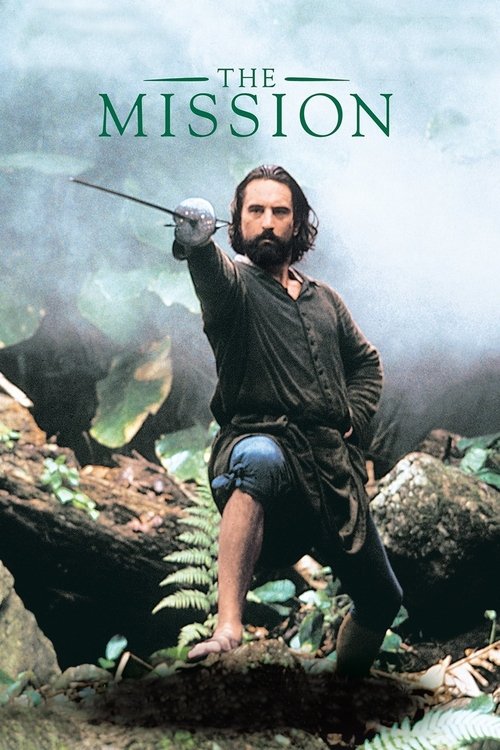
The Mission
1986 · Roland Joffé
For a serious, sweeping evening — when you want history, moral weight, and landscapes that swallow the screen, and you're willing to have your heart broken a little.
What it's about
In the jungles above the great falls of eighteenth-century South America, a Jesuit priest climbs into hostile territory to build a mission among the Guaraní people. He's joined by his opposite: a mercenary slave trader who, after killing his own brother, seeks a penance heavy enough to match his guilt. When a treaty hands the territory from Spain to slave-holding Portugal, the two men must choose how — and whether — to defend the community they've built.
The experience
A grand, mournful epic that moves at a stately pace and builds toward moral crisis rather than simple triumph. It's physically stunning and emotionally heavy — the kind of film that leaves the room quiet.
Performances
Robert De Niro carries the film's most powerful stretch as the slaver Mendoza, whose penance is played out in punishing physical terms, opposite Jeremy Irons's quiet, immovable Father Gabriel — two very different ideas of conviction sharing the frame.
The craft
Shot amid real waterfalls and rainforest, its images of the falls are among the most breathtaking location photography ever put in an epic, and Ennio Morricone's score — oboe melody against native drums and choir — is widely considered one of the greatest ever written for film. Robert Bolt's literate screenplay gives the spectacle a real moral argument. See it big, hear it loud.
Why it matters
Won the top prize at Cannes and endures mostly through Morricone's beloved score, a touchstone that outgrew the film; it remains a reference point for how cinema reckons with colonialism and faith.
Snapshot
The Mission is a British historical epic that dramatizes the destruction of the Jesuit reducciones — the semi-autonomous mission settlements established among the Guaraní in the borderlands of eighteenth-century South America — in the aftermath of the 1750 Treaty of Madrid, by which Spain ceded the territory to Portugal and its slave-tolerating colonial regime. Directed by Roland Joffé from a screenplay by Robert Bolt, produced by Fernando Ghia and David Puttnam, and financed largely through the British company Goldcrest, the film pairs Jeremy Irons as the contemplative Jesuit Father Gabriel against Robert De Niro as Rodrigo Mendoza, a mercenary and slaver who, after killing his brother, undertakes a penitential conversion and becomes a Jesuit himself. The drama turns on the two men's divergent responses when the Church abandons the missions to Portuguese arms: Gabriel's pacifist martyrdom against Mendoza's return to violence. The film won the Palme d'Or at Cannes in 1986 and the Academy Award for Best Cinematography (Chris Menges), and is remembered above all for Ennio Morricone's score. It is also remembered as one of the productions that bankrupted Goldcrest. It stands as a late, ambitious example of the literate, conscience-driven British historical epic — and as a film whose grandeur and earnestness have made it a recurring test case in debates about the "white savior" colonial narrative.
Industry & production
The Mission was a flagship project of the mid-1980s British production renaissance associated with David Puttnam and Goldcrest Films. Puttnam, fresh from Chariots of Fire (1981) and Joffé's The Killing Fields (1984), partnered with the Italian producer Fernando Ghia, who had nurtured Robert Bolt's screenplay for over a decade. The film was a large-scale international co-production shot principally on location in Colombia, Argentina, and Brazil, with the Iguazú Falls on the Argentine–Brazilian border serving as the film's overwhelming natural set. Mission buildings were constructed for the production, and large numbers of Indigenous extras — drawn substantially from the Waunana (Wounaan) people of Colombia — were employed to populate the Guaraní community.
The production is historically significant as much for its finances as its content. Together with Revolution (1985) and Absolute Beginners (1986), The Mission's heavy budget and disappointing commercial returns are widely credited with precipitating the collapse of Goldcrest as an independent power in British cinema — a cautionary episode documented at length in Jake Eberts and Terry Ilott's account My Indecision Is Final. The film's logistics were formidable: filming at and around a major waterfall, transporting cast and crew through jungle terrain, and staging large set-piece battles and the elaborate opening martyrdom in which a crucified priest is sent over the falls. The Jesuit priest, poet, and anti-war activist Daniel Berrigan served as a consultant on the production and appears in a small role; he later published a journal of the experience.
Technology
The Mission was shot photochemically on 35mm color stock in the anamorphic widescreen idiom appropriate to the historical-epic tradition, and its technological interest lies less in novel apparatus than in the demands location work placed on conventional equipment. The proximity of water — mist, spray, and the sheer scale of Iguazú — required careful protection of cameras and exposure management in high-contrast jungle light. The film belongs to a moment before digital intermediates and computer-generated imagery, so its vistas of falls, river, and rainforest are unmediated photographic records of real places, achieved through camera placement, long lenses, and physically built sets rather than composited effects. The penitential sequences and battle scenes likewise depended on practical staging, stunt work, and in-camera realism. Post-production sound and Morricone's orchestral-and-choral score were married to the image in the analog tradition of the period.
Technique
Cinematography
Chris Menges's photography is the film's most acclaimed technical achievement, earning him the Academy Award for Best Cinematography — his second in three years after The Killing Fields. Menges renders the South American landscape as both Edenic and overwhelming: the Iguazú Falls function less as backdrop than as an active moral presence, a sublime force against which human figures are dwarfed. He balances the saturated greens and earth tones of the jungle against the candlelit interiors of the mission church and the shadowed chambers of colonial and ecclesiastical power. The visual scheme repeatedly contrasts the natural, horizontal world of the Guaraní with the vertical, hierarchical spaces of European authority. Menges's command of natural and available light, honed in documentary and in his collaborations with Ken Loach, lends the spectacle an observational grounding that keeps the epic from tipping wholly into the picturesque.
Editing
Jim Clark edited the film, structuring it around a retrospective frame: Cardinal Altamirano's letter to the Pope, which bookends and periodically punctuates the narrative with voice-over reflection. The editing alternates between contemplative passages — Gabriel's solitary ascent into Guaraní territory, the famous scene in which he disarms hostility with the sound of his oboe — and the accelerating momentum of the final assault, where parallel cutting tracks Gabriel's processional pacifism and Mendoza's armed defense as simultaneous, irreconcilable responses to the same catastrophe. The film's deliberate, sometimes stately pace reflects its origins in the prestige-epic tradition rather than the kinetic action cinema of its decade.
Mise-en-scène / staging
The staging is organized around oppositions made visible in space: the mission as a self-sufficient, communal Utopia of music, craft, and worship set against the predatory economy of the slave market and the marbled corridors of colonial diplomacy. The opening martyrdom — a Jesuit lashed to a cross and carried over the falls — establishes a visual rhetoric of crucifixion and sacrifice that recurs through Mendoza's penance, in which he hauls a net bundle of his own armor and weapons up the cliffs beside the cataract until a Guaraní man cuts it loose, releasing him from his guilt. The final destruction stages the missions' annihilation as a passion play, with Gabriel leading a procession bearing the monstrance into gunfire.
Sound
Ennio Morricone's score is inseparable from the film's identity and is frequently ranked among the greatest in cinema. Morricone interweaves three distinct musical idioms to embody the film's collision of cultures: a liturgical European motet tradition, an Indigenous-inflected percussive and vocal element, and the now-iconic solo oboe melody known as "Gabriel's Oboe," which functions diegetically as the instrument through which Father Gabriel first reaches the Guaraní. The contrapuntal layering of these strands — heard most fully in the choral "On Earth as It Is in Heaven" — musically dramatizes the film's central tension between conquest and communion. Beyond the score, the sound design foregrounds the omnipresent roar of the falls as a near-constant ground bass to the action.
Performance
Jeremy Irons plays Father Gabriel with an interior stillness, embodying a faith that expresses itself through restraint and ultimately through non-resistance; his is a performance of conviction held in quiet. Robert De Niro's Mendoza is the more externalized arc — the swaggering slaver broken by fratricide, his anguished penance, and his hardened return to the sword. The two performances are deliberately calibrated as a debate in human form. The strong supporting cast includes Ray McAnally as the conflicted Cardinal Altamirano, the narrating instrument of the Church's compromise; Aidan Quinn as Mendoza's brother; and early appearances by Liam Neeson and Ronald Pickup among the Jesuits. Critics have at times found the central performances effective yet somewhat eclipsed by the landscape and music — a film in which the spectacle threatens to outscale its actors.
Narrative & dramatic mode
The film operates in the mode of the tragic historical epic, organized as a moral dialectic rather than a conventional hero's journey. Its frame — the Cardinal's confessional report — signals from the outset that the events are a fait accompli, a remembered catastrophe whose meaning is being weighed rather than a suspenseful outcome in doubt. The narrative pivots on two intertwined conversions: Mendoza's spiritual one, from slaver to Jesuit, and the structural betrayal by which the Church, to preserve its political standing in Europe, sacrifices the very communities its missionaries built. The drama withholds easy resolution, refusing to endorse either Gabriel's martyrdom or Mendoza's militancy as the correct response to injustice; both men die, and the missions are destroyed regardless. This tragic irresolution — the question of how faith should answer worldly power — is the film's true subject, framed by the Cardinal's closing admission that the dead are dead and the living, himself among them, must live with it.
Genre & cycle
The Mission sits at the intersection of the historical epic, the religious film, and the colonial adventure drama. It belongs recognizably to the lineage of David Lean's widescreen historical pictures — a connection made concrete by screenwriter Robert Bolt, Lean's collaborator on Lawrence of Arabia and Doctor Zhivago — and to the mid-1980s cycle of conscience-driven prestige epics that also includes Joffé's own The Killing Fields, Richard Attenborough's Gandhi (1982) and Cry Freedom (1987), and Bernardo Bertolucci's The Last Emperor (1987). As a film about Christian mission and martyrdom in the New World it also speaks to a small genre of Jesuit and colonial-encounter cinema, later joined by works such as Black Robe (1991) and Silence (2016). Its self-conscious grandeur and reformist moral seriousness mark it as a culmination — and, given Goldcrest's collapse, nearly an endpoint — of that British epic cycle.
Authorship & method
The film is best understood as a convergence of major authorial sensibilities rather than the product of a single auteur. Roland Joffé, directing his second feature after the Oscar-laden The Killing Fields, brought a commitment to politically charged history filmed on real and difficult terrain, with sympathy for the casualties of imperial power. Robert Bolt, the screenwriter, supplied the literary architecture: the moral debate-play structure, the theme of conscience against institutional authority, and the dignified, declamatory register familiar from A Man for All Seasons and his Lean collaborations. The Mission was among Bolt's last major works, written in the period following the severe stroke he suffered in 1979. Chris Menges (cinematographer) and Jim Clark (editor) shaped the film's observational grandeur and its reflective rhythm. Ennio Morricone contributed what may be the film's most enduring authorial signature; his score's tripartite cultural counterpoint is itself an interpretation of the material. Producers David Puttnam and Fernando Ghia were the project's prime movers, Ghia having championed Bolt's script across many years of development.
Movement / national cinema
The Mission is a landmark — and a casualty — of the 1980s British film revival. That moment, energized by the success of Chariots of Fire and the ambitions of Goldcrest under figures like Jake Eberts and David Puttnam, sought to mount internationally competitive, English-language prestige cinema from a British base. The Mission embodied the strategy's highest aspirations and its financial fragility: the film's scale outran the market's capacity to repay it, and Goldcrest's near-simultaneous failures helped bring the experiment to an end. The film is thus a British national-cinema artifact whose subject is wholly extra-British — a study of Spanish, Portuguese, and Roman ecclesiastical politics enacted on South American ground — reflecting the outward, internationalist ambition of its production culture.
Era / period
The film is set in the mid-eighteenth century, around the 1750 Treaty of Madrid that redrew the boundary between Spanish and Portuguese South America and doomed the Jesuit reductions to Portuguese jurisdiction, culminating in the Guaraní War and, more broadly, anticipating the suppression of the Jesuit order. It depicts a specific and well-documented historical rupture: the collision between a Counter-Reformation missionary project that had created prosperous, music-rich Indigenous communities and the geopolitical and economic forces — the slave trade, inter-imperial diplomacy, the Church's self-preservation — that destroyed them. As a film of its own era, it belongs to the mid-1980s, when the colonial past was being revisited on screen with a reformist, anti-imperial conscience characteristic of the period's prestige cinema, even as that revisionism remained organized around European protagonists.
Themes
The dominant themes are the conflict between faith and worldly power; the moral problem of how the oppressed and their allies should respond to injustice — pacifist witness versus armed resistance; sin, penance, and the possibility of redemption, embodied in Mendoza's arc; and the complicity of institutions, the Church above all, in the very evils they profess to oppose. Underlying these is a critique of colonialism and slavery, and an elegiac vision of a destroyed Indigenous Utopia. Music itself becomes thematic — the oboe and the choral mass as instruments of cross-cultural communion, and as markers of what the Guaraní achieved and lost. The film's framing question, voiced by the Cardinal, is whether such destruction can ever be reconciled with the demands of conscience; its refusal to answer is its central thematic gesture.
Reception, canon & influence
Critically and on the festival circuit, The Mission arrived with major honors: the Palme d'Or at the 1986 Cannes Film Festival and seven Academy Award nominations, including Best Picture and Best Director, with Chris Menges winning for cinematography. Reviews, however, were notably divided. Admirers praised its visual majesty, Morricone's score, and its moral seriousness; detractors found it ponderous, emotionally cool, and dramatically schematic — a magnificent spectacle whose ideas were stated more than dramatized. A persistent line of later criticism reads the film through the "white savior" lens, faulting it for centering European protagonists in a story of Indigenous suffering and granting the Guaraní limited interiority of their own.
The influences on the film run backward through the David Lean epic tradition (carried directly by Bolt), the religious-historical cinema of martyrdom and conscience, and the documented history of the Jesuit reductions and the Guaraní War, with Daniel Berrigan's involvement lending a contemporary anti-war, liberation-theology resonance.
Forward, the film's most durable legacy is musical. Morricone's score — which, in one of the Academy's more contested outcomes, lost the Oscar to Herbie Hancock's adaptation score for 'Round Midnight — became a concert-hall and crossover standard; "Gabriel's Oboe" was later given lyrics as "Nella Fantasia" and entered the repertoire of popular classical vocalists, achieving a cultural life well beyond the film. As cinema, The Mission helped sustain the small tradition of serious Jesuit and colonial-encounter films that would later include Black Robe and Scorsese's Silence. Within industry history it endures as a defining case study in the economics of ambition: the prestige epic whose reach exceeded the market's grasp, and whose production helped close a chapter of British film financing. It remains widely seen, frequently taught, and steadily argued over — canonical for its images and its music, contested for its politics.
A Deleuzian reading
Start with Mendoza on the cliff.
The full Deleuzian reading of The Mission →
Reception
It won the Palme d'Or at Cannes in 1986, then landed to mixed reviews and a soft box office — critics called it gorgeous but ponderous. Decades on, it's been warmly reclaimed, though partly on the shoulders of a score whose fame now towers over the film itself.
How The Mission was received, from release to now →
Influences: the films it descends from and the films it influenced
- Lawrence of Arabia (1962) — Robert Bolt's screenplay model — anamorphic landscape as a moral arena where vast terrain externalizes a protagonist's inner schism — is the exact template Bolt carries into The Mission's river-and-forest staging.
- A Man for All Seasons (1966) — Bolt's debate-play architecture of conscience pitted against institutional authority — declamatory set-piece arguments standing in for action — supplies the dialectical scaffolding of the Altamirano/Gabriel/Mendoza confrontations.
- Doctor Zhivago (1965) — Bolt's technique of framing private moral fate against the sweep of historical catastrophe, paced to a single recurring musical theme, is the structural inheritance behind The Mission's epic-intimate counterpoint.
- The Killing Fields (1984) — Joffé's immediately prior film with cinematographer Chris Menges established their shared method — politically charged history shot observationally on real, punishing terrain — which they reproduce wholesale here.
- Aguirre, the Wrath of God (1972) — Herzog's South American jungle-and-river conquest filmed in punishing real locations under natural light, treating the rainforest as an indifferent destroyer of European ambition, prefigures The Mission's waterfall ordeal.
- Days of Heaven (1978) — Néstor Almendros's commitment to natural and magic-hour available light, with landscape elevated to a quasi-divine presence over the human drama, is the cinematographic precedent Menges extends into the Iguazú setting.
- Once Upon a Time in the West (1968) — Morricone's method of composing distinct character leitmotifs before the shoot and structuring scenes around their contrapuntal interplay is the same compositional logic behind The Mission's tripartite oboe/native/liturgical themes.
- The Battle of Algiers (1966) — Morricone's earlier anti-colonial scoring — percussion and lament marking the violence of empire against a subject people — is the political-musical lineage his Mission score deepens.
- The Gospel According to St. Matthew (1964) — Pasolini's austere, ground-level staging of Passion iconography with non-professional faces models the crucifixion/martyrdom tableaux that close The Mission.
- The African Queen (1952) — South American jungle rivers as both practical location and symbolic terrain for moral transformation; Chris Menges's cinematography extends the African Queen tradition of treating extreme tropical environments with documentary directness, while the prestige literary-historical subject requiring real jungle logistics follows the same Anglo-American coproduction template Spiegel pioneered.
- Black Robe (1991) — The most direct heir: a Jesuit missionary among indigenous peoples in a hostile wilderness, extending The Mission's colonial-encounter genre while consciously granting its natives more autonomous interiority.
- Silence (2016) — Scorsese's Jesuit-martyrdom drama explicitly continues the serious colonial-conscience tradition The Mission revived, foregrounding the same crisis of faith versus institutional and imperial pressure.
- The New World (2005) — Malick films the European-indigenous first contact almost entirely in natural light with landscape as moral and spiritual presence, carrying forward the available-light colonial-encounter aesthetic The Mission codified.
- The Last of the Mohicans (1992) — Mann builds a colonial-frontier epic around anamorphic wilderness vistas wedded to a soaring, near-continuous score, replicating The Mission's fusion of landscape grandeur and musical sweep.
- Apocalypto (2006) — Gibson extends the indigenous-language, jungle-set survival epic shot on location with native casts, inheriting The Mission's commitment to immersive Mesoamerican/South-American physical authenticity.
- Embrace of the Serpent (2015) — A Amazonian colonial-encounter film that deliberately inverts The Mission's European-centered viewpoint, answering its 'white savior' framing by narrating the river journey from the indigenous protagonist's perspective.
- Dances with Wolves (1990) — Costner's prestige colonial-encounter epic adopts the same sympathetic-European-among-the-doomed-natives structure and tragic-historical register, becoming the defining later case of the white-savior framing The Mission is critiqued for pioneering.
- Braveheart (1995) — Morricone's integration of indigenous instruments — pan pipes functioning as leitmotif within a full classical orchestral score — for a martyrdom narrative in a colonial setting provided the sonic template for James Horner's use of Uilleann pipes as recurring thematic material throughout Braveheart.
- The Emerald Forest (1985) — Released a year prior, it shares the on-location Amazonian indigenous-encounter mode — casting native peoples and shooting the rainforest as a contested cultural threshold — running parallel to Joffé's Guaraní setting.
- Cinema Paradiso (1988) — Scored by Morricone in the same period, it shares the lush, theme-driven orchestral idiom — long melodic lines carrying emotional irresolution — that made the Mission score a crossover concert-hall standard.
- Gandhi (1982) — Produced by Goldcrest (Gandhi's own production company), the film shares Gandhi's Western-indigenous score hybridization grammar — Morricone mixing baroque orchestration with South American indigenous instrumentation exactly parallels Ravi Shankar and George Fenton's fusion — and stages colonial violence against native spiritual resistance with equivalent ceremonial framing.
- Fitzcarraldo (1982) — Chris Menges's cinematography deploys identical civilization-jungle-threshold staging at Iguazú Falls, and Ennio Morricone's score applies the same counterpoint principle as Caruso: European sacred music — here Jesuit chant and baroque strings — played against Amazonian landscape and indigenous resistance to colonial labor.
- The Name of the Rose (1986) — Same-year European prestige co-production staging a religious-historical drama through physical location reconstruction and a sacred choral score (Morricone), the parallel template to Annaud's monastic immersion and Horner's liturgical music.
- Out of Africa (1985) — Contemporaneous prestige epic where landscape cinematography (Menges) and a single dominant orchestral theme (Morricone) do the work of carrying a colonial moral drama.
Similar films
- Silence (2016) — influence & lineage · same viewing thread
- Aguirre, the Wrath of God (1972) — influence & lineage
- The Last of the Mohicans (1992) — influence & lineage
- Embrace of the Serpent (2015) — influence & lineage
- Once Upon a Time in the West (1968) — influence & lineage
- The Last Temptation of Christ (1988) — same viewing thread · often watched together
- The Gospel According to St. Matthew (1965) — same viewing thread
- Jesus of Montreal (1989) — same viewing thread
All the films related to The Mission →
Watch it with: curated runs of related films
- The Testing of Faith — Watch these together when you want cinema that puts belief on the rack — devout men pushed to the brink of renouncing everything while their bodies are broken and their souls interrogated.