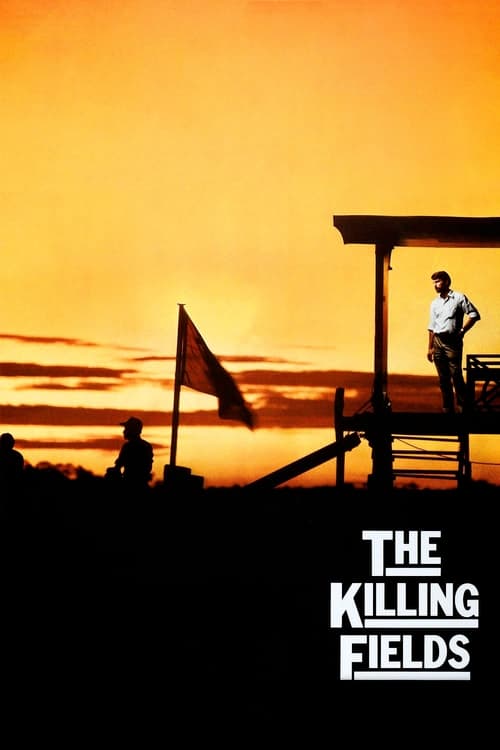
The Killing Fields
1984 · Roland Joffé
For when you want a serious, wrenching film that earns its weight — a story of friendship and survival to watch when you're ready to be shaken, not soothed.
What it's about
Phnom Penh, 1975. As Cambodia collapses into the hands of the Khmer Rouge, New York Times correspondent Sydney Schanberg covers the catastrophe alongside Dith Pran, the Cambodian interpreter and journalist who is his partner and friend. When the Americans pull out, Schanberg can arrange Pran's escape — but Pran chooses to stay and keep reporting, a decision that tests their friendship against one of the century's great horrors.
The experience
Gripping and harrowing in the way only true stories can be — it moves with the urgency of frontline reportage, then deepens into something devastating and quietly hopeful. It stays with you for a long time.
Performances
Haing S. Ngor, a Cambodian doctor and genocide survivor with no acting experience, won an Academy Award as Dith Pran in one of cinema's most extraordinary cases of lived truth on screen; Sam Waterston burns with guilt and stubbornness as Schanberg, and a young John Malkovich is vivid as a war photographer.
The craft
Chris Menges's Oscar-winning cinematography gives a society's collapse the texture of documentary — chaotic evacuations, choked streets, and fields that look like the end of the world, staged at a scale films rarely attempt anymore. The sound and score keep tightening the vise without ever tipping into melodrama.
Why it matters
It brought the Cambodian genocide into the world's living rooms and stands as the high-water mark of the 1980s British prestige cinema revival — the film against which journalism-in-wartime dramas are still measured.
Snapshot
The Killing Fields is a British prestige drama that reconstructs the fall of Cambodia to the Khmer Rouge and the genocide that followed, told through the friendship between New York Times correspondent Sydney Schanberg and his Cambodian assistant and interpreter Dith Pran. Adapted by Bruce Robinson from Schanberg's 1980 New York Times Magazine article "The Death and Life of Dith Pran," the film was the feature directorial debut of Roland Joffé and a flagship production of David Puttnam's Goldcrest-backed slate. It arrived as the most ambitious entry in the early-1980s British cinema revival, marrying the moral seriousness of the "quality" British film to the scale and reportorial texture of a Hollywood war picture. Its lasting reputation rests on two pillars: Chris Menges's documentary-grade cinematography of a society collapsing, and the casting of Haing S. Ngor — a Cambodian physician and genocide survivor with no acting experience — as Dith Pran, a performance whose authority comes from lived catastrophe. The film won three Academy Awards and brought the specific horror of the Cambodian "Year Zero" to a mass Western audience that had largely framed Indochina through the lens of the American war in Vietnam.
Industry & production
The film was produced by David Puttnam through his Enigma operation with financing and distribution muscle from Goldcrest Films, the British company then riding the prestige and capital generated by Chariots of Fire (1981) and Gandhi (1982); Warner Bros. handled distribution in the United States. Puttnam, fresh from the Best Picture success of Chariots of Fire, was the decisive industrial force: he commissioned the screenplay, recruited Joffé from British television, and pushed the project as exactly the kind of socially serious, internationally legible film that Goldcrest's strategy depended on. The production carried a large budget by the standards of British filmmaking of the period — among the most expensive of Goldcrest's undertakings — and the company's willingness to back films of this scale would, within two years, contribute to its overreach and collapse after the failures of Revolution and Absolute Beginners. In that sense The Killing Fields sits on the upslope of the Goldcrest story: a vindication of the ambition that the company would shortly take too far.
Because Cambodia was inaccessible, principal photography took place largely in Thailand, which stood in for Phnom Penh and the Cambodian countryside, with additional work in locations including Canada and Toronto interiors for the New York and newsroom material. The logistics were formidable — large crowd sequences, the staged evacuation of a capital, and the recreation of Khmer Rouge labor camps. Casting was unconventional and consequential: Puttnam and Joffé chose to fill the role of Dith Pran not with a professional but with Haing S. Ngor, a Cambodian doctor living as a refugee who had himself survived the regime depicted on screen. The decision aligned the film's production ethics with its subject and is inseparable from its critical standing.
Technology
The Killing Fields was shot photochemically on 35mm with a deliberately naturalistic exposure regime, but its most historically notable technological dimension is its music. The score was composed by the rock musician Mike Oldfield — best known for Tubular Bells — in what remains his principal film work. Oldfield built the score around the Fairlight CMI, the pioneering digital sampling synthesizer that was reshaping record production in the early 1980s, blending synthesized and sampled textures with conventional orchestral and choral elements. The result is a hybrid sound that marked a moment when electronic music production was migrating from the pop studio into the prestige film. The film's most discussed musical choice, however, is not synthetic at all: its closing reunion is scored to John Lennon's "Imagine," a needle-drop that has divided viewers ever since between those who find it cathartic and those who find it an over-reach of sentiment against the preceding horror.
Technique
Cinematography
Chris Menges's photography is the film's defining formal achievement and earned him the Academy Award for Best Cinematography. Menges, who came out of documentary and shared the social-realist sensibility associated with Ken Loach, shot the Cambodian collapse with a reportorial immediacy — handheld camera in the crowd, available and naturalistic light, long lenses that flatten and crowd the frame during the chaos of the evacuation and the besieged French embassy. The approach refuses the picturesque: even the atrocities are rendered with an unsensational matter-of-factness that makes them harder to dismiss. The film's signature image — Pran moving across a flooded paddy field strewn with human bones, the literal killing field — derives its force precisely from this restraint, allowing the landscape's horror to register without rhetorical underlining.
Editing
Jim Clark's editing, also Oscar-winning, solves the film's central structural problem: it is two movies joined at a rupture. The first half is a dense, polyphonic war-correspondent drama anchored by Schanberg's point of view, cross-cutting between newsroom dispatches, diplomatic maneuvering, and street-level danger. After Pran is unable to leave and disappears into the Khmer Rouge's agrarian terror, the film narrows and slows into his largely wordless ordeal of survival. Clark manages the transfer of narrative gravity from the Western journalist to the Cambodian survivor, and modulates the pacing from the kinetic compression of the war sequences to the attritional, near-silent stretches of the labor camps.
Mise-en-scène / staging
The staging operates at two scales. The crowd set-pieces — the panicked evacuation, the embassy compound packed with those seeking refuge — are organized for density and confusion, with the principals threaded through masses of extras so that the protagonists feel swept along rather than commanding the frame. The second half inverts this, isolating Pran within the regimented emptiness of the collectivized countryside, where uniformity of dress and the erasure of individuality become the visual grammar of the regime's ideology. The recurrent motif of the field of remains gives the title its concrete referent and the film its moral center of gravity.
Sound
The soundscape moves between the overwhelming and the eerily depleted. The war sequences are built on layered chaos — ordnance, crowds, radio, the polyglot babble of a city under siege — while the camp sequences strip the track toward silence and whispered Khmer, heightening the danger of a single overheard word. Oldfield's score threads through both registers, its electronic textures lending an estranging, mournful continuity.
Performance
The performances are calibrated against documentary realism. Sam Waterston plays Schanberg as driven, abrasive, and morally implicated — a man whose professional hunger keeps Pran in danger and whose guilt animates the search that frames the film. The film marked the screen debut of John Malkovich, cast as the volatile combat photographer Al Rockoff, an early display of his unsettling presence. But the performance that defines the film is Haing S. Ngor's Dith Pran. Ngor, untrained as an actor and drawing on his own survival of the regime, gives a performance of extraordinary stillness and endurance; much of his greatest work is non-verbal, registering fear, calculation, and grief through behavior rather than speech. It is among the most celebrated cases in film history of authenticity of experience translating directly into screen truth.
Narrative & dramatic mode
The film's mode is realist witness-cinema in the journalistic tradition: it dramatizes historical events through the perspective of reporters whose job is to see and record. Structurally it is a two-movement drama of testimony and survival. The first movement is a procedural of war reporting, organized around access, risk, and the ethics of bearing witness; the second is a survival narrative shorn of dialogue and exposition, in which the dramatic question contracts to whether one man can stay alive and escape. The reunion that closes the film provides emotional resolution, but the film withholds easy uplift: the catastrophe is collective and irreversible, and the friendship at its center is shadowed by Schanberg's complicity in Pran's exposure. The dramatic engine is moral rather than suspenseful — the persistent question of what the Western witness owes to the local who made his witnessing possible.
Genre & cycle
The Killing Fields belongs to the prestige war drama and to a specific early-1980s cycle of films about Western journalists caught inside Third World political violence — a cluster that includes The Year of Living Dangerously (1982), Under Fire (1983), and, soon after, Oliver Stone's Salvador (1986). These films share a self-conscious interrogation of the reporter as both witness and intruder. It also stands apart from the dominant Hollywood reckoning with Indochina, which centered on the American combat experience in Vietnam — The Deer Hunter (1978), Apocalypse Now (1979), and the later Platoon (1986). By relocating attention to Cambodia and to the genocide that the wider war helped unleash, The Killing Fields expanded that cycle's geography and shifted its moral emphasis from American trauma to Cambodian annihilation, foregrounding a non-Western protagonist as its survivor-hero.
Authorship & method
Roland Joffé came to the film from British theater and television, where he had directed for the stage and for the BBC and ITV; The Killing Fields was his first feature, and its assurance is partly attributable to Puttnam's assembly of an exceptionally strong creative team around a first-time director. Joffé's method here is one of controlled realism in service of moral argument — a sensibility he carried directly into his next film, The Mission (1986), again with Puttnam, Menges, and Goldcrest, which won the Palme d'Or at Cannes. The two films together define Joffé's peak as a director of large-scale, conscience-driven historical drama; his later career (Fat Man and Little Boy, City of Joy, and the critically savaged The Scarlet Letter, 1995) never recovered the same standing.
The key collaborators are central to the film's authorship. Screenwriter Bruce Robinson — who would the following years write and direct the cult comedy Withnail and I (1987) — shaped Schanberg's reportage into a two-handed human drama and was Oscar-nominated for the adapted screenplay. Cinematographer Chris Menges brought the documentary realist tradition that gives the film its visual ethics. Editor Jim Clark gave it its architecture. Composer Mike Oldfield supplied its distinctive electronic-orchestral score. The collaboration is a textbook case of producer-driven authorship: Puttnam's curation of talent is as legible in the finished film as any single directorial signature.
Movement / national cinema
The film is a central document of the early-1980s British cinema revival — the moment screenwriter Colin Welland had announced from the Oscar stage with "the British are coming" after Chariots of Fire. Puttnam was the impresario of this revival's prestige wing, and The Killing Fields, with Gandhi and The Mission, exemplifies its ambition to make internationally minded, morally serious films of scale from a British production base. The movement's industrial vehicle, Goldcrest, embodied both the promise and the fragility of that moment: a British company attempting to finance films at near-Hollywood scale. The Killing Fields represents the strategy working; the company's subsequent collapse represents the strategy's limits. The film thus sits at a pivotal juncture in the history of British film financing.
Era / period
Produced in 1984, the film speaks to a mid-1980s Western culture still metabolizing the Indochina wars and newly attentive to the machinery of genocide. It belongs to the era's prestige humanitarian cinema, in which serious filmmakers used historical atrocity to address contemporary conscience. It also reflects the period's technological inflection point in film music, with digital sampling entering the prestige score. Set across the mid-1970s — the American withdrawal, the Khmer Rouge takeover of Phnom Penh in 1975, and the years of the regime through to its 1979 fall and the refugee crisis on the Thai border — the film reconstructs a recent history that, in 1984, remained politically live and incompletely reckoned with in the West.
Themes
The film's governing themes are loyalty and complicity. The friendship between Schanberg and Pran is built on an asymmetry of power and risk: the Western journalist's work depends on the local interpreter, who bears the consequences when the foreigners can leave and he cannot. From this springs the theme of survivor's guilt and Western moral responsibility — including the implicit indictment of the American bombing campaign that destabilized Cambodia. The film foregrounds the ethics and limits of witness: journalism can record atrocity but cannot prevent it, and the act of reporting can itself endanger those who enable it. Language and translation recur as both literal plot mechanism and metaphor for the gulf between observer and lived experience. Against these runs the film's portrait of the Khmer Rouge's "Year Zero" ideology — the violent erasure of individuality, history, and the educated class — which the second half renders as a landscape of enforced uniformity and silence.
Reception, canon & influence
The Killing Fields was received as a major film and a moral event. It earned seven Academy Award nominations — including Best Picture, Best Director, Best Actor for Waterston, and Best Adapted Screenplay — and won three: Chris Menges for Cinematography, Jim Clark for Editing, and Haing S. Ngor for Best Supporting Actor. Ngor's win was historically resonant: a non-professional and a survivor honored for embodying his own people's catastrophe, and one of the very few Asian performers so recognized to that point. At the BAFTAs the film was a dominant winner, taking Best Film and a sweep of craft and acting awards. The Lennon-scored ending drew the most divided commentary, emblematic of a broader critical reservation that the film occasionally pressed toward sentiment; but the consensus held it a powerful and important work.
Its influences run backward to the British social-realist documentary tradition (carried by Menges), to the witness-journalism cycle of The Year of Living Dangerously and Under Fire, and to the wider body of Indochina cinema against which it defined itself. Its forward legacy is substantial. For a generation of Western viewers it was the primary cinematic account of the Cambodian genocide, fixing the phrase "the killing fields" in common usage as shorthand for the atrocity itself. It helped legitimize the casting of non-professional survivors and native-language actors in historical-trauma cinema, anticipating later practice in films about genocide and displacement. Haing S. Ngor became an advocate and public figure on Cambodia's behalf until his murder in Los Angeles in 1996 — a coda that, tragically, returned the violence the film depicted to its own star. And within British film history, the picture stands as the high-water mark of Puttnam-Goldcrest ambition, a touchstone in any account of the 1980s British revival and its swift, costly unraveling.
A Deleuzian reading
A man wades through a flooded field, and his foot finds something that isn't mud.
The full Deleuzian reading of The Killing Fields →
Reception
A critical and awards juggernaut on release — eight BAFTAs including Best Film, seven Oscar nominations, three wins — and its standing has barely wobbled since: still routinely cited as the definitive film about the Cambodian genocide, though it's talked about less than its 80s prestige peers.
How The Killing Fields was received, from release to now →
Influences: the films it descends from and the films it influenced
- Kes (1969) — Chris Menges' formative work here established the handheld, available-light, long-lens naturalism of British social-realist documentary that he transplanted wholesale into The Killing Fields' visual ethics.
- The Battle of Algiers (1966) — Pioneered the newsreel-grain documentary staging of mass political atrocity using non-professionals drawn from the affected populace — the casting and crowd-realism logic behind Haing S. Ngor and the evacuation set-pieces.
- Z (1969) — Fused investigative-journalism procedure with kinetic documentary urgency to dramatize state terror, modeling the reporter-uncovering-atrocity engine the film inherits.
- The Year of Living Dangerously (1982) — Set the template of the Western correspondent as compromised witness inside an Asian political catastrophe, the witness-cinema viewpoint TKF adopts through Schanberg.
- Under Fire (1983) — Foregrounded photojournalist ethics — the moral cost of recording rather than acting — in a Third World revolution, the immediate witness-journalism cycle TKF caps.
- Apocalypse Now (1979) — Built the immersive Indochina sensorium of jungle dread and atrocity against which Joffé deliberately pitched his soberer, reportorial counter-realism.
- The Deer Hunter (1978) — Established the long-form, two-movement war-trauma architecture — immersive normalcy then captivity/escape — that Jim Clark's editing mirrors in TKF's bifurcated structure.
- Culloden (1964) — Invented the docudrama 'live-reportage' camera treating historical massacre as if covered by a news crew — the British TV docudrama grammar Joffé carried from the BBC.
- Missing (1982) — Carries forward the fact-based docudrama of a Westerner confronting state atrocity and disappearance, anchored by restrained against-type lead performance.
- The Mission (1986) — Reassembles the identical Joffé–Menges–Puttnam–Goldcrest authorship to stage conscience-driven historical epic with massed non-professional crowd set-pieces, the immediate twin work.
- A World Apart (1988) — Menges' directorial debut applies his TKF realist cinematography to political trauma observed through an outsider/child witness, carrying his method forward as authorship.
- Schindler's List (1993) — Extends TKF's genocide-witness ethics via documentary-realist monochrome, long-lens crowd liquidations, and the survivor-testimony imperative.
- Welcome to Sarajevo (1997) — Places a journalist-witness inside an active genocide and intercuts real news footage, radicalizing TKF's reportage-as-drama into hybrid documentary form.
- Hotel Rwanda (2004) — Renders genocide through one survivor's ground-level witness pitched to Western audiences, inheriting TKF's strategy of moral enormity filtered through a single endangered protagonist.
- The Missing Picture (2013) — Reclaims the same Khmer Rouge atrocity from inside, through survivor memory — the logical endpoint of TKF's non-professional-survivor witness, now authored by a survivor.
- First They Killed My Father (2017) — Direct lineal heir: stages the Cambodian genocide with Khmer-speaking non-professionals and a near-wordless child's-eye witness, fulfilling TKF's native-language, non-verbal casting practice.
- The Last King of Scotland (2006) — Established the prestige-political-drama template of a Western professional who is simultaneously witness and complicit in Third World state violence, shot by Chris Menges in available light on authentic Southeast Asian locations with documentary density of background incident.
- Civil War (2024) — Builds its drama as a journalism-procedural in which embedded reporters navigate a collapsing nation, the same witness-as-protagonist structure Garland adopts.
- Cry Freedom (1987) — Same British prestige witness-cinema apparatus framing a non-Western atrocity (apartheid) through a sympathetic Western liberal's viewpoint and large-scale crowd staging.
- Salvador (1986) — Extends the journalist-as-witness model into Central American death-squad terror with grainy handheld immediacy and atrocity reconstructed at ground level.
- Local Hero (1983) — Menges scales the identical method — handheld, available light, documentary distance — to widescreen on another Puttnam production the following year, proving the technique was a portable authorial signature and not a one-film adaptation.
Similar films
- Apocalypse Now (1979) — influence & lineage
- Hotel Rwanda (2004) — influence & lineage
- Schindler's List (1993) — influence & lineage
- Platoon (1986) — shared sensibility
- Saving Private Ryan (1998) — shared sensibility
- Civil War (2024) — shared sensibility
- The Act of Killing (2012) — shared sensibility
- Out of Africa (1985) — shared sensibility
All the films related to The Killing Fields →