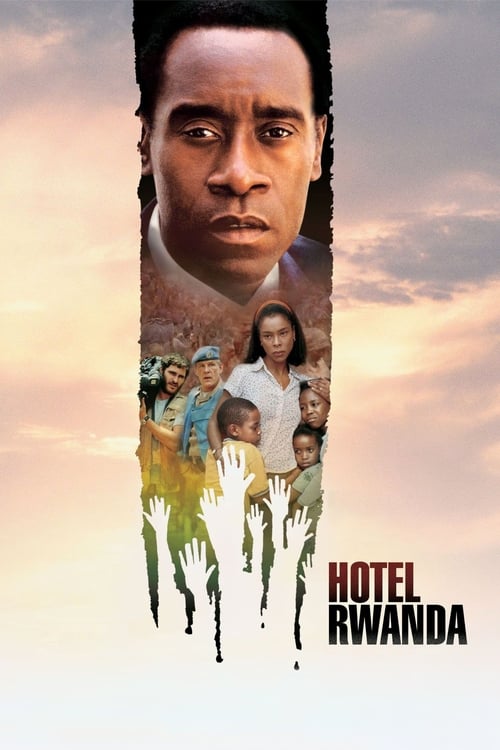
Hotel Rwanda
2004 · Terry George
For when you want a film of real moral weight — one that leaves you shaken and grateful you watched. Emotionally heavy but built like a thriller, so it grips even as it devastates.
What it's about
Kigali, 1994. As genocide engulfs Rwanda and the world looks away, Paul Rusesabagina — manager of a Belgian-owned luxury hotel — uses every favor, bribe, and bluff he knows to shelter more than a thousand refugees inside its walls. Based on a true story, it follows one man improvising survival for others as the machinery of protection around him collapses.
The experience
Gripping and wrenching without wallowing — the tension comes from negotiation and nerve, a man buying lives with whisky, flattery, and phone calls. It leaves you shaken and angry at the world's indifference, but also moved by what one person's cunning and decency accomplished.
Performances
Don Cheadle gives a career-defining performance as Rusesabagina, all composed charm over mounting terror, and Sophie Okonedo matches him with quiet ferocity as his wife Tatiana — both were Oscar-nominated.
The craft
Terry George keeps the atrocity largely at the edges of the frame, trusting implication and Cheadle's face to carry the horror, which makes the film bearable without softening it. The screenplay's structure — one building, escalating sieges of bureaucracy and militia — turns history into taut drama.
Why it matters
The definitive mainstream dramatization of the Rwandan genocide, it brought the catastrophe — and the world's failure to act — to a global audience and earned three Academy Award nominations.
Snapshot
Hotel Rwanda dramatizes the 1994 Rwandan genocide through the true story of Paul Rusesabagina, the acting manager of the Hôtel des Mille Collines, a Belgian-owned luxury hotel in Kigali, who sheltered more than a thousand Tutsi and moderate Hutu refugees as the killing engulfed the country. Directed by the Irish filmmaker Terry George from a screenplay he co-wrote with Keir Pearson, the film stars Don Cheadle as Rusesabagina, with Sophie Okonedo as his wife Tatiana, Nick Nolte as a beleaguered UN colonel, and Joaquin Phoenix as a Western journalist. It premiered at the Toronto International Film Festival in September 2004 and entered wide release later that year. Widely received as the definitive mainstream dramatization of the genocide, it earned three Academy Award nominations and became, for a generation of viewers, the primary cinematic reference point for events that the international community had largely ignored as they unfolded. Its reputation is inseparable from a difficult afterlife: subsequent disputes over the historical accuracy of Rusesabagina's portrayal, and his own later imprisonment in Rwanda, have complicated but not erased the film's standing.
Industry & production
Hotel Rwanda was a transnational co-production assembled around modest resources for a film of its dramatic ambition. Financing and distribution came through a coalition that included United Artists and Lions Gate, with production partners drawn from the United Kingdom, Italy, and South Africa. The reported budget was in the range of the high teens of millions of dollars—small by Hollywood standards for a historical epic—which shaped nearly every production decision, from casting to location strategy. The film was shot substantially in South Africa, using Johannesburg and the Kwazulu area as stand-ins alongside limited work in Kigali itself; the South African base supplied crews, extras, and infrastructure that Rwanda, a decade after the genocide, could not economically provide. Terry George has described developing the project with Keir Pearson over several years, working closely with the real Paul Rusesabagina, whose account formed the spine of the screenplay. Distribution was pitched squarely at the awards season and the specialty market, relying on festival exposure, critical momentum, and word of mouth rather than a saturation marketing campaign. It performed respectably at the box office relative to its cost and became a durable presence in classrooms and human-rights education, an afterlife arguably more consequential than its theatrical run. I have avoided citing precise budget or gross figures here because the publicly circulated numbers vary and I cannot confirm a single authoritative figure.
Technology
Technologically, Hotel Rwanda is a conventional production, and honesty requires stating that it broke no new ground in this respect. It was photographed on 35mm film using standard camera equipment of the period, without the digital-cinematography experimentation that some contemporaneous films were beginning to embrace. The picture makes essentially no use of visual effects spectacle; its most harrowing images—roadblocks, corpse-strewn roads, the fog-shrouded highway sequence—are achieved through staging, makeup, art direction, and editing rather than computer-generated imagery. This restraint is partly aesthetic and partly economic, and the two are hard to separate. The film's power derives from analog, on-set craft: physical crowds of extras, practical smoke and firelight, and the tactile realism of location shooting. Where many mid-2000s message films leaned on technological augmentation, Hotel Rwanda deliberately withholds it, a choice consonant with its ethic of witness rather than sensation.
Technique
Cinematography
The cinematography, by the French director of photography Robert Fraisse—a veteran of The Lover, Ronin, and Enemy at the Gates—favors a grounded, humane realism over stylistic flourish. Fraisse works largely with available-feeling light and a handheld-inflected mobility that keeps the camera close to Cheadle's face, privileging the moral drama legible in expression over panoramic depictions of atrocity. A defining strategy is what the violence is not shown: the film repeatedly declines to render the killing graphically, keeping massacres at the edge of frame, in the dark, or in the aftermath. The most cited image—Rusesabagina's van striking something on a fog-obscured road, the mist lifting to reveal a highway carpeted with bodies—works precisely because the camera has withheld until that moment. The palette is muted and earthbound, the framing intimate; grandeur is reserved for the hotel's incongruous colonial elegance, which the compositions repeatedly contrast against the chaos beyond its walls.
Editing
Naomi Geraghty's editing sustains a slow tightening of tension rather than kinetic montage. The film is structured as a gradual constriction—the shrinking of safe space, the failure of each hoped-for rescue—and the cutting patiently accumulates dread, holding on reaction and negotiation. Crucial to the film's restraint is its editorial discretion around violence, cutting away from or before acts of killing so that horror registers through consequence and implication. The pacing gives Cheadle room to perform Rusesabagina's improvised diplomacy in near-real time, letting scenes of bribery, pleading, and telephone brinkmanship run long enough to generate genuine suspense.
Mise-en-scène / staging
The production design organizes the whole film around a single controlling contrast: the Mille Collines as a fragile island of colonial-era order—linens, cocktails, a swimming pool—surrounded by an encroaching catastrophe. Staging exploits thresholds obsessively: gates, lobbies, corridors, and the hotel's perimeter become the film's essential dramatic geography, the membrane between refuge and slaughter. Crowd staging is central; the massing of refugees in courtyards and hallways conveys scale and claustrophobia at once. The recurring motif of the radio—the RTLM broadcasts urging Hutus to kill the Tutsi "cockroaches"—is woven into the mise-en-scène as an ambient, disembodied incitement, a sound-object that saturates the environment.
Sound
Sound design leverages that radio propaganda as a persistent auditory threat, and uses off-screen sound—gunfire, screams, mob noise beyond the walls—to keep the violence present without depicting it. The score blends orchestral scoring with African musical elements; music credits are shared among composers including Andrea Guerra and Rupert Gregson-Williams, and the film is closely associated with the song "Million Voices" performed by Wyclef Jean, which accompanies the closing and became one of the film's signatures. (Because the scoring was a collaborative effort, I attribute individual cues cautiously.) African vocal and percussion textures lend the film cultural specificity and an elegiac register.
Performance
Performance is the film's greatest strength, and Don Cheadle's Rusesabagina is its center of gravity. Cheadle plays him not as a conventional hero but as an accommodating, status-conscious hotelier—a man fluent in the small corruptions of hospitality—whose competence at flattery and bribery is gradually repurposed toward moral heroism. The performance is built on restraint and calibration, its most devastating moment a private breakdown (the knotting of a necktie that dissolves into collapse) rather than any speech. Sophie Okonedo, as Tatiana, grounds the film's domestic stakes with a performance of fierce vulnerability. Nick Nolte's UN colonel—an invented figure evoking the Canadian general Roméo Dallaire—delivers the film's bluntest indictment of Western indifference, and Joaquin Phoenix's journalist voices its most quoted line, the observation that Western viewers will call footage of the genocide horrible and then "go on eating their dinners."
Narrative & dramatic mode
The film operates in the mode of the historical dramatization built on the "ordinary man in extraordinary circumstances" template—closer to the humanist rescue narrative than to the war epic. Its dramaturgy is that of steadily escalating entrapment: a domestic and professional world we recognize is invaded and dismantled, and the protagonist must improvise survival through wit rather than force. The screenplay foregrounds moral transformation—Rusesabagina's evolution from a man protecting his own family to one who accepts responsibility for a thousand strangers—and organizes tension around negotiation, favors called in, and the recurring collapse of external rescue. It is a film almost entirely without action-heroics; its climaxes are phone calls, convoys, and lists of names. The mode is fundamentally testimonial: it asks the audience to bear witness, and it repeatedly stages the failure of the wider world to do so.
Genre & cycle
Hotel Rwanda sits within the genocide-and-atrocity drama, a lineage that includes The Killing Fields (1984) and, most insistently in its reception, Schindler's List (1993)—the comparison to Spielberg's film, with its industrialist-turned-rescuer and its hero saving lives from within a system of murder, was immediate and near-universal. More specifically, the film belongs to a mid-2000s cycle of Western-facing films about African crisis and conscience: The Constant Gardener (2005), Blood Diamond (2006), and the concurrent wave of Rwanda-specific films—Raoul Peck's Sometimes in April (2005) and Michael Caton-Jones's Shooting Dogs / Beyond the Gates (2005). Within that cluster, Hotel Rwanda was the highest-profile and most conventionally structured, and it drew both the widest audience and the sharpest critiques about centering an accessible, redemptive protagonist. It also participates in the broader "based on a true story" prestige drama that dominated 2000s awards seasons.
Authorship & method
Terry George came to the material from a career steeped in political conflict, particularly the Northern Irish Troubles: he had written In the Name of the Father and directed Some Mother's Son, and his sensibility is that of a dramatist drawn to individuals crushed between political machinery and personal loyalty. His method on Hotel Rwanda was collaborative and research-driven, developed with co-writer Keir Pearson and grounded in extensive consultation with Paul Rusesabagina himself—a reliance that is both the film's authority and, later, the focus of its controversy, since building the account so completely around one man's testimony shaped what the film could and could not see. George's directorial approach privileges actors and restraint, trusting performance and implication over spectacle. Among key collaborators, cinematographer Robert Fraisse supplied the intimate realism; editor Naomi Geraghty shaped its tightening suspense; and the shared musical authorship, associated with Andrea Guerra, Rupert Gregson-Williams, and the Wyclef Jean song, gave the film its blend of orchestral gravity and African voice. The screenplay by George and Pearson earned an Academy Award nomination, marking the writing as the film's most institutionally honored element alongside its performances.
Movement / national cinema
The film resists tidy placement within any national cinema or movement, and it would be a distortion to force one. It is the work of an Irish auteur, financed through American and European sources, shot in South Africa, and set in Rwanda—a genuinely transnational artifact of globalized "issue" filmmaking rather than an expression of a coherent national school. It is not a product of African cinema in any meaningful authorship sense; its perspective is that of an outsider dramatizing African trauma primarily for Western audiences, a positioning that later postcolonial criticism scrutinized. If it belongs to any tendency, it is the international human-rights or "conscience" cinema of the 2000s, funded and circulated through festival and specialty-distribution networks, rather than to a geographically rooted movement.
Era / period
The film is a characteristic product of the mid-2000s prestige-drama ecosystem, arriving at the tenth anniversary of the genocide and amid a broader cultural reckoning with the 1990s failures of Western intervention in Rwanda, Bosnia, and elsewhere. Its release coincided with post-9/11 debates about intervention, humanitarian responsibility, and the limits of the United Nations, which gave its indictment of international indifference contemporary resonance. Industrially it belongs to the era when mini-major and specialty distributors—the Lions Gate model—could turn modestly budgeted, socially engaged dramas into awards contenders. Its aesthetic conservatism and its faith in the star-driven humanist narrative also mark it as of its moment, a film made just before digital production and streaming would reshape how such stories were financed and seen.
Themes
The film's dominant theme is the moral catastrophe of international indifference—the "genocide that went mostly unnoticed"—dramatized through the abandonment of the refugees by the UN, the departure of Western nationals, and the journalist's bleak prophecy about dinner-table apathy. Intertwined is the theme of ordinary heroism: the argument that decency under pressure is improvised, imperfect, and rooted in mundane competence rather than saintliness. The film examines the machinery of dehumanization, especially the role of radio propaganda in manufacturing genocide, and the fragility of the categories—Hutu, Tutsi—that colonial administration had hardened into lethal identities. It meditates on complicity and the ethics of self-preservation, tracing Rusesabagina's expansion of moral obligation from family to strangers. And it interrogates the politics of witness itself—who gets to be seen, whose suffering registers in the West, and the failure of images to compel action.
Reception, canon & influence
Critically, Hotel Rwanda was received with wide admiration, its acclaim concentrated on Cheadle's performance and on the film's restraint in handling atrocity; the comparison to Schindler's List recurred throughout its reviews. It earned three Academy Award nominations—Best Actor for Don Cheadle, Best Supporting Actress for Sophie Okonedo, and Best Original Screenplay for Terry George and Keir Pearson—and accumulated further critics'-group and guild recognition, though it won no Oscars. It swiftly became a canonical teaching text on the genocide and on international human-rights failure, embedded in curricula worldwide.
Its lines of influence run backward to Schindler's List and The Killing Fields as templates for the individual-rescuer atrocity drama, and to the documentary and journalistic record of the genocide, including accounts of General Roméo Dallaire's frustrated UNAMIR mission that inform Nolte's character. Forward, it stands as the most visible entry in the mid-decade wave of Rwanda films and consolidated the "African crisis and Western conscience" cycle that Blood Diamond and others extended; it also became a reference point in debates about who is authorized to tell such stories and about the ethics of centering a marketable protagonist.
That legacy is genuinely contested, and the record here is not thin but fraught. In the years after release, some survivors and historians disputed the heroism attributed to Rusesabagina and the film's account of events at the Mille Collines, arguing it simplified or embellished his role. Rusesabagina's own trajectory deepened the complication: an outspoken critic of the Rwandan government, he was detained and, in 2021, convicted on terrorism-related charges by a Rwandan court in proceedings widely criticized internationally as politically motivated, before his release in 2023. These developments have made Hotel Rwanda a case study not only in the genocide but in the politics of historical memory and cinematic mythmaking—its enduring importance now inseparable from the questions it raises about how, and by whom, atrocity is narrated.
Reception
In 2004 it was an awards-season triumph — three Oscar nominations and instant 'Africa's Schindler's List' framing — but its afterlife has been complicated by real-world events: the 2020–2023 arrest and conviction of the real Paul Rusesabagina in Rwanda, plus long-running disputes from survivors and the Rwandan government over the film's heroic portrait of him, mean it's now impossible to discuss the movie without discussing the man.
How Hotel Rwanda was received, from release to now →
Influences: the films it descends from and the films it influenced
- Schindler's List (1993) — Supplies the rescuer-as-fixer template Hotel Rwanda transposes wholesale: a compromised businessman launders bribes, liquor, and professional connections into saved lives while the killing stays largely at the frame's edge, with the Mille Collines standing in for the Kraków factory.
- The Killing Fields (1984) — Establishes genocide rendered through the fraying bond between a Western observer (journalist/colonel) and a trapped local man, the massacres glimpsed as handheld fragments amid roadblock chaos rather than staged as spectacle.
- The Battle of Algiers (1966) — Model for the newsreel-grained handheld realism and the colonial-order-vs-chaos staging of checkpoints and crowds, plus broadcast media deployed as an instrument of mass mobilization and terror.
- Missing (1982) — The political-conscience thriller built on a decent civilian navigating bureaucratic indifference while atrocity happens off-screen; Nolte's impotent UN colonel echoes its structure of indicting Western institutions for looking away.
- Come and See (1985) — Precedent for registering atrocity through a single overwhelmed witnessing face and through subjective sound design — distant gunfire, radio, ringing — locating the horror in implication and aftermath rather than the act itself.
- In the Name of the Father (1993) — Terry George's own screenplay, where he forges the method he brings to Rusesabagina: dramatizing an ordinary man crushed between political machinery and personal loyalty, structured as escalating entrapment.
- Some Mother's Son (1996) — George's directorial debut, where he develops the actor-first restraint and the threshold-geography of a domestic sanctuary besieged by political violence that he later reworks at the hotel gates.
- Cry Freedom (1987) — Supplies the 'African crisis narrated for Western audiences through one sympathetic, marketable protagonist' model that Hotel Rwanda both inherits and is critiqued for reproducing.
- Salvador (1986) — Precedent for handheld immersion in a collapsing state, where corpse-strewn roads and improvised roadblocks are shot with documentary immediacy from inside a protagonist's panic.
- Blood Diamond (2006) — Consolidates the mid-decade African-crisis/Western-conscience cycle Hotel Rwanda headlined, pairing a compromised local guide with an outsider and using civil-war atrocity as the engine of a marketable rescue arc.
- The Last King of Scotland (2006) — Carries forward the actor-first, restraint-driven realism for African political atrocity, filtering it through a compromised outsider's vantage — Whitaker's Amin the performance-anchored center as Cheadle was.
- Beasts of No Nation (2015) — Extends handheld-realist African-atrocity cinema in which an ordinary figure is swept into extremity and much of the killing is implied at the frame's edge rather than fully shown.
- Hotel Mumbai (2018) — Directly inherits the 'grand hotel as fragile sanctuary under siege' architecture — staff shielding guests, threshold suspense at doors and lobbies, violence heard and cut away from — that Hotel Rwanda made a template.
- Sometimes in April (2005) — The Rwandan-authored counter-narrative made in direct dialogue with Hotel Rwanda, extending its RTLM radio-propaganda motif into the film's connective tissue while contesting its outsider-facing rescuer frame.
- Shooting Dogs (Beyond the Gates) (2005) — Restages the genocide as threshold-geography siege — a school compound as fragile sanctuary with machetes at the gate and UN forces withdrawing — the exact 'safe enclosure vs. chaos outside' device Hotel Rwanda centers.
- The Constant Gardener (2005) — Extends the handheld, restless docu-texture 'Western conscience in Africa' mode, keeping violence off-frame and implied while indicting international indifference and corporate/state complicity.
- Playing for Keeps (2012) — Showcases composer Andrea Guerra's signature aching-strings emotional underscoring method — the collaborator technique recruited to manufacture sentiment in Muccino's films, including this one.
- Quo Vadis, Aida? (2021) — A protagonist leveraging their institutional position to shelter civilians while UN peacekeepers are ordered to stand down — the same abandonment-by-mandate at the story's core.
Similar films
- Sometimes in April (2005) — influence & lineage
- The Constant Gardener (2005) — influence & lineage
- Schindler's List (1993) — influence & lineage
- The Killing Fields (1984) — influence & lineage
- Winter Sleep (2014) — often watched together
- The Notebook (2004) — shared sensibility
- Camp de Thiaroye (1988) — shared sensibility
- Carandiru (2003) — shared sensibility