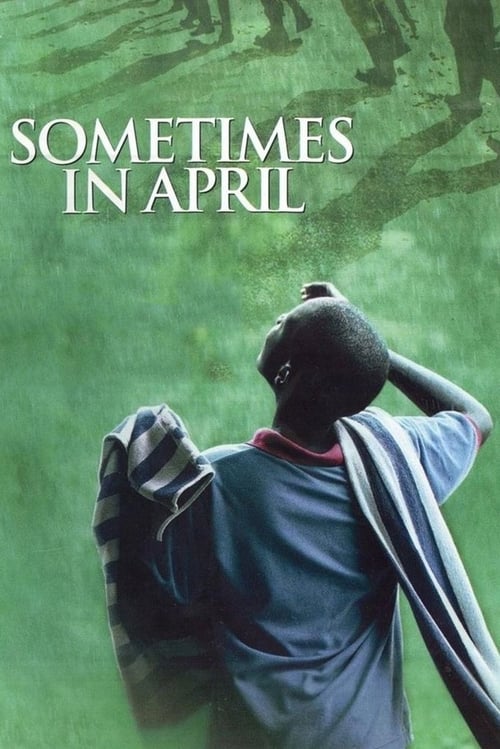
Sometimes in April
2005 · Raoul Peck
For when you're ready to actually confront a piece of history rather than be comforted about it — a demanding, necessary watch, not a casual one. Choose it when you want to understand, and give it your full attention.
What it's about
Rwanda, 1994: as the genocide begins, a Hutu soldier married to a Tutsi woman tries to protect his family through the hundred days of killing, while his brother broadcasts hate radio. A decade later, the two men face each other again — one living with what happened, the other awaiting trial at the international tribunal. The film moves between the catastrophe and its aftermath, asking not just what happened but what accountability could even look like.
The experience
Sober, unflinching, and heavy in the way it should be — this is not a rescue story with an uplifting exit, and it doesn't look away. The dual timeline gives you room to breathe, but the weight accumulates; it's the kind of film you sit with in silence afterward.
Performances
Idris Elba, in one of his first major dramatic leads, is quietly devastating — a man carrying survival and guilt in the same body, doing his biggest acting in stillness.
The craft
Raoul Peck shot on location in Rwanda, casting survivors and filming at actual massacre sites with their communities' cooperation, and that decision gives every frame a documentary gravity no set could fake. The two-timeline structure is the film's argument: genocide is not just an event but an aftermath of complicity, testimony, and imperfect justice.
Why it matters
Made for HBO and released the same season as Hotel Rwanda, it stands as the sterner, survivor-centered counterpoint — and as an early landmark for Peck, who went on to become one of cinema's essential political filmmakers with I Am Not Your Negro.
Raoul Peck — the Haitian director and former culture minister who would later make I Am Not Your Negro — answers the question of how cinema should face the 1994 Rwandan genocide with rigor rather than uplift. Where Hotel Rwanda offered a rescuer's narrative, Peck structures his film as a wound examined a decade on: an ex-soldier (a quietly devastating Idris Elba) navigates the hundred days of killing in one timeline while, in 2004, he confronts his brother, a former hate-radio broadcaster awaiting trial at the international tribunal in Arusha. The dual structure insists that genocide is not only an event but an aftermath — of complicity, testimony and the vexed possibility of justice. Peck shot on location in Rwanda, casting survivors and filming at actual massacre sites with their cooperation, and the film carries the weight of that permission. Produced for HBO but premiered in competition at the Berlinale, and screened in Rwanda itself before international audiences saw it, it remains among the most morally serious dramatizations of the catastrophe — attentive, too, to the Western officials who parsed the word 'genocide' while the machetes did their work.
Reception
It arrived in Hotel Rwanda's Oscar shadow in 2005 — an HBO movie versus a theatrical awards player — but the verdict among film fans has steadily flipped: this is now widely called the tougher, truer Rwanda film, and its stock has only risen as Hotel Rwanda's has fallen.
How Sometimes in April was received, from release to now →
Influences: the films it descends from and the films it influenced
- The Battle of Algiers (1966) — Establishes the newsreel-grammar of anticolonial atrocity — handheld on-location shooting with non-professional locals playing themselves — that Peck adopts by filming in Rwanda with survivor-witnesses rather than restaging on a soundstage.
- Night and Fog (1955) — Pioneers the then/now dual-timeline of a genocide site — returning to the emptied ground years after — the exact aftermath-and-present cut structure Peck uses to intercut 1994 with the 2004 tribunal-era frame.
- Shoah (1985) — Builds atrocity from survivor and perpetrator testimony delivered at the actual locations; Peck imports this evidentiary, place-anchored voice into fiction, letting Kigali's real geography carry the memory.
- Come and See (1985) — Locks the camera to a single overwhelmed witness moving through massacre in near-real-time, refusing spectacle for endurance — the immersive survivor-POV register Peck's roadblock and church sequences inherit.
- Z (1969) — Fuses political-thriller pacing with a docudrama investigation of state-organized murder, the Costa-Gavras template of indicting institutions by procedure that shapes Peck's Arusha-tribunal spine.
- Missing (1982) — Dramatizes Western governmental complicity through an official's belated reckoning across two timeframes — the 'what did our government know and permit' structure that drives Peck's US State Department scenes.
- Schindler's List (1993) — Sets the prestige-drama convention of rendering industrial genocide legible to a mass audience through a few tracked individuals; Peck works against its rescuer-optimism while borrowing its intimate-witness scale.
- Lumumba (2000) — Peck's own prior method — reconstructing an African political catastrophe on African locations with a flashback frame narrated by the dead/absent — is the direct authorial rehearsal for Sometimes in April's structure.
- Munyurangabo (2007) — Takes Peck's survivor-casting and on-location Rwanda shooting to its limit — non-actors speaking Kinyarwanda in their own landscape — to dramatize the post-genocide complicity between a victim's and a perpetrator's sons.
- Shake Hands with the Devil (2007) — Extends the international-inaction thread by centering Dallaire and the UNAMIR command, formalizing the 'the world had the cables and did nothing' institutional indictment Peck stages in Washington.
- Waltz with Bashir (2008) — Carries forward the aftermath-and-complicity form — a participant reconstructing a massacre years later through fractured memory and testimony — pushing Peck's survivor-recollection frame into animated first-person inquiry.
- The Act of Killing (2012) — Radicalizes the complicity strand by handing the camera to perpetrators; it is the perpetrator-side counterpart to Peck's survivor-and-witness testimony about how ordinary neighbors were mobilized to kill.
- Kinyarwanda (2011) — Adopts Peck's braided multi-strand, on-location, largely Rwandan-cast approach — several interlocking 1994 stories drawn from survivor accounts — over the single-hero model, directly extending Sometimes in April's mosaic.
- Hotel Rwanda (2004) — The explicit counterpoint: same event and same hate-radio motif, but where George offers a single hotel-bound rescue arc for Western viewers, Peck deliberately diffuses across ordinary Rwandans and refuses the uplift.
- Shooting Dogs (2005) — Shot on the actual Rwandan school site with survivors in the cast, it shares Peck's on-location survivor-casting ethic and the same indictment of UN peacekeepers withdrawing from a compound of the doomed.
- A Sunday in Kigali (2006) — Contemporaneous Rwanda-set drama built on the same dual register — the 1994 slaughter recalled from a later return to Kigali — extending Peck's aftermath-and-complicity frame from an expatriate vantage.
- Quo Vadis, Aida? (2021) — Dramatizes genocide through the documented failure of international institutions and closes on a coda time-jump into the aftermath, the structural move Aida ends on.
Similar films
- Hotel Rwanda (2004) — influence & lineage
- Shoah (1985) — influence & lineage
- The Act of Killing (2012) — influence & lineage
- Camp de Thiaroye (1988) — shared sensibility
- Son of Saul (2015) — shared sensibility
- Tae Guk Gi: The Brotherhood of War (2004) — shared sensibility
- Quo Vadis, Aida? (2021) — shared sensibility
- The White Ribbon (2009) — shared sensibility