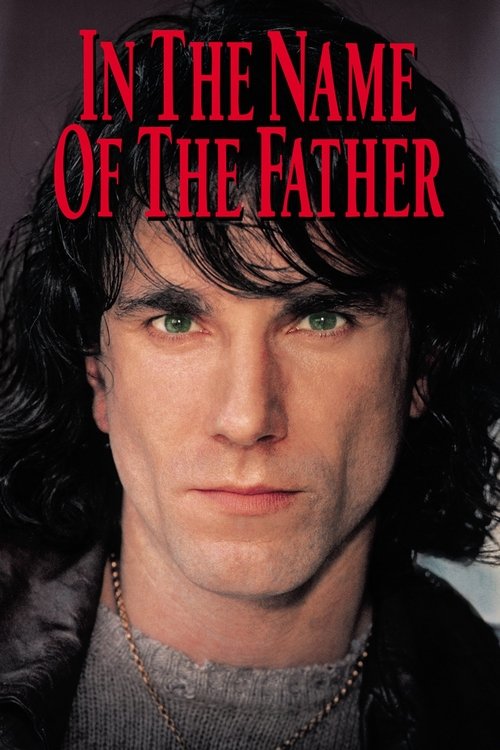
In the Name of the Father
1993 · Jim Sheridan
When you want to be swept up in a true story that makes you angry in the best way — a righteous, emotionally direct drama for a night you want to feel outraged, moved, and finally lifted.
What it's about
Gerry Conlon is a feckless small-time Belfast thief in the wrong city at the wrong time: when an IRA bomb kills civilians in an English pub in 1974, police coerce a confession out of him, and he's convicted along with his friends — and, unbearably, his own gentle, principled father. Locked in the same prison system, father and son fight to prove their innocence across fifteen years, while a determined lawyer takes up their cause on the outside.
The experience
A furious, gripping injustice drama that plays like a thriller in its interrogation scenes and something much more tender behind bars — the anger at the system and the ache of the father-son relationship build together until the courtroom scenes land like body blows. It earns every tear.
Performances
Daniel Day-Lewis is ferocious and heartbreaking as Gerry, charting a wastrel's transformation into a man with a cause; Pete Postlethwaite's quietly devout Giuseppe is the film's soul, and Emma Thompson brings steel to the crusading lawyer.
The craft
Jim Sheridan directs with propulsive energy — the interrogation sequence is among the most harrowing ever filmed — and welds a legal procedural to an intimate two-hander in a shared cell. The period texture of 1970s Belfast and London is vivid, and the soundtrack drives it hard.
Why it matters
Nominated for seven Academy Awards, it brought the Guildford Four scandal to a world audience and stands as one of the defining films about the Troubles and British miscarriages of justice.
Snapshot
In the Name of the Father dramatizes the wrongful conviction of Gerry Conlon and the so-called Guildford Four for the 1974 IRA pub bombings in Guildford, England, and the parallel persecution of the Maguire Seven — among them Gerry's father, Giuseppe Conlon. Adapted from Conlon's memoir Proved Innocent, the film compresses fifteen years of imprisonment, appeal, and eventual exoneration into a tight double narrative: a miscarriage-of-justice procedural welded to an intimate story of a wayward son and his ailing, principled father. Directed by Jim Sheridan in his second feature after My Left Foot (1989), and again anchored by Daniel Day-Lewis, it stands as one of the most prominent English-language films to confront the domestic legal fallout of the Northern Irish Troubles. It earned seven Academy Award nominations and the Golden Bear at the 1994 Berlin International Film Festival, while also drawing sustained debate over its liberties with the historical record — a tension between documentary fidelity and dramatic construction that has shadowed its reputation ever since.
Industry & production
The film was produced through Hell's Kitchen, the production company Sheridan ran with Arthur Lappin, with financing and distribution from Universal Pictures — a studio-backed budget for an Irish-driven project that reflected the commercial credibility Sheridan and Day-Lewis had earned from the Oscar success of My Left Foot. It represents a characteristic early-1990s arrangement in which a Hollywood major underwrote a European-authored, politically charged drama on the strength of prestige talent. Sheridan co-wrote the screenplay with Terry George, adapting Conlon's autobiography. The pairing of an Irish director and co-writer with a subject drawn directly from the Troubles gave the production an authorial specificity unusual for a studio release on this material.
Casting concentrated star power around a realist core: Day-Lewis as Gerry Conlon, Pete Postlethwaite as Giuseppe, Emma Thompson as the solicitor Gareth Peirce, and John Lynch as Paul Hill. The exact budget and precise box-office returns are not something I can cite reliably from memory, so I will not attach figures; what is well established is that the film performed strongly on the awards circuit and reached a wide international audience. Its production also unfolded amid the ongoing conflict itself — the film was released before the 1994 IRA ceasefire — which lent its release a charged contemporaneity, and contributed to the scrutiny it received from British commentators sensitive to how the security services and judiciary were portrayed.
Technology
In the Name of the Father is a photochemical, 35mm production of its era, employing conventional film stock and anamorphic-scaled framing without recourse to the digital tools that would reshape filmmaking later in the decade. Its technological interest lies less in innovation than in the deliberate texturing of period recreation: the grain, color temperature, and lighting are marshalled to distinguish the film's registers — the saturated, chaotic Belfast and London of the early scenes against the cold institutional palette of interrogation rooms and prison. This is a film whose "technology" is essentially the mature craft of early-1990s realist cinema rather than any novel apparatus, and I would caution against overstating technical claims the record does not support.
Technique
Cinematography
Peter Biziou, an Oscar-winning cinematographer (for Mississippi Burning), shot the film with a documentary-inflected realism that nonetheless allows for expressive heightening at key moments. The opening Belfast sequence — a riot amid the Troubles — is handled with kinetic, handheld immediacy, establishing Gerry as a small-time thief caught in a world already saturated with violence. The interrogation scenes tighten toward claustrophobia, using confined framing and hard light to convey coercion and disorientation. Prison interiors are rendered in muted, institutional tones. Biziou's camera repeatedly isolates the father-son relationship within the crowded frame of the prison, using the shared cell (a dramatic invention, discussed below) as an intimate two-hander space carved out of an oppressive environment.
Editing
Gerry Hambling, a frequent Alan Parker collaborator and a veteran of British editing, cut the film and received an Academy Award nomination for the work. The editing carries a heavy structural burden: it must telescope fifteen years and two intertwined legal cases into a coherent arc, and it frames the story partly as recollection, with Gerry recounting events to Peirce. Hambling's cutting drives the propulsive early sequences and the interrogation montage while modulating to a slower, more elegiac rhythm in the prison passages, particularly around Giuseppe's decline. The film's compression — a recurring point of both praise and criticism — is fundamentally an editorial and screenwriting achievement.
Mise-en-scène / staging
Sheridan's staging foregrounds the relationship between confinement and human dignity. The prison cell becomes the film's central stage, where the reckless son and the devout, patient father are forced into proximity that becomes moral education. The interrogation rooms are staged as theaters of intimidation. A crucial staged set-piece is the courtroom climax, built for maximum dramatic release — a construction that departs markedly from the actual legal process, prioritizing catharsis over procedure. Throughout, Sheridan stages the Conlon relationship as the emotional spine, letting the political indictment emerge through the personal.
Sound
The film's soundtrack is one of its most distinctive elements. Trevor Jones composed the score, and the film is bracketed and punctuated by contemporary rock and Irish popular music, most prominently the title song "In the Name of the Father" performed by Bono and Gavin Friday, and Sinéad O'Connor's "You Made Me the Thief of Your Heart" over the end credits. Jimi Hendrix's "Voodoo Child (Slight Return)" appears in the early sections, keying Gerry's youthful recklessness to the countercultural energy of the era. The juxtaposition of driving contemporary music against period-accurate dialogue and the harsh diegetic sound of riots and interrogations gives the film a charged, anachronistic pulse that heightens its emotional immediacy.
Performance
Performance is the film's greatest asset. Daniel Day-Lewis delivers a total transformation as Gerry, tracing an arc from feckless, self-absorbed youth to a man politicized and matured by injustice and by his father's example; his commitment, in keeping with his well-documented immersive method, was widely reported to have extended to physical deprivation and sustained in-character work during production, though I would treat the more colorful anecdotes with caution absent verification. Pete Postlethwaite's Giuseppe is the film's moral center — restrained, dignified, and quietly devastating — and the role brought him international recognition. Emma Thompson plays Gareth Peirce with cool intelligence, and John Lynch grounds Paul Hill. The Conlon father-son dynamic between Day-Lewis and Postlethwaite is the performance engine that carries the political argument.
Narrative & dramatic mode
The film operates in a realist-dramatic mode structured around a partial flashback frame: Gerry narrates his story to Peirce as she builds the case, so the account arrives filtered through memory and testimony. Structurally it fuses several familiar dramatic architectures — the coming-of-age story, the prison drama, the father-son melodrama, and the courtroom/investigative procedural — into a single escalating movement from injustice toward vindication. The dramatic mode is unabashedly emotional and morally legible; Sheridan does not pursue ambiguity so much as accumulate the weight of wrongdoing until the climactic release. The double focus — Gerry's inner transformation and the external legal fight — allows the film to be at once a personal redemption narrative and a public indictment, with the father's death in prison functioning as the tragic pivot that converts private grief into political resolve.
Genre & cycle
In the Name of the Father belongs to the wrongful-conviction/miscarriage-of-justice genre and, more specifically, to the cycle of films addressing the Northern Irish Troubles that gathered force through the late 1980s and 1990s. Within Sheridan's own body of work it forms part of an informal trilogy of Troubles-adjacent and Irish-identity films alongside The Boxer (1997) and his production/writing involvement in related projects. It also sits within the broader 1990s cluster of Troubles-themed cinema — including works such as The Crying Game (1992) and later Some Mother's Son (1996, which Sheridan co-wrote) — that brought the conflict to international art-house and mainstream audiences. As a courtroom-and-prison drama it draws on a durable Anglo-American genre tradition while inflecting it with distinctly Irish concerns of family, faith, and colonial grievance.
Authorship & method
The film is centrally Jim Sheridan's, and it consolidates the concerns of his authorship: family bonds under duress, Irish identity, the dignity of the marginalized, and the redemptive relationship between fathers and sons — themes already visible in My Left Foot and carried forward into The Boxer. Sheridan's method emphasizes actor-centered realism and emotional directness, and he is willing to reshape factual chronology in service of dramatic and thematic truth, a choice that defines this film's controversies. His screenwriting partnership with Terry George — himself later a significant director of politically engaged cinema — sharpened the film's structure and its political argument.
Among key collaborators, cinematographer Peter Biziou supplied the realist-to-expressive visual register; editor Gerry Hambling engineered the film's demanding compression and its memory-frame structure; and composer Trevor Jones, working alongside the contributions of Bono, Gavin Friday, and Sinéad O'Connor, built a sonic identity that fused orchestral score with contemporary rock and Irish song. The recurring creative alliance between Sheridan and Day-Lewis — their second of three collaborations — is itself an authorial signature, a director-actor partnership through which Sheridan's humanist themes found their most powerful embodiment.
Movement / national cinema
The film is a landmark of contemporary Irish cinema and of the internationalization of Irish filmmaking in the 1990s. Sheridan, working through his own production company and with studio backing, helped establish a model in which Irish stories of national and political weight could reach global audiences without surrendering their specificity. It belongs to a resurgent Irish national cinema that used the Troubles, emigration, family, and Catholic identity as central material, and it did so at a moment when the conflict remained unresolved. At the same time, because it addresses a British legal scandal and was produced with American finance, the film sits at a revealing intersection of Irish, British, and Hollywood cinema — an Irish-authored critique of the British justice system delivered through the international apparatus of a major studio.
Era / period
Released in 1993, the film arrived at the tail end of the Troubles and just before the 1994 ceasefire, giving it acute contemporary resonance. It depicts events of 1974 onward — the Guildford bombings, the wrongful convictions, the long imprisonment, and the eventual 1989 quashing of the Guildford Four's convictions — and it reconstructs the mid-1970s with period detail in costume, music, and social texture. Its production era, the early 1990s, was a high-water mark for prestige realist drama and for a wave of cinema reckoning with recent political violence and institutional failure across Britain and Ireland. The film thus operates on two temporal planes at once: the 1970s of its story and the still-unsettled early-1990s present of its release.
Themes
The film's dominant theme is the miscarriage of justice — the capacity of a state, under the pressure of terror and public fear, to fabricate guilt, coerce confessions, and suppress exculpatory evidence. Interwoven with this public theme is the intensely private one of fatherhood and reconciliation: Gerry's transformation is driven less by legal vindication than by his belated understanding of his father Giuseppe's quiet integrity, so that the political and the familial become inseparable. Further themes include Irish identity and the experience of being cast as suspect within Britain; the corrosive relationship between the individual and coercive institutions; faith, patience, and moral endurance embodied by Giuseppe against Gerry's initial nihilism; and redemption achieved through suffering. The title itself carries a triple charge — religious invocation, the father-son bond, and the idea of acting in a father's name — binding the personal and political dimensions into a single phrase.
Reception, canon & influence
Critically, the film was widely acclaimed for its performances and emotional power, earning seven Academy Award nominations — including Best Picture, Best Director, Best Actor for Day-Lewis, Best Supporting Actor for Postlethwaite, Best Supporting Actress for Thompson, Best Adapted Screenplay, and Best Film Editing — though it did not win in these categories; I will not claim specific competitive outcomes beyond noting the nominations. It won the Golden Bear at the 1994 Berlin International Film Festival, a significant marker of its international critical standing.
The most persistent thread in the film's reception is the debate over historical accuracy. Critics — particularly in Britain — objected to its dramatic license: the depiction of Gerry and Giuseppe sharing a prison cell (they did not); the introduction of a composite IRA figure; and above all the climactic courtroom scene, in which the suppression of exculpatory evidence is revealed in a burst of dramatic confrontation that does not correspond to how the actual appeal unfolded. Sheridan and his defenders framed these as legitimate compressions in service of emotional and thematic truth; detractors argued they distorted a real and serious injustice. This tension has become part of the film's critical identity and a standard case study in discussions of the ethics of dramatizing real events.
Influences on the film run backward to the traditions of the prison drama, the courtroom drama, and the social-realist British and Irish cinema of the preceding decades, as well as to the concrete factual record of the Guildford Four and Maguire Seven cases and Conlon's own memoir. Its legacy forward lies in cementing Jim Sheridan as a major voice in Irish cinema, extending the Sheridan–Day-Lewis partnership toward The Boxer, elevating Pete Postlethwaite to international prominence, and contributing to a broader public reckoning with wrongful convictions and with the human cost of the Troubles. Alongside contemporaries like The Crying Game, it helped bring Troubles-era subject matter to a global mainstream audience and remains a touchstone reference in conversations about miscarriage-of-justice cinema and the responsibilities of the fact-based drama.
A Deleuzian reading
Gerry Conlon is stealing when the street goes up.
The full Deleuzian reading of In the Name of the Father →
Reception
A hit on release — Golden Bear winner, seven Oscar nominations — though the British press hammered its dramatic liberties with the Guildford Four case; it went home empty-handed on Oscar night (the year of Schindler's List) and has since settled in as a cornerstone of Irish cinema and one of Daniel Day-Lewis's defining performances.
How In the Name of the Father was received, from release to now →
How to watch In the Name of the Father: what to notice on a first viewing
- Watch the handheld camera get jostled during the opening Belfast riot. Biziou shoots it like a news crew caught in the crowd, not a composed action scene; this loose, kinetic look mostly vanishes once Gerry is arrested. The camera's freedom disappears exactly when Gerry's does.
- Notice how tight and hard-lit the interrogation room gets. Confined framing and harsh light close in around Gerry as the questioning continues, with almost no room to breathe visually. The visual squeeze puts you inside coercion instead of just watching it.
- Notice how much of the film happens inside one small cell. The shared cell becomes an intimate two-hander space where father and son are forced into constant proximity. Confinement turns a political case into a private, moral education between two men.
- Listen for contemporary rock songs playing over 1970s-set scenes. Hendrix keys Gerry's early recklessness, and the Bono/Gavin Friday title song and Sinéad O'Connor's end song both belong to 1993, not 1974. The soundtrack keeps insisting this history is not finished.
- Watch how still Pete Postlethwaite holds his body as Giuseppe. His restraint barely rises even under pressure, a quiet counterweight to Day-Lewis's coiled, reckless energy as Gerry. Stillness becomes the clearest argument the film makes for dignity under injustice.
The whole guide to watching In the Name of the Father, with the keys for a rewatch →
Influences: the films it descends from and the films it influenced
- My Left Foot (1989) — The first Sheridan–Day-Lewis collaboration that established their actor-centered realism and Day-Lewis's total physical immersion (playing Christy Brown from a wheelchair on and off set) as the partnership's governing method.
- On the Waterfront (1954) — Kazan's Method-school template of an inarticulate, physically expressive working-class protagonist inside a father-figure moral drama is the acting register Day-Lewis inherits for Gerry Conlon.
- Raging Bull (1980) — De Niro's transformational, live-the-role Method (weight gain, real boxing) set the industry benchmark for the immersive physical performance Day-Lewis brings, including reportedly staying in cell conditions during shooting.
- Midnight Express (1978) — Shares cinematographer Peter Biziou and editor Gerry Hambling, whose brutal prison-interior lighting and compressive cutting rhythms Sheridan directly reuses for his incarceration and interrogation sequences.
- Kes (1969) — Loach's British social-realist grammar — handheld observational camera, natural light, working-class dignity under institutional pressure — underwrites the film's realist-to-expressive visual approach.
- The Battle of Algiers (1966) — Pontecorvo's newsreel-style handheld realism dramatizing colonial violence and coercive state interrogation is the documentary-fiction model for the film's raids and detention scenes.
- Z (1969) — The political-procedural thriller that exposes a state cover-up through reconstructive flashback is the structural precedent for the climactic revelation of suppressed exculpatory evidence.
- GoodFellas (1990) — Codified the anachronistic rock needle-drop scored over period narrative — echoed in Sheridan's opening deployment of Hendrix and U2/Bono contemporary rock across a 1970s-set story.
- My Left Foot: The Story of Christy Brown (1989) — Reuses the actor-centred direction, Day-Lewis immersion, frame-and-flashback (prison testimony) and the father-son family unit staged as a quasi-theatrical ensemble.
- The Boxer (1997) — The third Sheridan–Day-Lewis film, extending the partnership's immersive-Method humanism (Day-Lewis trained as a boxer for years) into another Troubles-set redemption narrative.
- Some Mother's Son (1996) — Directed by Sheridan's co-writer Terry George, extending the film's signature of family-under-the-Troubles melodrama and a parent's endurance into another fact-based political drama.
- Bloody Sunday (2002) — Pushes the film's handheld realism to full vérité, using restless documentary camera and real-time compression to dramatize a real Troubles atrocity.
- Hunger (2008) — Extends the IRA prison two-hander — most explicitly the sustained cell confrontation — and the transformational physical performance (Fassbender's fast) that descend from Sheridan's cell-bound father-son staging.
- The Hurricane (1999) — A miscarriage-of-justice biopic built, like Sheridan's, on a single immersive star performance and a courtroom vindication of a real wrongfully imprisoned man.
- Official Secrets (2019) — Sheridan's performance direction extracts compressed interiority under sustained legal-institutional pressure — Day-Lewis holding psychological disintegration without melodramatic externalization — establishing the British realist acting grammar that Official Secrets relies on in Knightley's performance as Gun across the GCHQ-to-Old Bailey arc.
- Just Mercy (2019) — Anchors the wrongful-conviction structure Just Mercy inherits, including the recurring prison-visitation scene shot across the separation-glass motif that partitions the innocent man from his advocate.
- Hotel Rwanda (2004) — Terry George's own screenplay, where he forges the method he brings to Rusesabagina: dramatizing an ordinary man crushed between political machinery and personal loyalty, structured as escalating entrapment.
- Belén (2025) — The fact-based wrongful-conviction advocacy drama structured around the methodical exposure of judicial error and the advocate who forces the reopening.
- Jai Bhim (2021) — Model for cutting torture-extracted confession against the courtroom that later reads it aloud, and for hinging acquittal on a single suppressed police document physically produced in the room rather than on rhetoric.
- The Crying Game (1992) — A contemporaneous work of the emerging Irish cinema wave that likewise carried Troubles-era subject matter to a global mainstream audience through intimate character focus rather than combat spectacle.
- JFK (1991) — Deploys the same temporal-compression editing and paranoid memory-frame flashbacks building to a courtroom climax where withheld evidence is dramatically unveiled — the exact device Sheridan compresses history into.
- The Shawshank Redemption (1994) — The wrongful-conviction prison drama structured around endurance, faith, and a two-hander male bond inside the cell — the same prison-cell dramaturgy Sheridan invents by placing Gerry and Giuseppe together.
- There Will Be Blood (2007) — Carries the Day-Lewis immersive-Method authorship — the actor as the film's dominant expressive force through voice and body — into another director partnership modeled on the Sheridan alliance.
Similar films
- The Crying Game (1992) — influence & lineage
- Hunger (2008) — influence & lineage
- The Shawshank Redemption (1994) — influence & lineage
- GoodFellas (1990) — influence & lineage
- My Left Foot: The Story of Christy Brown (1989) — shared sensibility
- Philomena (2013) — shared sensibility
- Gangs of New York (2002) — shared sensibility
- The Irishman (2019) — shared sensibility