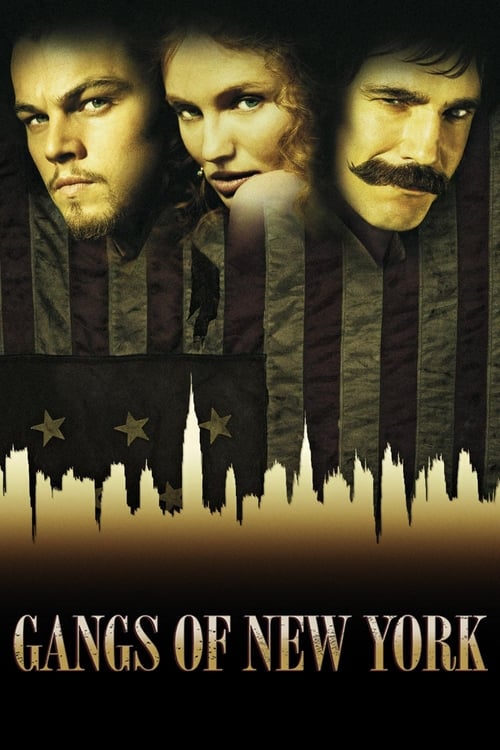
Gangs of New York
2002 · Martin Scorsese
For when you want a huge, meaty historical epic to sink an evening into — something violent and ambitious that leaves you thinking about where a country actually comes from. This is a challenge pick, not comfort food.
What it's about
In the 1860s slum of the Five Points, a young Irish immigrant comes out of prison with one purpose: get close to Bill the Butcher, the nativist gang lord who killed his father, and take revenge from inside his inner circle. Around that vendetta swirls a whole vanished New York — street gangs, corrupt politicians, firefighting rackets, waves of immigrants coming off the ships — as the city lurches toward the explosion of the Civil War draft riots. It's a personal blood feud staged inside the violent birth of an American city.
The experience
Big, brutal, and operatic — it opens with a battle and rarely lets the pressure off, alternating hushed cat-and-mouse scenes with eruptions of street violence. You feel the mud, the knives, and the tribal hatred; it's a long sit that earns its sprawl.
Performances
Daniel Day-Lewis is the reason to watch: his Bill the Butcher is charming, terrifying, and weirdly principled, a villain who devours every scene without ever seeming hammy. Leonardo DiCaprio holds his own as the avenger forced to smile at the man he hates.
The craft
Scorsese had wanted to make this since the 1970s, and the obsession shows — an entire 19th-century Manhattan built from scratch, teeming with period detail down to the slang and the butcher-shop knives. The scale of the sets and crowd scenes rewards the biggest screen you can find; this is physical, handmade epic filmmaking from just before digital worlds took over.
Why it matters
It kicked off the Scorsese–DiCaprio partnership that would define the next two decades of both careers, and it put the ugly, nativist prehistory of New York — the Five Points, the draft riots — into the popular imagination.
Snapshot
Gangs of New York is Martin Scorsese's long-gestated historical epic about the violent birth of modern New York, set in the immigrant slum of the Five Points and culminating in the 1863 Draft Riots. Built around a revenge plot — Amsterdam Vallon (Leonardo DiCaprio) infiltrating the gang of the man who murdered his father — the film uses that intimate vendetta as a lens onto a larger argument: that the American city was forged in tribal, nativist, and racial violence rather than civic consensus. It is among Scorsese's most ambitious projects, a film he had wanted to make since the early 1970s, and it inaugurated his ongoing collaboration with DiCaprio. Its reputation is double-edged: widely admired for Daniel Day-Lewis's performance as Bill "the Butcher" Cutting and for its physical recreation of a vanished city, but also frequently cited as a film whose grandeur was compromised by a troubled production and a contested final cut.
Industry & production
The project was famously protracted. Scorsese had been drawn to Herbert Asbury's 1927 anecdotal history The Gangs of New York for decades, and the film carries the weight of that long incubation. It was ultimately produced by Miramax under Harvey Weinstein, in association with Initial Entertainment Group, with Alberto Grimaldi among the producers — a financing structure that reflected the film's scale and risk.
Rather than shoot in New York, the production built the Five Points and surrounding period New York as enormous standing sets at Cinecittà Studios in Rome — one of the largest set-construction efforts of its era, overseen by production designer Dante Ferretti. Principal photography ran across an unusually long schedule beginning in 2000, and the shoot became notorious for cost overruns and for friction between Scorsese and Weinstein over length and content. The release was delayed — partly attributed to the changed cultural atmosphere following September 11, 2001, given the film's imagery of New York consumed by fire and violence — and arrived in December 2002.
The most persistent industry story attached to the film is the editorial tug-of-war: reports of a substantially longer Scorsese cut and Weinstein's pressure to shorten it. Scorsese has spoken in interviews about compromises on the final running time. The precise length of any longer assembly and the exact nature of cuts are matters where accounts vary, and the record is not fully settled; the released theatrical version runs around two hours and forty minutes. What is clear is that the film's reception cannot be separated from the perception that it was a wounded epic — a recurring framing in critical writing of the period.
Technology
Gangs of New York was shot photochemically on 35mm film, consistent with Scorsese's practice in this era, and its visual identity depends heavily on physical sets, practical scale, and large numbers of extras rather than on digital environment creation. That said, the film did use digital effects to extend its world — composited skylines, crowd augmentation, and set extensions to turn the Cinecittà builds into a continuous metropolis stretching to the harbor. The opening battle and the climactic Draft Riots, where the city is shelled from the water, combine practical staging with effects work.
The film sits at a transitional moment: a fundamentally analog, hand-built production using digital tools selectively to enlarge a world that could not be fully constructed even on Cinecittà's backlots. It is not a film whose technique is defined by digital innovation; its "technology" is closer to nineteenth-century stagecraft scaled to cinema — forged blades, period costume, mud, and fire — than to the CGI spectacle dominant in the early-2000s blockbuster landscape.
Technique
Cinematography
The cinematography is by Michael Ballhaus, Scorsese's frequent collaborator of the period. Ballhaus renders the Five Points in a palette of soot, candlelight, and saturated reds, leaning toward an almost infernal interior world — the underground warren of Paradise Square introduced as a subterranean hell of competing tribes. The camera is mobile and theatrical, with sweeping moves that establish the geography of the slum and the choreography of its gangs. The film favors a heightened, painterly look over documentary naturalism; firelight and gaslight motivate much of the palette, and the recurring red of Bill the Butcher's world ties color to violence and nation. Ballhaus's work here is grand and presentational, matched to the film's operatic register rather than to the kinetic handheld idiom of Scorsese's contemporary-set crime films.
Editing
Thelma Schoonmaker, Scorsese's editor since Raging Bull, cut the film, and the editing bears the visible strain of the film's production history. The opening — the tribal battle in the snow between the Dead Rabbits and the Natives — is a bravura passage, escalating from the ritual gathering of weapons to chaotic slaughter. Elsewhere the film's rhythm is more uneven, and the much-discussed studio-imposed shortening is often read in the structure: passages of compression, narrative ellipses, and a sense that the connective tissue between set-pieces was thinned. Schoonmaker's craft remains evident in the montage logic and the orchestration of the climactic intercutting between the personal duel and the citywide riot, but the editing is also where the film's compromises are most frequently located by critics.
Mise-en-scène / staging
This is the film's most celebrated dimension. Dante Ferretti's Five Points is a fully imagined world — layered, vertical, and dense with period texture, from butcher shops and brothels to the missions and firehouses. The staging is consistently theatrical: Bill the Butcher presides over his domain like a stage tyrant, and set-pieces (the Chinese pagoda theater, the political machinery of Tammany under Boss Tweed, the volunteer fire companies brawling over a burning building) function as tableaux of a society organized entirely around faction. Sandy Powell's costume design reinforces tribal identity through dress. The mise-en-scène argues the film's thesis visually: every space is contested territory, every interior a stage for performances of belonging and exclusion.
Sound
The score is credited to Howard Shore, working in the same period as his Lord of the Rings music, and the soundtrack mixes original composition with period and folk sources and contemporary songs — including, prominently, U2's "The Hands That Built America" over the closing, which won notice and awards attention. The film's sound design renders the slum as a cacophony of dialects, trades, and violence; Day-Lewis's Bill speaks in a stylized, archaic-inflected accent that is itself a sonic invention rather than strict historical reconstruction. The closing sequence's dissolve forward in time to the modern Manhattan skyline, scored to U2, makes the soundtrack an explicit bridge between the buried nineteenth-century city and the present.
Performance
Performance is the film's center of gravity, and it is decisively unbalanced toward Daniel Day-Lewis. His Bill "the Butcher" Cutting — modeled in part on the historical nativist figure William Poole — is a towering, theatrical creation: menacing, charismatic, perversely principled, and grotesquely funny, anchored by physical business (the knives, the glass eye, the flag draped over his shoulders) that has become iconic. The performance earned a Best Actor Oscar nomination and is routinely cited as one of the great screen villains. Against it, Leonardo DiCaprio's Amsterdam is comparatively muted, a reactive protagonist whose vendetta structure is somewhat overwhelmed by his antagonist; this imbalance is one of the film's recurring critical knocks. Cameron Diaz plays Jenny Everdeane, the pickpocket caught between the men, in a role often judged underwritten. Strong supporting work comes from Jim Broadbent as Boss Tweed, John C. Reilly, Brendan Gleeson, and Liam Neeson as Amsterdam's martyred father, "Priest" Vallon, in the prologue.
Narrative & dramatic mode
The film operates in two registers at once. On the surface it is a classical revenge tragedy: a son returns to avenge his father, infiltrates the killer's confidence, becomes a quasi-son to him, and moves toward an inevitable reckoning. This Oedipal triangle — Amsterdam, Bill as surrogate father and target, Jenny between them — gives the film its dramatic spine. But Scorsese repeatedly subordinates the personal plot to the panoramic, treating the vendetta as a thread through a historical fresco of the Five Points, Tammany politics, the Civil War draft, and conscription's class injustice. The result is a hybrid mode: melodrama nested inside historical epic. The film's ending fuses the two by collapsing the private duel into the public catastrophe of the Draft Riots, then dissolving across more than a century of city-building to argue that the personal story is finally swallowed by, and foundational to, the larger national one. Voiceover narration frames the film as retrospective myth, history told as legend.
Genre & cycle
Gangs of New York belongs to the historical epic and to Scorsese's lifelong gangster cinema, but it relocates the gangster film to the nineteenth century, treating the street gang as the primordial form of American organized power — political machine, ethnic militia, and protection racket fused. It can be read within a cycle of turn-of-the-millennium American historical epics reckoning with national origins and violence, and within Scorsese's own cycle of films about tribal masculine codes and the cost of belonging. It also functions as an origin story for the modern crime film's preoccupations: the immigrant's bargain with violence, the thin membrane between criminality and civic authority. Its sustained interest in nativism, immigration, and who counts as American gives it a thematic kinship with the immigrant-saga strain of American cinema.
Authorship & method
The film is unmistakably a Scorsese project — a passion piece carried for decades — and it gathers his core collaborators of the era. The script is credited to Jay Cocks (who first brought Asbury's book to Scorsese), Steven Zaillian, and Kenneth Lonergan, a multi-hand authorship that reflects the long development and may contribute to the film's tonal unevenness. Michael Ballhaus's camera, Thelma Schoonmaker's editing, Dante Ferretti's design, Sandy Powell's costumes, and Howard Shore's score constitute the principal authorial team alongside the director.
Methodologically, the film is characteristic of Scorsese's interest in archival recovery and myth-making: Asbury's book is anecdotal and unreliable as straight history, and Scorsese embraces this, building a stylized, legend-inflected past rather than a documentary reconstruction. Day-Lewis's well-known immersive method — total absorption into period craft and character — shaped the production's texture and, by many accounts, its on-set intensity. The film is also a key biographical hinge: it began Scorsese's long partnership with DiCaprio, which would run through The Aviator, The Departed, Shutter Island, The Wolf of Wall Street, and Killers of the Flower Moon.
Movement / national cinema
The film is firmly within American cinema — specifically the tradition of the New Hollywood-descended auteur working at epic scale — yet it is, materially, a film made in Italy, on Cinecittà's stages, in the lineage of the great studio-built historical spectacles. That production fact creates an interesting doubling: an intensely American story about the making of New York, physically fabricated in Rome. It does not belong to a formal movement so much as to Scorsese's individual project of cataloging American violence and immigrant experience. Its engagement with Irish-American identity and the Catholic immigrant's place in the nation connects it to Scorsese's broader autobiographical preoccupations as a chronicler of ethnic America.
Era / period
The film depicts roughly 1846 (the prologue battle) through 1863 (the Draft Riots), concentrating on Civil War-era New York and the social order of the Five Points. It dramatizes specific historical realities — nativist agitation against Irish Catholic immigrants, the patronage politics of Tammany Hall under Boss Tweed, the $300 commutation clause that let the wealthy buy out of conscription, and the racially charged violence of the 1863 riots, in which mobs attacked Black New Yorkers. Scorsese treats this period as the crucible of the modern city, and the film insists on the continuity between that violence and the present, most explicitly in its final time-lapse to the contemporary skyline. As a production object, it is a film of the early 2000s, shaped by post-9/11 sensitivities and by the late-Miramax model of prestige filmmaking under Harvey Weinstein.
Themes
The film's central theme is the violent founding of American civic life: the idea that the nation and the city were built not on consensus but on tribal slaughter, nativism, and the suppression of the immigrant and the Black New Yorker. Nativism and immigration are foregrounded — Bill the Butcher's brutal, almost religious Americanism defines itself against the incoming Irish, and the film stages assimilation as a bloody, transactional process. Revenge and surrogate fatherhood drive the personal narrative, with the Oedipal struggle between Amsterdam and Bill carrying the film's emotional weight. Other persistent themes include the entanglement of crime and political power (gangs as the raw material of the machine), class injustice crystallized in conscription, and the relationship between memory and myth — the sense, voiced in the closing narration, that the dead who built the city are paved over and forgotten. Religion, ritual, and the iconography of the American flag recur as markers of contested belonging.
Reception, canon & influence
Critical reception was respectful but divided. Day-Lewis's performance and Ferretti's production design drew near-universal praise; the film's ambition and visual grandeur were widely acknowledged; but many reviewers found it bloated, structurally compromised, and dramatically lopsided, with DiCaprio's and Diaz's roles judged weaker than their antagonist. The film was a significant awards presence — it received multiple Academy Award nominations, including Best Picture and Best Director, and is often cited in discussions of Scorsese's long wait for a competitive Oscar — though accounts of the exact nominations and outcomes should be checked against the record rather than asserted from memory here. It was, by reputation, a costly production whose commercial performance was modest relative to its budget, though precise box-office figures are not reproduced here.
Looking backward, the film's influences are clear: Herbert Asbury's source book as the seed of its mythology; the tradition of the historical epic and the studio-built spectacle (the Cinecittà lineage); and Scorsese's own films about tribal violence and ethnic America. Visconti, the operatic European epic, and nineteenth-century painting inform its tableau aesthetic, while the western's settling-of-territory logic underlies its gang warfare.
Looking forward, its most consequential legacy is biographical and institutional: it launched the Scorsese–DiCaprio partnership that became one of the defining director-star collaborations of the twenty-first century. Its vision of New York's violent origins and its treatment of immigration and nativism have given it renewed thematic resonance in later American political moments. Day-Lewis's Bill the Butcher entered the canon of great screen villains and remains the film's most enduring cultural artifact. Critically, Gangs of New York occupies a particular niche in the Scorsese canon — a flawed, fascinating major work, more often discussed as a compromised epic and a key transitional film than as one of his unqualified masterpieces — and it continues to attract reappraisal precisely because the gap between its ambition and its execution remains a live critical question.
A Deleuzian reading
Watch Bill the Butcher lay out his cleavers.
The full Deleuzian reading of Gangs of New York →
Reception
In 2002 it landed as Scorsese's compromised passion project — decades in the making, delayed and trimmed under Harvey Weinstein's Miramax, and it went 0-for-10 at the Oscars. Today the messy-epic reputation stands, but Daniel Day-Lewis's Bill the Butcher has been fully canonized as one of the great screen performances.
How Gangs of New York was received, from release to now →
Influences: the films it descends from and the films it influenced
- The Leopard (1963) — Scorsese's operatic, painterly tableau staging and obsessive period-craft texture (every fabric, candle, and dance figure rendered as historical immersion) descend directly from Visconti's mode of the aristocratic historical epic.
- Senso (1954) — Visconti's Risorgimento melodrama models the nineteenth-century-painting compositional logic — figures arranged in deep, lit canvases — that Ballhaus and Ferretti adopt for the Five Points tableaux.
- Barry Lyndon (1975) — The firelight/candlelit period palette and the framing of historical scenes as moving period paintings is a direct technical antecedent to Ballhaus's amber, lamp-lit Paradise Square interiors.
- The Birth of a Nation (1915) — Griffith's monumental Civil War-era reconstruction and his crowd-scale staging of civic violence (riot, mob, draft-era America) establish the historical-spectacle grammar Scorsese reworks for the Draft Riots climax.
- Heaven's Gate (1980) — Cimino's ruinously lavish immigrant-labor-war epic supplies both the western's settling-of-territory logic applied to ethnic gang turf and the model of the over-built, dollied period crowd set.
- Once Upon a Time in America (1984) — Leone's operatic, memory-and-myth structuring of immigrant New York gangsterdom — violence elevated to legend via slowed, ritualized staging — prefigures the voiceover-myth and mythologized-past method here.
- Mean Streets (1973) — Scorsese's own template of tribal ethnic-neighborhood violence, loyalty, and ritual brutality on contested turf is the corpus root that Gangs scales up to historical-epic size.
- 1900 (1976) — Bertolucci's painterly, operatic epic of class and political violence across decades models the long-historical-arc-as-personal-feud structure and the lush Cinecittà-built period mise-en-scène.
- Cabiria (1914) — The founding film of the Cinecittà tradition of fully studio-built historical spectacle — the lineage of Ferretti's reconstructed Five Points as a controlled, designed world rather than a location shoot.
- The Age of Innocence (1993) — Scorsese's next New York period epic and next Day-Lewis collaboration, extending Dante Ferretti's operatic reconstruction of 19th-century Manhattan and the Cocks-Scorsese script's anatomy of the city's hidden social warfare.
- There Will Be Blood (2007) — Day-Lewis's Plainview extends the Bill the Butcher template — a theatrical-voiced, period-immersed monologuing patriarch as the violent engine of American capitalist founding, built through the same total-immersion method.
- Lincoln (2012) — Reuses Day-Lewis's archival-immersion method and the Civil War-New-York moment, rendering period America through meticulous vernacular speech and lamp-lit interior tableaux.
- Killers of the Flower Moon (2023) — The Scorsese–DiCaprio partnership launched here matures into another anatomy of violent American civic founding and the nation's origin in dispossession and nativist predation.
- Gangs of London (2020) — Extends the turf-as-tribal-territory premise — rival ethnic factions warring over a single contested urban ground — staging gang power as a quasi-feudal map of the city.
- The Northman (2022) — Carries forward the oedipal-revenge myth rendered through total period-craft immersion and voiceover-incantation, staging founding violence as legend rather than documentary history.
- Gangs of Wasseypur - Part 2 (2012) — Its portrait of tribal turf warfare — rival clans feuding across generations over a contested piece of ground as the state looms in the background — is the historical-epic mode GoW localizes to Dhanbad's coalfields.
- Kung Fu Hustle (2004) — A specific knife-throwing beat is patterned on Scorsese's staging, absorbed into KFH's magpie citation method.
- The Godfather Part II (1974) — Shares the gangster-origin-story-as-American-founding-myth structure, treating immigrant criminal ascent and oedipal succession as the secret history of the nation's civic formation.
- Deadwood (2004) — Builds a 19th-century American settlement from period-vernacular profanity and theatrical-monologue performance, dramatizing the violent, lawless civic founding of a town as the same nativist-vs-newcomer struggle over turf.
Similar films
- The Godfather Part II (1974) — influence & lineage
- Mean Streets (1973) — influence & lineage
- Once Upon a Time in America (1984) — influence & lineage
- 1900 (1976) — influence & lineage
- There Will Be Blood (2007) — influence & lineage
- Killers of the Flower Moon (2023) — influence & lineage
- The Irishman (2019) — shared sensibility
- The Godfather (1972) — shared sensibility
All the films related to Gangs of New York →