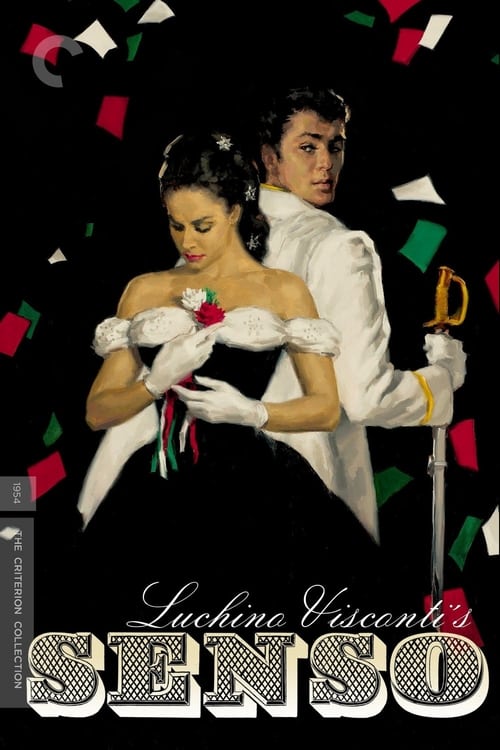
Senso
1954 · Luchino Visconti
For when you want to drown in a doomed, gorgeous romance — velvet, candlelight, and heartbreak on a grand scale. It's a challenge in length and intensity, but pure pleasure to look at.
What it's about
Venice, 1866, under Austrian occupation: Countess Livia Serpieri, an aristocrat tied to the Italian independence movement through her cousin, falls into a consuming affair with Franz Mahler, a cynical Austrian lieutenant. As war between her country and his approaches, her passion pulls her toward betrayals she can't take back — of the cause, of her class, and of herself. It's a grand romantic melodrama with real history burning underneath.
The experience
Lush, feverish, and slowly devastating — it sweeps you up in operatic emotion, then makes you watch a woman dismantle her own life with open eyes. The pace is stately but the feelings are anything but.
Performances
Alida Valli is extraordinary as Livia, letting pride curdle into obsession by visible degrees, and Farley Granger makes the lieutenant's charm and rot inseparable.
The craft
Visconti's first color film, and it shows: interiors like oil paintings, an opera house sequence that sets the whole story's key, battle scenes staged with a historian's eye. Every frame is composed with a decorator's obsession and a director's purpose — this one genuinely rewards the biggest, richest screen you can find.
Why it matters
It marked Visconti's turn from gritty neorealism to sumptuous historical melodrama, opening the vein of grand period filmmaking that defined the rest of his career and influenced decades of costume epics.
Snapshot
Senso is Luchino Visconti's first film in color and his most decisive turn from the neorealist idiom he had helped found toward a mode of historical melodrama saturated with opera, painting, and political argument. Adapted from Camillo Boito's 1882 novella, it unfolds during the Third Italian War of Independence in 1866, as Austrian occupation of the Veneto nears its end. Countess Livia Serpieri (Alida Valli), a Venetian aristocrat nominally aligned with the patriotic cause through her partisan cousin, falls into a ruinous affair with the Austrian Lieutenant Franz Mahler (Farley Granger). She diverts money entrusted to her for the Italian resistance to him; he uses it to bribe his way out of frontline service. Her humiliation culminates in denunciation and his execution. Around this private catastrophe Visconti builds a sweeping indictment of the Risorgimento itself — the founding myth of the Italian nation read not as heroic liberation but as a transaction conducted, and betrayed, by a decadent ruling class. The film is at once intimate and monumental: chamber drama of erotic obsession set against the panorama of a national war, and a touchstone for what would later be called "operatic" cinema.
Industry & production
Senso was produced by Lux Film, one of the major Italian studios of the period, on a budget that made it one of the most ambitious Italian productions of its time — a costume spectacle in Technicolor at a moment when most Italian cinema was still working in modest black-and-white. The scale brought friction. Visconti's perfectionism and the logistics of period reconstruction, location shooting in Venice and the Veneto countryside, and large-scale battle staging strained the production.
The film's most consequential collision was with the state. Italian military and government authorities objected to the depiction of the Italian defeat at the Battle of Custoza and to an unflattering portrait of the Risorgimento army and its disorganization. Censorship pressure altered the film: material treating the Italian forces and a planned emphasis on a young deserter was cut or softened, and Visconti maintained afterward that the released film was not entirely the one he intended. The precise contours of what was removed are debated in the literature, and some accounts are colored by Visconti's own retrospective framing, so the safest statement is that political sensitivity around the national narrative materially shaped the final cut.
Senso premiered in competition at the 1954 Venice Film Festival. It did not take the festival's top prize — the Golden Lion that year went to Renato Castellani's Romeo and Juliet — and the omission became a celebrated grievance among Visconti's partisans, who read it as politically motivated. An English-language version, prepared for international distribution and titled The Wanton Countess, also circulated; it is shorter and is generally regarded as inferior to the Italian original.
Technology
Senso was shot in three-strip Technicolor, and its use of the process is central to its meaning rather than incidental decoration. Where Hollywood Technicolor of the era tended toward saturated brightness, Visconti and his cinematographers pursued the muted, layered tonalities of nineteenth-century painting — the deep reds, golds, and shadowed interiors of a culture in twilight. The film stands as a landmark in Italian color cinematography, demonstrating that the process could serve a somber, painterly, historically specific palette rather than spectacle alone. The Technicolor apparatus of the time — bulky cameras, demanding lighting levels, laboratory color control — imposed constraints that the production absorbed into a deliberately composed, almost tableau-based visual style.
Technique
Cinematography
The photography of Senso carries one of the more poignant production histories in postwar cinema. It was begun by G.R. Aldo (Aldo Graziati), Visconti's gifted cinematographer from La terra trema, who was killed in a car accident during the shoot. The work was completed by Robert Krasker, the British cinematographer best known for The Third Man. The seam between the two hands is not obvious on screen; the film maintains a consistent visual grammar of stately camera movement, painterly composition, and chiaroscuro interiors lit to evoke gaslight and candle. The famous opening at the Teatro La Fenice, the nocturnal flight through Venetian streets and along canals, and the dust-and-smoke expanses of the Custoza sequences all share an aesthetic of arranged, frieze-like deliberation. Color and light are organized to read emotionally and historically — the warmth of aristocratic interiors curdling into the cold gray of war and abandonment.
Editing
The editing was by Mario Serandrei, a long-standing Visconti collaborator. The film's rhythm is unhurried and architectural, built to let décor, gesture, and musical phrasing breathe rather than to generate suspense through cutting. Scenes are often allowed to play in extended, composed durations; the montage privileges accumulation of mood and detail over compression, in keeping with the melodramatic and operatic structure.
Mise-en-scène / staging
Mise-en-scène is where Senso is most fully itself, and where Visconti's aristocratic eye and theatrical training are most visible. Period reconstruction is exhaustive — furnishings, fabrics, military uniforms, and architecture rendered with antiquarian precision. The production design (Ottavio Scotti) and the costuming, associated with Piero Tosi and Marcel Escoffier, organize the frame into dense, legible historical worlds. Visconti, who had a major parallel career as a stage and opera director, stages action as if for a proscenium: the opera-house prologue literally frames the drama as performance, and throughout, blocking, drapery, and the disposition of bodies in space carry the weight of meaning. The result is the painterly, "decadent" surface that critics have linked to nineteenth-century Italian art and to Visconti's own patrician sensibility.
Sound
The score is built around Anton Bruckner's Seventh Symphony, whose Romantic grandeur lends the love story a tragic, fated weight that comments on the lovers rather than merely accompanying them. The film opens inside a performance of Verdi's Il trovatore at La Fenice, the aria "Di quella pira" coinciding with a patriotic demonstration as nationalist leaflets rain down on the Austrian officers below — a founding gesture that fuses opera, politics, and private passion in a single image and announces the film's operatic conception of history. Music in Senso is thus not underscore but argument: Verdi for the public theater of nationhood, Bruckner for the interior theater of doomed desire.
Performance
Alida Valli's Livia is the film's center of gravity — a performance of mounting hysteria and degradation that traces a noblewoman's descent from composed dignity to abject obsession and vengeful collapse. Farley Granger, an American star cast partly with the international market in mind, plays Franz as a cynical, weak, self-serving seducer, his glamour curdling into squalor. The supporting playing — Massimo Girotti as the patriot cousin Roberto Ussoni, Heinz Moog as the accommodating Count Serpieri, Rina Morelli as the maid Laura — is drawn from Visconti's theatrical and cinematic milieu and pitched to the film's heightened register. The mixing of Italian and American performers, and the postsynchronized multilingual production, reflect the film's bid for a market beyond Italy.
Narrative & dramatic mode
Senso operates in the register of melodrama in its fullest, least pejorative sense: a dramaturgy of excess, fate, and moral legibility in which private passion and public history are made to rhyme. Boito's first-person novella, a confession of erotic abjection, is opened outward by Visconti into a tragedy with a political thesis. The narrative tracks Livia's progressive self-betrayal — emotional, financial, and finally national — as a single continuous fall, and stages her diversion of the resistance funds as the pivot on which both the love affair and the larger allegory turn. The mode is operatic not only in its music but in its structure: grand public set-pieces (the opera, the battle) bracket and amplify the chamber scenes of seduction and humiliation, and the ending arrives with the inexorability of tragic form.
Genre & cycle
The film belongs to the lineage of the historical costume melodrama, but it transforms the genre's conventions toward critical, even revisionist ends. It is a Risorgimento film that refuses Risorgimento heroics, a love story that treats desire as a vector of moral and political ruin. Within Italian cinema it stands at a hinge: emerging from the neorealist movement Visconti had pioneered, it inaugurates a strain of richly upholstered historical filmmaking — sometimes labeled "critical realism" or associated with literary "decadentism" — that would run through Visconti's own later career and influence the Italian historical spectacle more broadly.
Authorship & method
Senso is a quintessential Visconti work, and it crystallizes the contradictions that make him a singular figure: a Marxist who was also a hereditary aristocrat, a former neorealist drawn irresistibly to opera, melodrama, and the textures of a class he was committed to historicizing as obsolete. His method fused exhaustive material reconstruction with a theatrical conception of staging carried over from his work in opera and on the stage.
The collaboration was unusually distinguished. The screenplay was written by Visconti with Suso Cecchi d'Amico, his essential writing partner across many films; the English-language dialogue was contributed by Tennessee Williams and Paul Bowles, a remarkable literary pairing whose involvement is well documented even if the exact division of labor is not. The cinematography passed from G.R. Aldo to Robert Krasker after Aldo's death; the editing was by Mario Serandrei; the visual world was built with designers and costumers including Piero Tosi, whose long association with Visconti began in this period. The score drew on Bruckner and Verdi rather than an original composition, an authorial choice as deliberate as any other element.
Movement / national cinema
Senso marks the visible mutation of Italian neorealism. Visconti had made Ossessione (1943) and La terra trema (1948), cornerstones of the realist current; with Senso he moved decisively into historical fiction, color, studio resources, and frank melodrama, a shift that some contemporaries read as a betrayal of neorealist principles and others as their dialectical extension into the past. The film is inseparable from the cultural politics of postwar Italy — its engagement with the Risorgimento was also an oblique engagement with questions of national identity, class, and historical accounting in a country reckoning with Fascism and Resistance. It is a foundational work of the more literary, painterly, and operatically inclined Italian art cinema of the 1950s and after.
Era / period
The film is set in 1866, during the war that brought Venice and the Veneto into the new Kingdom of Italy, and it reconstructs that moment with deliberate density. But its 1954 vantage is equally legible: made less than a decade after the war, in the midst of debates about what kind of nation postwar Italy would be, Senso uses the Risorgimento as a mirror. Its disillusioned reading of national unification — as a project compromised by the self-interest of the classes that led it — speaks to mid-century anxieties about continuity, opportunism, and the gap between revolutionary myth and historical reality.
Themes
The governing theme is betrayal at every scale: Livia betrays her marriage, her cousin, her cause, and finally her lover; Franz betrays his uniform and her trust; and behind both, the film argues, the ruling class betrays the national revolution it claims to lead. Erotic obsession is figured as a force of self-destruction and moral dissolution, inseparable from the decadence of a dying aristocratic order. The collision of private passion and public history is the film's structural and thematic engine, dramatized in the recurring juxtaposition of opera house and battlefield, bedroom and war. Underlying all of it is Visconti's Marxist historiography — the conviction that the Risorgimento was less a popular liberation than a passage of power among elites, a thesis the film shares with his later Il Gattopardo.
Reception, canon & influence
Critical reception was substantial and politically charged from the outset. The film's perceived snub at the 1954 Venice Film Festival became a cause célèbre, and its standing has only risen with time; it is now widely regarded as one of Visconti's major achievements and a landmark of Italian color cinema, frequently revisited in restored form (notably through the work of the Cineteca di Bologna).
Looking backward, Senso draws on a dense web of sources: Boito's novella; the Italian operatic tradition, Verdi above all; nineteenth-century painting and the visual culture of the Risorgimento; and the melodramatic traditions of theater and literature that Visconti, as a stage and opera director, knew intimately. Its Marxist reading of history connects it to the Gramscian and broader Italian-left intellectual currents of its moment.
Looking forward, the film's influence is far-reaching. It anticipates and informs Visconti's own later historical films, above all Il Gattopardo (1963), with which it shares a disenchanted Risorgimento subject, and Ludwig, in its operatic treatment of decadence. More broadly it is a foundational text for the "operatic" tendency in modern cinema and for filmmakers drawn to the fusion of melodrama, history, and painterly mise-en-scène — a lineage in which Bernardo Bertolucci is often situated, and which Martin Scorsese, a vocal champion of Visconti and of Italian cinema's restoration, has repeatedly cited as formative for his own period work. Senso endures as the pivot on which Visconti turned neorealism toward grand historical tragedy, and as one of the screen's most fully realized marriages of opera and history.
A Deleuzian reading
Start with the leaflets.
The full Deleuzian reading of Senso →
Reception
Booed and politicked over at Venice in 1954 — where its Golden Lion snub caused a genuine scandal — and attacked by leftist critics as Visconti's betrayal of neorealism, it's now canonized as the moment he became Visconti: the operatic Technicolor melodramatist of The Leopard.
How Senso was received, from release to now →
Influences: the films it descends from and the films it influenced
- Ossessione (1943) — Visconti's neorealist insistence on the documentary weight of real locations and bodies, which Senso retains as the material substrate beneath its studio operatics.
- La terra trema (1948) — G.R. Aldo's deep-focus, available-light compositions — Aldo being Senso's original cinematographer, whose painterly realist eye shaped its frames before his death.
- The Third Man (1949) — Robert Krasker's expressionist low-key chiaroscuro and steep contrast, the lighting grammar he carried directly into Senso's nocturnal interiors.
- Brief Encounter (1945) — Krasker's photographic treatment of doomed adulterous passion, holding long emotionally-saturated durations on a woman's face in collapse.
- Gone with the Wind (1939) — Three-strip Technicolor applied to a war-costume melodrama, establishing the saturated period-epic palette Senso appropriates for the Risorgimento.
- Black Narcissus (1947) — Jack Cardiff's painterly Technicolor mise-en-scène using color itself as the carrier of erotic hysteria — color-as-emotion rather than verisimilitude.
- The Red Shoes (1948) — The fusion of staged operatic/balletic spectacle with cinematic melodrama, theatrical proscenium framing absorbed into the film image.
- Il Gattopardo (1963) — Same disenchanted Marxist Risorgimento subject, Piero Tosi's antiquarian costume reconstruction, extended into Technirama and the famous durational ballroom set-piece.
- Death in Venice (1971) — Visconti's signature appropriation of a pre-existing classical score (Mahler) as authorial scoring strategy, exactly the Bruckner/Verdi method of Senso.
- Ludwig (1973) — Operatic treatment of historical decadence and erotic obsession through obsessive material reconstruction of an aristocratic milieu marked for extinction.
- The Conformist (1970) — Painterly, color-architected mise-en-scène (Storaro) wedded to a Marxist historicizing of a doomed class — the Visconti synthesis recast in modernist style.
- 1900 (1976) — Operatically-scaled Marxist epic of Italian class transition, extending Senso's reading of history as the supersession of one social order by another.
- Barry Lyndon (1975) — Painterly tableau period reconstruction lit from period sources, with appropriated classical music and extended durations governing the rhythm of a costume melodrama.
- The Age of Innocence (1993) — Antiquarian material reconstruction of a vanishing genteel class as decor-driven tragedy, by a filmmaker who explicitly cites Visconti's period method as formative.
- El Cid (1961) — Krasker's color historical-epic cinematography extending the large-scale painterly battle-and-pageant photography he developed on Senso.
- The Last Emperor (1987) — Visconti's Risorgimento melodrama codified the Italian prestige historical epic's grammar: Technicolor as political emotion, dissolves between time registers, and a protagonist whose capitulation to institutional power is staged as theatrical self-betrayal — Bertolucci's explicit formal inheritance.
- Rocco and His Brothers (1960) — Visconti's first full embrace of operatic scale, heightened emotion and theatrically choreographed ensemble blocking — the 'transition to art cinema' — is the register Rocco fuses back onto neorealist material.
- Gangs of New York (2002) — Visconti's Risorgimento melodrama models the nineteenth-century-painting compositional logic — figures arranged in deep, lit canvases — that Ballhaus and Ferretti adopt for the Five Points tableaux.
- Jamon Jamon (1992) — Codifies the operatic melodrama-into-tragedy mode where heightened performance and lush score carry doomed passion, the register Piovani and the cast supply here.
- The Earrings of Madame de... (1953) — Operatic melodrama of aristocratic adultery in which costume and circulating objects function as moral architecture, told via fluid choreographed camera.
- Lola Montès (1955) — Color-and-widescreen operatic spectacle staging a woman's public degradation as literal proscenium theater, the same erotic-decline-as-performance logic.
- Romeo and Juliet (1954) — Contemporaneous Krasker color cinematography in Italy keyed to Quattrocento painting as source imagery — the painterly-reconstruction project run in parallel.
- Othello (1951) — G.R. Aldo brought to Visconti the same chiaroscuro location-lighting method he developed shooting Othello — deep directional light that makes Venetian palace interiors carry moral and psychological weight — creating a direct craft continuity through the cinematographer's hand across two successive films.
- Gate of Hell (1953) — Visconti's near-simultaneous turn to lush period color treats costume and painting as the source of the palette, the same costume-theorist's approach Sanzō Wada brought to Gate of Hell.
Similar films
- Obsession (1943) — influence & lineage
- The Leopard (1963) — influence & lineage
- Death in Venice (1971) — influence & lineage
- The Earrings of Madame de... (1953) — influence & lineage
- Two Women (1960) — shared sensibility
- Red Desert (1964) — shared sensibility
- White Nights (1957) — shared sensibility
- Rocco and His Brothers (1960) — shared sensibility