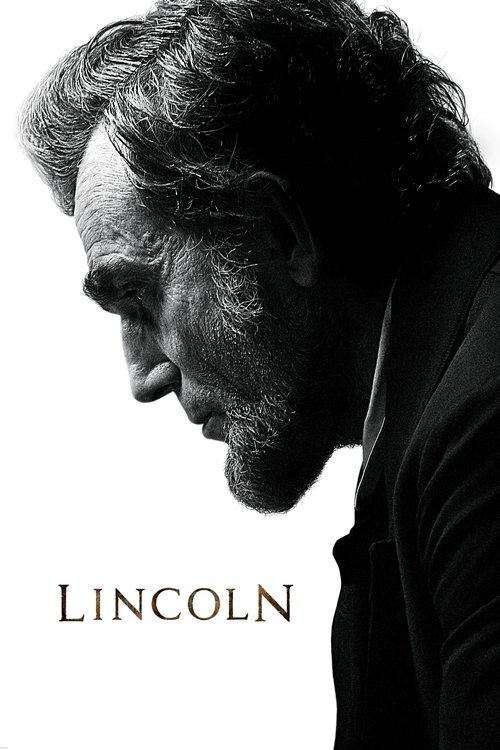
Lincoln
2012 · Steven Spielberg
For when you want substance — a film to lean into, argue about afterward, and feel smarter for having watched. Demanding in the best way; ideal for a night when explosions won't cut it.
What it's about
January 1865: the Civil War is grinding toward its end, and Abraham Lincoln has one narrow window to get the Thirteenth Amendment — abolishing slavery — through a hostile, lame-duck House of Representatives. Rather than a life-spanning biopic, this is a tight procedural about his final months: vote-counting, patronage, arm-twisting, and the moral compromises democracy demands, argued out in lamplit rooms. The most mythologized man in American memory, shown doing retail politics.
The experience
Talky, absorbing, and unexpectedly funny — Lincoln keeps disarming rooms with anecdotes — it builds real suspense out of a vote whose outcome history already recorded. You leave thinking hard about how change actually gets made, and moved by the cost of it.
Performances
Daniel Day-Lewis gives a career-crowning performance, playing Lincoln soft-spoken and stooped, a storyteller and a shrewd operator in the same breath — it won him an unprecedented third Best Actor Oscar. Tommy Lee Jones is ferociously entertaining as the radical abolitionist Thaddeus Stevens, and Sally Field brings raw grief and steel to Mary Todd Lincoln.
The craft
Tony Kushner's screenplay is the star machinery — dense, witty, morally serious, turning parliamentary procedure into drama — and Spielberg directs with uncharacteristic restraint, letting argument carry scenes. The lamplit, wintry cinematography makes every interior feel like a period daguerreotype come to life, and John Williams's score stays unusually quiet and mournful.
Why it matters
It reframed what a presidential biopic could be — process over pageantry — and stands as one of the defining screen portraits of American democracy at work, anchored by one of the most acclaimed performances of its era.
Snapshot
Lincoln is Steven Spielberg's chamber history of legislative process — a film that takes the most mythologized figure in American memory and confines him, for the most part, to lamplit rooms full of argument. Rather than a cradle-to-grave biopic, it narrows to roughly the final four months of Abraham Lincoln's life, from January 1865 to his assassination, and to a single legislative objective: securing passage of the Thirteenth Amendment abolishing slavery through a recalcitrant lame-duck House of Representatives. Adapted by playwright Tony Kushner, in part from Doris Kearns Goodwin's Team of Rivals: The Political Genius of Abraham Lincoln, the film is essentially a procedural about vote-counting, patronage, and the moral compromises that attend democratic action. Daniel Day-Lewis's central performance — soft-spoken, anecdotal, weary — became the film's defining feature and won him a third Academy Award for Best Actor, the first performer to reach that mark in a lead category. The film is unusual in Spielberg's catalog for its restraint: it largely forgoes spectacle for talk, and treats the workings of Congress as a suspense mechanism. It stands as one of the most commercially and critically successful "prestige" historical dramas of its decade, and a touchstone for how American cinema dramatizes governance.
Industry & production
Lincoln was a long-gestating project. Spielberg's DreamWorks acquired rights to Goodwin's book before its 2005 publication, and the director attached himself early, but the screenplay passed through years of development. John Logan and later Paul Webb worked on drafts before Tony Kushner took over and, by his own account, produced a sprawling manuscript that was eventually pared down to focus tightly on the amendment fight. The narrowing of scope — from a panoramic life to a legislative episode — was the decisive creative choice, and it transformed the film from conventional biopic into something closer to a stage play.
The production was a co-financing arrangement between DreamWorks, Twentieth Century Fox, and Participant Media, with Disney's Touchstone handling domestic distribution and Fox handling international. Reported budgets place the film around $65 million — modest for a Spielberg picture and notably restrained for a period production with extensive costuming and crowd work. It was shot largely in and around Richmond, Virginia, and Petersburg, drawing on the region's historical architecture to stand in for 1860s Washington. The Virginia State Capitol, designed by Thomas Jefferson, served as a key location.
Casting was central to the film's profile. Day-Lewis was Spielberg's long-sought choice; Liam Neeson had earlier been attached during the project's slower years before departing. The supporting ensemble was unusually deep, including Sally Field as Mary Todd Lincoln (Field had to campaign and screen-test to overcome concerns about her age relative to Day-Lewis), Tommy Lee Jones as Radical Republican Thaddeus Stevens, David Strathairn as Secretary of State William Seward, and a large bench of character actors filling the House.
Commercially, the film substantially outperformed expectations for a dialogue-driven historical drama, grossing well over $250 million worldwide against its modest budget — a figure that should be treated as approximate here rather than cited to the dollar. At the 85th Academy Awards it received twelve nominations, the most of any film that year, winning two (Day-Lewis for Best Actor and the production design team).
Technology
Lincoln was photographed on 35mm film by Janusz Kamiński, in keeping with Spielberg's long-standing preference for photochemical capture over digital at this point in his career. The choice was both aesthetic and ideological: film grain and the particular rendering of low-light interiors were integral to the period texture the production sought. The film made deliberate, restrained use of practical and period-appropriate lighting motifs — windows, oil lamps, fireplaces, and gaslight — supplemented by carefully concealed modern sources, to evoke a pre-electric world.
Visual effects were present but largely invisible by design, used for set extensions, crowd augmentation, and the recreation of period Washington and battlefield aftermaths rather than for spectacle. This restraint is itself a technological statement: where much of Spielberg's blockbuster work foregrounds effects, Lincoln hides them in service of verisimilitude. The film belongs to a moment — the early 2010s — when major directors were beginning to migrate to digital, and Spielberg and Kamiński's commitment to celluloid reads as a conscious traditionalism appropriate to the subject.
Technique
Cinematography
Janusz Kamiński, Spielberg's regular collaborator since Schindler's List (1993), shot Lincoln in a register of subdued, often crepuscular light. Interiors are dominated by shafts of window light cutting through dim rooms, frequently rendering figures as silhouettes or half-lit profiles. The palette is desaturated and wintry — grays, browns, blacks — befitting both the season depicted and the gravity of the material. Kamiński frequently places Lincoln near windows, the diffuse light from outside lending his face a worn translucency that reinforces the script's emphasis on the President's physical and moral fatigue.
The camera is generally more reserved than in Spielberg's action work, favoring measured compositions and a degree of theatrical stillness suited to scenes built on talk. But the film is not static: handheld camerawork and a degree of restless framing animate the more contentious passages, and the brief battlefield material that opens the film is rendered with visceral, muddy brutality. Throughout, Kamiński's lighting performs much of the dramatic work, isolating speakers, carving faces out of darkness, and lending the legislative chambers a chiaroscuro that elevates parliamentary procedure to something nearly sacramental.
Editing
Michael Kahn, Spielberg's editor across decades of collaboration, cut the film to favor sustained scenes of conversation over rapid montage. The editing logic is dramaturgical rather than kinetic: long takes and patient shot/reverse-shot exchanges allow performances to breathe and allow the audience to follow intricate political argument. The film's principal set piece — the climactic roll-call vote on the amendment — is edited for suspense in the manner of a heist or a courtroom verdict, cross-cutting among the chamber, the galleries, and the various interested parties to wring tension from a historical outcome the audience already knows. That the film generates genuine suspense from a foregone conclusion is largely an achievement of pacing and cutting.
Mise-en-scène / staging
The film's production design, by Rick Carter with set decoration by Jim Erickson (the team that won the film's Oscar in this category), is meticulously researched and texturally dense. Rooms are cluttered with paper, maps, and the material residue of governance; the White House is depicted as a working, somewhat shabby building rather than a gleaming monument. Joanna Johnston's costumes likewise emphasize wear and period accuracy over glamour. The staging is frequently theatrical — figures arranged around tables, the geometry of debate — reflecting Kushner's playwriting sensibility. Spielberg and his collaborators reportedly took pains with historical detail, including an effort to approximate the actual sound of Lincoln's pocket watch and other small authenticities; such claims about specific artifacts should be understood as part of the production's well-publicized fidelity rhetoric.
Sound
John Williams's score is restrained by his own standards — Americana inflected, often built on solo instruments and chamber textures rather than the soaring orchestral statements associated with his blockbuster work. The music recedes during the dense dialogue scenes and emerges to underline emotional and historical weight. Sound design favors the intimate and the domestic: the creak of floorboards, the scratch of pens, the ambient hush of nighttime rooms, all reinforcing the film's chamber-drama scale. The aural world is deliberately quiet, making the few louder eruptions — battlefield, applause, gunfire offscreen — land with heightened force.
Performance
Performance is the film's center of gravity. Day-Lewis's Lincoln is a study in lowered volume: a reedy, higher-pitched voice (a deliberate departure from the booming orator of popular imagination, grounded in historical accounts of Lincoln's actual tenor), a stooped gait, a habit of digression and folksy storytelling that masks shrewd political calculation. The performance resists hagiography, presenting a man capable of evasion, manipulation, and weariness alongside moral conviction. Sally Field's Mary Todd Lincoln is brittle and grief-stricken, the marriage rendered as a site of strain. Tommy Lee Jones's Thaddeus Stevens supplies the film's sharpest rhetoric and its most quietly devastating private moment. The supporting ensemble — including James Spader as a comic patronage broker, and a large gallery of congressmen — functions almost as a repertory company, lending the legislative scenes a lived-in density.
Narrative & dramatic mode
Lincoln operates in the mode of the political procedural, structured around a clear, time-bound objective: assemble the votes to pass the Thirteenth Amendment before the war ends and removes the political pressure that makes passage possible. This ticking-clock dramaturgy — the fear that peace will arrive too soon and doom the amendment — supplies narrative propulsion to material that is otherwise talk. The film's drama is one of means rather than ends: the audience is asked to weigh the moral cost of the bribery, dissembling, and procedural maneuvering through which a just outcome is secured.
Kushner's screenplay is dense, allusive, and rhetorical, full of nested anecdotes and extended speeches; it asks the audience to follow argument closely. The structure is broadly classical — a defined goal, escalating obstacles, a climactic vote, and a coda — but the texture is novelistic and theatrical. The film notably ends not with the assassination staged directly but with its aftermath reported and a closing return to Lincoln's words, a choice that keeps the focus on legacy rather than martyrdom, though some critics found the final passages overly reverent.
Genre & cycle
The film sits at the intersection of the historical biopic and the political drama, and it consciously revises the former. Where the classical Hollywood Lincoln film — most famously John Ford's Young Mr. Lincoln (1939) and the various reverent treatments of the mid-century — tended toward myth and moral iconography, Spielberg's film belongs to a later cycle of revisionist prestige histories that foreground process, compromise, and institutional mechanics. It can be grouped with the early-2010s wave of awards-oriented American historical films engaging slavery and its legacies, alongside titles such as 12 Years a Slave (2013) and Django Unchained (2012), though Lincoln's emphasis is on white legislative power rather than the experience of the enslaved — a focus that drew both praise for its specificity and criticism for its marginalization of Black agency.
Authorship & method
Lincoln is a Spielberg film of his "serious historian" mode, the lineage that runs through Schindler's List, Amistad (1997), Munich (2005), and Bridge of Spies (2015). In these works Spielberg subdues his populist instincts toward a more sober, dialogue-forward classicism, while retaining a fundamental faith in moral seriousness and, often, a reach toward uplift. Critics have long debated whether this register represents Spielberg's maturation or a recurring sentimentality; Lincoln is among the strongest cases for the former, largely because Kushner's script supplies a countervailing intelligence and ambivalence.
The collaboration with Tony Kushner — the Pulitzer-winning playwright of Angels in America, who had earlier scripted Munich — is decisive. Kushner's verbal density and his interest in the ethics of political action shape the film as much as Spielberg's staging. The other key authorial presences are long-term collaborators: cinematographer Janusz Kamiński, editor Michael Kahn, and composer John Williams, the core craft team that has defined the look and rhythm of Spielberg's work for decades. Doris Kearns Goodwin's Team of Rivals supplied historical grounding, though the finished film draws on only a portion of that book and the credited adaptation relationship is, by Kushner's account, loose.
Movement / national cinema
Lincoln is a quintessentially American film — in its subject, its institutions, and its address. It belongs to no avant-garde movement; it is mainstream studio filmmaking at its most prestigious and resourced. Its formal conservatism is part of its meaning: the classical, legible style mirrors a faith in the legibility and ultimate workability of American democratic institutions. The film is also a document of Hollywood's "prestige" ecosystem of the early 2010s, in which major studios and specialty financiers (here Participant Media, with its mandate for socially engaged cinema) combined to produce adult-oriented dramas pitched at both the box office and the awards circuit. In that sense it represents a particular national-industrial formation as much as a national subject.
Era / period
The film depicts a precisely bounded historical moment — the winter of 1864–65, the closing of the Civil War, and the legislative endgame of abolition — and it is saturated with the iconography of that period: the muddy battlefields, the gaslit Capitol, the era's oratorical culture. Made and released in 2012, it also speaks to its own moment. Arriving during Barack Obama's presidency and amid intense partisan gridlock, the film's drama of a President wrangling a divided legislature toward a transformative end carried unmistakable contemporary resonance. Without allegorizing crudely, Lincoln offered a meditation on the legitimacy of political deal-making and the relationship between idealism and the grubby work of governing — questions sharpened by the polarized political climate of its release.
Themes
The film's governing theme is the ethics of political means: whether a morally necessary end justifies bribery, evasion, and compromise, and what it costs a leader to pursue justice through impure instruments. Bound up with this is a meditation on democracy itself — slow, venal, exasperating, and yet capable of enacting profound moral change through its ordinary machinery. The film insists that abolition was achieved not by transcendent virtue alone but by counting votes and trading favors, an argument that is at once deflating and oddly inspiring.
Other recurring concerns include the burden of leadership and the loneliness of moral authority (Lincoln is repeatedly framed in isolation, bearing knowledge others cannot share); the relationship between language and power (the film is obsessed with rhetoric, anecdote, and the law's exact wording); and grief, both private (the Lincolns' mourning, the strained marriage) and national (the war's vast human cost). The film also probes the limits of incrementalism, dramatized in the tension between Lincoln's pragmatism and Thaddeus Stevens's uncompromising radicalism — a debate the film stages without fully resolving.
Reception, canon & influence
Critically, Lincoln was widely praised on release, with particular acclaim for Day-Lewis's performance, Kushner's screenplay, and the supporting ensemble. It earned twelve Academy Award nominations and won two (Day-Lewis's record-setting third Best Actor and the production design award), and it performed strongly across the broader awards season. The principal lines of criticism were that the film was overly reverent, talky, or static for some tastes, and — more substantively — that by centering white politicians it sidelined Black historical agency in the story of emancipation, a critique advanced by several historians and commentators. Specific factual liberties (for instance, a dramatized rendering of how individual congressmen voted) also drew scholarly objection, though the film's overall fidelity was generally respected.
The influences on the film run in two directions. Backward into film history, it consciously revises the Ford-era Lincoln myth and draws on the tradition of the political and courtroom drama, where suspense is generated from procedure and rhetoric. Within Spielberg's own corpus it extends the sober historical mode of Schindler's List, Amistad, and Munich. Its intellectual lineage owes much to Goodwin's historiography and to Kushner's theatrical sensibility, and behind those to a long American tradition of Lincoln scholarship and hagiography that the film both honors and complicates.
Its legacy, forward-looking, lies chiefly in demonstrating that a dialogue-driven film about legislative process could succeed commercially and critically at scale — a proof of concept for the "governance procedural" that informs later prestige film and television interested in the mechanics of power. It cemented a particular cultural image of Lincoln as the pragmatic moralist, and it stands as a reference point in debates about how cinema should represent slavery, emancipation, and the distribution of historical agency. Within Spielberg's late career it is frequently grouped with Bridge of Spies and The Post (2017) as part of a sustained cycle of films about American institutions, civic duty, and the moral tests of public life. Whether Lincoln endures as a canonical work or as a distinguished example of its prestige moment remains, a decade on, an open question — but its craft, and Day-Lewis's performance in particular, have kept it firmly in critical circulation.
A Deleuzian reading
Watch how Lincoln answers an emergency.
The full Deleuzian reading of Lincoln →
Reception
A prestige juggernaut on release — 12 Oscar nominations, the most of its year — it then lost Best Picture to Argo and got quietly filed under 'homework Spielberg'; the reappraisal since has centered on Tony Kushner's script, with a growing camp calling it one of the sharpest political procedurals ever made.
How Lincoln was received, from release to now →
Influences: the films it descends from and the films it influenced
- Young Mr. Lincoln (1939) — Establishes the courtroom-rhetoric-as-suspense template and the folksy Lincoln myth of homespun moral authority that Kushner and Spielberg deliberately complicate, retaining Ford's faith in oratory while stripping away the iconographic reverence.
- Abe Lincoln in Illinois (1940) — The Raymond Massey hagiographic stage-to-screen Lincoln (from Robert Sherwood's play) that fixed the marble-saint register Lincoln's anti-hagiographic performance and ambivalent Kushner dialogue consciously revise.
- Mr. Smith Goes to Washington (1939) — Pioneers the legislative-floor procedural where dramatic suspense is wrung from parliamentary maneuver, vote-counting, and the rhetorical set-piece speech — the exact governance-mechanics engine Lincoln runs on.
- A Man for All Seasons (1966) — Model for the dialogue-forward, theatrically-staged historical drama where a single principled politician's verbal sparring over conscience and law carries the film, prizing rhetoric and tableau over spectacle.
- 12 Angry Men (1957) — Demonstrates that confined, talk-driven deliberation can generate ticking-clock tension through argument and shifting votes alone — the procedural-suspense grammar behind Lincoln's Thirteenth Amendment whip-count.
- The Godfather (1972) — Gordon Willis's low-key chiaroscuro — faces half-submerged in shadow, power negotiated in underlit interiors — is the cinematographic precedent for Kamiński's murky, window-lit cabinet and parlor scenes.
- Barry Lyndon (1975) — Kubrick's commitment to period-authentic practical sources (candlelight, window daylight) as the motivated lighting scheme directly informs Lincoln's practical-period lighting and window-light-silhouette compositions.
- Schindler's List (1993) — Inaugurates Spielberg's sober 'serious historian' mode with Kamiński's high-contrast monochromatic light and Kahn's restraint, the house style Lincoln extends into color.
- Amistad (1997) — Spielberg's earlier slavery-and-law courtroom procedural, where emancipation is litigated through legal argument and rhetoric — the structural and thematic dry run for Lincoln's legislative drama.
- Munich (2005) — The first Spielberg–Kushner collaboration, establishing Kushner's dense, morally ambivalent dialogue and interrogation of the ethics of political action as a countervailing intelligence to Spielberg's uplift.
- Gandhi (1982) — Tony Kushner's screenplay structures Lincoln's final months through Gandhi's episodic moral-development pattern — selected encounters that accumulate character across historical pressure — while Daniel Day-Lewis's physical vocal transformation (the carefully researched high pitch) extends Kingsley's method-biopic template as the definitive mode of prestige political biography.
- Gangs of New York (2002) — Reuses Day-Lewis's archival-immersion method and the Civil War-New-York moment, rendering period America through meticulous vernacular speech and lamp-lit interior tableaux.
- Bridge of Spies (2015) — Continues the late-Spielberg institutions cycle with the same Kamiński/Kahn/Williams team and a negotiation-as-suspense structure, dramatizing civic duty through quiet rooms and legal procedure.
- The Post (2017) — Completes the governance-procedural triptych, deriving tension from institutional decision-making and the moral test of public duty using Kamiński's window light and Kahn's cross-cut deadline editing.
- Selma (2014) — Directly answers Lincoln's sidelining of Black agency by re-centering the political procedural on Black-led strategy, while adopting the same vote/legislation-pressure ticking-clock architecture around civil-rights legislation.
- Darkest Hour (2017) — Extends the revisionist single-statesman biopic built on a tour-de-force transformative lead performance and oratory, plus low-key period chiaroscuro and a compressed political-crisis clock.
- The Trial of the Chicago 7 (2020) — Carries forward Lincoln's proof that dense, dialogue-driven procedure about the machinery of law and politics can play at prestige scale, generating suspense from rhetoric and ensemble verbal sparring.
- Angels in America (2003) — Kushner's own Pulitzer-winning material, sharing his verbal density, his fascination with American political conscience, and the theatrical-monologue rhythms that shape Lincoln's speech-heavy scenes.
- Path to War (2003) — Spielberg and Janusz Kamiński's deep-focus stratified-plane compositions in the congressional lobbying scenes stage power hierarchies across multiple spatial planes, extending the Wyler–Pakula–Frankenheimer compositional tradition for depicting political deliberation.
- J. Edgar (2011) — Janusz Kaminski's candle-lit desaturated amber for Lincoln is a direct formal parallel to Tom Stern's J. Edgar palette: both directors of photography chose to drain period color toward amber-gray as a strategy for conferring historical weight and emotional restraint on institutional biography.
- The Iron Lady (2011) — Contemporary prestige political biopic organized around a single isolated leader and an actor's total impersonation, foregrounding intimate domestic scenes over the sweep of policy.
- De Gaulle: Liberté (2026) — Stakes a leader biopic almost entirely on negotiation, persuasion and political maneuver rather than battle — the 'diplomacy over combat' emphasis Baudry foregrounds.
- The Fabelmans (2022) — Same core team (Kushner script, Kahn edit, Kamiński camera, Williams score) and the same Kushner method of building drama around long, morally weighted monologues—the register of Hirsch's Boris and Hirsch's aria.
- Che: Part Two (2008) — A biographical film that declines cradle-to-grave shape by confining itself to a few months of vote-counting and procedural horse-trading, with the mythic figure filmed as a working legislator — the same substitution of process for life-story that Che makes by excising 1959–65.
Similar films
- Bridge of Spies (2015) — influence & lineage · same viewing thread
- Darkest Hour (2017) — influence & lineage · same viewing thread
- Schindler's List (1993) — influence & lineage
- The Post (2017) — influence & lineage
- Selma (2014) — influence & lineage
- 12 Angry Men (1957) — influence & lineage
- The Trial of the Chicago 7 (2020) — influence & lineage · same viewing thread
- The Brutalist (2024) — same viewing thread
All the films related to Lincoln →
Watch it with: curated runs of related films
- Great Men, Grand Reckonings — A run of prestige true stories about singular, obsessive men chasing an epochal achievement — the bomb, the moon, the checkered flag, a nation — and reckoning with what it cost them and everyone around them.