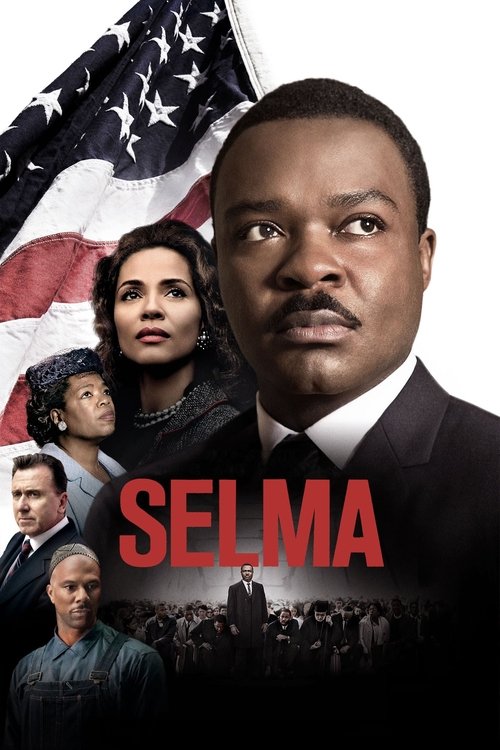
Selma
2014 · Ava DuVernay
For when you want a film that's both galvanizing and serious-minded — a history lesson that plays like drama, not homework. Heavy in places, but it leaves you charged rather than crushed.
What it's about
Alabama, 1965: Martin Luther King Jr. and the civil rights movement converge on the town of Selma to march for Black voting rights, against a wall of state violence and a president reluctant to act. The film follows King not as a monument but as a strategist — calculating risk, holding a fragile coalition together, absorbing doubt while history waits on his next move.
The experience
Gripping and grave, with the tension of a political thriller — you feel the cost of every decision, and the scenes of confrontation carry real physical dread. It's also stirring in an earned way: the emotion comes from watching ordinary people choose to keep walking.
Performances
David Oyelowo plays King from the inside out — catching the weariness beneath the famous cadence, the private man managing the public icon. It's a performance of remarkable restraint and command.
The craft
Because King's actual speeches were licensed elsewhere, Ava DuVernay rewrote them herself, paraphrasing his rhetoric closely enough to ring true without quoting a word — a legal constraint turned into a feat of writing. Bradford Young's low-light cinematography gives church interiors and motel rooms the density of oil paint, insisting the movement lived in those shadowed rooms as much as on the bridge.
Why it matters
It vaulted DuVernay from Sundance-scale independent filmmaking to the center of American cinema and reset expectations for how the civil rights era could be portrayed — as strategy and struggle, not sainthood.
Ava DuVernay's account of the 1965 voting-rights marches from Selma to Montgomery treats Martin Luther King Jr. not as a monument but as a strategist — a man calculating risk, managing coalitions, and absorbing doubt while history waits on his next move. David Oyelowo plays him from the inside out, catching the weariness beneath the cadence. Because King's actual speeches were licensed to another project, DuVernay rewrote them herself, paraphrasing his rhetoric closely enough to ring true while never quoting a word — a constraint turned into one of the film's quiet feats of craft. Bradford Young's low-light cinematography gives church interiors and motel rooms the density of oil paint, insisting that the movement lived in these shadowed rooms as much as on the bridge. DuVernay, who had come up through Sundance-scale independent filmmaking, became the first Black woman to direct a Best Picture nominee. The Edmund Pettus Bridge sequence is staged with terrible clarity — tear gas drifting through telephoto haze — and the film's real subject is how ordinary bodies, marching in lines, forced a government's hand.
A Deleuzian reading
Tear gas arrives through a long lens.
The full Deleuzian reading of Selma →
Reception
Rapturously reviewed on release but instantly overshadowed by its Oscar snubbing — just two nominations, with DuVernay and David Oyelowo shut out, helping ignite #OscarsSoWhite. A decade on, the film looks better than ever and the Academy's cold shoulder looks worse, cementing its status as the defining case study in awards-season blind spots.
How Selma was received, from release to now →
Influences: the films it descends from and the films it influenced
- The Battle of Algiers (1966) — Its docu-realist staging of collective action — crowds, not lone heroes, filling the frame — and its procedural attention to how a movement provokes and absorbs state violence give Selma its template for depicting the march as organized tactics rather than spontaneous emotion.
- Gandhi (1982) — Established the nonviolence-as-strategy biopic, dramatizing marches (the Salt March) engineered to make state brutality visible to the world — the exact 'leadership-as-strategy' logic Selma applies to Bloody Sunday.
- Malcolm X (1992) — Modeled the interior civil-rights-leader portrait that intercuts public oratory with private doubt and domestic life, the balance DuVernay strikes between King the orator and King the fatigued strategist.
- Bloody Sunday (2002) — A single protest march building to a massacre at a chokepoint, shot in handheld docudrama immediacy — the structural and formal precedent for Selma's Edmund Pettus Bridge confrontation.
- Ali (2001) — Mann's telephoto, low-light framing that stays tight on a Black public figure's face amid spectacle prefigures Bradford Young's compression of King within crowds and dim interiors.
- Lincoln (2012) — Recast a moral cause as backroom tactical negotiation — the leader as vote-counting operator — which Selma mirrors in King's strategic bargaining with Johnson and choice of Selma as a pressure point.
- Milk (2008) — The activist biopic built around the granular labor of movement organizing and coalition-building, blending archival texture with dramatization as Selma does.
- Middle of Nowhere (2012) — DuVernay's own first collaboration with Bradford Young, where the interior, low-light portraiture of Black emotional life was worked out and then scaled up into Selma.
- Mississippi Burning (1988) — Explicitly named successor that recenters Black leadership and movement strategy, dramatizing the FBI as antagonist rather than savior — a corrective inversion of Parker's premise.
- Daughters of the Dust (1991) — Composes marches as slowed, frieze-like processions of Black bodies moving through landscape — Bradford Young's cinematography reprising Dash's staging of collective movement as tableau.
- The Butler (2013) — Oyelowo moves from the militant son to King himself; DuVernay retains the procedural-of-rooms approach to movement politics but replaces archival intercutting with FBI surveillance-log intertitles, narrowing to one campaign in explicit refusal of the landmark-survey structure.
- 13th (2016) — DuVernay carries Selma's themes of collective action and structural power into essayistic documentary form, extending the same argument about strategy and systemic resistance.
- Arrival (2016) — Bradford Young transplants his low-light, telephoto interiority and muted palette from Selma into science fiction, keeping the camera intimate and underlit around a single protagonist's face.
- If Beale Street Could Talk (2018) — Extends Selma's treatment of the Black face in warm, low-key close-up as something sacred and interior — the tender rendering of Black skin that Young's Selma work helped legitimize.
- Judas and the Black Messiah (2021) — Depicts a civil-rights leader as movement strategist under state surveillance, pairing charismatic oratory with the tactical machinery of organizing and repression that Selma foregrounded.
- One Night in Miami (2020) — An interior, dialogue-driven portrait of civil-rights icons off the public stage, prioritizing private deliberation over spectacle — the 'interior portrayal' mode Selma advanced for movement figures.
- Till (2022) — A restrained civil-rights historical drama that centers dignity and grief over graphic violence, inheriting Selma's choice to dramatize the era through composed, interior emotion rather than exploitation.
- Black Panther (2018) — Bradford Young's skin-tone digital calibration on this film — specific exposure and color-temperature protocols for honoring dark skin under digital sensors — altered industry practice and directly informed Rachel Morrison's chromatic approach to Wakandan faces and the film's palette-structuring decisions.
- The Hate U Give (2018) — Demonstrates studio-scale, legibly-staged Black protest cinema pitched to a mainstream audience without abandoning docu-realist gravity — the commercial register THUG adopts.
- Just Mercy (2019) — Bradford Young's available-light naturalism and its dignified, ensemble-restrained treatment of a Black civil-rights struggle set the visual and performance register Just Mercy works within.
- Origin (2023) — Supplies Origin's grammar of dignified period tableaux and Spencer Averick's rhythmic cutting, staging Black protagonists moving with composure through hostile institutional architecture.
- Mother of George (2013) — Bradford Young's underexposed, telephoto rendering of dark skin as luminous and expressive — refusing to 'correct' or over-light Black faces — the cinematographic ethic he brought directly to Selma.
- Ain't Them Bodies Saints (2013) — Young's naturalist magic-hour palette and backlit silhouettes in available light, the same low-light discipline that gives Selma its dusk marches and lamp-lit interiors.
- Fruitvale Station (2013) — Intimate, humanizing portraiture of a Black man before the state violence that claims him — establishing personhood ahead of the historical event, as Selma does with its murdered marchers.
- A Most Violent Year (2014) — Young's concurrent 2014 cinematography that, alongside this film, consolidated his desaturated, naturally-lit-toward-darkness period look as a defining strain of contemporary American imagery.
- The Help (2011) — A civil-rights prestige film that pointedly re-centers Black agency and leadership, the formal corrective to The Help's white-heroine frame.
- Pariah (2011) — Young scales Pariah's dark-skin-forward, low-light exposure discipline up to a historical epic, proving the technique holds beyond intimate indie scale.
- 12 Years a Slave (2013) — Part of the same post-2013 wave of Black-authored American historical drama, prioritizing the interior dignity of its subjects over the white-savior framing of prior studio treatments.
- Mudbound (2017) — Bradford Young photographs the civil-rights South with the same underexposed, sun-through-haze naturalism, the sibling grammar for filming Black skin in Southern light that Morrison practices.
Similar films
- Lincoln (2012) — influence & lineage
- If Beale Street Could Talk (2018) — influence & lineage
- One Night in Miami... (2020) — influence & lineage
- Malcolm X (1992) — influence & lineage
- Judas and the Black Messiah (2021) — influence & lineage
- Mudbound (2017) — same viewing thread
- The Help (2011) — same viewing thread
- Mississippi Burning (1988) — same viewing thread
All the films related to Selma →
Watch it with: curated runs of related films
- Heat and Reckoning in the American South — A run of Southern dramas where family, race, and old money simmer under the same unbearable heat — watch them together to trace the region from the plantation myth through the civil-rights march.