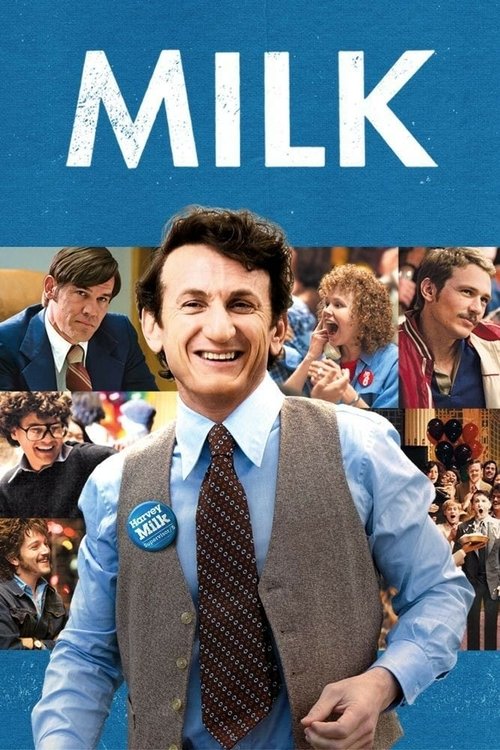
Milk
2008 · Gus Van Sant
For when you want to feel galvanized — a film about courage and community that leaves you moved and a little braver. Expect to cry, but the good kind.
What it's about
The true story of Harvey Milk, a New York transplant who opens a camera shop in San Francisco's Castro district in the 1970s and finds his calling as an organizer, running for office again and again until he becomes the first openly gay man elected to major public office in America. The film follows his campaigns, his loves, his rivalries at City Hall, and the movement that grew up around him.
The experience
Warm, urgent, and alive with the energy of street-level politics — it's a film about coalition-building that somehow plays like a romance with hope itself. A current of foreboding runs underneath, and by the end it earns real tears.
Performances
Sean Penn disappears into Harvey Milk — the wit, the warmth, the theatrical instincts of a born campaigner — in one of the great biographical performances. Josh Brolin is quietly unnerving as fellow supervisor Dan White, and Emile Hirsch and James Franco give the movement human texture.
The craft
Dustin Lance Black's script structures the life as a testament — Milk narrating into a tape recorder — which gives a conventional biopic real emotional architecture. Van Sant weaves in archival footage of the actual era so the period feels documented rather than dressed, and the grainy, sun-warmed photography puts you on Castro Street in 1977.
Why it matters
Released weeks before California voted on a same-sex marriage ban, it landed as history rhyming in real time, won Oscars for Penn and Black, and fixed Harvey Milk's story in the mainstream imagination. It remains a touchstone of LGBTQ political cinema.
Snapshot
Milk is Gus Van Sant's account of the last eight years in the life of Harvey Milk, the San Francisco camera-shop owner and gay-rights organizer who in 1977 became the first openly gay man elected to major public office in the United States, and who was assassinated in November 1978 alongside Mayor George Moscone by former city supervisor Dan White. Written by Dustin Lance Black and anchored by Sean Penn's transformative lead performance, the film is at once a conventional biographical drama and a civic history of the Castro's emergence as a gay political stronghold. It structures itself around a real device — a tape recording Milk made "to be played only in the event of my death by assassination" — which lets the film narrate its own subject's life as an act of testament. Released in the autumn of 2008, weeks before California voters approved Proposition 8 banning same-sex marriage, it landed with an unplanned contemporary charge, its portrait of the 1978 anti-gay Briggs Initiative fight reading as immediate rather than historical. It won Academy Awards for Penn and for Black's screenplay and was nominated for Best Picture and Best Director, marking Van Sant's fullest return to mainstream narrative filmmaking after a decade of formal experimentation.
Industry & production
Milk was produced by Dan Jinks and Bruce Cohen — the team behind American Beauty — and financed and distributed by Focus Features, the specialty arm of Universal that had become one of the principal homes for prestige, adult-oriented independent cinema in the 2000s. The project reached the screen only after a long and crowded development history. Harvey Milk's story had been circling Hollywood since Randy Shilts's 1982 biography The Mayor of Castro Street, and a competing feature version was for years associated with Oliver Stone as producer and, at various points, other directors. Van Sant himself had been attached to Milk material at earlier moments in his career. The version that was finally made grew out of Dustin Lance Black's independently researched screenplay, developed through extensive interviews with Milk's surviving associates, which gave the production both dramatic shape and documentary credibility.
Shooting took place in San Francisco in early 2008, much of it on the actual Castro Street locations where the events occurred. The production restored the storefronts of the Castro to their late-1970s appearance and used Milk's real Castro Camera location, an unusually literal form of historical reconstruction that the film foregrounds rather than hides. The comparatively modest budget typical of a Focus prestige drama was stretched by location shooting and period detail. Precise box-office figures are best consulted directly, but the film performed strongly for a specialty release and became a significant awards-season title, its commercial life extended by the Oscar campaign and by the political timeliness of its release during the Proposition 8 debate.
Technology
Milk was photographed on 35mm film by Harris Savides, working in a naturalistic register consistent with his broader body of work; the film is not a showcase for the digital-capture transition then reshaping the industry, and its technological interest lies elsewhere. Its most distinctive technical strategy is the systematic integration of archival material — period television news footage, campaign broadcasts, and documentary record — into the dramatized narrative. The film incorporates real footage of the era's figures rather than casting actors to impersonate all of them: the anti-gay crusader Anita Bryant, for instance, appears through archival television footage rather than as a performed role, a decision that lends her a documentary reality the fictional scenes cannot manufacture. This weaving of found footage with staged reconstruction required careful matching of film grain, color, and framing so that the seams between the historical record and the recreated present would register as porous rather than jarring. The approach situates Milk within a tradition of biographical cinema that treats the archive not as illustration but as connective tissue, allowing the film to claim continuity with the actual past.
Technique
Cinematography
Harris Savides, one of Van Sant's most important collaborators, shoots Milk with the restrained, available-light naturalism that characterizes his work. The camera favors handheld intimacy in the crowded interiors of Castro Camera and the campaign headquarters, and it stages the street politics of the Castro with a documentary looseness that dovetails with the inserted archival footage. Savides's palette leans toward the muted, slightly desaturated warmth of 1970s photography, reinforcing the period without lapsing into nostalgic gloss. Reflections and glass — the camera shop's windows, mirrors — recur as motifs, at times used to compose Milk within layered surfaces. The cinematography's overall achievement is a kind of self-effacement: it makes the reconstructed world feel continuous with the real footage it sits beside.
Editing
Elliot Graham's editing, which earned an Academy Award nomination, carries much of the film's structural burden. The narrative is organized retrospectively around Milk's dictated tape, so the cutting must move fluidly between the framing "testament" and the chronological unfolding of events, and between staged drama and archival record. Graham modulates the film's rhythm from the loose, discovery-driven early scenes of Milk's arrival in San Francisco to the tightening, more propulsive cross-cutting of the campaign and the final movement toward the assassination, where the editing braces the audience for an ending it already knows is coming. The interleaving of documentary footage is itself an editorial argument, repeatedly reminding the viewer that the drama is tethered to fact.
Mise-en-scène / staging
The film's production design (by Bill Groom) reconstructs the Castro of the 1970s with granular specificity, and the staging treats the neighborhood as a character — a territory that Milk's movement claims block by block. Interiors are dense with period texture, and the camera shop functions as the film's hearth, the room from which a community organizes itself. Costume design by Danny Glicker, also Oscar-nominated, is central to this world-building, distinguishing Milk's shaggy activist milieu from the buttoned civic order of City Hall and from Dan White's straitened, resentful respectability. Van Sant stages the mass scenes — the candlelight march, the rallies — with an eye to both scale and human particularity, so that political history remains legible as individual faces.
Sound
Danny Elfman's score, nominated for an Academy Award, is notable for its restraint relative to his signature idiom; it works in a warmer, more elegiac and lyrical mode suited to the film's blend of hope and elegy. The sound design integrates period music and the ambient texture of the era's media, and it must accommodate the archival footage's own degraded sonic quality, again folding the historical record into the film's fabric. The recurring device of Milk's recorded voice gives the soundtrack a spectral first-person presence, the dead man narrating his own life.
Performance
Sean Penn's performance as Harvey Milk is the film's center and its most celebrated element, winning him the Academy Award for Best Actor. It is a study in transformation: Penn, known for intensity and gravity, remakes himself into Milk's open, humorous, tactically shrewd warmth, capturing both the man's showmanship and his emotional generosity. Josh Brolin's Dan White — nominated for Best Supporting Actor — is a carefully modulated portrait of a man undone by his own rigidity and resentment, refusing caricature. The ensemble is deep: Emile Hirsch as the young activist Cleve Jones, James Franco as Milk's partner Scott Smith, Diego Luna as the troubled Jack Lira, Alison Pill as campaign manager Anne Kronenberg, and Victor Garber as Mayor Moscone. The performances collectively render the movement as a texture of relationships rather than a single great-man narrative.
Narrative & dramatic mode
Milk operates in the mode of the historical-biographical drama, but it complicates the biopic's usual cradle-to-grave arc with a framing conceit that foregrounds mortality from the first frames. Milk's dictated tape — the "in the event of my death" recording — establishes the ending before the beginning, converting the film into an elegy told in the subject's own voice. The narrative proper begins with Milk's fortieth birthday and his decision, with Scott Smith, to move to San Francisco, and it traces his repeated electoral failures, his eventual victory, his coalition-building on the Board of Supervisors, the pivotal battle against the Briggs Initiative, and his deteriorating relationship with Dan White. The dramatic engine is less the individual than the birth of a political movement; the film consistently subordinates private psychology to public consequence, using Milk's personal relationships as points of entry into a collective history. Its tone balances buoyant, often comic optimism against the gathering dread of its foreknown conclusion.
Genre & cycle
The film belongs to the prestige historical biopic, and more specifically to a cycle of politically engaged American dramas of the mid-to-late 2000s that used recent history to speak to the present. It is also a landmark in the maturation of mainstream LGBTQ cinema: released in the wake of Brokeback Mountain (2005), it demonstrated that a studio-backed film centered unapologetically on gay life and gay political struggle could command major awards attention. It can be read against the earlier documentary treatment of its subject and against the broader tradition of the social-movement film, in which a charismatic organizer becomes the lens for a community's coming-to-consciousness. Van Sant's own filmography frames it as a return to accessible narrative after his austere experimental period.
Authorship & method
Milk is a meeting point of several distinct authorial sensibilities. Gus Van Sant, whose career spans the queer independent landmarks Mala Noche and My Own Private Idaho, the mainstream success of Good Will Hunting, and the radically minimalist "Death trilogy" of Gerry, Elephant, and Last Days, brings to the material both his long-standing engagement with gay experience and his more experimental instincts, here largely channeled into the film's archival strategy and its intimate handling of community. That Van Sant, a foundational figure of New Queer Cinema, directed the definitive narrative account of Harvey Milk gives the film a particular authorial resonance.
Screenwriter Dustin Lance Black, whose Oscar-winning script was built on original research and interviews, is arguably the project's animating author; his acceptance speech, addressed to LGBTQ youth, became a cultural moment in its own right. Cinematographer Harris Savides supplies the naturalistic visual grammar that has defined much of Van Sant's later work. Editor Elliot Graham gives the film its retrospective architecture, and composer Danny Elfman its elegiac emotional undertow. The result is a collaboration in which a director known for formal risk applies his sensibility to a fundamentally classical, and deeply personal, subject.
Movement / national cinema
Milk sits within American independent-adjacent prestige cinema — a Focus Features production operating in the specialty ecosystem that flourished in the 1990s and 2000s. Through Van Sant, it connects to New Queer Cinema, the early-1990s movement of formally adventurous, unapologetically gay American filmmaking; Milk can be understood as that movement's sensibility arriving, two decades on, at the center of the industry's awards culture. As a work of San Francisco history made substantially on San Francisco locations, it is also a regional film, intimately bound to the specific geography of the Castro and to the civic mythology of a particular American city.
Era / period
The film depicts the 1970s — roughly 1970 to 1978 — and is saturated in that decade's textures, from the gay migration to the Castro through the era's ballot-box culture wars. But it is inseparable from the moment of its release. Arriving in late 2008, during the campaign over California's Proposition 8, Milk found its account of the 1978 Briggs Initiative fight uncannily mirrored in the present, and audiences received it as a film about a still-unfinished struggle. This doubling of periods — the reconstructed 1970s and the charged 2008 present — is essential to how the film was understood, and it gave a historical drama the urgency of a contemporary argument.
Themes
The film's governing theme is the transformation of private identity into public power — the idea, repeatedly voiced by Milk, that visibility itself is a political act and that coming out is a form of activism. It dramatizes the building of a coalition, insisting that liberation is won through organizing, alliance, and the patient accumulation of ordinary people's courage rather than through solitary heroism. Hope is the film's explicit keyword, set against the counter-currents of fear, shame, and internalized despair (embodied in part by the fate of Jack Lira). Martyrdom and legacy run beneath everything, structured by the framing recording: the film is about a man who understood he might die and who prepared his death to serve the movement. Dan White functions as the film's study of resentment and thwarted belonging, a portrait of the fragile order that the movement's openness threatens. Underlying all of it is a meditation on the relationship between the individual life and collective history.
Reception, canon & influence
Milk was met with strong critical acclaim, praised in particular for Penn's performance, Black's screenplay, and its emotional and political resonance. It received eight Academy Award nominations, including Best Picture and Best Director, and won two — Best Actor for Penn and Best Original Screenplay for Black — outcomes that confirmed both its artistic standing and its cultural significance. Its release amid the Proposition 8 fight amplified its reception, and Black's advocacy-oriented Oscar speech extended the film's influence beyond the screen into the marriage-equality movement then gathering force.
Looking backward, the film draws on a documented historical and cinematic record: Randy Shilts's biography The Mayor of Castro Street, the extensive news archive of the period, and, most directly, Rob Epstein's Academy Award–winning documentary The Times of Harvey Milk (1984), which established much of the visual and narrative memory of these events. Black's original interviews with Milk's surviving associates gave the dramatization its evidentiary grounding, and the film's very method — folding archival footage into staged scenes — announces its debt to that documentary tradition.
Looking forward, Milk helped consolidate the place of LGBTQ history within mainstream prestige cinema, standing alongside Brokeback Mountain as proof that such stories could win the industry's highest honors, and it became a touchstone in the cultural argument for gay rights at a pivotal political moment. It confirmed Sean Penn's stature among his generation's leading actors and elevated Dustin Lance Black as a screenwriter and activist. Within Gus Van Sant's filmography, it stands as the work in which his queer-independent origins and his mainstream craft most fully converged. Its longer influence on the biopic form and on queer historical cinema continues to unfold, and any sweeping claims about that legacy are best made cautiously; what is certain is that Milk became the canonical narrative-film account of its subject.
A Deleuzian reading
A man sits down with a tape recorder and dictates his own obituary while he is still alive.
The full Deleuzian reading of Milk →
Reception
Landed in late 2008 with eerie timing — weeks after California passed Prop 8 — and rode that urgency to 8 Oscar nominations and wins for Sean Penn and screenwriter Dustin Lance Black. It's since settled in as the respectable mainstream milestone of queer cinema, with cinephiles now more likely to note it as Van Sant's return to Hollywood polish after his experimental Death Trilogy years.
How Milk was received, from release to now →
Influences: the films it descends from and the films it influenced
- The Times of Harvey Milk (1984) — The Oscar-winning documentary whose actual period news footage Milk literally reuses and whose imagery of the assassination aftermath and candlelight march the staged film reconstructs almost shot-for-shot.
- Mala Noche (1986) — Van Sant's own debut sets the grainy, available-light naturalism and tender attention to marginal gay life that Savides later refines into Milk's documentary texture.
- My Own Private Idaho (1991) — Van Sant's handheld, elliptical intimacy with queer outsiders is the sensibility he channels into Milk's fly-on-the-wall Castro community scenes.
- Citizen Kane (1941) — Establishes the template of reconstructing a dead public man through retrospective testimony framed by a faux-newsreel, the archival-plus-recollection architecture Milk mirrors.
- Sunset Boulevard (1950) — The doomed narrator recounting his own story from beyond death is the exact spectral-voiceover device Milk adopts as Harvey dictates his testament into a tape recorder anticipating his murder.
- Reds (1981) — Braids real witness testimony into dramatized history, the documentary-witness/testament framing strategy Milk extends through Harvey's recorded confession and archival voices.
- JFK (1991) — Pioneers the seamless intercutting of authentic newsreel with restaged assassination footage under retrospective editing, the archival-integration grammar Milk inherits.
- Philadelphia (1993) — The first mainstream Hollywood prestige drama to center gay rights on a movie-star physical transformation, clearing the commercial and Oscar path Milk walks.
- J. Edgar (2011) — Screenwriter Dustin Lance Black reuses his Milk method whole: a dictated-memoir testament framing that structures a public man's life through retrospective crosscutting.
- When We Rise (2017) — Black's LGBT-movement chronicle directly extends Milk's coalition history and its folding of archival footage into dramatization across decades.
- Selma (2014) — Dramatizes a movement's tactics and alliances rather than one great man, extending Milk's coalition-over-heroism staging of collective activism.
- Dallas Buyers Club (2013) — Builds an AIDS-era activism biopic on a radical star body-transformation, extending the Penn-transformation-as-prestige-engine model Milk exemplifies.
- BPM (Beats Per Minute) (2017) — Makes ACT UP's collective visibility and protest the protagonist, pushing Milk's coalition-over-heroism to a fully de-centered activist ensemble.
- Pride (2014) — Structures its narrative around alliance-building between gay activists and striking miners, mirroring Milk's coalition politics as dramatic architecture.
- Brokeback Mountain (2005) — The explicitly cited New Queer Cinema-to-Oscar breakthrough proving queer stories could win the industry's top honors, a precedent Milk consolidates a season later.
- Good Night, and Good Luck (2005) — A period-reconstructed activist drama that splices real archival footage of its antagonist directly into staged scenes, the same archive-in-narrative, media-as-activism method.
- Zodiac (2007) — Harris Savides's other meticulous 1970s San Francisco reconstruction, sharing the naturalistic period lighting and obsessive documentary surface he brings to Milk the same year.
- Elephant (2003) — The Savides-shot, available-light, handheld-following aesthetic and patient dread toward an inevitable killing that Milk restrains into classical prestige form.
Similar films
- Dallas Buyers Club (2013) — influence & lineage
- Selma (2014) — influence & lineage
- Brokeback Mountain (2005) — influence & lineage
- Pride (2014) — influence & lineage
- Elephant (2003) — influence & lineage
- Moonlight (2016) — shared sensibility
- Doubt (2008) — shared sensibility
- Vice (2018) — shared sensibility