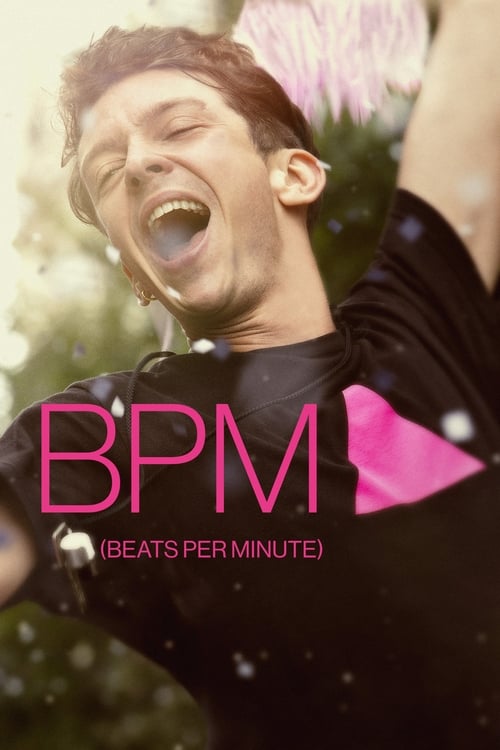
BPM (Beats per Minute)
2017 · Robin Campillo
For when you want to feel part of something — a film about fighting for your life that leaves you more awake than when you sat down. Bring your full attention and maybe tissues; it's a challenge that repays every minute.
What it's about
Paris, early 1990s: the weekly meetings of ACT UP, where young HIV-positive activists argue brilliantly — finger-snaps for applause, parliamentary procedure at the pitch of survival — about how to force a government and the pharmaceutical industry to care whether they live. The film follows the group's direct actions, its debates, and a love story growing inside the movement. Director Robin Campillo was an ACT UP member in those years, and it shows.
The experience
Electric and alive — the meetings crackle like the best ensemble scenes you've seen, and the film moves from debate to demonstration to nightclub in one continuous pulse. It's angry, sexy, funny, and finally devastating, in that order.
Performances
Nahuel Pérez Biscayart is the film's live wire — mouthy, magnetic, and heartbreaking — in a performance that made his name.
The craft
Campillo, a career editor before he was a director, builds the film like one: debates dissolve into demonstrations, demonstrations into strobe-lit dancing, and dust motes in club light become something else entirely in one astonishing transition. The sound and rhythm are the point — good speakers and no distractions.
Why it matters
Winner of the Grand Prix at Cannes 2017 — where many felt it deserved the Palme — it stands as the definitive screen memoir of ACT UP and a rallying point for cinema about collective political action.
Paris in the early nineties, and the weekly meetings of ACT UP are cinema in themselves: parliamentary procedure conducted at the pitch of survival, finger-snaps for applause, dying young people arguing brilliantly about how to make a government care. Robin Campillo was there — a member of ACT UP Paris in those years — and his film has the double authority of memoir and history, honoring the movement's rage without embalming it. Best known before this as Laurent Cantet's editor and screenwriter (he wrote the Palme-winning The Class), Campillo builds the film like an editor: debate dissolves into demonstration, demonstration into nightclub, until dust motes swirling in strobe light become, in one astonishing transition, something else entirely. It won the Grand Prix at Cannes in 2017, where many felt it deserved the Palme outright. What lingers is its insistence that activism and desire are the same energy — that the meeting room, the street, and the bedroom form a single continuous space where life is fought for.
Reception
It stormed Cannes 2017 — Grand Prix, standing ovations, jury president Pedro Almodóvar openly moved — then France's Oscar hopes died when the Academy left it off the foreign-film shortlist, a snub still cited as one of the decade's worst. Since then it's only climbed: now a fixture of modern queer-canon lists.
How BPM (Beats per Minute) was received, from release to now →
Influences: the films it descends from and the films it influenced
- The Class (Entre les murs) (2008) — Campillo co-wrote and cut this film, and BPM reuses its signature engine — a single institutional room where overlapping, cross-cut argument around a table becomes the drama itself, edited to catch every interruption and shift of the collective.
- Human Resources (1999) — Campillo's editing here built the template of the meeting-room as arena, where political strategy is hammered out through the procedural back-and-forth of a group deciding on collective action.
- Time Out (L'Emploi du temps) (2001) — Campillo's elliptical, rhythm-first cutting of interior time — letting scenes breathe then jumping — is the editorial hand he later turns on himself in BPM's oscillation between debate, sex, and dance.
- The Battle of Algiers (1966) — BPM dramatizes activism the way Pontecorvo did — through the granular mechanics of the clandestine cell and its meetings, reconstructing collective political tactics as docudrama procedure rather than heroic biography.
- How to Survive a Plague (2012) — This ACT UP documentary supplies the source-craft BPM fictionalizes — the filmed general-assembly meetings, the choreography of the 'zap' die-in action — which Campillo restages as narrative.
- Milk (2008) — A grassroots-organizing biopic that treats the tactics of activism — coalition-building, media stunts, the mechanics of a movement — as its dramatic subject, and threads archival footage into fiction as BPM does with its bloodstream/street inserts.
- 2001: A Space Odyssey (1968) — Campillo's associative graphic matches across scales — nightclub dust motes dissolving into HIV in the bloodstream, glitter into the Seine running red — descend from Kubrick's match-on-form cutting that links disparate objects by shape.
- Longtime Companion (1989) — Established the AIDS-era ensemble chronicle in which a community is followed across years and thinned by successive deaths, a memoir-history structure BPM inherits and compresses.
- Dallas Buyers Club (2013) — Advances the early-2010s AIDS-crisis revival DBC helped consolidate, but pointedly corrects it by centering collective ACT UP activism and gay experience over a lone straight everyman.
- Holding the Man (2015) — Extends AIDS-crisis remembrance into activist collective memory while ending, like Holding the Man, on an intimate deathbed and mourning sequence rendered with documentary specificity.
- Climax (2018) — Extends BPM's strobe-nightclub grammar into a whole film — the dance floor as a formal, rhythmic engine where bodies, music, and lighting become the narrative rather than its backdrop.
- Pose (2018) — Carries forward the fusion of queer nightlife performance and AIDS-era community-under-siege chronicle, using the ballroom floor the way BPM uses its club — as the site where desire and mortality are staged together.
- Beau Travail (1999) — Shares the device of dissolving political/bodily tension into pure rhythmic dance abstraction — Campillo's strobe-lit nightclub finales work like Denis's closing dance, letting choreographed bodies carry what dialogue cannot.
- Eastern Boys (2013) — Campillo's own prior feature runs on the same craft DNA — long negotiation-and-meeting set pieces staged as slow-building group tension, and desire braided into questions of survival and belonging.
- Nocturama (2016) — A near-contemporary French film about a young collective committing to direct action, cross-cutting the planning/logistics of the group against consumerist and party spaces, sharing BPM's youth-in-collective staging.
- The Normal Heart (2014) — Dramatizes early AIDS activism through the same meeting-room debate form — the founding rows over strategy, rage versus respectability — that BPM stages as its structural core.
- Sorry Angel (Plaire, aimer et courir vite) (2018) — A near-simultaneous memoir-history of the exact same milieu — early-1990s French gay life under AIDS — rendered in elliptical, desire-forward vignettes rather than polemic, a mirror to BPM's private register.
- United in Anger: A History of ACT UP (2012) — An oral-history documentary assembled from ACT UP's own meeting and action footage, sharing BPM's insistence that the movement's craft lived in its assembly-floor process and its rehearsed civil-disobedience actions.
- Pride (2014) — Extends the same craft of dramatizing queer collective action through the texture of the activist meeting itself — debate, faction, and consensus staged as ensemble drama drawn from real movement history (ACT UP).
Similar films
- Climax (2018) — influence & lineage
- Jim Queen and the Quest for Chloroqueer (2026) — shared sensibility
- Soundtrack to a Coup d'Etat (2024) — shared sensibility
- Bohemian Rhapsody (2018) — shared sensibility
- Humanist Vampire Seeking Consenting Suicidal Person (2023) — shared sensibility
- Elite Squad (2007) — shared sensibility
- Portrait of a Young Girl at the End of the '60s in Brussels (1994) — shared sensibility
- Blue Is the Warmest Color (2013) — shared sensibility